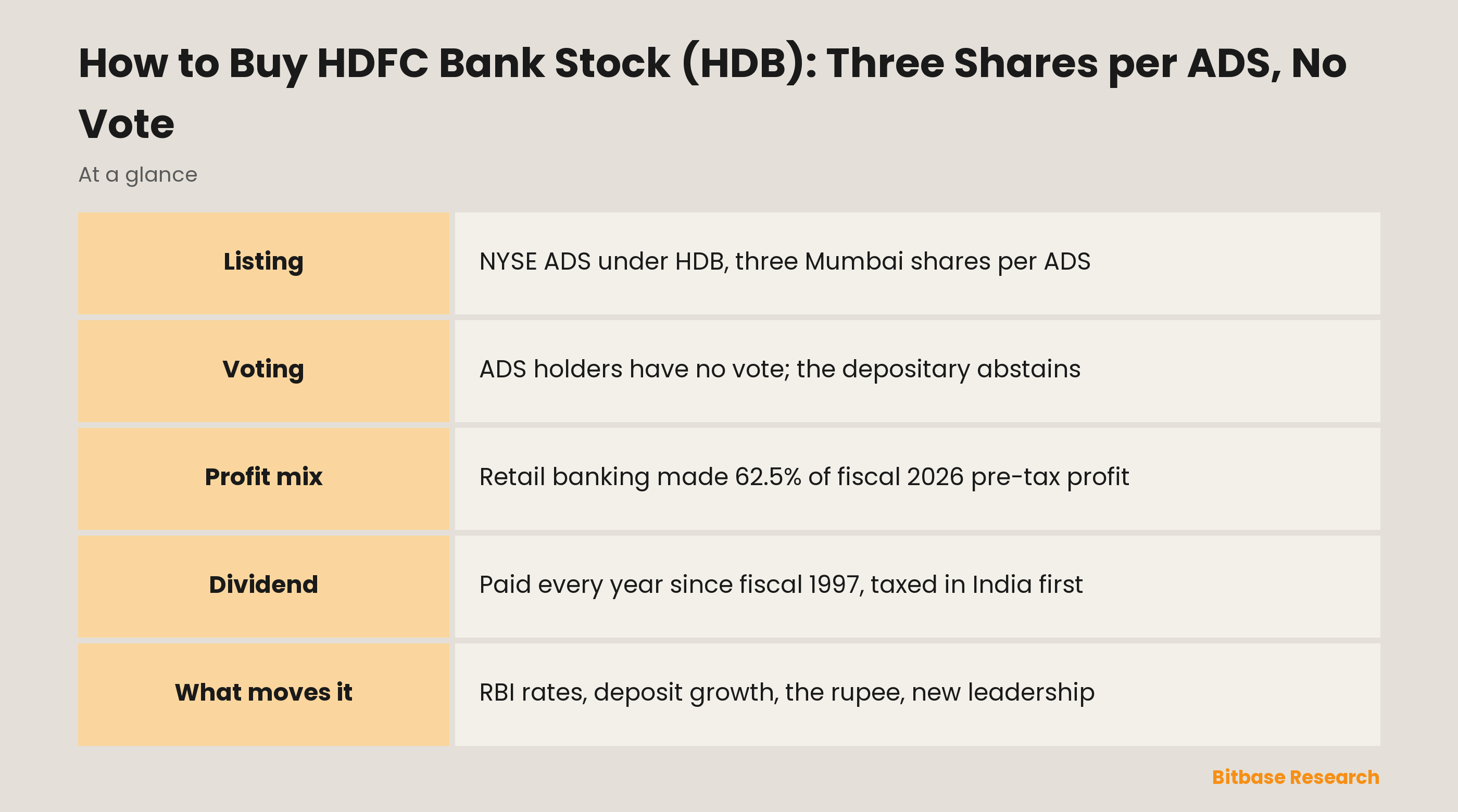
Its NYSE ticker is HDB, and for most investors outside India, buying HDFC Bank stock means buying exactly that: American depositary shares (ADSs) on the New York Stock Exchange, available through any broker that offers US stocks, each representing three equity shares traded in Mumbai. Two things set this ADS apart: its holders have no vote, because the depositary abstains on the underlying shares, and the bank behind it has owned a life insurer and a fund manager since absorbing its former parent, the mortgage lender HDFC Limited, on July 1, 2023.
What Does HDFC Bank Do?
HDFC Bank Limited was incorporated in India in August 1994 and began operating as a scheduled commercial bank in January 1995. It describes itself as "a new-generation private sector bank in India." Times Bank merged into it in 2000, and it acquired Centurion Bank of Punjab in 2008.
The 20-F names four principal business activities. Retail banking takes deposits and lends to individuals and small firms through home loans, personal loans, credit cards, auto loans and business loans. Wholesale banking gives companies working capital, term loans, trade services and cash management. Treasury manages liquidity and interest rate risk and trades Indian government securities. Insurance is the life business of HDFC Life, a subsidiary. Other group companies include HDB Financial Services, a non-bank lender; HDFC Securities, a stockbroker; HDFC Asset Management, a fund manager; and HDFC ERGO, a general insurance joint venture.
At March 31, 2026 the bank had 9,689 branches, up from 6,342 four years earlier, and over 100.6 million customers. Substantially all of its operations and assets are in India.
The merger with HDFC Limited, the housing finance company that had founded the group, took effect on July 1, 2023. Because HDFC Limited was dissolved, the bank ceased to have a promoter, the Indian term for a founding shareholder group that controls a listed company.
How HDFC Bank Makes Money
In fiscal 2026, the year to March 31, 2026, net interest revenue after provisions for credit losses made up 57.2% of net revenue; the rest came from fees, trading gains and, since the merger, insurance premiums.
The 20-F reports five segments; the table compares each one's share of fiscal 2026 net revenue and income before tax.
| Segment | Share of net revenue | Share of income before tax |
|---|---|---|
| Retail banking | 53.1% | 62.5% |
| Wholesale banking | 12.2% | 23.8% |
| Treasury services | 2.7% | 6.3% |
| Insurance services | 29.8% | 4.2% |
| Others | 2.2% | 3.1% |
Revenue shares are as printed in the 20-F; income shares are calculated from its segment note, which follows US GAAP.
The insurance row explains the gap: premiums count as revenue, while claims and benefits paid to policyholders count as expenses, so the life insurer adds much revenue and little profit. Retail banking is where the bank makes most of its money.
The loan book points the same way. At March 31, 2026, retail loans were 74.7% of gross loans, and 18.5% of those retail loans were unsecured. Housing loans, the main business of the former HDFC Limited, were the biggest retail product at 31.7% of retail loans, followed by retail business banking at 25.2%. Wholesale loans to corporate customers made up the remaining 25.3%.
The mix shifted during fiscal 2026: total segment income before tax rose 9.0%, with retail banking up 19.0% and wholesale banking down 17.7%. Net income attributable to the bank's shareholders grew 4.6%.
HDB Stock at a Glance
| Item | Detail |
|---|---|
| Issuer | HDFC Bank Limited, incorporated in India in 1994 |
| US listing | American depositary shares on the NYSE, ticker HDB |
| ADS ratio | One ADS represents three equity shares of Rs 1 par value |
| Home market | National Stock Exchange of India (HDFCBANK) and BSE (500180), in rupees |
| Depositary | JPMorgan Chase Bank, N.A. |
| ADS voting | None; the depositary abstains on the shares behind the ADSs |
| Held as ADSs | 13.36% of share capital at March 31, 2026 |
| Foreign ownership | Capped at 74% of paid-up capital; 51.80% at March 31, 2026 |
| Fiscal year | April 1 to March 31 |
| 20-F accounting | US GAAP; Indian statutory accounts use Indian GAAP |
| Dividend record | Paid every year since fiscal 1997 |
| SEC filer | CIK 1144967; Form 20-F and Form 6-K |
For the live HDB quote and chart, open the HDFC Bank stock page on Bitbase.
How to Buy HDFC Bank Stock
The bank trades on two lines: the ADS in New York, in dollars, and the equity shares on the NSE and BSE, in rupees. Outside India the ADS is usually the practical route, because Indian rules limit foreign ownership of the rupee shares.
1. Open a brokerage account that offers NYSE stocks. HDB is bought and sold like any other US-listed share.
2. Fund it in dollars. If your savings are in another currency, compare the conversion cost as well as the commission.
3. Search for HDB and check the name. The listing should read HDFC Bank Limited. HDB Financial Services, the group's non-bank lender, has its own shares on the NSE and BSE, and buying those is not buying the bank.
4. Choose an order type. A limit order caps the price you pay, while a market order fills at whatever price is available.
5. Size the position. Compare the ADS price with three converted rupee shares, not one. Fractional ADSs depend on your broker.
ADS or Indian shares. The shares sit with a custodian acting for JPMorgan Chase Bank, the depositary, which is their only shareholder of record. The 20-F is blunt about the trade-off: "Investors in ADSs will have no voting rights, unlike holders of equity shares." You can surrender ADSs and take the shares to vote, but that may bring delays and costs, Indian foreign-ownership limits then apply, and you may not be able to redeposit them. The ADSs have historically traded at a premium to the shares in India, partly because Indian law restricts converting shares into ADSs, and the 20-F warns that the premium may not continue. Not every foreign bank in New York works this way: Royal Bank of Canada's NYSE line is its ordinary common share, with no depositary in between.
Indian tax. Dividends on ADSs are taxed in India at 10% plus surcharge and cess, withheld before the cash reaches you, under Section 209 of the Income-tax Act, 2025, in force since April 1, 2026. A sale of ADSs by one non-resident to another outside India is not treated as a transfer and carries no Indian capital gains tax.
Through a fund. Index funds rank among the biggest owners: at March 31, 2026 the largest holder in the 20-F's principal shareholder table was the SBI Nifty 50 ETF, with 6.46%, holding the bank as one position among many.
What Moves HDB Stock
Indian interest rates. The Reserve Bank of India cut its repo rate from 6.5% in February 2025 to 5.25% in December 2025, then held it at its February, April and June 2026 meetings. Net interest margin slipped to 3.6% in the year to March 31, 2026 from 3.7%, which the 20-F ties to rate cuts reaching floating-rate loans faster than deposits.
Swapping borrowings for deposits. The merger brought HDFC Limited's high-cost borrowings onto the bank's balance sheet, raising its cost of funds in fiscal 2024 and 2025. Fiscal 2026 showed the repair under way: deposits rose 14.4% against 10.3% for gross loans, and long-term debt fell 12.7%. Net loans equalled 103.7% of deposits at March 31, 2025; a year later deposits had edged past them. Cheap deposits are the slow part: current and savings accounts were 34.1% of deposits at March 31, 2026, and grew more slowly than total deposits in both fiscal years.
Directed lending. The RBI requires banks to lend 40% of a reference credit base to priority sectors such as agriculture and small business. HDFC Bank reached 51.44% in fiscal 2026 but missed sub-targets: agriculture came to 14.77% against 18%, and weaker sections to 10.23% against 12%. Shortfalls go into deposits with development banks that may pay less than the bank would earn elsewhere.
The rupee. HDB is priced in dollars, but the business earns rupees, and the depositary converts rupee dividends into dollars. The rupee lost close to 9% against the dollar in fiscal 2026, and the 20-F says it has weakened against the dollar every year since 2018 except fiscal 2021.
Leadership. On March 18, 2026, part-time chairman Atanu Chakraborty resigned, writing: "Certain happenings and practices within the bank, that I have observed over last two years, are not in congruence with my personal Values and Ethics." The next day the RBI said "there are no material concerns on record as regards its conduct or governance." In June two outside law firms reported that his statement was "not substantiated by the record and witness interviews." In July Rajiv Kumar, a former Finance Secretary of India, became part-time chairman with RBI approval. In October the RBI approved Anup Bagchi, then chief executive of ICICI Prudential Life Insurance, to succeed Sashidhar Jagdishan as managing director and chief executive from October 27, 2026.
What the 20-F Warns HDB Holders About
Interest rates. "Our business is particularly vulnerable to interest rate risk, and volatility in interest rates could adversely affect our net interest margin, the value of our fixed income portfolio, our treasury income and our financial performance."
The merger's promise. The bank "may fail to realize all anticipated benefits of the Transaction," its term for the HDFC Limited merger, and many recently added branches do not yet run as efficiently as the rest of the network.
Credit quality. Gross non-performing customer assets were 1.2% of gross customer assets at March 31, 2026. Unsecured loans have no collateral behind them, and directed lending may bring more bad loans.
Regulators at home and abroad. "We have previously been subjected to penalties imposed by the RBI, the SEBI and other authorities," the 20-F says. On September 25, 2025 the Dubai Financial Services Authority barred the bank's Dubai International Financial Centre branch from taking on new clients for specified financial services; the bank calls that business not material.
Foreign ownership. Foreign investment is capped at 74% of paid-up capital. When foreign holdings crossed that limit again in 2017, the RBI re-imposed restrictions on foreign purchases of the shares; at March 31, 2026 the figure was 51.80%.
The ADS itself. Besides the missing vote and an uncertain premium, ADS holders may be unable to join rights offerings unless a US registration statement or an exemption covers them. And as with any single stock, one bank ties your result to one balance sheet.
How to Research HDFC Bank Yourself
On EDGAR, HDFC Bank files under CIK 1144967. The annual Form 20-F, the latest filed on July 29, 2026 for fiscal 2026, holds the segment note, risk factors and ADS terms. Form 6-K reports, several a month, copy the bank's letters to the NYSE on results, board decisions and management changes, including a short update on advances and deposits a few days after each quarter ends.
Three habits help. Check the accounting basis: the 20-F uses US GAAP, while results published in India use Indian GAAP, so profit figures will not match. Mind the calendar: fiscal 2026 ran from April 1, 2025 to March 31, 2026, written FY 2025-26 in the bank's Indian filings. And adjust per-share data for the 2025 bonus issue, one new share for every share held on August 27, 2025, ADS holders included; earlier per-share figures were restated, and one ADS still represents three shares.
HDFC Bank Stock FAQ
Is one HDB ADS the same as HDFC Bank shares on the NSE?
Not quite. Each ADS represents an ownership interest in three equity shares held by the depositary, ranking equally with all other shares for dividends, which reach you in dollars after Indian withholding. But the ADS carries no vote and has historically traded at a premium to the shares in India.
Does HDFC Bank pay a dividend?
Yes, every year since fiscal 1997. The board recommends a final dividend after the fiscal year closes, and shareholders at the annual general meeting can approve or reduce it but not raise it. RBI rules cap the fiscal 2026 payout at 35% of net profit under Indian GAAP. For that year the bank also paid a special interim dividend on August 11, 2025, before the bonus issue; the final dividend recommended on April 18, 2026 had a record date of June 19, 2026.
Can I buy HDFC Bank stock with crypto?
Not directly. The ADS is bought through a broker in dollars and the Indian shares in rupees, so crypto has to be sold for cash first, and that sale can itself be a taxable event.
Is HDB stock the same as HDB Financial Services?
No. HDB is the NYSE ticker of HDFC Bank's ADS. HDB Financial Services is a non-bank lender in the group whose shares were listed on the NSE and BSE on July 2, 2025, after an IPO required by RBI rules for "upper layer" non-bank lenders. HDFC Bank sold part of its stake in the IPO and held 74.6% at March 31, 2026.
What happened in the HDFC Bank and HDFC Ltd merger?
HDFC Limited merged into HDFC Bank on July 1, 2023. Its shareholders received 42 HDFC Bank shares for every 25 HDFC Limited shares; just before completion, HDFC Limited and its subsidiaries had owned 20.83% of the bank. The bank took over the mortgage business and its borrowings, and HDFC Life and HDFC Asset Management became its subsidiaries.
Conclusion
Buying HDFC Bank from outside India usually comes down to one NYSE order for HDB, where each ADS stands for three Mumbai shares and carries no vote. What you then own is a retail-led Indian lender still absorbing its former parent, replacing borrowings with deposits while adjusting to lower RBI rates, a weaker rupee and new leadership in 2026. Read the latest 20-F and later 6-Ks before deciding how much one bank should weigh in a portfolio.
Related reading
Other Bitbase articles on this topic:
- How to Buy BNY Stock (BNY): Custody Bank Formerly Traded as BK
- How to Buy Capital One Stock (COF): Card Lender, Discover Network
- How to Buy CIBC Stock (CM): Dividend, Mortgages, Caribbean Sale
Disclaimer: This article is educational content from Bitbase Academy, provided for information only. It explains what a company or fund does and how the instruments referenced here differ from one another; it does not constitute investment, trading, tax, or financial advice, and it is neither a recommendation nor an endorsement of any security, token, or trading strategy. A tokenized stock is issued by a third party and is designed to give economic exposure to an underlying asset: it is not a share, it carries no shareholder rights, and it depends on the issuer's structure, eligibility rules, and redemption terms, which the issuer can change. Perpetual futures are leveraged derivatives that hold no underlying asset and can be liquidated, and trading hours, product availability, and eligibility differ by instrument and by jurisdiction and can change at any time. Written as of October 2026; verify everything yourself through company filings, the issuer's own documentation, and the product pages of the venue you trade on.
References
[1] HDFC Bank, Form 20-F for fiscal 2026 (SEC EDGAR) www.sec.gov
[2] HDFC Bank 20-F for fiscal 2026, XBRL cover page (R1) www.sec.gov
[3] HDFC Bank, resignation of the part-time chairman, 18 March 2026 (Form 6-K) www.sec.gov
[4] HDFC Bank, Reserve Bank of India statement on the bank, 19 March 2026 (Form 6-K) www.sec.gov
[5] HDFC Bank, conclusion of the external legal review, 26 June 2026 (Form 6-K) www.sec.gov
[6] HDFC Bank, appointment of Rajiv Kumar as part-time chairman, 29 June 2026 (Form 6-K) www.sec.gov
[7] HDFC Bank, appointment of Anup Bagchi as MD and CEO, 1 October 2026 (Form 6-K) www.sec.gov
[8] HDFC Bank, outcome of the board meeting of 18 April 2026 (Form 6-K) www.sec.gov





