
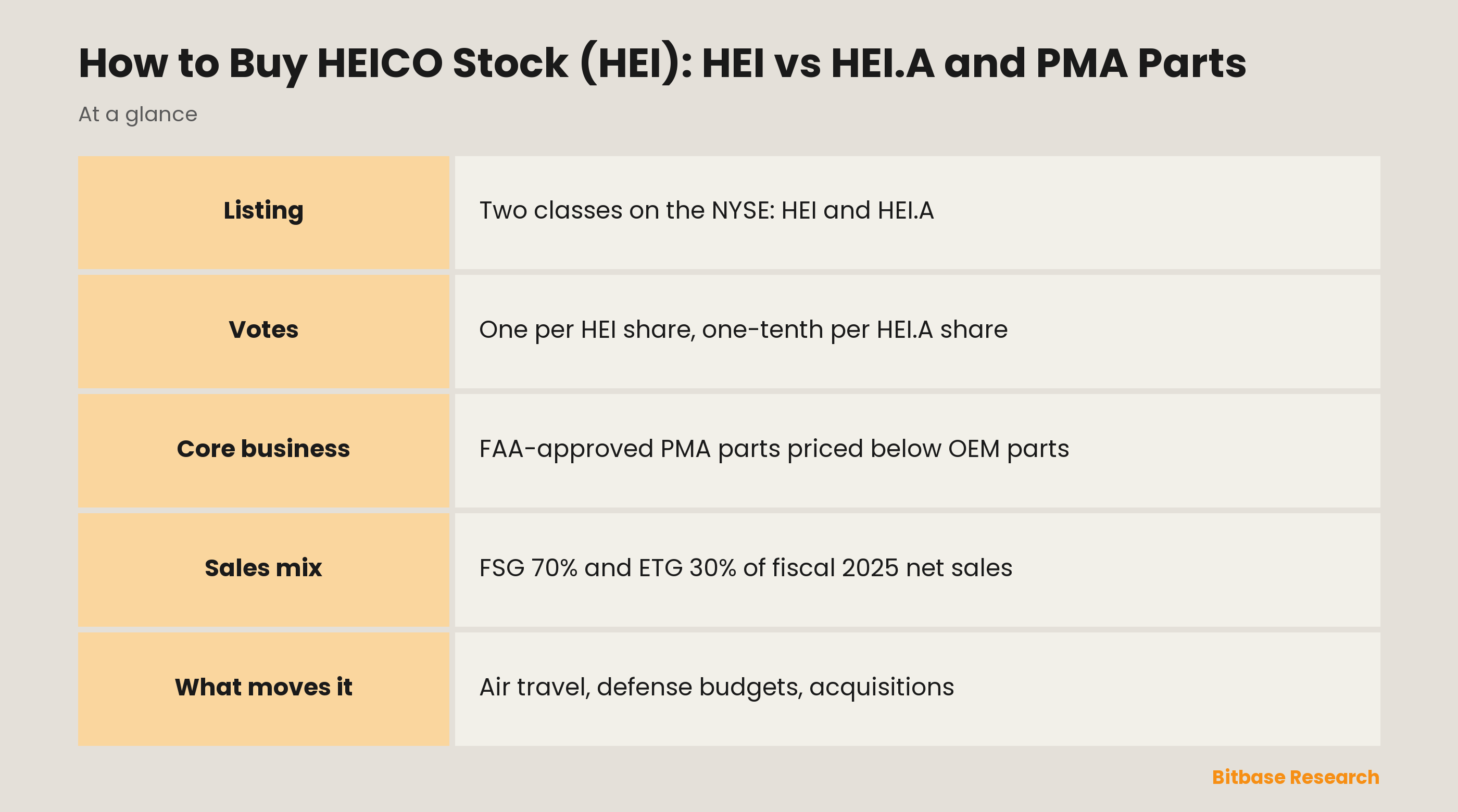
Two share classes of HEICO trade on the New York Stock Exchange, the common stock as HEI and the Class A common stock as HEI.A, and any broker that offers US equities can fill an order for either one. The classes differ mainly in voting power, and the company behind them makes FAA-approved replacement parts that compete with the engine and aircraft makers' own. Below: what HEICO sells, how to order, which class to pick and the risks its filings name.
What Does HEICO Do?
HEICO "believes it is the world's largest manufacturer of Federal Aviation Administration ('FAA')-approved jet engine and aircraft component replacement parts, other than the original equipment manufacturers ('OEMs') and their subcontractors." It also builds electronic equipment for aviation, defense, space, medical and telecommunications customers. First organized in 1957, it is incorporated and headquartered in Florida.
The first of two segments, the Flight Support Group (FSG), produced 70% of net sales in fiscal 2025. Historically, the 10-K explains, the three main jet engine makers, General Electric (including CFM International), Pratt & Whitney and Rolls-Royce, were the sole source of almost all replacement parts for their engines. A non-OEM manufacturer can only sell a replacement part after the FAA grants a Parts Manufacturer Approval, or PMA, which requires sample parts, drawings and test data. HEICO says it adds roughly 400 to 550 PMAs a year and has developed about 20,000 parts with PMAs, and it argues that the process "creates a significant barrier to entry." The parts are sold "at lower prices than those manufactured by OEMs" and are FAA-approved functional equivalents of the OEM parts. FSG also repairs and overhauls components, supplies military aircraft parts to the US Department of Defense and allied forces, and makes specialty items such as thermal insulation blankets.
The Electronic Technologies Group (ETG) produced the other 30%. It designs niche components for larger systems, from infrared test equipment used in missile development and laser rangefinder receivers to microwave parts for satellites and underwater locator beacons for flight recorders. About 51% of ETG's fiscal 2025 sales went to military agencies, defense contractors and satellite and spacecraft makers.
Since 1990, when the current management team took control, HEICO has completed approximately 107 acquisitions, including Wencor, a large aftermarket parts company bought in August 2023 and folded into FSG. One partner is unusual: Lufthansa Technik, the technical services arm of the German airline, owns 20% of HEICO Aerospace Holdings, one of the two companies that make up FSG.
How HEICO Makes Money
In fiscal 2025 (the year to 31 October 2025) net sales rose 16% and operating income rose 24%. By market, about 58% of sales came from commercial aviation, 31% from defense and space and 11% from other industrial markets. The segment note breaks the year down further:
| Revenue line | Share of segment sales, fiscal 2025 | What it covers |
|---|---|---|
| FSG aftermarket replacement parts | 62% of FSG | PMA jet engine and component parts |
| FSG repair and overhaul | 24% of FSG | Parts consumed in repair and overhaul services |
| FSG specialty products | 14% of FSG | Insulation, composites, parachutes, missile hardware |
| ETG defense, space and aerospace components | 81% of ETG | Electro-optical, microwave, power and memory parts |
| ETG components for other industries | 19% of ETG | Shielding, high-voltage and connectivity products |
Both segments earn similar margins. FSG's operating income came to 24.1% of its sales in fiscal 2025, up from 22.5%, and ETG's to 23.0%, up from 22.8%. FSG grew 18%, with organic growth of 14%; ETG grew 12%, with organic growth of 7%.
No customer reached 10% of sales in any of the last three fiscal years, the five largest together took about 20% in fiscal 2025, and about 38% of sales went to foreign customers in roughly 130 countries. Over the longer run, the 10-K puts the compound annual growth rate of sales from fiscal 1990 to fiscal 2025 at approximately 16%, and of net income at approximately 18%.
HEI Stock at a Glance
| Feature | HEICO |
|---|---|
| Exchange | New York Stock Exchange |
| Tickers | HEI (common stock) and HEI.A (Class A common stock) |
| Votes per share | One for HEI; one-tenth for HEI.A |
| Economic rights | "Virtually identical in all economic respects" |
| Sector | Aerospace and defense: replacement parts, repair, electronic components |
| Headquarters | Hollywood, Florida |
| Incorporated | Florida |
| Fiscal year | Ends 31 October |
| Dividend | Paid twice a year on both classes |
| SEC identifier | CIK 46619 |
Prices for the two classes differ and move with every trade; the HEICO stock page on Bitbase shows live figures for HEI.
How to Buy HEICO Stock
HEICO is a US company, so there is no depositary receipt in between: both tickers are the company's own shares. The steps:
1. Pick a broker with NYSE access. Outside the US, use a local or international broker that offers US shares. Check which regulator supervises it.
2. Open and verify the account. Non-US individuals usually certify their status on IRS Form W-8BEN, which the IRS says is submitted "when requested by the withholding agent or payer."
3. Fund it. Money sent in another currency gets converted, so compare the exchange rate as well as the commission.
4. Choose the class. Search for HEI or HEI.A and check the name on the result. Brokers format the Class A symbol in different ways; the 10-K writes HEI.A, while the SEC's company data lists it as HEI-A.
5. Set the order. FINRA says a market order "provides the most certainty that your order will be executed," while a limit order fills only "at or better than a specified price."
6. Decide the size. Some brokers let you buy a fraction of a share; if yours does not, the share price sets the minimum.
HEI or HEI.A? The classes differ in voting weight, not in the business you own (see the FAQ), and their prices do not move in lockstep: in the 10-K's five-year performance table to 31 October 2025, the common stock shows a cumulative total return of about 204% and the Class A about 167%.
Taxes for investors abroad. The IRS says "most types of U.S. source income received by a foreign person are subject to U.S. tax of 30%," with a lower rate or exemption possible under a tax treaty. Your home country may tax the dividends too.
Through a fund. HEICO is not in the S&P 500 (see the FAQ), but sector funds can hold it: State Street's SPDR S&P Aerospace & Defense ETF (XAR), which tracks the S&P Aerospace & Defense Select Industry Index, listed HEI among its holdings on 6 November 2026.
What Moves HEI Stock
Air traffic and the aftermarket. Commercial aviation produced about 58% of fiscal 2025 sales. The 10-K notes that downward cycles in aviation have historically reduced demand for replacement parts and repair work, and that air travel depends on airline profitability, trade policy and disease outbreaks, among other factors.
Defense and space budgets. About 31% of fiscal 2025 net sales came from defense, space and homeland security products, and smaller budgets or new US limits on sales to foreign militaries "could lower sales of our products and services."
Acquisitions. In fiscal 2026 HEICO bought Axillon Aerospace's fuel containment business (renamed Rockmart) in January, EthosEnergy's accessories and components repair business in February and 80% of Sherwood Avionics in April. In July 2026 it sold two new series of senior notes, due 2031 and 2036, and used the proceeds to repay its revolving credit facility.
Recent results. In the third quarter of fiscal 2026 (to 31 July 2026), net sales rose 23%: FSG grew 18%, with 12% organic, and ETG grew 36%, with 18% organic. For the first nine months, sales were up 21%.
Leadership. Laurans Mendelson, chairman and chief executive from 1990 and later executive chairman, died on 27 September 2025, and co-chief executives Eric and Victor Mendelson became co-chairmen under the company's succession plan.
Acquisition, Airline and Budget Risks for HEICO
The 10-K lists many risk factors. These bear most directly on the stock:
Acquisition strategy. "We may not be able to effectively execute our acquisition strategy, which could slow our growth." Goodwill and intangible assets made up 60% of total assets at 31 October 2025, and an impairment would be a non-cash charge to earnings.
OEM competition. HEICO competes with "the industry's leading jet engine and aircraft component OEMs," some with greater name recognition and resources. As OEMs improve their engines and components, HEICO "may not be able to re-design and manufacture replacement parts that perform as well."
Approvals and regulation. The FAA and its counterparts "highly regulate" aircraft parts and repair, and the revocation or suspension of material approvals "would have an adverse effect." HEICO also notes that it has no material patents for its proprietary techniques and relies mainly on trade secret protection.
Concentrated control. At 19 December 2025, executive officers, their entities, the 401(k) plan and directors beneficially owned about 11% of the common stock and about 3% of Class A, and the 10-K says they "will be able to substantially influence the election of the Board of Directors."
Owning one stock ties your result to one company, and the dividend is not fixed: the board will "regularly evaluate whether dividends should be paid in cash or stock, as well as what amounts should be paid."
How to Research HEI Yourself
HEICO files under CIK 46619 on SEC EDGAR: the 10-K after each October year-end, three 10-Qs, and 8-Ks for events, including the earnings releases. In fiscal 2026 these came on 25 February, 27 May and 25 August 2026. heico.com posts the same reports at no charge.
In the 10-K, the business section explains PMAs and each segment, the shareholders' equity note sets out the voting rights of the two classes, and the revenue note splits sales by product line and by industry.
When comparing data, check which class each source quotes. For comparison with an engine maker whose parts HEICO's PMAs compete with, see our GE Aerospace stock guide; for another aftermarket parts company, see our TransDigm stock guide. Live quotes for HEI are on the stock page linked above, and Bitbase's index of US stock pages covers other companies.
HEICO Stock FAQ
Can I buy HEICO stock with crypto?
Not directly. HEI and HEI.A are bought through a brokerage account in US dollars, so you would first sell crypto for cash and move it to the broker, a sale that may be taxable where you live. A share also carries dividend and voting rights in a company, one of the key differences between stocks and crypto.
What is the difference between HEI and HEI.A?
Voting. HEI, the common stock, has one vote per share; HEI.A, the Class A common stock, has one-tenth of a vote per share. The 10-K calls the two classes "virtually identical in all economic respects": both receive dividends when declared and share ratably in assets on liquidation.
Does HEICO pay a dividend?
Yes, twice a year, on both classes. HEICO says it has paid cash dividends semi-annually since 1979; the July 2025 payment was its 94th consecutive one. The board reviews the policy regularly, so check the latest filings for the current amount.
Is HEICO in the S&P 500?
No. State Street's daily holdings file for SPY, the S&P 500 fund, did not include HEICO on 6 November 2026, and neither did the file for MDY, which tracks the S&P MidCap 400. Membership can change, so check current holdings.
Who runs HEICO?
Brothers Eric A. Mendelson and Victor H. Mendelson are co-chairmen and co-chief executives. Eric also heads the Flight Support Group and Victor the Electronic Technologies Group.
Conclusion
HEICO combines two businesses that answer to different customers: a parts maker whose PMA approvals let it undercut the OEMs, paired with a defense and space electronics group, both fed by a steady stream of acquisitions. Airline traffic drives the first, and military and space buyers much of the second. Read the latest 10-K, compare the two classes before you buy, and size the position for a single aerospace company.
Related reading
Other Bitbase articles on this topic:
- How to Buy Comfort Systems Stock (FIX): Data Centers and Backlog
- How to Buy Dover Stock (DOV): 70 Years of Dividend Raises
- How to Buy D.R. Horton Stock (DHI): Lots, Mortgages and Buybacks
- How to Buy Roper Technologies Stock (ROP): From Pumps to Software
Disclaimer: This article is educational content from Bitbase Academy, provided for information only. It explains what a company or fund does and how the instruments referenced here differ from one another; it does not constitute investment, trading, tax, or financial advice, and it is neither a recommendation nor an endorsement of any security, token, or trading strategy. A tokenized stock is issued by a third party and is designed to give economic exposure to an underlying asset: it is not a share, it carries no shareholder rights, and it depends on the issuer's structure, eligibility rules, and redemption terms, which the issuer can change. Perpetual futures are leveraged derivatives that hold no underlying asset and can be liquidated, and trading hours, product availability, and eligibility differ by instrument and by jurisdiction and can change at any time. Written as of November 2026; verify everything yourself through company filings, the issuer's own documentation, and the product pages of the venue you trade on.
References
[1] HEICO Form 10-K for fiscal 2025 (SEC EDGAR) www.sec.gov
[2] HEICO fiscal 2025 Form 10-K, XBRL listing data (SEC EDGAR) www.sec.gov
[3] HEICO Form 10-Q for the third quarter of fiscal 2026 (SEC EDGAR) www.sec.gov
[4] HEICO Form 8-K of 29 September 2025 on leadership changes (SEC EDGAR) www.sec.gov
[5] SEC EDGAR company data for HEICO (tickers and filings) data.sec.gov
[6] State Street SPDR S&P 500 ETF Trust (SPY): fund page and daily holdings www.ssga.com
[7] State Street SPDR S&P MidCap 400 ETF Trust (MDY): fund page and daily holdings www.ssga.com
[8] State Street SPDR S&P Aerospace & Defense ETF (XAR): fund page and daily holdings www.ssga.com
[9] FINRA: Order Types www.finra.org
[10] IRS: NRA Withholding www.irs.gov
[11] IRS: About Form W-8 BEN www.irs.gov





