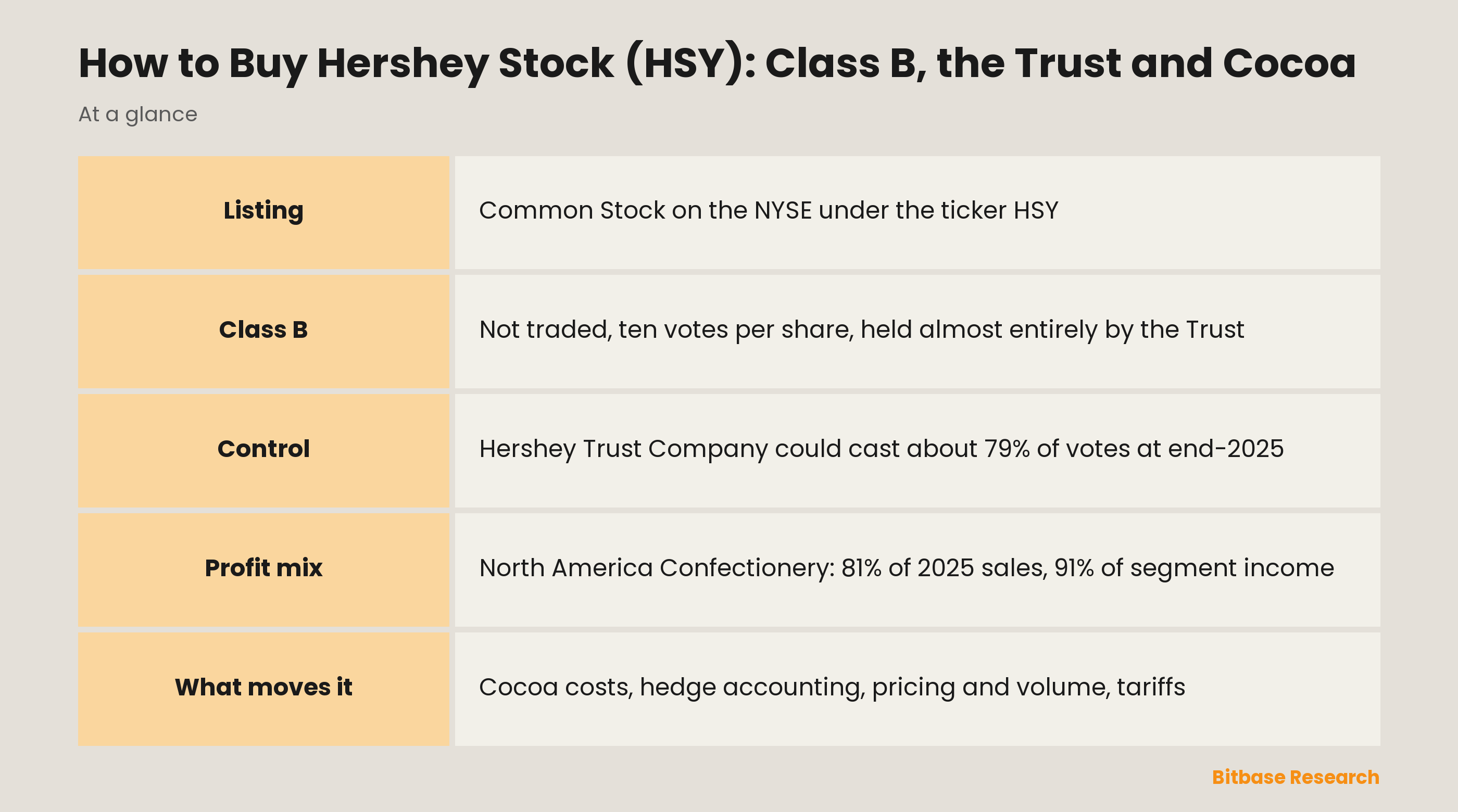
Ordering a Hershey share is a New York Stock Exchange trade: any broker that offers US equities can buy the Common Stock under the ticker HSY, the only Hershey class that is publicly traded. The other class, Class B, carries ten votes per share and is held almost entirely by Hershey Trust Company as trustee for the Milton Hershey School Trust, which could cast about 79% of the votes at the end of 2025. This guide covers the chocolate and snacks business, the purchase itself, and the cocoa, pricing and control questions that come with an HSY share.
What Does Hershey Do?
The Hershey Company makes chocolate, candy, mints, gum and salty snacks. It was incorporated in Delaware on 24 October 1927 as the successor to a business Milton S. Hershey founded in 1894, and its head office is at 19 East Chocolate Avenue in Hershey, Pennsylvania. Its annual report calls it "the largest producer of quality chocolate in North America, a leading snack maker in the United States and a global leader in chocolate and non-chocolate confectionery." Products are sold under more than 85 brand names in approximately 65 countries.
The company reports three segments, and each has its own shelf of brands:
North America Confectionery covers the United States and Canada. Hershey's, Reese's and Kisses lead a list that also takes in Jolly Rancher, Twizzlers, Heath, York and Sour Strips. ONE protein bars, Ice Breakers mints and gum, Bubble Yum and Lily's baking products belong here too, as do the Hershey's Chocolate World stores in Hershey, New York, Las Vegas, Niagara Falls (Ontario) and Singapore, and the income from licensing Hershey brands to other manufacturers.
North America Salty Snacks is the US popcorn and pretzel business: SkinnyPop and LesserEvil popcorn, Pirates Booty and Dot's Homestyle Pretzels. Acquisitions keep adding to it, the latest being LesserEvil, an organic popcorn and puffed snack maker bought on 18 November 2025. The year before, Hershey bought the Sour Strips candy brand, and in May 2023 it took over manufacturing assets from Weaver Popcorn, which used to co-pack SkinnyPop.
International groups everything outside North America. Hershey makes products in Mexico, Brazil, India and Malaysia, mainly for those markets, and sells regional brands such as Pelon Pelo Rico in Mexico, IO-IO in Brazil and Sofit beverages in India, while exporting confectionery to Asia, Latin America, the Middle East, Europe and Africa.
Not every famous name in the portfolio belongs to Hershey outright. In the United States it sells Kit Kat and Rolo under licence from Nestlé and Cadbury and Caramello under licence from Cadbury UK, York, Almond Joy and Mounds come under a worldwide licence from Cadbury and Kraft Foods entities, and Heath, Jolly Rancher, Payday and Whoppers under one from Iconic IP Interests.
How Hershey Makes Money
Chocolate and candy in North America pay for most of the company. In the 2025 10-K, net sales and segment income split like this:
| Segment | Share of 2025 net sales | Share of 2025 segment income | Typical products |
|---|---|---|---|
| North America Confectionery | 81% | 91% | Hershey's, Reese's, Kisses, Kit Kat (US), mints, gum, protein bars |
| North America Salty Snacks | 11% | 9% | SkinnyPop and LesserEvil popcorn, Pirates Booty, Dot's pretzels |
| International | 8% | 0.1% | Mexico, Brazil, India, Malaysia and export markets |
Shares are calculated from the segment note of the 10-K. Segment income is measured before unallocated corporate costs and before gains and losses on commodity hedges, which the company keeps outside the segments until the hedged inventory is sold.
Most sales go to wholesale distributors, grocery chains, mass merchandisers, drugstores, convenience stores, dollar stores, clubs and vending operators, which resell to consumers. One distributor stands out: McLane Company, Inc., which also supplies Walmart with Hershey products, accounted for approximately 27% of consolidated net sales in 2025. Sales outside the United States made up 12.3% of the total that year.
2025 showed how a chocolate company earns through a cocoa shock. Net sales rose 4.4%, driven by price realization of approximately 6% from higher list prices and roughly 1% from the Sour Strips and LesserEvil deals, while volume fell about 1% as shoppers reacted to prices. Costs moved faster. Higher commodity and tariff costs, plus losses on hedges for future years' purchases, cut gross margin to 33.5% from 47.3%, operating profit fell 50.3%, and diluted earnings per share fell 60.3%.
The 2026 quarters have run the other way on margin. In the third quarter, net sales grew 3.0% and organic, constant currency net sales 0.8%, as price realization of about 11 points offset a volume decline of about 10 points; gross margin was 46.1%, against 32.6% a year earlier. The business is also seasonal: sales "are typically higher during the third and fourth quarters of the year," which the 10-K ties to seasonal and holiday-related buying.
HSY Stock at a Glance
| Item | Detail |
|---|---|
| Exchange | New York Stock Exchange |
| Ticker | HSY |
| What you can buy | Common Stock, one dollar par value; the only class registered on an exchange |
| Second class | Class B Common Stock: not publicly traded, ten votes per share, convertible into Common Stock share for share at any time |
| Controlling holder | Hershey Trust Company, as trustee for the Milton Hershey School Trust |
| Business | Chocolate and non-chocolate confectionery, mints, gum and salty snacks |
| Index membership | S&P 500 |
| Headquarters | Hershey, Pennsylvania |
| Incorporated | Delaware, 1927 |
| Fiscal year | Calendar year, ending 31 December |
| Dividends | Paid quarterly on both classes; the Common Stock receives 10% more per share than Class B |
| SEC identifier | CIK 47111 |
Price, market value and dividend yield change with every trade; for live numbers, open the Hershey stock page on Bitbase.
How to Buy Hershey Stock
The listed security is the company's own Common Stock, issued by a Delaware corporation, so no depositary receipt stands in between. The purchase runs through six stages:
1. Find a broker with access to the NYSE. Abroad, a local firm offering US equities or an international one will do; check which entity holds the account and who regulates it.
2. Complete the account paperwork. People who are not US persons normally sign IRS Form W-8BEN. The IRS tells beneficial owners to submit it "when requested by the withholding agent or payer," and brokers request it when the account is opened.
3. Move money in. HSY is quoted in US dollars, so a deposit in another currency is converted, and the conversion rate can cost more than the commission.
4. Search for HSY and check the line. The result should read The Hershey Company Common Stock on the NYSE. Class B shares never appear in a broker's search because they do not trade.
5. Choose how the order executes. FINRA notes that brokerage firms "typically enter your order as a market order unless you specify otherwise," while a limit order is "for investors who know the price they want."
6. Decide on the amount. If your broker sells fractional shares, you can invest a fixed sum instead of a whole share. FINRA points out that investors "typically receive one vote per share of common stock they own" but that a fractional owner "might not have shareholder voting rights."
Withholding tax abroad. Under IRS rules, "most types of U.S. source income received by a foreign person are subject to U.S. tax of 30%," and "a reduced rate, including exemption, may apply" when a tax treaty provides for one. That is why the W-8BEN matters for HSY dividends, which your country of residence may tax again.
Owning it inside a fund. HSY is a member of the S&P 500, so an index fund that tracks that benchmark, such as State Street's SPY, holds Hershey as one position among hundreds. For a confectionery peer listed on Nasdaq, see our Mondelez stock guide.
What Moves HSY Stock
Cocoa. Cocoa liquor, butter and powder are the main raw materials, and the 10-K says West Africa "accounts for approximately 70% of the world's supply of cocoa beans." A trading company in Switzerland handles all of Hershey's cocoa buying and hedging. The average cocoa futures price on the Intercontinental Exchange rose 5.8% in 2025 after an earlier surge, and in the first nine months of 2026 the average was about 43% below the 2025 average. Hershey "generally hedge[s] commodity price risks for 3- to 24-month periods," so its own costs follow the market with a delay and do not mirror it.
Hedge accounting. Gains and losses on commodity derivatives bought to cover future years flow through cost of sales before the cocoa is used. The 10-K puts the 2025 loss from this mark-to-market activity among the main reasons cost of sales rose 31.7%. Hershey publishes adjusted figures that strip these swings out, so reported and adjusted results can diverge widely: third-quarter 2026 gross margin was 46.1% as reported and 42.7% adjusted.
Price against volume. List price increases arrive with a lag, because the company typically honours promotions already promised to retailers. In the third quarter of 2026, North America Confectionery had organic price realization of about 13% and a volume and mix decline of about 11%.
Salty snacks and deals. North America Salty Snacks net sales rose 22.3% in the third quarter of 2026, of which 20.0 points came from the LesserEvil acquisition. The 10-K warns that synergies depend on coupling Hershey's scale "with the existing operations of our acquired brands."
Tariffs and rules. The 10-K says tariffs on US imports and retaliatory tariffs "had a material negative impact" on 2025 results, while third-quarter 2026 gross margin benefited partly from tariff refunds. In food policy, Hershey has said it will remove all certified Food, Drug & Cosmetic colors from its snacks by the end of 2027.
Cocoa, Concentration and Control Risks at Hershey
Of the risk factors in the 10-K, these bear most directly on an HSY holder:
Input costs. Hedging or not, the 10-K says "commodity price increases ultimately result in corresponding increases in our raw material and energy costs." The list of causes runs from weather and crop disease to "speculative influences" and political unrest in producing countries.
Pricing power. Raising prices or shrinking packs "have in the past and may in the future result in a reduction in sales volume and/or consumption." If inflation outruns what consumers will accept, margins take the difference.
Changing demand. Among the factors the company lists are shelf space, store trips, the growth of digital commerce and "consumer health and wellness concerns, including weight management (i.e., use of medications, dieting)."
Customer concentration. McLane's share of about a quarter of net sales means a change in that one relationship would be felt across the business.
Operations. Approximately 74% of manufacturing capacity is in the United States, and disruptions from weather, strikes, cyber incidents or supplier failures could interrupt production.
Regulation. The EU Deforestation Regulation, scheduled to take effect in December 2026, will require diligence on cocoa and other commodities to show they "do not result from recent deforestation."
Control. This risk sits in the share structure, not the business. Common and Class B stock vote together on most matters, including the election of directors, and the Trust's Class B holding gave it about 79% of combined votes at the end of 2025. Common stockholders voting as a separate class elect one-sixth of the board. Three directors of Hershey Trust Company sit on the Hershey board, among them its chairman, Maria Kraus, and since February 2026 the board's choice of chairman must be made with the Trust's agreement. The Trust "has indicated it intends to retain its controlling interest," and Pennsylvania law requires advance notice to the state Attorney General of any transaction that would end its voting control, which, according to the 10-K, "makes it more difficult for a third party to acquire a majority of our outstanding voting stock." A buyer of HSY gets a vote, but not a decisive one.
Above all of this sits the plain fact that one stock ties your money to one company, and that each quarterly dividend is a fresh decision of the board.
How to Research HSY Yourself
Hershey files with the SEC under CIK 47111. The 10-K, three 10-Qs a year and 8-Ks for events are all on EDGAR; in 2026 the quarterly results came on 5 February, 30 April, 30 July and 29 October, and an Investor Day presentation was filed on 31 March.
Four parts of the 10-K answer most questions. The business section lists the brands and the licence agreements. The market section confirms that only the Common Stock trades and counts 22,080 holders of record of the Common Stock against 5 of the Class B. The market risk section sets out cocoa futures prices year by year, and the equity note shows how many Class B shares the Trust holds and its share of the vote. The proxy statement, filed in March, names the three directors who represent Hershey Trust Company and explains how the Trust decides the votes of its shares.
Each quarter, read the earnings release next to the 10-Q: the release sets adjusted figures, which exclude derivative mark-to-market effects, beside reported ones, and the 10-Q adds the cocoa commentary. The stock performance graph in the 10-K compares Hershey with the S&P 500 and the S&P 500 Packaged Foods Index over five years. Quotes and charts are on the stock page linked above, and the list of US stock pages on Bitbase covers other companies, among them PepsiCo, whose snacks and drinks are profiled in our PepsiCo stock guide.
Hershey Stock FAQ
Can I buy Hershey stock with crypto?
No broker takes crypto for HSY. You would first sell the crypto for cash, which can be a taxable event, then send US dollars or local currency to a brokerage account and buy the Common Stock there. What you then own is a registered share with a vote and a dividend, a different kind of asset from a token.
Does Hershey pay a dividend?
Yes, every quarter. The dividend declared on 4 February 2026 was the company's 384th consecutive quarterly dividend on the Common Stock. Holders of Common Stock are entitled to cash dividends 10% higher per share than Class B holders. The board sets each payment, so check the latest 8-K for the current amount and dates.
What is Hershey Class B stock, and can I buy it?
You cannot buy it on an exchange. Class B Common Stock is "not publicly traded," carries ten votes per share and can be converted into Common Stock share for share at any time. At the end of 2025 it had five holders of record, and almost all of it was held by Hershey Trust Company as trustee for the trust Milton S. and Catherine S. Hershey set up for the Milton Hershey School, its sole beneficiary. The 10-K adds that the company's board, not the Trust, is responsible for running the business.
Does Hershey own Kit Kat?
No. Hershey makes and sells Kit Kat and Rolo in the United States under a licence from Société des Produits Nestlé SA, and the 10-K gives the United States as the only territory of that agreement. Reese's, Kisses and Hershey's do not appear in its table of licensed brands.
Is HSY in the S&P 500?
Yes. State Street's SPY daily holdings file dated 6 November 2026 lists Hershey Co under HSY.
Conclusion
Hershey is a chocolate maker whose profits rise and fall with cocoa, and whose votes are controlled by the Milton Hershey School Trust through its Class B shares. The HSY share gives you a claim on Reese's, Kisses and a growing salty snacks unit, together with a reporting line that swings sharply with hedge accounting and a governance structure in which outside holders cannot change control. Before buying, read the latest 10-K and 10-Q, compare reported with adjusted earnings over a full cocoa cycle, and decide how much of one confectionery company belongs in your portfolio.
Related reading
Other Bitbase articles on this topic:
- How to Buy Coca-Cola Europacific Partners Stock (CCEP): No ADR
- How to Buy Diageo Stock (DEO): Four Shares per ADS and Guinness
- How to Buy Dollar General Stock (DG): Small Towns, Thin Margins
- How to Buy Kroger Stock (KR): Groceries, Fuel and Pharmacy
Disclaimer: This article is educational content from Bitbase Academy, provided for information only. It explains what a company or fund does and how the instruments referenced here differ from one another; it does not constitute investment, trading, tax, or financial advice, and it is neither a recommendation nor an endorsement of any security, token, or trading strategy. A tokenized stock is issued by a third party and is designed to give economic exposure to an underlying asset: it is not a share, it carries no shareholder rights, and it depends on the issuer's structure, eligibility rules, and redemption terms, which the issuer can change. Perpetual futures are leveraged derivatives that hold no underlying asset and can be liquidated, and trading hours, product availability, and eligibility differ by instrument and by jurisdiction and can change at any time. Written as of November 2026; verify everything yourself through company filings, the issuer's own documentation, and the product pages of the venue you trade on.
References
[1] Hershey Form 10-K for 2025 (SEC EDGAR) www.sec.gov
[2] Hershey 2025 Form 10-K, XBRL cover page (SEC EDGAR) www.sec.gov
[3] Hershey 2025 Form 10-K, XBRL segment data (SEC EDGAR) www.sec.gov
[4] Hershey Form 10-Q for the third quarter of 2026 (SEC EDGAR) www.sec.gov
[5] Hershey third-quarter 2026 results release, filed with Form 8-K (SEC EDGAR) www.sec.gov
[6] Hershey 2026 proxy statement (SEC EDGAR) www.sec.gov
[7] State Street, SPY daily holdings www.ssga.com
[8] FINRA: Order Types www.finra.org
[9] FINRA: Investing in Fractional Shares www.finra.org
[10] IRS: NRA Withholding www.irs.gov
[11] IRS: About Form W-8 BEN www.irs.gov





