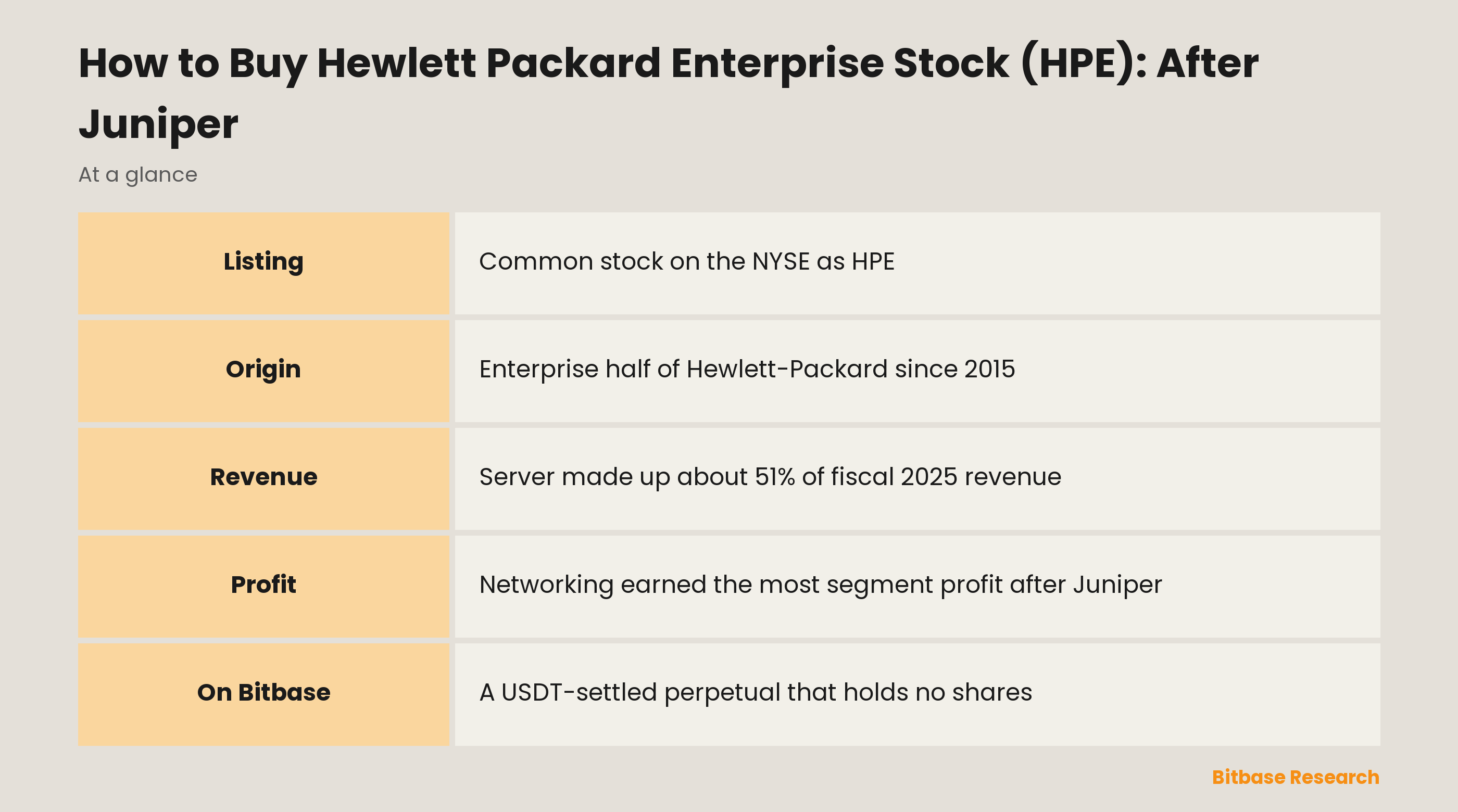
Unless your brokerage account is confined to local shares, buying Hewlett Packard Enterprise stock is an ordinary order: the common shares trade on the New York Stock Exchange under the ticker HPE. The company is the enterprise half of the old Hewlett-Packard, and in fiscal 2025, the year it bought Juniper Networks, networking earned more segment profit than servers on about a fifth of revenue. On Bitbase, HPE comes as a USDT-settled perpetual futures contract that follows the share price without being a share.
What Does Hewlett Packard Enterprise Do?
HPE sells the infrastructure that companies and governments run their own computing on: servers, storage, networking equipment, the software that manages them, and services and financing. Its customers range "from small-and-medium-sized businesses to large global enterprises and governmental entities."
In fiscal 2025 it reported five segments. Server covers HPE ProLiant machines, HPE Cray supercomputers and AI systems. Hybrid Cloud is HPE Alletra storage and the HPE GreenLake private cloud. Networking sells Wi-Fi access points, switches, routers and the Mist and Aruba Central management software. Financial Services leases and finances IT equipment, and Corporate Investments and Other holds advisory services and Hewlett Packard Labs. From 1 November 2025, the start of fiscal 2026, Server, Hybrid Cloud and Financial Services became a single Cloud & AI segment, alongside Networking and Corporate Investments and Other.
The lineage goes back to a partnership founded in 1939 by William R. Hewlett and David Packard. HPE itself began on 1 November 2015, when the old company separated its enterprise technology infrastructure, software, services and financing businesses from personal systems and printing, handing out one HPE share for each of its own; the former parent is now HP Inc. The Juniper Networks deal, agreed on 9 January 2024, closed on 2 July 2025.
HPE builds few finished products itself, relying on outsourced design and contract manufacturers. The 10-K names Dell Technologies, Super Micro Computer and Lenovo among server rivals and Arista Networks, Nokia and Huawei among networking rivals; Cisco appears in the lists for servers, hybrid cloud and networking alike.
How HPE Makes Money
Fiscal 2025 ran to 31 October 2025, and revenue rose about 14%. Server produced about 51% of it, Networking about 20%, Hybrid Cloud about 16% and Financial Services about 10%, with the remaining 2% in Corporate Investments and Other. Networking revenue grew by about half, "primarily due to revenue attributable to Juniper Networks," and Server revenue rose 10%, mainly on higher average unit prices.
Profit is spread differently. Networking earned about 44% of total segment operating earnings and Server about 37%, because Networking's segment margin was about 23% and Server's about 8%.
Fiscal 2025 still ended with a GAAP operating loss, after a goodwill impairment on the Hybrid Cloud unit that was "predominantly driven by an increase in the discount rate used in the analysis, as well as a strategic shift away from Non-IP storage business." Approximately 61% of revenue came from outside the United States, and one distributor accounted for approximately 10%.
HPE Stock at a Glance
| Feature | HPE |
|---|---|
| Exchange | New York Stock Exchange |
| Ticker | HPE |
| Share class | Common stock; a mandatory convertible preferred is listed separately |
| Industry | Enterprise IT: servers, storage and networking |
| Index membership | S&P 500, per SPY holdings on 29 October 2026 |
| Headquarters | Spring, Texas |
| Incorporated | Delaware |
| Independent since | 1 November 2015 |
| Fiscal year end | 31 October |
| Dividend policy | Quarterly, at the board's discretion; preferred dividends rank first |
| Share buybacks | Programme approved on 13 October 2015, no expiration date |
The live quote and chart are on the HPE stock page on Bitbase.
How to Buy Hewlett Packard Enterprise Stock
Through a broker, the order takes five steps:
1. Pick a broker with NYSE access that accepts residents of your country.
2. Complete the application and identity checks. Non-US individuals are normally asked for Form W-8BEN.
3. Deposit money. Converting another currency into dollars is part of the cost.
4. Enter the ticker HPE and choose how to price the order. A market order takes whatever price is available; a limit order sets your maximum and might not execute.
5. Decide how many shares; some brokers also sell fractions of one.
Check the line before you submit. HPE is the common stock; the mandatory convertible preferred trades separately, and HPQ belongs to HP Inc., a different company.
From outside the US, you get the same common stock a US buyer does; no depositary receipt is involved. The difference is dividend tax: the IRS states that "Most types of U.S. source income received by a foreign person are subject to U.S. tax of 30%," a rate a treaty can reduce, and Form W-8BEN goes to the payer "whether or not you are claiming a reduced rate of, or exemption from, withholding." This is not tax advice.
Through a fund, the holding is indirect: S&P 500 index funds, SPY among them, own a small slice of HPE.
Trading HPE on Bitbase
For USDT, Bitbase offers the HPE perpetual futures contract, margined and settled in that stablecoin. It is a derivative written on the share price, so a position brings no dividend, no vote and no part in corporate events such as the conversion of HPE's preferred stock. In return it can go short as well as long, with leverage, and it trades at night and over weekends while the NYSE is closed.
Funding holds the contract near HPE's price: at set intervals the crowded side pays the other. Liquidation is judged on the mark price, not the last trade. News that lands while the exchange is shut moves the contract first, and the stock can open elsewhere. The stock perpetual guide explains both mechanisms; the HPE contract rules on Bitbase give the funding interval, margin tiers, leverage limit and closed-market pricing. Other stock markets are on the TradFi page.
What Moves HPE Stock
Networking after Juniper. It is now the larger profit source, and the integration "will continue to require sustained management attention."
AI system orders. HPE's AI solutions "have historically been purchased primarily by a small number of larger customers and cloud service providers," and such orders "may occur in some periods and not others."
GPU supply. The company calls the GPU market uneven "as the market navigates transition to next generation GPUs," which at times left its inventory elevated in fiscal 2025.
Server costs. Server, about half of revenue, has a thin margin, and HPE has at times been unable to pass higher production costs on to customers.
Debt and capital returns. HPE says it is "prioritizing de-leveraging" after the deal while keeping a quarterly dividend and an open-ended buyback programme.
HPE's Risk Factors After the Juniper Deal
Integration. Failing to integrate acquisitions, "including the integration of Juniper Networks following the Merger," could harm results and the stock price. The antitrust settlement also required HPE to divest its Instant On campus and branch business and auction up to two licences to the Mist AIOps source code.
Leverage. The deal debt could absorb "a substantial portion of our cash flow from operations" and limit the ability to "pay cash dividends or repurchase our common stock."
Goodwill. Any future impairment, like the fiscal 2025 Hybrid Cloud charge, "could materially and adversely affect our results of operations."
The shared name. HPE and HP Inc. both use legacy Hewlett-Packard branding through a joint brand holding structure, so "conduct or events adversely affecting the reputation of HP Inc. could also adversely affect our reputation."
Dividends and the preferred. Preferred dividends come first, and "We cannot guarantee that we will continue to pay a dividend in any future period." The preferred is due to convert automatically into common stock on a mandatory conversion date expected to be 1 September 2027, adding to the common share count.
The perpetual. Losses grow with leverage, funding keeps accruing for as long as a position is held, and if HPE opens far from the contract's last level, liquidation can come before you react.
Following HPE Through Its Own Filings
HPE files on SEC EDGAR under CIK 1645590. In the 10-K, Item 1 covers the business, Item 1A the risk factors and Note 2 the segment figures; 10-Qs cover the first three quarters and 8-Ks carry results and events such as the Juniper closing. From fiscal 2026, reports use three segments with earlier periods recast, so compare like with like. Filings are also posted at investors.hpe.com.
Hewlett Packard Enterprise Stock FAQ
Is Hewlett Packard Enterprise the same company as HP Inc.?
No. Both come from the old Hewlett-Packard Company, which on 1 November 2015 separated its enterprise businesses into HPE and kept personal systems and printing. That company is now HP Inc., listed on the NYSE as HPQ, so buying HPQ gives no exposure to HPE.
Does Hewlett Packard Enterprise pay a dividend?
Yes, quarterly. SEC financial data show dividends paid on the common stock in every fiscal year since fiscal 2016, and the 10-Q for the July 2026 quarter lists another regular dividend, payable in October 2026.
Did HPE complete its acquisition of Juniper Networks?
Yes, on 2 July 2025, after settling with the US Department of Justice, which had sued on 30 January 2025 to block the deal. Twelve states and the District of Columbia later intervened in the court's Tunney Act review; on 12 August 2026 the court found the settlement to be in the public interest and granted entry of the final judgment.
Can I buy Hewlett Packard Enterprise stock with crypto?
Not the shares directly: a broker sells HPE for money, so any crypto would first be sold for cash. On Bitbase, USDT can instead go into the HPE perpetual, a derivative with no dividend or vote that can be liquidated. Buying stocks with crypto compares the routes.
When does HPE report earnings?
Quarterly. HPE's fiscal year ends on 31 October; fiscal 2025 results were filed by 8-K in March, June, September and December 2025, and the 10-K followed on 18 December 2025.
Conclusion
Any broker with NYSE access can fill an HPE order, so the real decision is about the business. Servers bring in about half of revenue, networking now earns more of the segment profit, and Juniper came with debt and an integration that needs sustained attention. The HPE perpetual on Bitbase offers price exposure without ownership, as a separate, leveraged instrument.
Related reading
Other Bitbase articles on this topic:
- How to Buy Corning Stock (GLW): Gorilla Glass and AI Fiber
- How to Buy Fortinet Stock (FTNT): FortiGate, ASICs, No Dividend
- How to Buy Lumentum Stock (LITE): Lasers, NVIDIA Stake and Perps
Disclaimer: This article is educational content from Bitbase Academy, provided for information only. It explains what a company or fund does and how the instruments referenced here differ from one another; it does not constitute investment, trading, tax, or financial advice, and it is neither a recommendation nor an endorsement of any security, token, or trading strategy. A tokenized stock is issued by a third party and is designed to give economic exposure to an underlying asset: it is not a share, it carries no shareholder rights, and it depends on the issuer's structure, eligibility rules, and redemption terms, which the issuer can change. Perpetual futures are leveraged derivatives that hold no underlying asset and can be liquidated, and trading hours, product availability, and eligibility differ by instrument and by jurisdiction and can change at any time. Written as of October 2026; verify everything yourself through company filings, the issuer's own documentation, and the product pages of the venue you trade on.
References
[1] Hewlett Packard Enterprise fiscal 2025 Form 10-K (SEC EDGAR) www.sec.gov
[2] Hewlett Packard Enterprise Form 8-K, July 2025: Juniper Networks acquisition completed (SEC EDGAR) www.sec.gov
[3] Hewlett Packard Enterprise Form 10-Q for the quarter ended 31 July 2026 (SEC EDGAR) www.sec.gov
[4] Hewlett Packard Enterprise Form 8-K, November 2015: separation from HP Inc. completed (SEC EDGAR) www.sec.gov
[5] HP Inc. fiscal 2025 Form 10-K (SEC EDGAR) www.sec.gov
[6] SEC XBRL financial data for Hewlett Packard Enterprise: dividends by fiscal year data.sec.gov
[7] State Street: SPY daily holdings, 29 October 2026 www.ssga.com
[8] IRS: NRA withholding www.irs.gov
[9] IRS: About Form W-8 BEN www.irs.gov





