
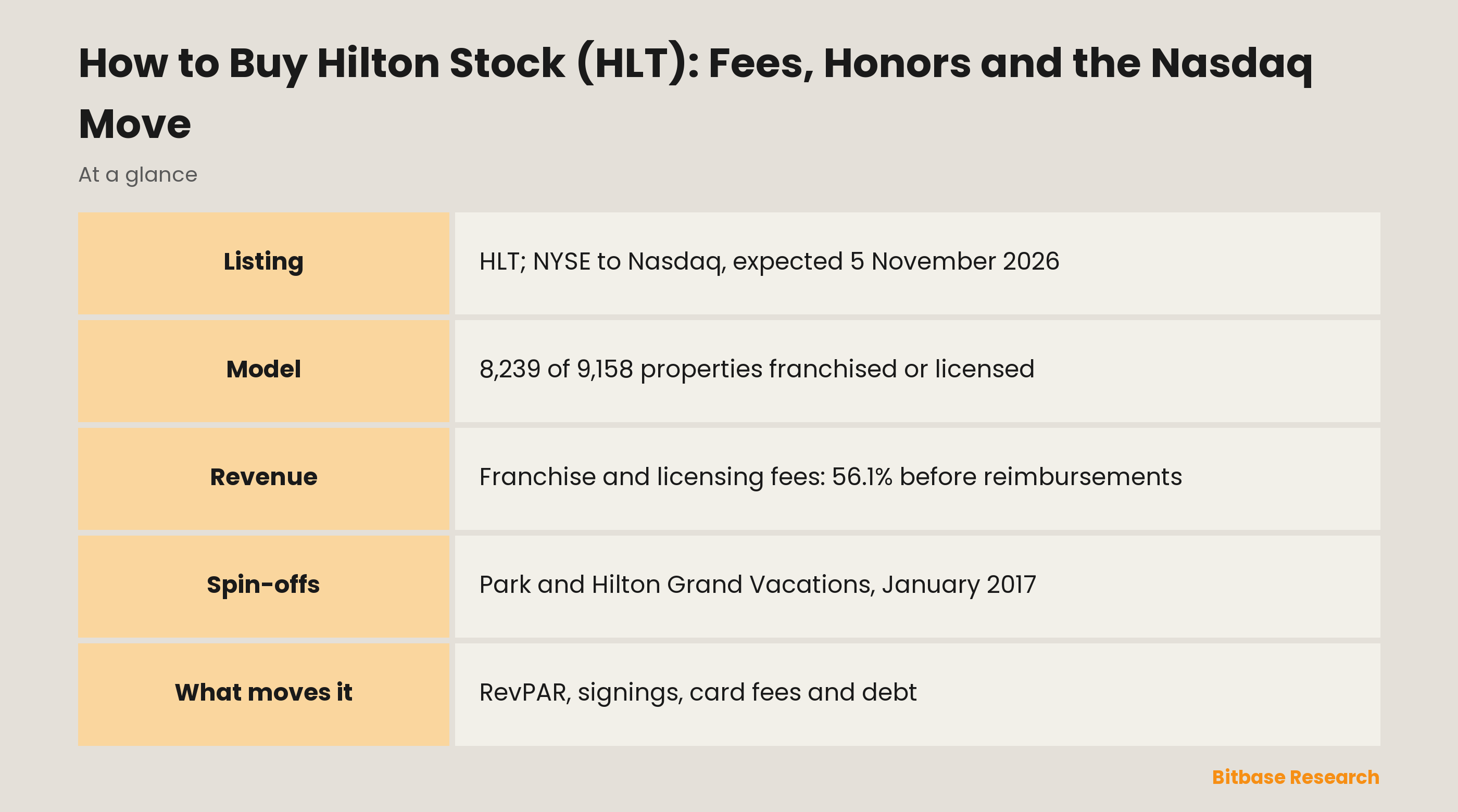
Between the New York Stock Exchange and Nasdaq, only the venue changes: Hilton Worldwide Holdings announced in October 2026 that its common stock would move to the Nasdaq Global Select Market, with trading there expected from 5 November 2026 under the same ticker, HLT, so the shares are still bought through any brokerage account with access to US-listed stocks. What they buy into is mostly a fee business: franchised and licensed properties made up 8,239 of the 9,158 in Hilton's system at the end of 2025. This guide covers where the money comes from, how to place the order and what the filings say can go wrong.
What Does Hilton Do?
Hilton puts its brands, booking systems and loyalty program on hotels that, in most cases, other people own. Its annual report describes "one of the largest global hospitality companies, with 9,158 properties comprising 1,351,351 rooms in 143 countries and territories as of December 31, 2025," and dates the business to 1919 and founder Conrad Hilton. The listed company, Hilton Worldwide Holdings Inc., is incorporated in Delaware and based in McLean, Virginia.
According to the company, Hilton became the first hotel company listed on the NYSE, in 1946. In 2007 it became a wholly owned subsidiary of affiliates of Blackstone, and it returned to the public market in 2013. On 3 January 2017 it split into three independent, publicly traded companies by distributing shares of Park Hotels & Resorts and Hilton Grand Vacations to its stockholders. Hilton Grand Vacations still holds "the exclusive right to use our timeshare brands" under a long-term license, and Hilton earns fees from it.
The brands run from the luxury names Waldorf Astoria, Conrad and LXR through Hilton Hotels & Resorts, DoubleTree and Embassy Suites to Hilton Garden Inn, Hampton by Hilton, Tru and Home2 Suites. Hampton alone held 26.6% of system rooms at the end of 2025 and Hilton Hotels & Resorts 16.9%. Tying them together is Hilton Honors, with 243 million members at the end of 2025, up 15% in a year; points can also be used with partners such as American Express, airlines and car rental companies.
The workforce shows the model at work: Hilton employed or managed about 182,000 people at its leased and managed hotels and offices, while about 328,000 more worked at franchised properties for those hotels' owners.
How Hilton Makes Money
Three kinds of contract carry the business. Under a franchise contract, an owner pays to use a brand and Hilton's reservation, marketing and technology systems, mainly through a royalty "generally based on a percentage of the hotel's monthly gross room revenue." Hilton does "not own, manage or operate franchised properties." Under a management contract, Hilton runs the hotel for its owner for a base fee tied to gross operating revenue and, where provided, an incentive fee tied to operating profits. Licensing fees come from co-branded credit card providers, partner hotels that use Hilton's booking channels, and Hilton Grand Vacations. Management agreements typically start at 20 to 30 years, franchise agreements at about 20 years for new hotels.
Owners also pay for the buildings. The 10-K says growth comes "with limited or no capital investment by us," because the capital to build, renovate and maintain hotels "is typically provided by the third-party owners." Restaurant franchising can differ: the McDonald's profile describes a franchisor that usually controls the land and building and collects rent as well as royalties.
| Revenue line | Share of 2025 revenue before cost reimbursements | What it pays for |
|---|---|---|
| Franchise and licensing fees | 56.1% | Royalties from franchised hotels; card, partner hotel and timeshare licences |
| Base and other management fees | 7.6% | A share of managed hotels' gross operating revenue |
| Incentive management fees | 6.3% | A share of managed hotels' operating profits |
| Ownership | 24.9% | Rooms, food and drink at the hotels in the ownership segment |
| Other revenues | 5.1% | Mainly purchasing operations |
Shares are calculated from the fiscal 2025 income statement and rounded to one decimal.
The table leaves out the largest line in reported revenue. Cost reimbursement revenues, about 59% of total 2025 revenues, are what owners repay for costs Hilton bears for them, chiefly payroll where Hilton is the legal employer at a managed hotel and the marketing, reservation and loyalty programs funded by monthly fees. Hilton says it does "not operate these programs to generate a profit," so the fee lines show what the business earns.
The segment note agrees. In 2025 management and franchise produced about 95.3% of segment Adjusted EBITDA and ownership about 4.7%, with no expenses allocated to management and franchise. Franchise and licensing fees rose 6.9% and total management fees 4.6%, while ownership revenues fell 1.8%.
The ownership segment is small: 46 hotels with 15,287 rooms at the end of 2025, of which 40 were leased by Hilton, 2 by consolidated variable interest entities and 4 owned or leased by unconsolidated affiliates, mostly in Europe and Japan. The United States held 64% of system rooms and produced about 79% of total revenues.
HLT Stock at a Glance
| Item | Detail |
|---|---|
| Exchange | NYSE until the close on 4 November 2026; Nasdaq Global Select Market from the open on 5 November 2026, as the company's 8-K expects |
| Ticker | HLT, unchanged by the transfer |
| Security | Common stock; no other class or security is registered on the cover of the 2025 10-K |
| Sector | Hospitality: hotel franchising, management and licensing |
| Index membership | S&P 500 (State Street SPY holdings file, 29 October 2026) |
| Headquarters | McLean, Virginia |
| Incorporated | Delaware |
| Fiscal year | Calendar year, ending 31 December |
| Dividend | Quarterly cash dividend; suspended in March 2020, resumed in June 2022 |
| Spin-offs | Park Hotels & Resorts and Hilton Grand Vacations, January 2017 |
| SEC identifier | CIK 1585689 |
Price, market value and dividend yield move with every trade; the Hilton stock page on Bitbase shows them live.
How to Buy Hilton Stock
Hilton is a Delaware company, so the US listing is the common stock itself, with no depositary receipt involved, and the company says "no action is required by shareholders in connection with the transfer." The purchase runs through a broker:
1. Choose a broker that offers US-listed stocks. If you live elsewhere, a domestic broker that routes orders to US exchanges or a global platform will do; find out which legal entity keeps your account and under which regulator.
2. Open the account and fill in the tax form. A non-US investor normally files Form W-8 BEN with the broker; the IRS instruction is to "give Form W-8 BEN to the withholding agent or payer."
3. Move money in. Converting from your home currency has a price of its own, so compare exchange rates as well as commissions.
4. Find the right line. Search HLT and check that the result reads Hilton Worldwide Holdings common stock. Around the transfer the exchange shown beside it should change from NYSE to Nasdaq; the ticker and the share stay the same.
5. Set the order. A market order buys at whatever price is available when it arrives, possibly away from the last quote on screen; a limit order caps the price and can go unfilled.
6. Decide the amount. Fractional shares let you invest a fixed sum, but FINRA notes that "the availability of fractional share trading varies by brokerage firm" and that "as a fractional share owner, you might not have shareholder voting rights."
Dividends and withholding. In the IRS's words, "most types of U.S. source income received by a foreign person are subject to U.S. tax of 30%," though "a reduced rate, including exemption, may apply" under the tax code or a treaty, and the country where you live may levy its own tax on top.
Through a fund. State Street's holdings files for SPY, its S&P 500 trust, and XLY, its consumer discretionary sector fund, both listed HLT on 29 October 2026.
What Moves HLT Stock
RevPAR and the travel cycle. Revenue per available room, room revenue divided by room nights available, is what Hilton's fees follow: royalties take a share of room revenue, incentive fees a share of hotel profits. System-wide comparable RevPAR rose only 0.4% in 2025, and fell 0.8% in the US as inbound international and business travel weakened. In the third quarter of 2026 it rose 5.8%, with US leisure lifted by the World Cup. The downside showed in 2020, when RevPAR fell 53.3% at comparable franchised hotels and 64.4% at managed ones, and Hilton reported a net loss.
Signings and the pipeline. Because owners fund construction, Hilton grows by adding hotels. Net unit growth was 6.7% in 2025, and the year-end pipeline held 3,703 hotels with 520,500 rooms, almost half of the rooms under construction and more than half outside the United States. The 10-K warns that such projects depend on "the owner's or developer's ability to obtain adequate financing," so credit conditions reach Hilton's growth.
Honors and partner fees. Licensing fees rose in 2025 mainly on co-branded card activity and timeshare revenues at Hilton Grand Vacations, so card spending and timeshare sales feed Hilton's results without a hotel stay. The share of travel spend Hilton captures from members "increases as they move up the tiers," which makes the program part of what owners buy with a brand.
Buybacks and debt. Hilton repurchases stock under a program first announced in February 2017, enlarged several times and without an expiration date. Shares outstanding fell about 4.7% during 2025, and 8.2 million more were bought back in the first nine months of 2026. The balance sheet has shown a total stockholders' deficit at the end of both 2024 and 2025, with treasury stock the largest negative item, and debt carried a weighted average interest rate of 5.09% at 30 September 2026.
Regional demand. In the first nine months of 2026, RevPAR in the Middle East and Africa fell 12.3% because of the conflict in the region, China declined on softer consumer sentiment and government restrictions on business travel, and Europe rose 6.0%. Outside the US such swings bite harder, since there Hilton's fees "are often more dependent on hotel profitability measures."
The Downside of Hilton's Asset-Light Model
Hilton's chief executive speaks of an "asset-light business model." Item 1A of the 10-K lists what can go wrong, and five of its headings matter most to a shareholder:
Owners. "Our business is subject to risks related to doing business with third-party property owners that could adversely affect our reputation, operational results or prospects for growth." Owners who cannot "repay or refinance loans secured by properties" can cut Hilton's revenues, and Hilton has been required to pay on debt it guaranteed.
The pipeline. "Some of our existing development pipeline may not be developed into new hotels, which could materially adversely affect our growth prospects."
Booking channels. "The growth of internet reservation channels could adversely affect our business and profitability," as online intermediaries may win "higher commissions or other significant concessions."
Debt. The filing names its "substantial indebtedness and other contractual obligations" and says servicing the debt "will require a significant amount of cash."
Dividend policy. "Although we currently pay a quarterly cash dividend to holders of our common stock, we may change our dividend policy at any time." The 2020 suspension showed that this is not hypothetical.
The share adds risks of its own. Holding a single company concentrates everything on its results; dividends are declared quarter by quarter, with no guarantee; and an investor who counts in another currency sees both price and payout converted at the exchange rate of the day.
How to Research HLT Yourself
Hilton files on SEC EDGAR under CIK 1585689: an annual report on Form 10-K, a 10-Q each quarter and an 8-K whenever something material happens, such as each earnings release or the October 2026 listing notice. The same filings are posted at ir.hilton.com.
In the 10-K, Item 1 holds the property tables by brand and region, Item 1A the risks, Item 2 the leased hotels and Item 7 the RevPAR tables. Three habits prevent misreadings: compare RevPAR on the comparable, currency-neutral basis the filings use; separate fees from cost reimbursements before judging growth; and expect first-quarter revenues to be the year's lowest, as the company does.
The performance graph in Item 5 gives a benchmark. Over the five years to the end of 2025, Hilton's cumulative total stockholder return was 161.4%, compared with 96.0% for the S&P 500 and 126.6% for the S&P Hotels, Resorts & Cruise Lines Index. Live quotes are on the HLT page above, and Bitbase's US stock pages cover other companies.
Hilton Stock FAQ
Does Hilton pay a dividend?
Yes, quarterly. Hilton suspended it in March 2020 to secure its liquidity during the pandemic and resumed it in June 2022. Future dividends are at the board's "sole discretion"; amounts and dates appear in each earnings release.
Can I buy Hilton stock with crypto?
No, not in one step. HLT is priced and settled in US dollars, so any crypto has to be converted to cash and transferred to the brokerage account first, and that conversion may be taxable where you live. A share also carries dividend and voting rights, one of the ways a share differs from a crypto asset, so treat the sale and the purchase as two decisions.
Is Hilton moving from the NYSE to Nasdaq?
Yes. On 20 October 2026 Hilton notified the NYSE that it would transfer its listing to the Nasdaq Global Select Market, expecting NYSE trading to end at the close on 4 November 2026 and Nasdaq trading to begin the next morning. The ticker stays HLT. Being listed on the exchange is not the same as being in the Nasdaq-100, an index that has to be tracked rather than held.
Are Hilton Grand Vacations and Park Hotels & Resorts part of Hilton?
No. Both were spun off on 3 January 2017, when Hilton stockholders received one Park share for every five Hilton shares and one Hilton Grand Vacations share for every ten, and each began trading on its own, under PK and HGV.
Has Hilton stock ever split?
Yes, in reverse. A 1-for-3 reverse stock split took effect on 3 January 2017, right after the spin-offs, and the stock began trading on a split-adjusted basis the next day. Per-share figures from before 2017 need adjusting before comparison.
Conclusion
Buying HLT is routine: a broker with US market access, the right line on the order screen, then a market or a limit order, whether before or after the move to Nasdaq. Understanding it takes more. A Hilton share is a claim on fees from hotels that others mostly own, so its income follows RevPAR, signings and card partnerships, while its balance sheet carries debt and years of buybacks. Read the latest 10-K and quarterly release before deciding how much of one hotel company belongs in your portfolio.
Related reading
Other Bitbase articles on this topic:
- How to Buy Airbnb Stock (ABNB): Class A Votes, Fees, City Rules
- How to Buy Booking Holdings Stock (BKNG): The 25-for-1 Split
- How to Buy Carvana Stock (CVNA): Class A Shares, Split and Perps
- How to Buy AMZN: Retail, Ads and AWS Under One Ticker
Disclaimer: This article is educational content from Bitbase Academy, provided for information only. It explains what a company or fund does and how the instruments referenced here differ from one another; it does not constitute investment, trading, tax, or financial advice, and it is neither a recommendation nor an endorsement of any security, token, or trading strategy. A tokenized stock is issued by a third party and is designed to give economic exposure to an underlying asset: it is not a share, it carries no shareholder rights, and it depends on the issuer's structure, eligibility rules, and redemption terms, which the issuer can change. Perpetual futures are leveraged derivatives that hold no underlying asset and can be liquidated, and trading hours, product availability, and eligibility differ by instrument and by jurisdiction and can change at any time. Written as of October 2026; verify everything yourself through company filings, the issuer's own documentation, and the product pages of the venue you trade on.
References
[1] Hilton Form 10-K for 2025: business, segments, results, risks (SEC EDGAR) www.sec.gov
[2] Hilton Form 10-Q for the quarter ended 30 September 2026 (SEC EDGAR) www.sec.gov
[3] Hilton Form 8-K, 20 October 2026: transfer of listing to Nasdaq (SEC EDGAR) www.sec.gov
[4] Hilton press release, 20 October 2026: planned transfer of stock listing to Nasdaq (Form 8-K) www.sec.gov
[5] Hilton third-quarter 2026 earnings release, 27 October 2026 (Form 8-K) www.sec.gov
[6] Hilton Form 8-K, 4 January 2017: spin-offs of Park and HGV, reverse stock split (SEC EDGAR) www.sec.gov
[7] Hilton Form 10-K for 2020: dividend suspension and 2020 results (SEC EDGAR) www.sec.gov
[8] Hilton Form 10-K for 2022: resumption of the dividend (SEC EDGAR) www.sec.gov
[9] State Street: SPY daily holdings, 29 October 2026 www.ssga.com
[10] State Street: XLY daily holdings, 29 October 2026 www.ssga.com
[11] FINRA: Investing in Fractional Shares www.finra.org
[12] IRS: NRA Withholding www.irs.gov
[13] IRS: About Form W-8 BEN www.irs.gov





