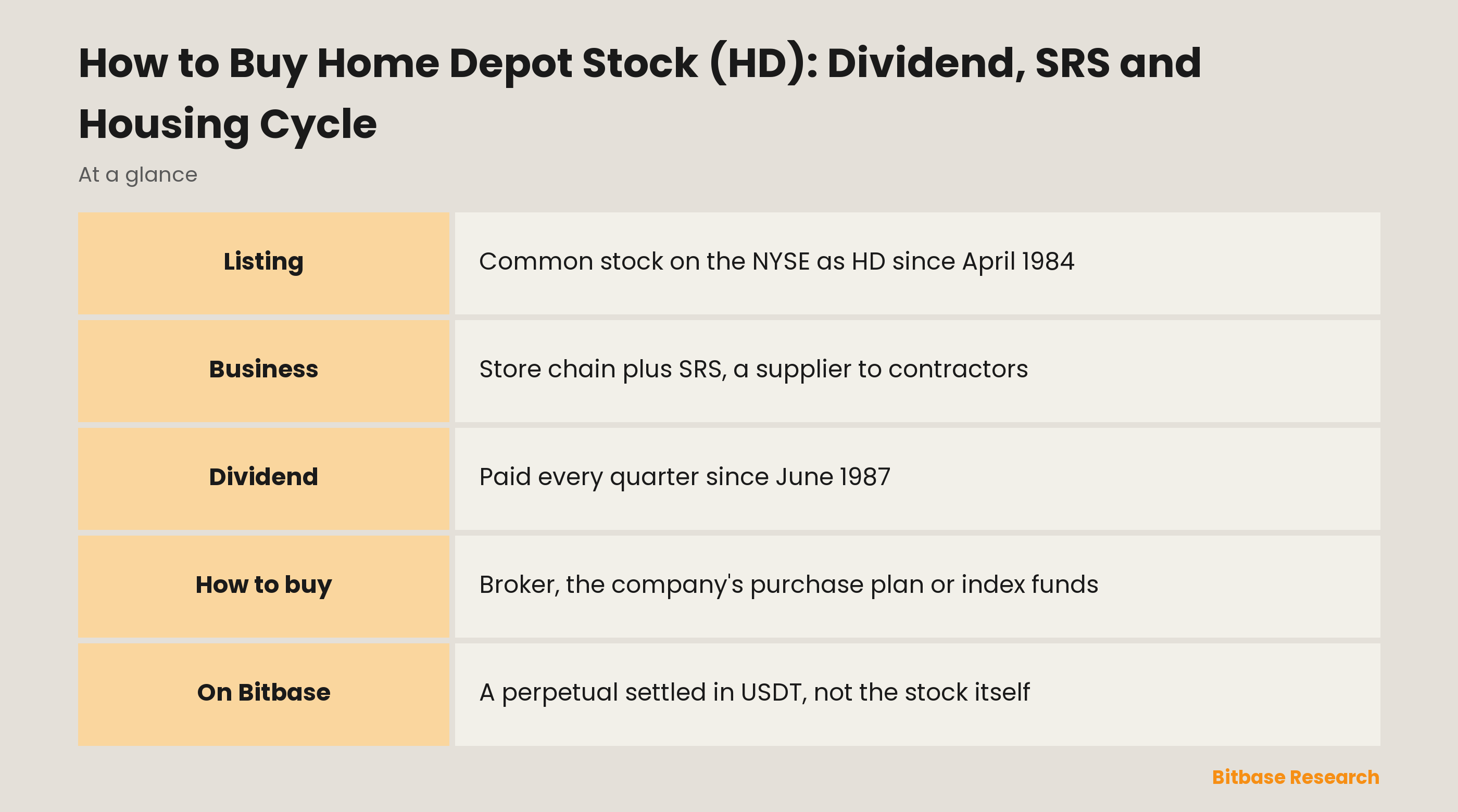
Buying Home Depot stock takes a brokerage account with access to the New York Stock Exchange, where the company's common shares have traded under the ticker HD since April 1984. The business behind the ticker describes itself as the world's largest home improvement retailer, and since buying SRS in 2024 it has been adding a distribution arm that supplies contractors. On Bitbase, HD trades as a USDT-margined perpetual contract, which follows the share price with no shares standing behind it.
What Does Home Depot Do?
Home Depot sells what people need to build, repair and maintain homes. The annual report lists "home improvement products, building materials, lawn and garden products, décor products, and facilities MRO products," sold in stores and online, plus installation services and tool and equipment rental. A typical store stocks approximately 30,000 to 40,000 items over a year.
The company reports in two parts. The Primary segment is the store chain in the US, Canada and Mexico with its websites and apps: 2,359 stores at the end of fiscal 2025, 324 of them in Canada and Mexico. Other is SRS, a specialty trade distributor bought on 18 June 2024 that serves roofers, landscapers and pool contractors. SRS then acquired GMS, a distributor of drywall, ceilings and steel framing, on 4 September 2025, and Mingledorff's, an HVAC distributor in the southeastern US, on 11 May 2026. At the end of fiscal 2025, SRS including GMS had over 1,250 locations in the US and Canada.
Customers fall into two groups, in the company's words "consumers (including both DIY and DIFM customers) and Pros." DIY customers do the job themselves, do-it-for-me customers hire professionals for it, and Pros range from general contractors and homebuilders to electricians, plumbers and roofers.
Home Depot was incorporated in Delaware in 1978 and is based in Atlanta, Georgia. Its shares were first offered to the public on 22 September 1981 on Nasdaq, under the symbol HOMD. The 10-K calls its industry "highly competitive, highly fragmented, and evolving."
How Home Depot Makes Money
The retail business still brings in the bulk of revenue, split across three product lines of similar size. In fiscal 2025, which ended on 1 February 2026, Building Materials, which includes lumber and plumbing, made up about 32% of net sales, Décor, from appliances to paint, about 31% and Hardlines, from hardware to garden, about 29%. SRS, reported as Other, accounted for about 8%, against about 4% in fiscal 2024, when it was owned for only part of the year. Roofing and related products were approximately 53% of that Other line.
Net sales rose 3.2% in fiscal 2025, which the filing credits mainly to SRS and GMS, partly offset by the extra week in fiscal 2024, a 53-week year. Comparable sales rose 0.3%: the average ticket grew 1.4% while comparable customer transactions fell 1.0%. Online sales were 15.9% of net sales, and the US produced about 92%.
Distribution changes the margin profile. Gross margin was 33.3% in fiscal 2025 against 33.4% a year earlier, a decline the company ties to "the inclusion of SRS and GMS in our consolidated results." No individual customer accounted for more than 10% of revenue in any of the last three fiscal years.
HD Stock at a Glance
| Item | Detail |
|---|---|
| Exchange | New York Stock Exchange |
| Ticker | HD |
| Share class | Common stock, the only class registered on an exchange |
| Industry | Home improvement retail, plus specialty trade distribution through SRS |
| Index membership | S&P 500 and Dow Jones Industrial Average, per SPY and DIA holdings on 16 October 2026 |
| Headquarters | Atlanta, Georgia |
| Listing history | Nasdaq IPO in September 1981 as HOMD; NYSE since April 1984 |
| Fiscal year end | Sunday nearest 31 January, giving 52- or 53-week years |
| Dividend policy | Cash dividend every quarter since June 1987, each declared by the board |
| Share buybacks | Paused since March 2024 and not resumed as of 2 August 2026 |
Share prices change every trading day, so none appear here. The Home Depot stock page on Bitbase carries the live quote and chart.
How to Buy Home Depot Stock
To buy HD stock through a broker:
1. Choose a broker with NYSE access. Confirm that it opens accounts for residents of your country.
2. Verify your identity. Investors outside the US may be asked for Form W-8BEN at this stage.
3. Deposit money. Converting another currency into US dollars is a cost in its own right.
4. Enter the ticker HD and choose how to order. Market orders fill at the prevailing price; limit orders cap what you pay but can go unfilled.
5. Set the quantity. Some brokers sell fractions of a share, so buying a whole one is not always required.
6. Keep records. Dividends arrive in cash each quarter, after any tax withheld.
Buying from the company is a second route. Home Depot's investor site describes a Direct Stock Purchase Plan as "a low-cost, convenient way for you to purchase shares of the common stock of The Home Depot, Inc." Eligibility and costs are in the plan's rules.
For investors abroad, nothing about the security changes: HD is common stock issued by Home Depot itself, with no depositary receipt or ADR ratio involved. Tax is where it differs. The IRS states that "Most types of U.S. source income received by a foreign person are subject to U.S. tax of 30%," and a tax treaty can reduce the rate. Form W-8BEN goes to the payer "whether or not you are claiming a reduced rate." Treat this as background rather than tax advice.
Through an index fund, Home Depot is held indirectly, as one holding among many in funds that track the S&P 500 or the Dow.
HD Perpetual Futures on Bitbase
Bitbase lists an HD perpetual futures contract, with USDT as both margin and settlement currency. The contract mirrors moves in Home Depot's share price without conveying any part of the company, so holders receive no dividend and have no vote. What it does allow is positioning for a fall as well as a rise, using leverage, and trading on evenings and weekends, outside NYSE hours.
Two mechanisms replace ownership. Periodic funding payments pass between longs and shorts to keep the contract near the share price, and a position whose margin runs out is liquidated at the mark price. The NYSE is open for only a fraction of the hours in a week, so the perpetual can move while the exchange is shut, and the stock may then open at a different price. The guide to stock perpetual futures walks through these mechanics, while Bitbase's rules for this particular contract specify the funding interval, margin tiers and maximum leverage. Other stocks and the forms they take are listed on Bitbase's TradFi page.
What Moves Home Depot Stock
Housing turnover. The 10-K ties demand to how often homes change hands. High interest rates through fiscal 2025 and "the significant increase in home prices in recent years have impacted housing affordability," it says, contributing to "historically low levels of housing turnover, which has reduced demand for projects and other purchases associated with buying and selling a home."
Interest rates. Management said fiscal 2025 comparable sales reflected engagement with smaller projects, offset by factors including "a persisting high interest rate environment." The 10-K also counts mortgages and home equity loans among the credit conditions that shape demand.
The contractor push. SRS, GMS and Mingledorff's move part of the business from retail into distribution for professionals. In fiscal 2025 that added sales and also pulled gross margin down slightly.
Tariffs and sourcing. Tariffs raised Home Depot's costs in fiscal 2025; the company says diversifying suppliers and some price increases helped it mitigate the impact, and it flags fresh uncertainty after the US Supreme Court struck down tariffs imposed under the International Emergency Economic Powers Act.
Spring, storms and lumber. Sales volume generally peaks in the second fiscal quarter as spring arrives, storms have historically influenced demand for certain products, and lumber prices are "historically volatile."
Capital returns. The stated order is reinvestment, then a quarterly dividend, then buybacks, and buybacks have been paused since March 2024 with no plan to resume them in fiscal 2026 while debt comes down.
Risks Before You Buy HD
Housing and the economy. The company says its results depend "significantly on the stability of the housing and home improvement markets," and lists unemployment, interest rates, credit conditions and tariffs among factors beyond its control.
Integrating acquisitions. "Integration is a complex and time-consuming process," the 10-K warns; if it is delayed or falls short, the expected synergies may not arrive. SRS, GMS and Mingledorff's are three integrations in under two years.
Credit extended to Pros. If customers who buy on trade credit cannot repay, the company says it "may face greater default risk."
Share price and payouts. The price can drop, and "future dividend payments are subject to declaration by our Board."
Risks specific to the perpetual. Leverage enlarges losses, funding payments add up the longer a position is held, and a price jump at the NYSE open can skip past a position's liquidation level in one move. The explainer on stock perpetual funding rates shows how those payments build up.
How to Research Home Depot Stock
The primary source is SEC EDGAR, where Home Depot files under CIK 354950. In the 10-K, Item 1 describes the business, Item 1A the risk factors, and Note 2 to the financial statements breaks net sales down by product line, department and geography. Quarterly reports for the first three quarters arrive as 10-Qs, earnings releases and other material events as 8-Ks, and annual meeting material as the DEF 14A proxy statement. The investor site, ir.homedepot.com, hosts the stock split table and the direct purchase plan.
When comparing years, set the Primary segment against Other, since acquisitions can lift total sales while existing stores barely move, and use comparable sales around a 53-week year such as fiscal 2024.
Home Depot Stock FAQ
Does Home Depot pay a dividend?
Yes, every quarter. The 10-K states that Home Depot paid its first cash dividend on 22 June 1987 and has paid one in each quarter since. Each future payment depends on declaration by the board, and the company announces the amount per share.
Can I buy Home Depot stock with crypto?
Not directly. A broker sells the shares for dollars or another ordinary currency, so any crypto must first be exchanged for cash. What Bitbase offers for USDT is the HD perpetual: it moves with Home Depot's price, yet it is a derivative that pays no dividend, carries no vote and can be liquidated. The routes are compared in how to buy stocks with crypto.
Is Home Depot in the S&P 500 and the Dow?
Yes. On 16 October 2026, Home Depot appeared in the holdings files of both SPY, an S&P 500 tracker, and DIA, which follows the 30-stock Dow Jones Industrial Average. Index lineups are revised from time to time, which is why the date is given.
Has Home Depot stock ever split?
Thirteen times between 1982 and 1999, according to the company's split table: eight 3-for-2 splits, three 2-for-1, one 5-for-4 and one 4-for-3. The last entry is a 3-for-2 split paid on 30 December 1999, and the company does not comment on the possibility of future splits.
When does Home Depot report earnings?
Once a quarter. The fiscal year ends on the Sunday nearest 31 January, so fiscal 2025 ended on 1 February 2026; quarterly figures for that year were filed on Form 8-K in May, August and November 2025 and February 2026, and the 10-K followed on 18 March 2026.
Conclusion
Buying Home Depot stock is an ordinary broker order; the reading comes first. Revenue rests on three store product lines of similar size, while SRS is a growing distribution arm with integration risk attached, and the filings tie demand to housing turnover, interest rates and tariffs. Anyone who only wants to trade the price, without owning part of the company, can look at the Bitbase perpetual, keeping in mind that it carries its own costs and gives no claim on Home Depot.
Related reading
Other Bitbase articles on this topic:
- How to Buy Airbnb Stock (ABNB): Class A Votes, Fees, City Rules
- How to Buy Booking Holdings Stock (BKNG): The 25-for-1 Split
- How to Buy Carvana Stock (CVNA): Class A Shares, Split and Perps
Disclaimer: This article is educational content from Bitbase Academy, provided for information only. It explains what a company or fund does and how the instruments referenced here differ from one another; it does not constitute investment, trading, tax, or financial advice, and it is neither a recommendation nor an endorsement of any security, token, or trading strategy. A tokenized stock is issued by a third party and is designed to give economic exposure to an underlying asset: it is not a share, it carries no shareholder rights, and it depends on the issuer's structure, eligibility rules, and redemption terms, which the issuer can change. Perpetual futures are leveraged derivatives that hold no underlying asset and can be liquidated, and trading hours, product availability, and eligibility differ by instrument and by jurisdiction and can change at any time. Written as of October 2026; verify everything yourself through company filings, the issuer's own documentation, and the product pages of the venue you trade on.
References
[1] Home Depot fiscal 2025 Form 10-K (SEC EDGAR) www.sec.gov
[2] Home Depot Form 10-Q for the quarter ended 2 August 2026 (SEC EDGAR) www.sec.gov
[3] Home Depot investor relations: FAQs ir.homedepot.com
[4] Home Depot investor relations: stock splits ir.homedepot.com
[5] State Street: SPY daily holdings, 16 October 2026 www.ssga.com
[6] State Street: DIA daily holdings, 16 October 2026 www.ssga.com
[7] IRS: NRA withholding www.irs.gov
[8] IRS: About Form W-8 BEN www.irs.gov





