
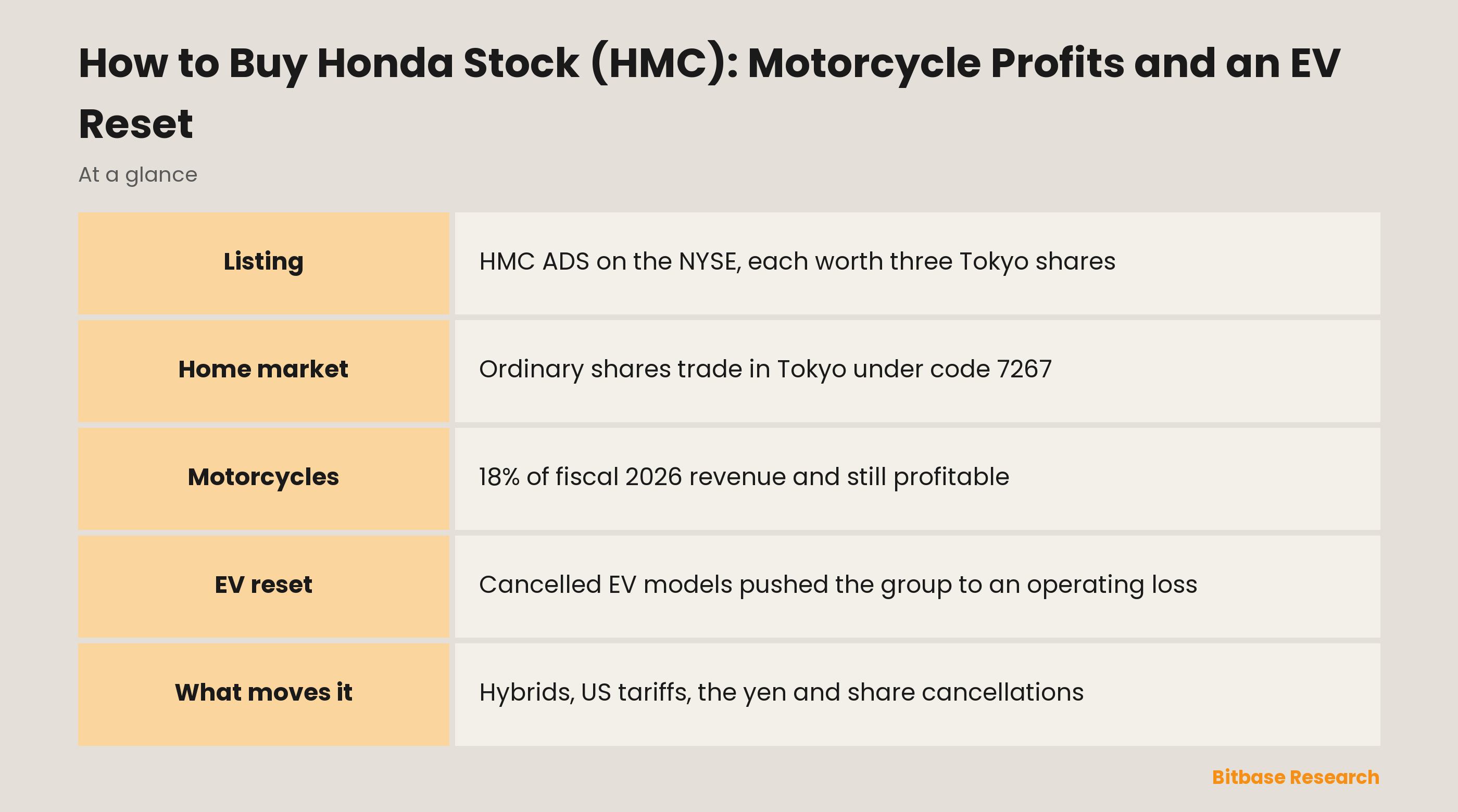
You can own Honda from outside Japan through HMC, an American depositary share (ADS) on the New York Stock Exchange that stands for three ordinary shares traded in Tokyo under the code 7267. In the year to 31 March 2026, fiscal 2026, motorcycles brought in 18% of revenue and still earned an operating profit, while losses tied to cancelled electric car plans pushed the car business, and the group, into an operating loss. Here is what Honda sells, how the ADS works and what moves the shares.
What Does Honda Do?
Honda Motor Co., Ltd. builds motorcycles, cars and power products and finances many of the vehicles it sells. It was incorporated in Japan on 24 September 1948, successor to a business Soichiro Honda had started in 1946 to make motors for motorized bicycles. The head office is in Tokyo, and Toshihiro Mibe is president.
Motorcycles came first. Mass production began in 1949 with the Dream D-Type, and by 1957 Honda was Japan's largest motorcycle maker by production volume. Including affiliates, the group sold about 22.1 million of them in fiscal 2026, roughly 85% in Asia.
Cars followed in 1963. The Civic arrived in 1972 and the Accord in 1976, and in 1982 Honda became the first Japanese carmaker to build cars in the United States. Acura followed in 1986. Light trucks, the category that holds SUVs such as the CR-V and Pilot, made up 57% of automobile retail units in fiscal 2026, and the 20-F says they earn a higher contribution margin than passenger cars.
Power products, made since 1953, include generators, pumps and lawn mowers, and Honda has delivered the HondaJet business aircraft since December 2015. Finance subsidiaries in countries including Japan, the United States and Canada lend to customers and dealers.
How Honda Makes Money
Cars bring in most of the revenue, but not, in fiscal 2026, the profit.
| Segment | Share of fiscal 2026 revenue | Fiscal 2026 operating result | What it sells |
|---|---|---|---|
| Automobile | 64% | Loss, mainly from EV-related losses and tariffs | Honda and Acura cars and light trucks |
| Motorcycle | 18% | Profit, up 10.3% | Motorcycles, scooters, ATVs and side-by-sides |
| Financial services | 16% | Profit, down 12.7% | Retail loans, leases and dealer financing |
| Power products and other | 2% | Small loss, including aircraft | Engines, generators, garden equipment, HondaJet |
Percentages use external sales in the fiscal 2026 Form 20-F.
The swing came from one set of decisions. As US EV growth slowed and new EV makers crowded in, Honda cancelled certain EV models for the US market, and on 12 March 2026 it went further, dropping models planned for North American production and revising EV plans in China. Sony Honda Mobility, its joint venture with Sony Group, also cancelled models that a Honda subsidiary was to build. The losses and expenses booked for these steps were larger than the car segment's entire operating loss, and Honda expects more in fiscal 2027.
Motorcycles carried the year: consolidated unit sales rose 7.2%, led by India, Brazil and the Philippines. By region, North America produced about 57.7% of group revenue, Asia 18.8% and Japan 11.6%.
HMC Stock at a Glance
| Item | Detail |
|---|---|
| What HMC is | American depositary share (ADS) representing three shares of common stock |
| New York | NYSE, ticker HMC, listed since 11 February 1977 |
| Home listing | Tokyo Stock Exchange Prime Market, code 7267, first listed in 1957 |
| Depositary | JPMorgan Chase Bank, N.A. |
| Voting unit in Japan | 100 shares |
| Shares held as ADSs | About 5.7% of outstanding shares on 31 March 2026 |
| Fiscal year | Ends 31 March; IFRS accounts in yen |
| Dividends | Interim (record date 30 September) and year-end (record date 31 March) |
| SEC reporting | Form 20-F each June and Forms 6-K, CIK 715153 |
The Honda stock page on Bitbase carries the live price.
How to Buy Honda Stock
HMC trades in dollars in New York, 7267 in yen in Tokyo.
1. Pick the line. A broker with US market access is enough for HMC; the Tokyo shares need access to Japan.
2. Open an account. Each broker decides which countries' residents it accepts.
3. Fund it. Converting into dollars or yen has its own cost, so compare exchange rates as well as commissions.
4. Search for HMC. Confirm the result reads Honda Motor ADS on the NYSE. EDGAR also lists HNDAF as an over-the-counter symbol; the NYSE security is HMC.
5. Set the order type. A market order fills at the next available price; a limit order only at your price or better.
6. Size it. Whether you can buy a fraction of an ADS depends on the broker.
What the ADS gives you. The depositary holds the underlying shares and is the holder of record. The 20-F says plainly that an ADS holder "will have fewer rights than a shareholder has and such holder will have to act through the depositary to exercise those rights." The depositary votes as instructed and pays dividends in dollars, but since Japanese law counts votes in units of 100 shares, it can only vote underlying shares in multiples of 100. It deducts a fee per ADS from cash distributions and may charge an annual service fee.
Japanese withholding tax. Japan generally withholds 15.315% on dividends from listed shares such as Honda's paid to holders abroad. Treaties usually cap it at 15% or 10% for portfolio investors; under the US treaty an eligible US holder generally pays 10%.
Through funds. Honda is not in the S&P 500, so check a fund's holdings list before assuming it owns Honda.
What Moves HMC Stock
The EV reset. Over the three years to March 2029, Honda plans to shift money set aside for EVs into hybrids, aims to eliminate EV-related losses by then and is striving for record operating profit that year. Each quarterly 6-K shows how much more EV cost lands in fiscal 2027.
Hybrids made in North America. In May 2026 Honda said it would add 15 new Honda and Acura hybrid models worldwide by 2030. On 9 November 2026 it announced a new car plant in Ohio, expected to start production in 2029 with planned capacity of 240,000 vehicles a year.
Tariffs. With North America producing over half of revenue, US trade policy matters. The 20-F says fiscal 2026 operations "were impacted by tariffs and semiconductor shortages resulting from export controls enacted by various countries."
The yen. Honda reports in yen and sells mostly abroad: fiscal 2026 revenue rose 0.5% as reported, against about 1.2% at the prior year's exchange rates. HMC adds the dollar-yen rate on top. In the April to June 2026 quarter, revenue rose 13.5% and operating profit 117.4% from a year earlier, when EV-related losses had weighed on results.
Buybacks and partners. On 27 February 2026 Honda cancelled 747 million treasury shares, about 14.1% of the shares then issued. In August 2026 it agreed with Nissan to jointly develop standard ECUs and software for next-generation vehicles from fiscal 2029.
Honda's Risk Factors, Read for an HMC Holder
Four of the risks in Item 3.D of the 20-F bear most directly on the ADS.
A shifting car market. "The automotive industry is undergoing a period of major change, including intensifying competition due to the rise of emerging Chinese EV companies, changes in environmental policies in North America and Europe and global trade wars arising from the imposition of additional tariffs by the United States."
Supplies. Honda relies on certain suppliers for some materials and parts, cites chip shortages as AI demand rises, and is "closely examining the impact on our group with regard to export restrictions on rare earths in China."
The finance arm. Its loans and leases carry "credit risk as well as risks relating to lease residual values, cost of capital and access to funding."
The ADS itself. Shareholder rights under Japanese law "may not be as extensive as shareholders' rights under the laws of the United States," dividend forecasts are "not legally binding," and each payment needs a board resolution.
How to Research HMC Yourself
Honda reports to the SEC as a foreign private issuer under CIK 715153. The fiscal 2026 Form 20-F was filed on 18 June 2026; Forms 6-K carry quarterly results and notices such as the Ohio plant.
In the 20-F, Item 3.D holds the risks and Item 4.B the business, including a Financial Strategy section with the EV losses and targets. Item 5 breaks results down by segment and region, and Item 12.D lists the depositary's fees. The structured cover, R1.htm, registers two securities: the ADS, trading as HMC, and the common stock, registered only in connection with it.
Our Toyota stock guide covers another Japanese carmaker with an NYSE ADS, and the Sony stock guide covers Honda's EV partner. Other companies are on Bitbase's US stock pages.
Honda Stock FAQ
Can I buy Honda stock with crypto?
Not directly. HMC is bought through a brokerage account in US dollars, so crypto has to be sold for cash first, and that sale can be a taxable event where you live.
What is the difference between HMC and the 7267 shares?
HMC is a dollar-priced ADS on the NYSE that represents three Honda shares held by the depositary. 7267 is the share itself, traded in yen in Tokyo.
Does Honda pay a dividend?
Yes, twice a year, with record dates of 30 September and 31 March. Honda says it will keep payments "stable and continuous" and targets a dividend on adjusted equity of 3%. Check the latest 6-K for amounts.
Is Honda in the S&P 500?
No. The 6 November 2026 holdings file of State Street's SPY, which tracks the S&P 500, lists General Motors, Ford and Tesla but not Honda.
Has Honda stock ever split?
Yes. A three-for-one split took effect on 1 October 2023. The 20-F for fiscal 2023 describes each ADS as one share; the reports from fiscal 2024 onward say three.
Conclusion
Buying is simple: HMC on the NYSE, where one ADS equals three Tokyo shares, or 7267 in Tokyo. The business is harder: a motorcycle unit that earned money through a bad year, a car unit resetting its EV plans around hybrids, and results that answer to US tariffs and the yen. Read the latest 20-F and quarterly 6-K before deciding how much one carmaker should weigh in your portfolio.
Related reading
Other Bitbase articles on this topic:
- How to Buy Copart Stock (CPRT): Salvage Auctions, ACV and Splits
- How to Buy Coupang Stock (CPNG): US Listing, Korean Revenue
- How to Buy Darden Stock (DRI): The Company Behind Olive Garden
- How to Buy Ulta Beauty Stock (ULTA): Rewards, Brands and Space NK
Disclaimer: This article is educational content from Bitbase Academy, provided for information only. It explains what a company or fund does and how the instruments referenced here differ from one another; it does not constitute investment, trading, tax, or financial advice, and it is neither a recommendation nor an endorsement of any security, token, or trading strategy. A tokenized stock is issued by a third party and is designed to give economic exposure to an underlying asset: it is not a share, it carries no shareholder rights, and it depends on the issuer's structure, eligibility rules, and redemption terms, which the issuer can change. Perpetual futures are leveraged derivatives that hold no underlying asset and can be liquidated, and trading hours, product availability, and eligibility differ by instrument and by jurisdiction and can change at any time. Written as of November 2026; verify everything yourself through company filings, the issuer's own documentation, and the product pages of the venue you trade on.
References
[1] Honda Form 20-F for the fiscal year ended 31 March 2026 (SEC EDGAR) www.sec.gov
[2] Honda fiscal 2026 Form 20-F, XBRL cover page R1.htm (SEC EDGAR) www.sec.gov
[3] Honda results for the quarter ended 30 June 2026 (Form 6-K, 5 August 2026) www.sec.gov
[4] Honda notice of a new Ohio auto plant (Form 6-K, 9 November 2026) www.sec.gov
[5] Honda and Nissan joint development agreement on ECUs and software (Form 6-K, 31 August 2026) www.sec.gov
[6] Honda Form 20-F for the fiscal year ended 31 March 2023 (SEC EDGAR) www.sec.gov
[7] Honda description of registered securities, Exhibit 2.4 (SEC EDGAR) www.sec.gov
[8] State Street SPDR S&P 500 ETF (SPY) daily holdings file www.ssga.com





