
Honeywell is bought through any brokerage account with access to Nasdaq, where its common stock trades under the ticker HON. The share changed shape in 2026: the aerospace business left as Honeywell Aerospace on 29 June, a 1-for-2 reverse stock split took effect that same morning, and what remains operates as Honeywell Technologies, a company built around automation alone. This guide covers the three segments behind HON, the steps to place an order, and the dates to keep in mind when reading its filings or its price history.
What Does Honeywell Do?
Honeywell sells automation: the controls, sensors, software and services that run buildings, industrial sites and energy plants. Its third-quarter 2026 report calls it "a global, pure-play automation company, providing mission-critical solutions across the buildings, industrial, and process sectors." The legal entity is still Honeywell International Inc., a Delaware corporation since 1985 with headquarters in Charlotte, North Carolina. Since 29 June 2026 it has operated under the name Honeywell Technologies.
The brand is older than the corporation: the filings trace it to the Honeywell Heating Specialty Company, formed in 1906, and credit Honeywell with "the first electronic control system in 1974."
Building Automation sells fire detection, building controls and optimization software, energy management systems, access control and video management software, along with installation, maintenance and upgrades. Its products reach customers mainly through channel partners; its solutions business integrates complete systems.
Process Automation and Technology (PAT) was formed at the start of 2026 by joining UOP, Honeywell's process-technology licensing business, with the core of its Process Solutions business. It automates new and existing plants, controls turbomachinery, licenses process technology, and supplies catalysts, adsorbents and services to customers in energy, mining and minerals, power generation and life sciences.
Industrial Automation is the sensing and measurement business: gas detectors, fiscal custody-transfer systems, sensors, switches, burner management systems and safety equipment for semiconductor fabs, sold into energy, utilities, aerospace and defense, medical devices and semiconductors.
Getting there took four steps in eight months, followed by the sale of two smaller units:
| Date | Step | What a HON holder received |
|---|---|---|
| 30 October 2025 | Advanced Materials spun off as Solstice Advanced Materials (SOLS) | One SOLS share for every four HON shares held on 17 October 2025 |
| 4 June 2026 | Quantinuum, the quantum computing business, completed its IPO | No shares; Honeywell kept a 48% stake |
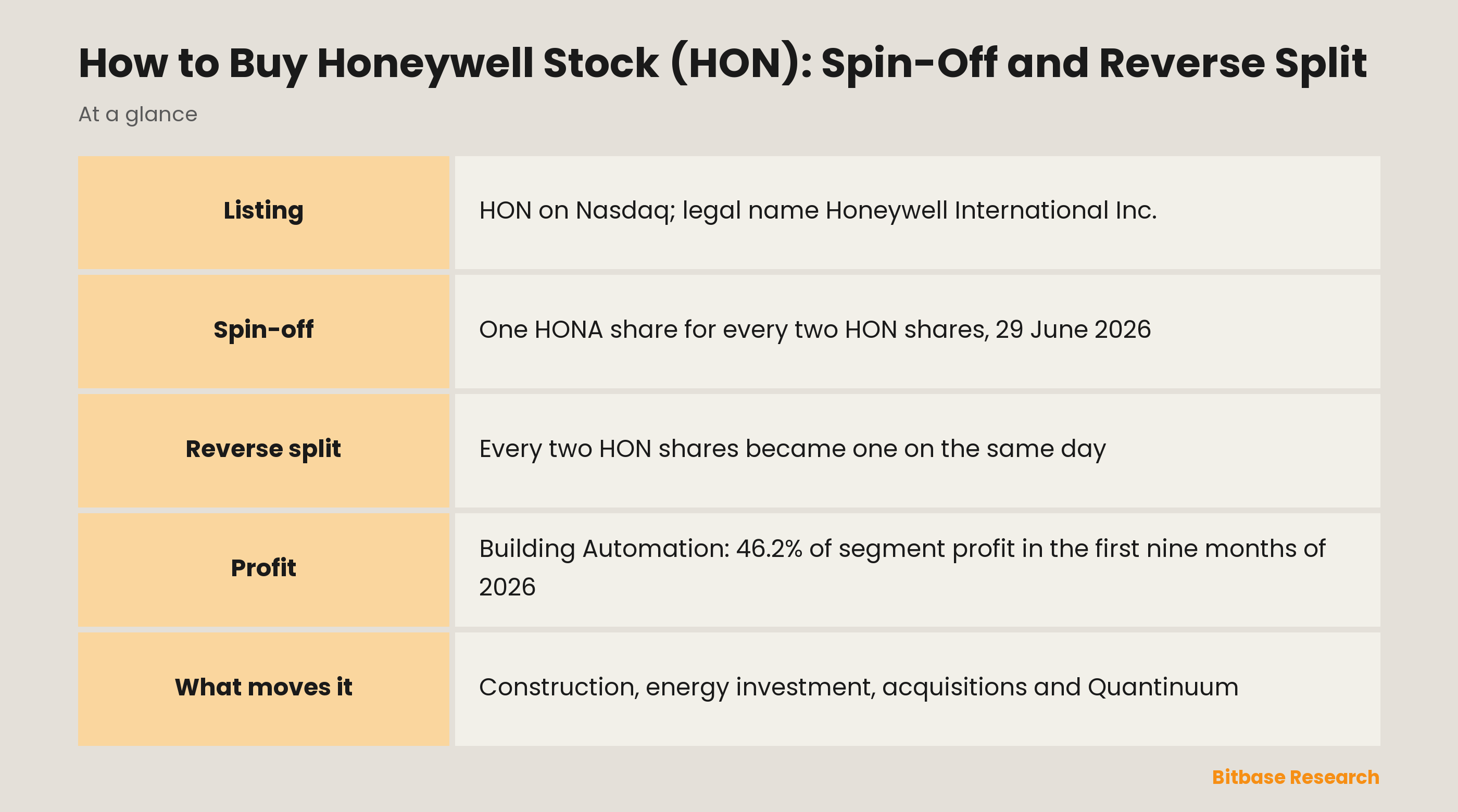
| 29 June 2026 | Aerospace Technologies spun off as Honeywell Aerospace (HONA) | One HONA share for every two HON shares held on 15 June 2026 |
| 29 June 2026 | Reverse stock split of HON | Every two HON shares combined into one |
| July and August 2026 | Warehouse and Workflow Solutions and Productivity Solutions and Services sold | No shares |
Fractions were paid in cash. Chairman and CEO Vimal Kapur called the June separation "the conclusion of the portfolio transformation we began in 2023." Keeping the old legal name has a precedent: General Electric did the same while operating as GE Aerospace, as the GE Aerospace stock guide describes.
How Honeywell Makes Money
The fiscal 2025 10-K is a poor guide to today's company: aerospace, now Honeywell Aerospace, brought in 46.8% of that year's net sales. The cleaner source is the third-quarter 2026 10-Q, which reports the remaining company on its own and recasts 2025 to match:
| Segment | Share of net sales, first nine months of 2026 | Share of segment profit | Segment margin | Business models reported |
|---|---|---|---|---|
| Building Automation | 39.3% | 46.2% | 26.8% | Products, Solutions |
| Process Automation and Technology | 33.7% | 33.3% | 22.6% | Projects, Aftermarket |
| Industrial Automation | 26.9% | 20.5% | 17.4% | Products, Solutions |
Sales shares use consolidated net sales; profit shares use the three segments' combined profit before corporate costs; margins are segment profit over segment sales.
Building Automation is the profit engine, with less than two-fifths of sales and close to half of segment profit. Across the company, services made up 27.6% of net sales and products the rest. Honeywell says it concentrates on "critical control points that often represent only a single-digit percentage of a project's spend," then earns aftermarket revenue over the life of the equipment.
More than half of sales come from outside the United States, and about a third from what the company calls high-growth regions. It names four verticals where it is building scale: data centers, semiconductors, life sciences and LNG.
The fiscal 2025 10-K names Johnson Controls, Schneider Electric and Siemens among Building Automation's competitors, Emerson Electric and Rockwell Automation among Industrial Automation's, and Clariant, Flowserve and Topsoe against the UOP business now inside PAT. Its aerospace rivals, from RTX to Safran, are now Honeywell Aerospace's concern.
Quantinuum no longer appears in sales. Honeywell books its share of Quantinuum's results on a separate equity-method line, which showed losses in the second and third quarters of 2026.
HON Stock at a Glance
| Item | Detail |
|---|---|
| Exchange | Nasdaq, since moving from the NYSE in 2021 |
| Ticker | HON |
| Security | Common stock, the only class of shares on the cover of the 10-Q |
| Other listed securities | Five series of euro senior notes with symbols such as HON 30 |
| Legal name | Honeywell International Inc., operating as Honeywell Technologies |
| CUSIP since 29 June 2026 | 438516205 |
| Sector | Industrial automation: buildings, process plants, sensing and measurement |
| Index membership | S&P 500 and Dow Jones Industrial Average |
| Headquarters | Charlotte, North Carolina |
| Incorporated | Delaware, 1985 |
| Fiscal year | Ends 31 December; interim quarters close on a Saturday |
| Dividend policy | Quarterly cash dividend declared by the board |
| SEC identifier | CIK 773840 |
Quotes, market value and dividend yield change through every session; for the live figures, open the Honeywell stock page on Bitbase.
How to Buy Honeywell Stock
Honeywell is a US company whose common stock is listed directly on Nasdaq, so no depositary receipt is involved. The purchase runs through a broker:
1. Choose a broker with Nasdaq access. If you live outside the US, find out which company will actually hold your account and which regulator oversees it.
2. Complete the account checks. Non-US residents certify their foreign status on IRS Form W-8BEN, which the IRS says to hand over when the broker or other payer requests it, "whether or not you are claiming a reduced rate" or an exemption.
3. Add money. A currency conversion is a second charge on top of the commission, so check the rate the broker applies.
4. Pick the right line. Search HON and confirm the result reads Honeywell International common stock on Nasdaq. Three look-alikes sit nearby: HONA is Honeywell Aerospace, SOLS is Solstice Advanced Materials, and symbols such as HON 30 belong to Honeywell's euro notes, debt securities rather than shares.
5. Choose an order type. FINRA explains that a market order "generally will execute at or near the current bid or ask prices," while a buy limit order "can be executed only at or below the limit price" and may never fill.
6. Decide on the size. Fractional shares are available at some brokers. FINRA cautions that, for now, "you can't transfer fractional shares to another brokerage firm," and that a fractional holder "might not have shareholder voting rights."
7. Keep the paperwork. Trade confirmations and statements record your cost basis and the dividends you receive.
Reading the chart after June 2026. Two things happened to HON on 29 June. The spin-off moved the aerospace business into HONA shares, and the reverse split combined every two HON shares into one, cutting the share count from about 634 million to about 317 million. Honeywell's 10-Qs restate per-share figures for the split; a price series adjusted for only one of the two events will mislead.
Non-US holders face withholding on dividends. Under IRS rules, most US-source income paid to a foreign person is "subject to U.S. tax of 30%," a rate a tax treaty can reduce or eliminate, and the country where you live may tax the same dividend again.
Through funds, you can own Honeywell without picking it. The daily holdings files State Street publishes for SPY and DIA, its S&P 500 and Dow Jones Industrial Average trusts, both listed HON on 29 October 2026; SPY also held HONA as a separate line.
What Moves HON Stock
Construction, retrofits and data centers. Building Automation is exposed to "global buildings and infrastructure construction activity (including retrofits and upgrades)" and to inventory swings in distribution channels, according to Honeywell's risk disclosures. Recent growth has leaned on fire and security: building products grew 11% in the third quarter of 2026, and data centers are one of the four target verticals.
Energy-sector investment. PAT depends on how fully refineries, petrochemical and chemical plants run, and Honeywell warns that volatile oil and gas prices "may result in less investment by our customers." In the third quarter, project sales rose 14%, led by LNG and petrochemical work, and aftermarket sales rose 4% on refining demand. The 10-Q also flags the conflict in the Middle East and "its impact on energy markets, trade flows, and shipping."
Acquisitions inside PAT. The segment's reported sales rose 8.5% in the first nine months of 2026, but organic growth was only 1%; acquisitions supplied six points. The two deals behind that were Sundyne, bought in June 2025, and Johnson Matthey's Catalyst Technologies business, bought on 17 July 2026. Project mix and dilution from the Johnson Matthey deal cut PAT's third-quarter margin by 210 basis points, while lower catalyst shipments held back aftermarket sales over the nine months.
A slimmer Industrial Automation. Reported sales fell 12.7% in the first nine months as the personal protective equipment, Warehouse and Workflow Solutions and Productivity Solutions and Services businesses were sold, yet organic growth was 3%. In the third quarter, sensing grew by double digits while "industry-wide meter deployment deferrals in utilities" left product sales flat.
Quantinuum. Through the 48% stake, Quantinuum's results flow into HON's net income even though none of its sales do.
How the Breakup Reshaped Honeywell's Risks
Honeywell rewrote its risk factors for the post-spin company in the second-quarter 2026 10-Q. These bear most directly on a HON share:
Less diversification. In the company's words, it "is a smaller, less diversified company than it was prior to the Aerospace Spin-Off, which could amplify the impact of factors affecting its performance."
Cyclical end markets. Each segment has its own trigger: construction activity for Building Automation, plant capacity utilization and energy prices for PAT, and retail, energy and semiconductor markets for Industrial Automation, where new technologies "may lead to product commoditization."
Raw materials and single suppliers. PAT uses copper, tungsten salts, aluminum and molybdenum, and "many major components, product equipment items, and raw materials are procured or subcontracted on a single or sole-source basis."
Liabilities left behind. For businesses it sold or spun off, Honeywell has agreed "to indemnify the counterparties against, or otherwise retain, certain liabilities, including certain lawsuits, product liability claims, and environmental matters." Past operations and those of predecessor companies also carry "potentially material liabilities related to the remediation of environmental hazards."
Trade and international exposure. The filing describes US tariff policy and the retaliation it draws as "a dynamic environment," and also covers sanctions, exchange rates and contracts with Russian counterparties, for which it cannot estimate possible losses beyond what it has accrued.
Two further risks belong to owning any single stock. One company's results decide the outcome, however many markets it sells into. And a dividend is declared quarter by quarter; if you count your money in another currency, exchange-rate moves change what both the price and the dividend are worth to you.
Reading Honeywell's Filings Across the Split
Honeywell files with the SEC under CIK 773840: a 10-K each year, 10-Qs each quarter, and 8-Ks for events in between, such as the spin-off report of 29 June 2026 and each earnings release. Honeywell Aerospace now files its own reports.
Three documents bridge the change: the fiscal 2025 10-K, which still describes the pre-spin company; the 29 June 2026 8-K, whose supplemental schedule recasts segment results for 2024, 2025 and the first quarter of 2026 without aerospace; and the second-quarter 2026 10-Q, which holds the rewritten risk factors. The third-quarter report covers what management called "our first quarter as a standalone company."
Read the 10-Q's organic growth figures next to the reported ones, since acquisitions and divestitures now run through the reported numbers. Quarters close on a Saturday near the calendar quarter end, 26 September in the third quarter of 2026. The investor relations website has an "About Our Spin-offs" section, and for quotes there are the stock page above and more US stock pages on Bitbase.
Honeywell Stock FAQ
Does Honeywell pay a dividend?
Yes. Honeywell pays quarterly, and the fiscal 2025 10-K reported a 5% rise in the quarterly rate from the fourth quarter of 2025 and said the company intends "to continue to pay quarterly dividends in 2026." The first payment after the spin-off was smaller per share: on the split-adjusted basis of the 10-Q, the third-quarter 2026 dividend was below the second quarter's. The board declares each payment.
Can I buy Honeywell stock with crypto?
Not directly. HON is sold for US dollars through brokerage accounts, so the crypto has to be converted to cash and transferred to the broker before an order can go in, and that sale can be taxable where you live. The result is a registered holding in the company, and the voting and dividend rights that come with it are part of how a listed share differs from a crypto asset.
What did Honeywell shareholders get in the aerospace spin-off?
One Honeywell Aerospace share for every two Honeywell shares held at the close of business on 15 June 2026, distributed on 29 June, with cash in place of fractions. Honeywell said it expected the distribution to be free of US federal income tax for shareholders, except for that cash. In the Solstice spin-off, holders received one SOLS share for every four Honeywell shares held on 17 October 2025.
What did the 1-for-2 reverse split change?
The number of HON shares. Every two shares became one at 12:02 a.m. New York time on 29 June 2026, a minute after the spin-off distribution took effect. The ticker stayed HON, the common stock received a new CUSIP, authorized shares fell from 2 billion to 1 billion, and later filings restate per-share data for the split.
Is HON in the S&P 500 and the Dow?
Yes. The SPY and DIA holdings files dated 29 October 2026 both list Honeywell International. SPY also lists Honeywell Aerospace as a separate holding, while DIA lists only HON. Weights change daily.
Does Honeywell still own part of Quantinuum?
Yes. Quantinuum completed its IPO on 4 June 2026, and Honeywell kept a 48% stake, which it now accounts for under the equity method instead of consolidating the business.
Conclusion
Buying HON is routine: a broker with Nasdaq access, the Honeywell International common stock line, a market or limit order. What changed is what the share represents. Since June 2026 that means three automation segments, led in profit by Building Automation, and a 48% stake in Quantinuum, without the aerospace business that produced 46.8% of 2025 sales. Read the latest 10-Q's organic figures and the recast segment data before comparing HON with anything from before the split.
Related reading
Other Bitbase articles on this topic:
- How to Buy Delta Air Lines Stock (DAL): Fuel, Miles and a Refinery
- How to Buy Eaton Stock (ETN): Data Centers, Irish Tax, Dana Deal
- How to Buy Emerson Stock (EMR): Valves, Sensors and AspenTech
Disclaimer: This article is educational content from Bitbase Academy, provided for information only. It explains what a company or fund does and how the instruments referenced here differ from one another; it does not constitute investment, trading, tax, or financial advice, and it is neither a recommendation nor an endorsement of any security, token, or trading strategy. A tokenized stock is issued by a third party and is designed to give economic exposure to an underlying asset: it is not a share, it carries no shareholder rights, and it depends on the issuer's structure, eligibility rules, and redemption terms, which the issuer can change. Perpetual futures are leveraged derivatives that hold no underlying asset and can be liquidated, and trading hours, product availability, and eligibility differ by instrument and by jurisdiction and can change at any time. Written as of October 2026; verify everything yourself through company filings, the issuer's own documentation, and the product pages of the venue you trade on.
References
[1] Honeywell Form 10-K for fiscal 2025 (SEC EDGAR) www.sec.gov
[2] Honeywell Form 10-Q, quarter ended 30 September 2026 (SEC EDGAR) www.sec.gov
[3] Honeywell Form 10-Q, quarter ended 30 June 2026: updated risk factors (SEC EDGAR) www.sec.gov
[4] Honeywell Form 8-K, 29 June 2026: Aerospace spin-off and reverse split (SEC EDGAR) www.sec.gov
[5] Honeywell Technologies release, 29 June 2026: spin-off completed (SEC EDGAR) www.sec.gov
[6] Honeywell Form 8-K, 30 October 2025: Solstice spin-off (SEC EDGAR) www.sec.gov
[7] Honeywell release, 5 June 2026: record date and expected tax treatment (SEC EDGAR) www.sec.gov
[8] Honeywell Technologies third-quarter 2026 results release (SEC EDGAR) www.sec.gov
[9] Honeywell Form 8-K, 30 April 2021: listing transfer to Nasdaq (SEC EDGAR) www.sec.gov
[10] State Street: SPY daily holdings, 29 October 2026 www.ssga.com
[11] State Street: DIA daily holdings, 29 October 2026 www.ssga.com
[12] FINRA: Order Types www.finra.org
[13] FINRA: Investing in Fractional Shares www.finra.org
[14] IRS: NRA Withholding www.irs.gov
[15] IRS: About Form W-8 BEN www.irs.gov





