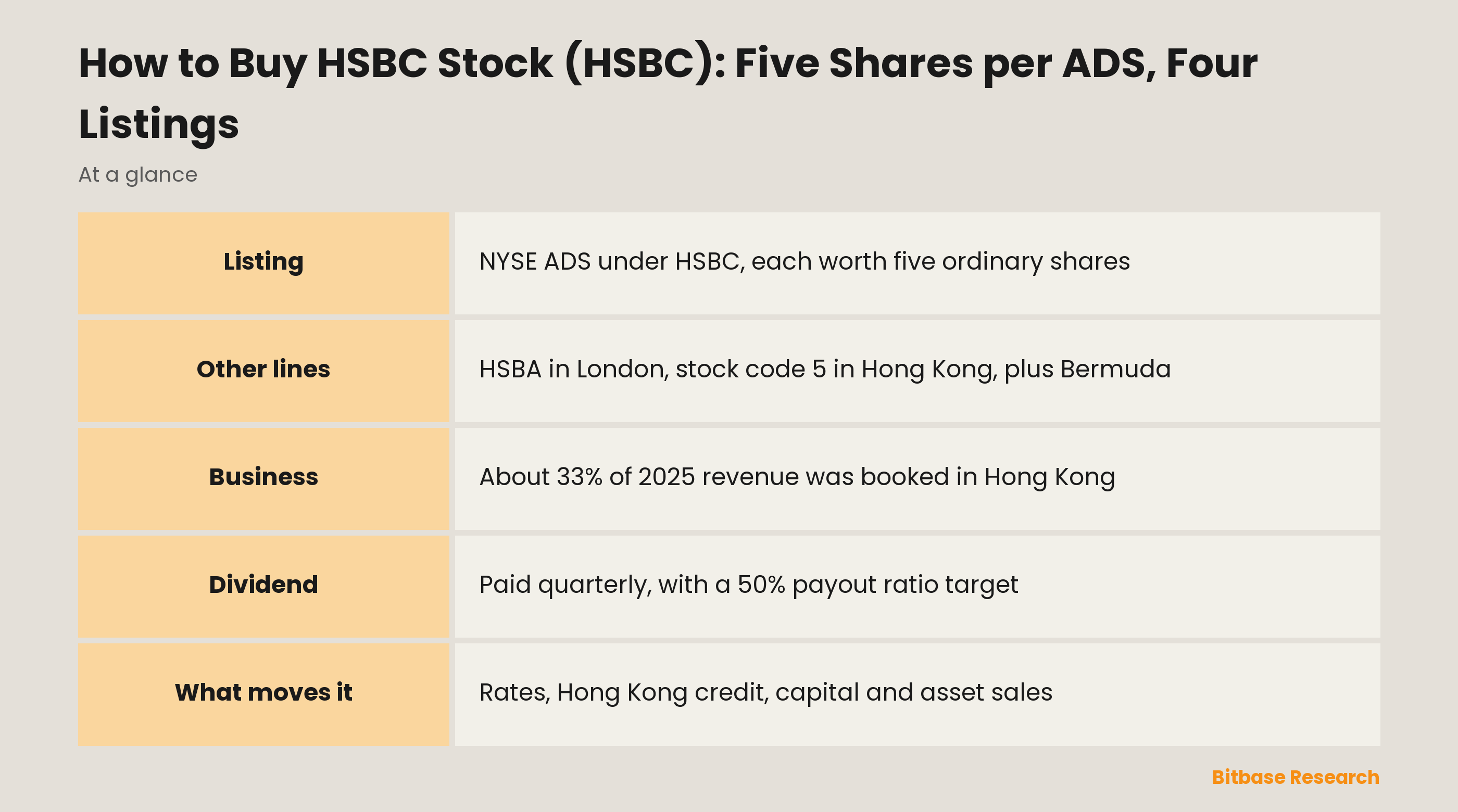
A broker with access to the New York Stock Exchange is all it takes to buy HSBC stock in the US, where the ticker HSBC is an American depositary share (ADS) that stands for five ordinary shares of HSBC Holdings plc. The same ordinary shares trade in London under HSBA, the group's primary market, in Hong Kong under stock code 5 and in Bermuda, and the bank behind them leans east: about 33% of its 2025 revenue was booked in Hong Kong and about 20% in the UK. This guide explains how HSBC earns that revenue, which line to buy, and which risks its own 20-F puts first.
What Does HSBC Do?
HSBC is a universal bank. It takes deposits, lends to households and companies, finances trade across borders, deals in currencies and securities, manages wealth and sells insurance. Its annual report starts plainly, "Founded in 1865," and the chairman's letter recalls the founders' aim: "to establish a bank in Hong Kong and Shanghai that would facilitate local and international trade." The group's Hong Kong bank is still The Hongkong and Shanghai Banking Corporation Limited. The listed parent, HSBC Holdings plc, is incorporated in England and Wales with its head office at 8 Canada Square in London; some long-standing holders received their Holdings shares in 1991 in exchange for shares in the Hong Kong bank.
Since 1 January 2025 the group has reported four businesses, replacing its previous segments. Hong Kong covers retail banking, wealth and commercial banking at HSBC Hong Kong and Hang Seng Bank. UK covers personal banking, including first direct and M&S Bank, plus commercial banking and HSBC Innovation Bank; there the group runs a ring-fenced bank, HSBC UK Bank plc, alongside HSBC Bank plc, which is not ring-fenced. Corporate and Institutional Banking (CIB) combines commercial banking outside the two home markets with global banking and markets. International Wealth and Premier Banking (IWPB) holds Premier banking elsewhere, the Private Bank, asset management and insurance. Unallocated costs sit in Corporate Centre, which also carries HSBC's stake in its associate Bank of Communications (BoCom).
The 20-F calls Hong Kong and the UK "our home markets" and says the group connects customers across 56 markets. Its positions at home are strong by its own count: at December 2025 it held a 25.4% share of Hong Kong deposits and a 32.6% share of Hong Kong trade finance, measured against Hong Kong Monetary Authority data, and an 8.1% share of UK mortgages on Bank of England figures.
Hong Kong also became simpler in 2026. HSBC already owned about 63% of Hang Seng Bank at the end of 2025, and on 26 January 2026 it completed the privatisation: Hang Seng is now wholly owned and its shares have been withdrawn from the Hong Kong Stock Exchange.
How HSBC Makes Money
HSBC reports "revenue" as net operating income before credit losses. In 2025 net interest income, the margin earned on loans and securities over the cost of deposits and funding, made up 51% of it. Net fee income contributed 19.5%, and income from instruments held for trading or managed at fair value 28.8%; insurance and other items made up the remainder.
By business, the split of 2025 revenue looks like this:
| Business | What it contains | Share of 2025 revenue |
|---|---|---|
| Corporate and Institutional Banking | Transaction banking, foreign exchange, capital markets, commercial banking outside the home markets | 38.9% |
| Hong Kong | Retail, wealth and commercial banking at HSBC Hong Kong and Hang Seng Bank | 22.4% |
| International Wealth and Premier Banking | Premier banking abroad, the Private Bank, asset management, insurance | 20.5% |
| UK | Personal and commercial banking, first direct, M&S Bank, HSBC Innovation Bank | 18.2% |
Shares are of the four businesses' combined 2025 revenue in the segment note; Corporate Centre, which reported a net expense, is left out.
Revenue and profit do not line up one for one. Hong Kong produced 32.0% of 2025 profit before tax, well above its revenue share, helped by the lowest cost efficiency ratio of the four: 30.4%, against 56.3% in CIB. CIB was still the largest contributor at 38.1% of profit, and IWPB brought in 14.6%.
Where revenue is booked tells the same story: Hong Kong accounted for about 33% of the 2025 total, the UK about 20% and the US about 7%.
Two more lines matter. Wealth is the growth area management stresses: wealth balances across all businesses rose 16% in 2025, and new Wealth Centres opened in Hong Kong, London and Leeds. And the BoCom stake shrank from 19.03% to 16.00% when BoCom raised capital in June 2025, leaving HSBC with a dilution loss and an impairment that year.
HSBC Stock at a Glance
| Field | HSBC |
|---|---|
| Issuer | HSBC Holdings plc, incorporated in England and Wales |
| US security | American depositary shares on the NYSE, ticker HSBC |
| ADS ratio | One ADS represents five ordinary shares |
| Ordinary share listings | London Stock Exchange (HSBA, primary market), Hong Kong Stock Exchange (stock code 5), Bermuda Stock Exchange (HSBC.BH) |
| Share class | One class of ordinary shares; those registered on the NYSE are "not for trading" except as ADSs |
| ISIN | Ordinary shares GB0005405286; ADSs US4042804066 |
| ADS depositary | The Bank of New York Mellon |
| Sector | Banking and financial services |
| Index membership | FTSE 100 |
| Headquarters | 8 Canada Square, London |
| Financial year | Calendar year, reported in US dollars under IFRS |
| Dividend policy | Quarterly interim dividends; target payout ratio of 50% of earnings per share, excluding material notable items, for 2026, 2027 and 2028 |
| SEC identifier | CIK 1089113; Form 20-F annually, Form 6-K for other news |
Price, market value and yield change with every trade; for live figures, open the HSBC stock page on Bitbase.
How to Buy HSBC Stock
HSBC offers a choice most US-listed companies do not: the same shares trade in three currencies. The ADS trades in US dollars in New York, while the company's buy-back reports show the ordinary shares trading in pounds sterling in London and in Hong Kong dollars in Hong Kong. The steps:
1. Pick a broker that reaches your market. NYSE access covers the ADS; HSBA needs London and stock code 5 needs Hong Kong. Note which company actually holds your account and which regulator supervises it.
2. Complete the account checks. If you are not a US person, a broker paying you through the US may ask you to certify that; the 20-F notes that non-US holders generally fall outside US backup withholding.
3. Fund it in the right currency. Each line settles in its own currency, and a conversion spread can cost more than the commission.
4. Pick the correct line on the screen. On a US screen, search HSBC and confirm the description reads American depositary shares of HSBC Holdings plc. The 20-F cover also registers 65 series of HSBC notes on the NYSE, under symbols such as HSBC26 or HSBC31A; those are bonds.
5. Set the order. A market order takes whatever price is available; a limit order sets a ceiling on what you pay, which matters most when trading is thin.
6. Decide on the size. One ADS costs roughly five times the London or Hong Kong share price after currency conversion. Ask whether your broker sells fractions.
7. File the paperwork. Contract notes and dividend statements establish your cost and income for tax.
When comparing the ADS with the London or Hong Kong quote, convert the currency, multiply by five and check the time stamp: regular-hours and extended-hours prices differ.
ADS or ordinary shares. HSBC approves dividends in US dollars; ordinary shareholders can take them in US dollars, sterling or Hong Kong dollars, while the depositary pays ADS holders in US dollars and may deduct a small per-ADS fee. ADS holders vote by instructing the depositary; the deposit terms state that they "will not be entitled to vote Deposited Securities directly." Buying shares in London generally attracts UK stamp duty or stamp duty reserve tax of 0.5%, whereas transfers of ADSs generally do not, provided the paperwork stays outside the UK. Moving ordinary shares into the ADS programme can cost 1.5%.
Tax on dividends. The 20-F says: "Currently, no tax is withheld from dividends paid by HSBC Holdings." That removes a UK layer, not your home-country one. For US holders, HSBC says it does not believe it was a passive foreign investment company for 2025, so its dividends "generally should be eligible for qualified dividends treatment."
Through a fund. HSBC is a FTSE 100 member, so UK large-cap funds hold it. The iShares MSCI United Kingdom ETF, for example, listed HSBC Holdings through its London line, HSBA, in its holdings file dated 16 October 2026.
What Moves HSBC Stock
Interest rates in three currencies. With net interest income at about half of revenue, rates set by the Federal Reserve, the Bank of England and Hong Kong's interbank market run straight into earnings. The 20-F lists fluctuations in HIBOR among the factors that can move results and warns that lower rates "could reduce revenue from net interest margins." HSBC manages part of that exposure with a structural hedge, and credits its reinvestment at higher yields for some recent income growth. Any deposit-funded lender works this way, as the Bank of America profile shows; HSBC runs it through three central banks at once.
Hong Kong and mainland China credit. Hong Kong is HSBC's largest commercial real estate portfolio, and credit losses on that sector featured in 2025 and again in the first half of 2026. The 20-F sees signs of improvement in Hong Kong but warns that "recovery is likely to take time," and says mainland China fundamentals "remain weak."
Capital, dividends and buy-backs. The 20-F ranks the ordinary dividend, at a 50% payout ratio target, as the first use of the capital HSBC generates, with growth of the four businesses next. Buy-backs depend on the common equity tier 1 (CET1) ratio, managed within a target range of 14% to 14.5%. The Hang Seng deal, with dividends and asset growth, took the ratio from 14.9% at the end of 2025 to 14.1% at 30 June 2026, and buy-backs paused. A new one started in August 2026 and concluded on 28 September; each further round is decided quarterly.
A shrinking map. HSBC announced 11 exits in 2025, and in the fourth quarter completed sales including its French retained home loan portfolio and its Bahrain retail bank. In July 2026 it agreed to sell its Australian home and personal loan portfolio to an entity owned by Blackstone-managed funds, and HSBC Life (Singapore) to Allianz, both expected to close in the first half of 2027. Each sale changes what a share owns; the Hang Seng integration, with revenue and cost synergies targeted by the end of 2028, works the other way.
Trade and geopolitics. CIB is built around cross-border transaction banking and capital markets, so US tariffs and US–China strategic competition are company-specific issues, not background noise. The 20-F says the impact of geopolitical risk in Asia "is heightened due to the region's relatively high contribution to the Group's profitability, particularly in Hong Kong."
Risks to Weigh Before Buying HSBC
The 20-F's risk factors run long. These bear most directly on a shareholder:
Political and geopolitical risk. "We are subject to political, social and other risks in the countries in which we operate." Complying with one jurisdiction's rules, the text adds, "may be seen as supporting the law or policy objectives of that jurisdiction over another," a hazard for a bank whose two home markets sit on opposite sides of US–China tensions.
Resolution powers. The UK Banking Act 2009 gives UK authorities stabilisation powers, bail-in among them, and lets them require capital instruments to be written down or converted into equity, which "may lead to the cancellation, transfer or dilution of HSBC Holdings' ordinary share capital."
A holding company in the middle. "HSBC Holdings is a non-operating holding company," so dividends depend on cash from subsidiaries, which "could also be restricted by applicable laws, regulations, exchange controls and other requirements."
Currency. HSBC reports in US dollars, but much of its business is in other currencies, and the 20-F names the risk of "a currency becoming de-pegged from the US dollar."
Financial crime and litigation. The company is "subject to the risk of financial crime" and to legal actions "the outcomes of which are inherently difficult to predict"; a provision linked to the Madoff fraud was among its 2025 notable items.
Above the bank sit the usual equity risks. One stock concentrates your money, and banks share a confidence risk, since banking stress and liquidity can hit a whole sector at once. Dividends are declared each quarter, not promised, and if your home currency is not the US dollar, price and payout both move with the exchange rate.
How to Research HSBC Yourself
HSBC's SEC filer number is CIK 1089113. The annual report comes on Form 20-F each February, and everything else on Form 6-K, from quarterly results to dividend currency conversions, buy-back transactions and disposals. Many of those announcements are also made under the Hong Kong listing rules and carry the line "Hong Kong Stock Code: 5". The annual report and the dividend currency options are also posted in the investors section of hsbc.com.
In the 20-F, the strategic report explains the four businesses, the risk factors section the threats, the segmental analysis note revenue and profit by business, and the shareholder information pages the dividend timetable, ADS fees and tax summary.
HSBC reports four times a year. In 2026, full-year 2025 results came on 25 February, first-quarter results on 5 May and interim results on 4 August, and a notice filed on 14 October set 27 October for the board meeting on third-quarter results and a third interim dividend.
One trap: segment figures before 2025 were re-presented for the four-business structure, so older annual reports use different lines. Live quotes are on the HSBC page linked above, and Bitbase's US stock pages cover other companies.
HSBC Stock FAQ
How is the HSBC ADS different from HSBC shares in London and Hong Kong?
Same company, same class of ordinary shares, different wrappers. An ADS is a receipt for five ordinary shares held by The Bank of New York Mellon as depositary; it trades in US dollars, pays dividends in US dollars net of depositary fees, and votes through the depositary. HSBA in London and stock code 5 in Hong Kong are the ordinary shares themselves, traded in sterling and Hong Kong dollars. At the end of 2025, approximately 3.28% of the ordinary shares were represented by ADSs held by US-address holders of record, so most of HSBC's share capital sits outside the ADS programme.
Does HSBC pay a dividend?
Yes, quarterly. HSBC pays four interim dividends a year, approved in US dollars, and targets a payout ratio of 50% of earnings per share excluding material notable items for 2026, 2027 and 2028. Ordinary shareholders choose the payment currency; ADS holders receive US dollars. The board approves each payment, and each amount and payment date is announced on Form 6-K.
Can I buy HSBC stock with crypto?
Not directly. HSBC shares and ADSs can only be bought through a broker, and every line settles in a government currency: US dollars, sterling or Hong Kong dollars. Any crypto you want to use must first be converted to one of those and transferred to the brokerage, and your local tax rules may treat that conversion as a disposal.
Is HSBC in the FTSE 100?
Yes. The 20-F describes the FTSE 100 Total Return Index as "a recognised broad equity market index of which HSBC Holdings is a member," and uses it as the benchmark for HSBC's ten-year shareholder return.
What happened to Hang Seng Bank?
HSBC took it private. The privatisation completed on 26 January 2026, after shareholder and court approval; Hang Seng Bank became a wholly owned subsidiary and its shares were withdrawn from the Hong Kong Stock Exchange. It keeps its own licence, brand and branches, and its results are reported, as before, inside HSBC's Hong Kong business.
Conclusion
Buying HSBC is easy once you choose the line: the NYSE ADS at five shares each, HSBA in London or stock code 5 in Hong Kong, each with its own currency and costs. What deserves more thought is the business inside the share: a bank anchored in Hong Kong and the UK, sensitive to three sets of interest rates and in the middle of selling businesses abroad. The latest 20-F and the 6-Ks filed since are where to check that picture before you size a position in a single bank.
Related reading
Other Bitbase articles on this topic:
- How to Buy Capital One Stock (COF): Card Lender, Discover Network
- How to Buy CIBC Stock (CM): Dividend, Mortgages, Caribbean Sale
- How to Buy Citigroup Stock (C): Five Businesses, Banamex Exit
Disclaimer: This article is educational content from Bitbase Academy, provided for information only. It explains what a company or fund does and how the instruments referenced here differ from one another; it does not constitute investment, trading, tax, or financial advice, and it is neither a recommendation nor an endorsement of any security, token, or trading strategy. A tokenized stock is issued by a third party and is designed to give economic exposure to an underlying asset: it is not a share, it carries no shareholder rights, and it depends on the issuer's structure, eligibility rules, and redemption terms, which the issuer can change. Perpetual futures are leveraged derivatives that hold no underlying asset and can be liquidated, and trading hours, product availability, and eligibility differ by instrument and by jurisdiction and can change at any time. Written as of October 2026; verify everything yourself through company filings, the issuer's own documentation, and the product pages of the venue you trade on.
References
[1] HSBC Holdings plc, Form 20-F for 2025 (SEC EDGAR) www.sec.gov
[2] HSBC 20-F for 2025, Exhibit 2.1: description of securities www.sec.gov
[3] HSBC 2026 interim results, 4 August 2026 (Form 6-K) www.sec.gov
[4] HSBC, conclusion of buy-back, 28 September 2026 (Form 6-K) www.sec.gov
[5] HSBC, board meeting notice, 14 October 2026 (Form 6-K) www.sec.gov
[6] HSBC, sale of Australian home and personal loans, 30 July 2026 (Form 6-K) www.sec.gov
[7] HSBC, sale of HSBC Life (Singapore) to Allianz, 24 July 2026 (Form 6-K) www.sec.gov
[8] iShares MSCI United Kingdom ETF holdings, 16 October 2026 www.ishares.com





