
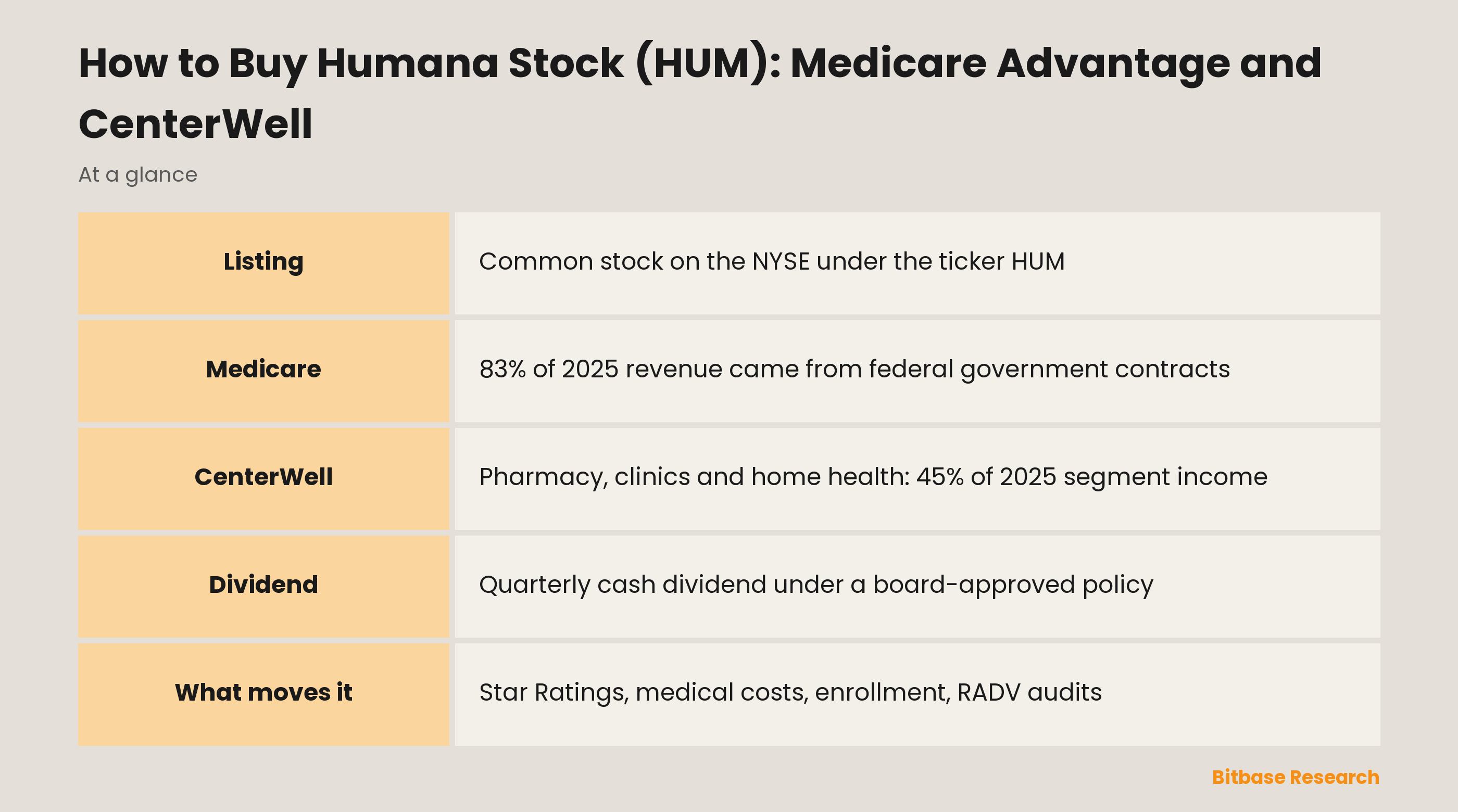
Your broker can buy Humana stock for you: the shares are listed on the New York Stock Exchange as HUM. What you are buying is mostly a Medicare business: in 2025 about 83% of Humana's premiums and services revenue came from contracts with the federal government, and individual Medicare Advantage plans alone produced about 70%. Below: what it sells, how an order works, and why government ratings and audits weigh so heavily on HUM.
What Does Humana Do?
Humana is a health insurer and care provider headquartered in Louisville, Kentucky, organized as a Delaware corporation in 1964. It works under two names: Humana for insurance and CenterWell for the care it delivers itself. At the end of 2025 it had about 15 million members in its medical plans and about 4.7 million in specialty products such as dental and vision.
Medicare is the center of the business. Humana has offered Medicare private health plans for more than 30 years and sells at least one type of Medicare plan in all 50 states. Its Medicare Advantage plans, private plans that replace traditional Medicare for people who choose them, covered about 5.2 million individual members at the end of 2025, about 1.0 million of them in Florida. It also sells stand-alone drug plans, one co-branded with Walmart, and group plans for employers that cover retirees.
Beyond Medicare, Humana runs Medicaid contracts in states such as Florida, Kentucky, Illinois and Ohio. Under a TRICARE contract with the Department of Defense it arranges care for about 4.6 million military beneficiaries, while the government keeps the cost risk.
CenterWell is the care side: CenterWell Pharmacy, the mail-order pharmacy, a specialty pharmacy, senior-focused primary care clinics under the CenterWell Senior Primary Care and Conviva brands, and CenterWell Home Health. The 10-K counts 350 primary care clinics.
In 2025 Humana also finished leaving the employer group commercial medical business, which it said was "no longer positioned to sustainably meet the needs of commercial members over the long term."
How Humana Makes Money
The Insurance segment collects premiums, for Medicare Advantage usually a fixed monthly payment per member from the Centers for Medicare & Medicaid Services (CMS), and pays its members' medical and drug bills. The 2025 10-K splits premiums and services revenue like this:
| Source | Share of 2025 premiums and services revenue |
|---|---|
| Individual Medicare Advantage | 70.3% |
| Group Medicare Advantage | 7.0% |
| Medicare stand-alone prescription drug plans | 5.3% |
| State-based contracts and other | 11.2% |
| Specialty, Medicare supplement and military services | 2.4% |
| CenterWell services sold to outside customers | 3.7% |
Because premiums are fixed in advance, profit depends on how much care members use. The figure to watch is the benefit ratio, benefits expense as a share of premiums: 90.2% in 2025 against 89.8% in 2024. Total revenues rose 10.1% in 2025, mainly on higher Medicare premiums per member.
CenterWell looks small from outside and large from inside. About 79% of its 2025 revenue came from Humana's own health plans, mostly pharmacy sales, yet it earned about 45% of the two segments' combined income from operations, with Insurance earning the other 55%. The company calls the profitability of the two segments "interdependent," since they serve the same members and share costs.
HUM Stock at a Glance
| Feature | HUM |
|---|---|
| Exchange | New York Stock Exchange |
| Ticker | HUM |
| Security | Common stock; no other class is listed |
| Sector | Health insurance and health care services |
| Segments | Insurance and CenterWell |
| Index membership | S&P 500 |
| Headquarters | Louisville, Kentucky |
| Incorporated | Delaware, 1964 |
| Fiscal year | Ends 31 December |
| Dividend | Quarterly cash dividend under a board-approved policy |
| SEC identifier | CIK 49071 |
Anything that moves daily, such as the share price, market value or yield, is better read live on the Humana stock page on Bitbase.
How to Buy Humana Stock
As a US company, Humana has no ADR layer: the NYSE line is the common stock itself. Six steps get you there:
1. Pick a broker that offers NYSE stocks. Abroad, find out which company actually keeps your account and under which regulator.
2. Complete the onboarding. Investors outside the US normally fill in IRS Form W-8BEN; the IRS tells them to provide it "when requested by the withholding agent or payer."
3. Fund it. Outside the dollar, compare conversion rates as well as commissions.
4. Find the right line. Search HUM and confirm it reads Humana Inc. common stock on the NYSE.
5. Choose the order type. In FINRA's words, a market order "provides the most certainty that your order will be executed," while a limit order fills only "at or better than a specified price."
6. Decide the size. Fractional shares let you invest a fixed amount, but some brokers limit them to "large-cap stocks or ETFs," and FINRA notes that "as a fractional share owner, you might not have shareholder voting rights."
Dividend tax abroad. The IRS says that "most types of U.S. source income received by a foreign person are subject to U.S. tax of 30%," with lower rates possible under a tax treaty. Where you live, that dividend can be taxed a second time.
Through a fund. Humana Inc. appeared in the SPY holdings list that State Street published for 5 November 2026; SPY tracks the S&P 500, so any fund following that index holds a small slice of the company.
Star Ratings, Medical Costs and Other Forces on HUM
Star Ratings. CMS rates Medicare Advantage plans on a star scale, and "Star Ratings of 4-star or higher" qualify plans for premium bonuses. The number of Humana plans at that level "significantly declined" in the 2025 ratings, which set 2026 bonus payments. A court rejected Humana's challenge to those ratings on 14 October 2025, and its appeal is pending at the Fifth Circuit. On 9 October 2026 the company said that, based on final 2027 ratings data from CMS, it had exceeded its own goal of "Top Quartile results."
Medical costs. Premiums are set a year ahead, so higher use of care comes straight out of margin. In the first nine months of 2026 the consolidated benefit ratio was 91.5%, up from 89.3% a year earlier, which the 10-Q puts down partly to the Bonus Year 2026 Star Ratings headwind and partly to new members, who "run at a higher benefit ratio."
Membership swings. Seniors can switch plans every autumn. Individual Medicare Advantage membership fell 7.3% during 2025, partly because Humana left unprofitable plans and counties, then rose 23.3% in the year to 30 September 2026.
Risk adjustment audits. CMS pays more for sicker members, based on diagnosis codes from providers, and checks those codes through audits known as RADV. A federal court vacated CMS's final RADV rule at Humana's request on 25 September 2025; the government's appeal, Humana v. Kennedy, is pending at the Fifth Circuit.
Primary care deals. Humana bought MaxHealth, a Florida primary care platform, in February 2026, and in October 2026 a joint venture with funds managed by HPS Investment Partners, part of BlackRock, replaced its clinic ventures with Welsh, Carson, Anderson & Stowe.
To see how other insurers face the same pressures, compare our guides to UnitedHealth stock and Elevance Health stock.
Where Humana's Filings Put the Risk
Of the risk factors in the 2025 10-K, these matter most for a shareholder; the third-quarter 2026 10-Q reports no changes to them.
Pricing. If premiums "are insufficient to cover the cost of health care services delivered to our members," or benefits expense is underestimated, "our profitability may be materially adversely affected."
Government dependence. Medicare, military services and Medicaid "accounted for approximately 93% of our total premiums and services revenue" in 2025, and the Florida Medicare Advantage contracts alone about 14%.
Ratings. Plans' operating results "may be significantly affected by their star ratings."
Litigation. A securities class action alleges misleading statements between July 2022 and October 2024 about medical costs and Star Ratings, and the Justice Department has joined part of a False Claims Act case over payments to call center broker partners. Humana says it will defend itself.
Owning HUM also carries the plain risks of any single stock, concentration in one company among them, and no dividend is guaranteed: future payments are "at the discretion of our Board and may be adjusted as business needs or market conditions change."
Reading Humana's 10-K and Earnings Reports
Humana's reports are on SEC EDGAR under CIK 49071 and free on humana.com. In the 10-K, Item 1 covers products and membership by state, Item 1A the risks, Item 5 the dividend table and a return chart against the S&P 500 and the Dow Jones US Select Health Care Providers Index, and Note 18 the segment results.
Two habits help: read the benefit ratio with the season in mind, since Humana says Medicare benefit costs rise through the year as members pass their deductibles, and read "Adjusted" earnings next to their reconciliation to GAAP. For peers and other listed names, browse Bitbase's index of US stock pages.
Humana Stock FAQ
Can I buy Humana stock with crypto?
Not directly. A broker settles HUM trades in US dollars, so you would have to convert crypto to cash and transfer it first, and that conversion can trigger tax in your country. Think of them as two separate holdings: a Humana share is a claim on a regulated company, with dividends and a vote, which is what separates a stock from a crypto token.
Does Humana pay a dividend?
Yes, quarterly, under a board-approved policy. The per-share amount was the same in every payment from January 2024 through the one declared for January 2027, but the board can change it.
Is HUM in the S&P 500?
Yes. Humana Inc. appears in the daily holdings of State Street's SPY, a fund built to track the S&P 500. Weights change every day, so check the fund's latest file if the size of the position matters to you.
Why do Star Ratings matter for Humana?
Plans rated 4 stars or higher qualify for CMS bonus payments, and most of Humana's revenue comes from Medicare Advantage, so a ratings drop cuts revenue a year or more later, as the 2025 ratings did in 2026.
Conclusion
Humana is a Medicare business first, and much of what drives HUM is decided outside the company itself. Its results turn on Medicare payment rules, star ratings, audits and how much care members use. Read the latest 10-K and 10-Q, track the benefit ratio, and decide how much one Medicare insurer should weigh in your portfolio.
Related reading
Other Bitbase articles on this topic:
- How to Buy Alcon Stock (ALC): Same Share on SIX and the NYSE
- How to Buy Centene Stock (CNC): Medicaid, Ambetter and Wellcare
- How to Buy Dexcom Stock (DXCM): G7, Stelo and Medicare Bidding
- How to Buy Labcorp Stock (LH): Lab Tests, Trial Labs and Fortrea
Disclaimer: This article is educational content from Bitbase Academy, provided for information only. It explains what a company or fund does and how the instruments referenced here differ from one another; it does not constitute investment, trading, tax, or financial advice, and it is neither a recommendation nor an endorsement of any security, token, or trading strategy. A tokenized stock is issued by a third party and is designed to give economic exposure to an underlying asset: it is not a share, it carries no shareholder rights, and it depends on the issuer's structure, eligibility rules, and redemption terms, which the issuer can change. Perpetual futures are leveraged derivatives that hold no underlying asset and can be liquidated, and trading hours, product availability, and eligibility differ by instrument and by jurisdiction and can change at any time. Written as of November 2026; verify everything yourself through company filings, the issuer's own documentation, and the product pages of the venue you trade on.
References
[1] Humana Form 10-K for 2025 (SEC EDGAR) www.sec.gov
[2] Humana 2025 Form 10-K, XBRL cover page (SEC EDGAR) www.sec.gov
[3] Humana Form 10-Q for the third quarter of 2026 (SEC EDGAR) www.sec.gov
[4] Humana Form 8-K of 9 October 2026 on 2027 Star Ratings (SEC EDGAR) www.sec.gov
[5] State Street SPDR S&P 500 ETF Trust (SPY): fund page and daily holdings www.ssga.com
[6] FINRA: Order Types www.finra.org
[7] FINRA: Investing in Fractional Shares www.finra.org
[8] IRS: NRA Withholding www.irs.gov
[9] IRS: About Form W-8 BEN www.irs.gov





