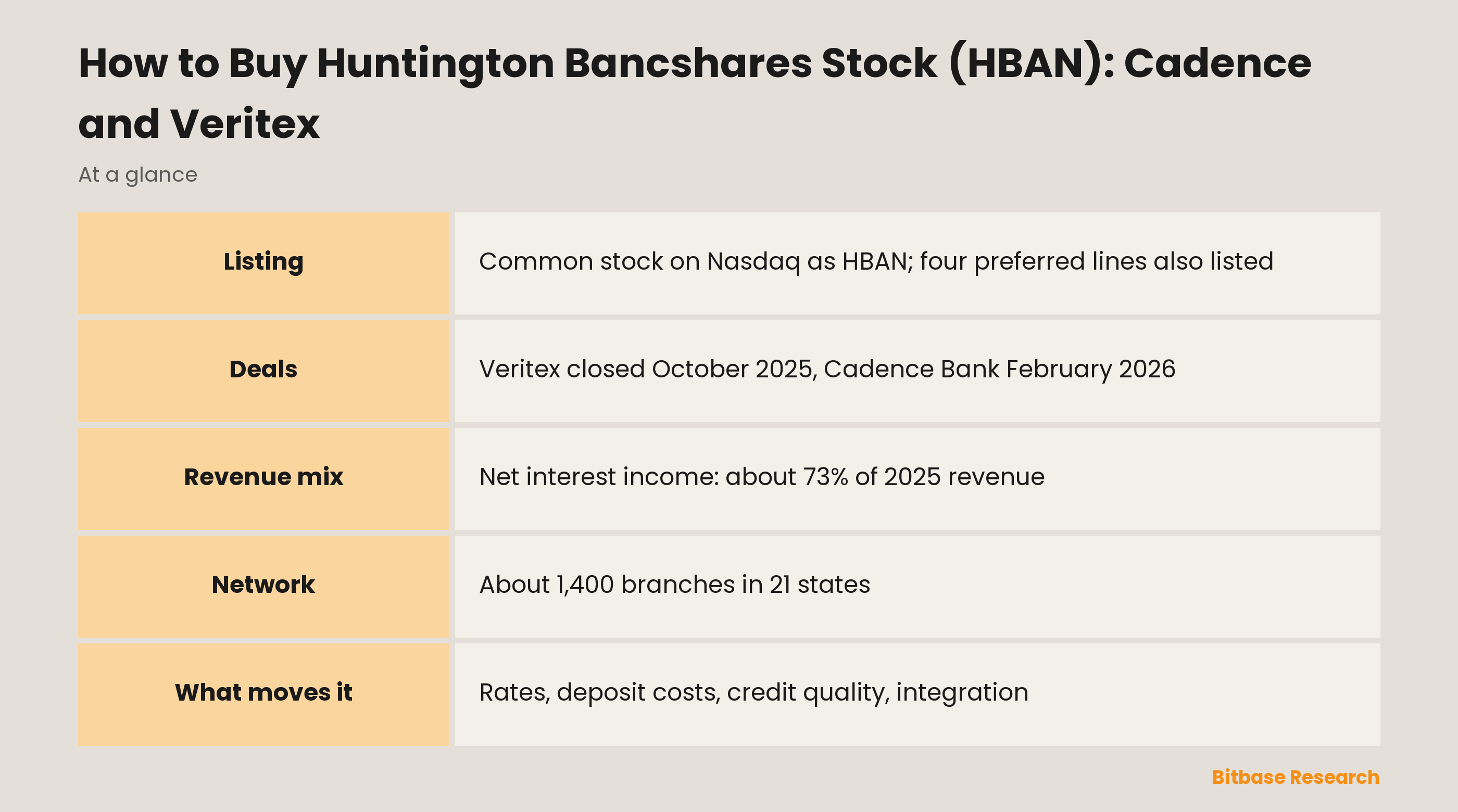
Buying into Huntington Bancshares takes a brokerage account that can trade Nasdaq-listed shares and an order for the common stock under the ticker HBAN, not for one of the four preferred-share lines that carry HBAN as a prefix. The bank behind the ticker grew fast in four months: it absorbed Dallas-based Veritex in October 2025 and Cadence Bank in February 2026, moving from more than 1,000 branches in 14 states to about 1,400 in 21. Below: how Huntington earns its money, how an order works, and what to watch as the two deals settle in.
What Does Huntington Bancshares Do?
Huntington Bancshares Incorporated is the holding company for The Huntington National Bank. Its annual report calls it "a multi-state diversified regional bank holding company organized under Maryland law in 1966 and headquartered in Columbus, Ohio," and adds that the group has served customers "since 1866." The 10-K says the bank "conducts most of our operations," which is why the parent's results, and its ability to pay shareholders, depend on what the bank can send upstream.
The menu is wide for a regional lender. The 10-K lists deposits and loans for households and companies, payments, mortgage banking, direct and indirect consumer finance, investment banking, capital markets, advisory work, equipment and distribution finance, investment management, trust, brokerage and insurance.
Management splits all of that into two reporting segments, with a Treasury / Other function alongside them:
Consumer & Regional Banking covers retail customers and small to mid-sized businesses. It includes branch banking, wealth management, and a consumer finance unit that makes direct loans such as mortgages and home equity lines, plus indirect loans arranged through car, RV, boat and powersports dealers. Huntington brands its retail approach "Fair Play" banking, with features such as 24-Hour Grace, which gives customers an extra business day to cover an overdraft before a fee applies, and Asterisk-Free Checking, which has no monthly maintenance fee.
Commercial Banking serves mid-market and large corporate clients "across a national footprint." Its units include Middle Market Banking; Corporate, Specialty, and Government Banking; Asset Finance; Commercial Real Estate Banking; Capital Markets; and National Settlements. The specialty groups focus on industries such as healthcare, technology and telecommunications, franchises, financial sponsors and Native American financial services.
The map changed twice in four months. On 20 October 2025 Huntington completed its acquisition of Veritex Holdings, a Texas bank holding company based in Dallas, paying 1.95 Huntington shares for each Veritex share. On 1 February 2026 it completed the acquisition of Cadence Bank, headquartered in Houston and Tupelo, Mississippi, in an all-stock deal at 2.475 Huntington shares per Cadence share. Cadence was not small: at the end of 2025 its assets equalled about 24% of Huntington's own. According to the third-quarter 2026 10-Q, Huntington now operates approximately 1,400 branches in 21 states, and its Commercial and Vehicle Finance businesses work nationally.
Competition, the 10-K says, comes from other banks, credit unions, mortgage and auto lenders, insurers, fund firms, brokerages, non-bank lenders and fintech companies.
How Huntington Bancshares Makes Money
A bank's revenue has two parts, and at Huntington one of them dominates. In 2025 net interest income, the gap between what the bank earns on loans and securities and what it pays on deposits and borrowings, made up about 73% of the combined total, and noninterest income, the fees and other charges, about 27%. Net interest income rose 12% over 2024, and net income attributable to the company rose 14%.
That reliance on lending margins is why the loan book matters. At the end of 2025 total loans and leases were 15% higher than a year earlier, helped by organic growth and Veritex, and the mix had tilted toward businesses:
| Loan category, 31 December 2025 | Share of total loans and leases | Share a year earlier |
|---|---|---|
| Commercial (all types) | 60% | 56% |
| of which commercial and industrial | 46% | 43% |
| of which commercial real estate | 10% | 9% |
| Consumer (all types) | 40% | 44% |
The fee side is spread across several lines. The largest is payments and cash management, from cards, merchant acquiring and treasury management, at about 31% of 2025 noninterest income and up 7% on the year. Wealth and asset management revenue grew 12%, which the 10-K attributes to "higher trust and investment management account income." Customer deposit and loan fees grew 17%, capital markets and advisory fees 6% and mortgage banking income 8%.
By segment, Consumer & Regional Banking produced about 65% of 2025 noninterest income and Commercial Banking about 35%, before a small Treasury / Other adjustment: retail earns most of the fees, while commercial lending drove most of the loan growth.
Costs climbed with the deals. Noninterest expense rose about 10% in 2025, and in the third quarter of 2026, with Cadence fully inside, it was 42% above the same quarter a year earlier, driven mainly by acquisition-related expenses and the larger base of the combined bank.
HBAN Stock at a Glance
| Feature | HBAN |
|---|---|
| Exchange | Nasdaq |
| Ticker | HBAN (common stock, par value one cent per share) |
| Other listed lines | Depositary shares of four preferred series: HBANP, HBANM, HBANL and HBANZ |
| Sector | Banking: regional commercial and consumer bank |
| Index membership | S&P 500 |
| Headquarters | Columbus, Ohio |
| Incorporated | Maryland, 1966 |
| Fiscal year | Calendar year, ending 31 December |
| Payouts | Quarterly cash dividend on the common stock, declared by the board |
| Main subsidiary | The Huntington National Bank |
| SEC identifier | CIK 49196 |
Prices, market value and yield move all day; for live figures, open the Huntington Bancshares stock page on Bitbase.
How to Buy Huntington Bancshares Stock
Huntington is a Maryland corporation listed in the United States, so there is no depositary receipt between you and the company: the HBAN line on Nasdaq is the common stock itself. A purchase runs through these steps:
1. Pick a broker that reaches Nasdaq. Outside the US this can be a local firm with access to American shares or an international broker. Check which legal entity holds your account and which regulator supervises it.
2. Open the account and confirm your identity. Non-US residents normally file IRS Form W-8BEN. The IRS tells foreign beneficial owners to give the form "to the withholding agent or payer" when they receive amounts subject to withholding.
3. Fund it. If your money is in another currency, the broker converts it to dollars; the exchange rate it applies can cost more than the commission.
4. Search for HBAN and read the result. The line you want is the Huntington Bancshares common stock. HBANP, HBANM, HBANL and HBANZ are depositary shares of non-cumulative perpetual preferred stock, a different security with its own stated dividend rate.
5. Choose the order type. FINRA notes that market orders "typically receive the highest priority, followed by limit orders," and that limit orders "are often used when obtaining the right price is more important than quick execution."
6. Decide the size. Fractional trading lets you "buy or sell specific dollar amounts rather than whole shares," in FINRA's words, but availability differs by firm, and a fractional holder may not get a vote.
7. Keep the records. Confirmations and statements show your cost basis and any dividends paid.
Tax for investors abroad. Under IRS rules, a foreign person's US-source income is generally taxed at 30%, withheld at the source, unless a treaty or a specific code section sets a lower rate. Your home country may tax the dividend as well.
Through a fund. Huntington Bancshares appeared in State Street's daily holdings file for SPY, its S&P 500 trust, dated 9 November 2026. An S&P 500 fund gives you a small slice of HBAN among hundreds of other companies.
What Moves HBAN Stock
Interest rates and deposit costs. With about 73% of 2025 revenue coming from net interest income, the spread between loan yields and deposit rates sets most of the result. The 10-K warns that changes in interest rates "could reduce our net interest income, reduce transactional income, and negatively impact the value of our loans, securities, and other assets." In the third quarter of 2026 the net interest margin on a fully taxable-equivalent basis was 3.25%, 12 basis points higher than a year earlier, which the 10-Q puts down mainly to lower deposit rates.
Digesting two banks at once. Third-quarter 2026 net interest income was 37% higher than a year earlier and noninterest income 15% higher, both lifted by Cadence and Veritex. Net income attributable to Huntington grew about 15%, yet diluted earnings per share fell about 20%: the average diluted share count was 38% larger after the stock-for-stock deals, and acquisition-related expenses weighed on the quarter. Whether per-share earnings catch up with the larger bank is the question the next few quarterly reports will answer.
Credit quality. Net charge-offs were 0.31% of average loans and leases in the third quarter of 2026, against 0.22% a year earlier. Nonperforming assets were 82% higher than at the end of 2025, partly because of loans taken on with Cadence and partly because of more nonaccrual commercial, commercial real estate and residential mortgage loans. A loan book that is now 60% commercial makes these numbers worth reading each quarter.
A heavier rulebook. At the end of 2025 Huntington was a Category IV banking organization, the lightest of the large-bank tiers. The 10-K says the Cadence deal is expected to push its average assets above the Category III threshold in the fourth quarter of 2026, so after a transition period the company and its bank will face the stricter Category III standards. Capital is part of the same story: the common equity tier 1 ratio was 10.1% at 30 September 2026, down from 10.4% at the end of 2025, reflecting the acquisition, growth in risk-weighted assets and share repurchases.
Fee growth. Payments, wealth management and capital markets let Huntington grow without taking on more interest-rate risk. Every major fee category rose in the third quarter of 2026, partly because of the two acquired banks.
Credit, Deposits and Deal Integration at Huntington
Of the many risks in Item 1A of the 10-K, these bear most directly on an HBAN share:
Lending mix. "Our emphasis on commercial lending may expose us to increased lending risks." The filing pairs it with a warning that its allowance for credit losses "may prove to not be adequate."
Deposit confidence. Changes in Huntington's own condition, the banking industry or interest rates "could result in a loss of depositor confidence," and deposits are the bank's main source of liquidity.
Cash from the bank. "We are a holding company and depend on dividends from our subsidiaries for liquidity needs." Regulators can limit those payments, and the 10-K says that if the bank could not pay, Huntington "would likely have to reduce or stop paying dividends" on its preferred and common stock.
Integration. Combining Huntington and Cadence "may be more difficult, costly or time consuming than expected," the company may "fail to realize the anticipated benefits," and it could lose staff from either bank. The 10-K also expects "substantial costs" from the merger and its integration.
Capital rules. Capital and liquidity regulations "could require higher levels of capital and liquidity," which could affect the bank's ability to pay common dividends or buy back stock.
Two further points apply to any single bank stock. A concentrated position ties your result to one balance sheet. And the dividend is a board decision each quarter, not a promise.
How to Research HBAN Yourself
Huntington files with the SEC under CIK 49196: a 10-K for the year, 10-Qs for the first three quarters, and 8-Ks for events such as quarterly results, dividend declarations and completed acquisitions. In 2026 quarterly results came on 22 January, 23 April, 23 July and 22 October, and the 10-K followed on 13 February.
Inside the 10-K, Item 1 describes the segments, the branch network and the acquisitions; Item 1A lists the risks; the MD&A has the loan mix, the fee lines and the credit statistics; and Note 3 covers the business combinations. Item 5 holds a five-year performance graph: with dividends reinvested, money put into HBAN at the end of 2020 had grown 72% by the end of 2025, compared with 96% for both the S&P 500 and the KBW Bank Index.
Three checks keep comparisons honest. Results before 20 October 2025 reflect Huntington alone, and those before 1 February 2026 exclude Cadence, so year-on-year growth rates mix organic change with acquired balances. Per-share figures move with a share count that rose sharply after both deals. And credit ratios, such as net charge-offs and nonperforming assets, are worth comparing with peers that report the same way, such as the banks in our PNC stock guide and U.S. Bancorp stock guide. Live quotes sit on the stock page linked above, and all US stock pages on Bitbase list other companies.
Huntington Bancshares Stock FAQ
Can I buy Huntington Bancshares stock with crypto?
Not directly. HBAN shares are bought in US dollars through a brokerage account, so you would first sell the crypto for cash and transfer it to the broker, and that sale may be taxable where you live. The share itself is an ownership stake in a regulated bank holding company, which is a different kind of asset from a cryptocurrency.
Does Huntington Bancshares pay a dividend?
Yes. The board declares a quarterly cash dividend on the common stock; the per-share amount declared was the same in 2023, 2024 and 2025, and on 21 October 2026 the board declared the next one, payable on 4 January 2027. Payouts depend on dividends from the bank and on capital rules, so check the latest 8-K for each amount.
Which Huntington ticker is the common stock?
HBAN. The 10-K cover registers five lines on Nasdaq: the common stock as HBAN, plus depositary shares of the Series H, I, J and L preferred stock as HBANP, HBANM, HBANL and HBANZ. Series L was created to replace the preferred stock of Cadence when that bank was absorbed.
Is HBAN in the S&P 500?
Yes. Huntington Bancshares was listed in State Street's SPY holdings file dated 9 November 2026. Index weights change daily.
What happened to Cadence Bank and Veritex?
Both became part of Huntington. Veritex Holdings merged into Huntington on 20 October 2025, with its bank folded into The Huntington National Bank. Cadence Bank merged into The Huntington National Bank on 1 February 2026, and its shareholders received 2.475 Huntington shares for each Cadence share.
Conclusion
Huntington today is a different bank from the one described in its 2024 annual report: larger, reaching into Texas and Mississippi through Veritex and Cadence, more commercial, and about to move into a stricter regulatory tier. Its earnings still rest mostly on lending margins, so rates, deposit costs and credit quality matter more than fee lines. The open question is whether per-share results grow into a share count enlarged by two deals. Read the latest 10-Q with the acquisition dates in mind, and size any position as a bet on one bank's integration.
Related reading
Other Bitbase articles on this topic:
- How to Buy Bradesco Stock (BBD): Two ADSs and Monthly Payouts
- How to Buy Citizens Financial Stock (CFG): Private Bank Growth
- How to Buy Credicorp Stock (BAP): BCP, Yape and Dividends in Soles
- How to Buy Northern Trust Stock (NTRS): Custody and Family Wealth
Disclaimer: This article is educational content from Bitbase Academy, provided for information only. It explains what a company or fund does and how the instruments referenced here differ from one another; it does not constitute investment, trading, tax, or financial advice, and it is neither a recommendation nor an endorsement of any security, token, or trading strategy. A tokenized stock is issued by a third party and is designed to give economic exposure to an underlying asset: it is not a share, it carries no shareholder rights, and it depends on the issuer's structure, eligibility rules, and redemption terms, which the issuer can change. Perpetual futures are leveraged derivatives that hold no underlying asset and can be liquidated, and trading hours, product availability, and eligibility differ by instrument and by jurisdiction and can change at any time. Written as of November 2026; verify everything yourself through company filings, the issuer's own documentation, and the product pages of the venue you trade on.
References
[1] Huntington Bancshares Form 10-K for 2025 (SEC EDGAR) www.sec.gov
[2] Huntington Bancshares 2025 Form 10-K, XBRL cover page (SEC EDGAR) www.sec.gov
[3] Huntington Bancshares Form 10-Q for the third quarter of 2026 (SEC EDGAR) www.sec.gov
[4] Huntington Bancshares Form 8-K: completion of the Cadence Bank merger, 2 February 2026 (SEC EDGAR) www.sec.gov
[5] State Street SPDR S&P 500 ETF Trust (SPY): fund page and daily holdings www.ssga.com
[6] FINRA: Order Types www.finra.org
[7] FINRA: Investing in Fractional Shares www.finra.org
[8] IRS: NRA Withholding www.irs.gov
[9] IRS: About Form W-8 BEN www.irs.gov





