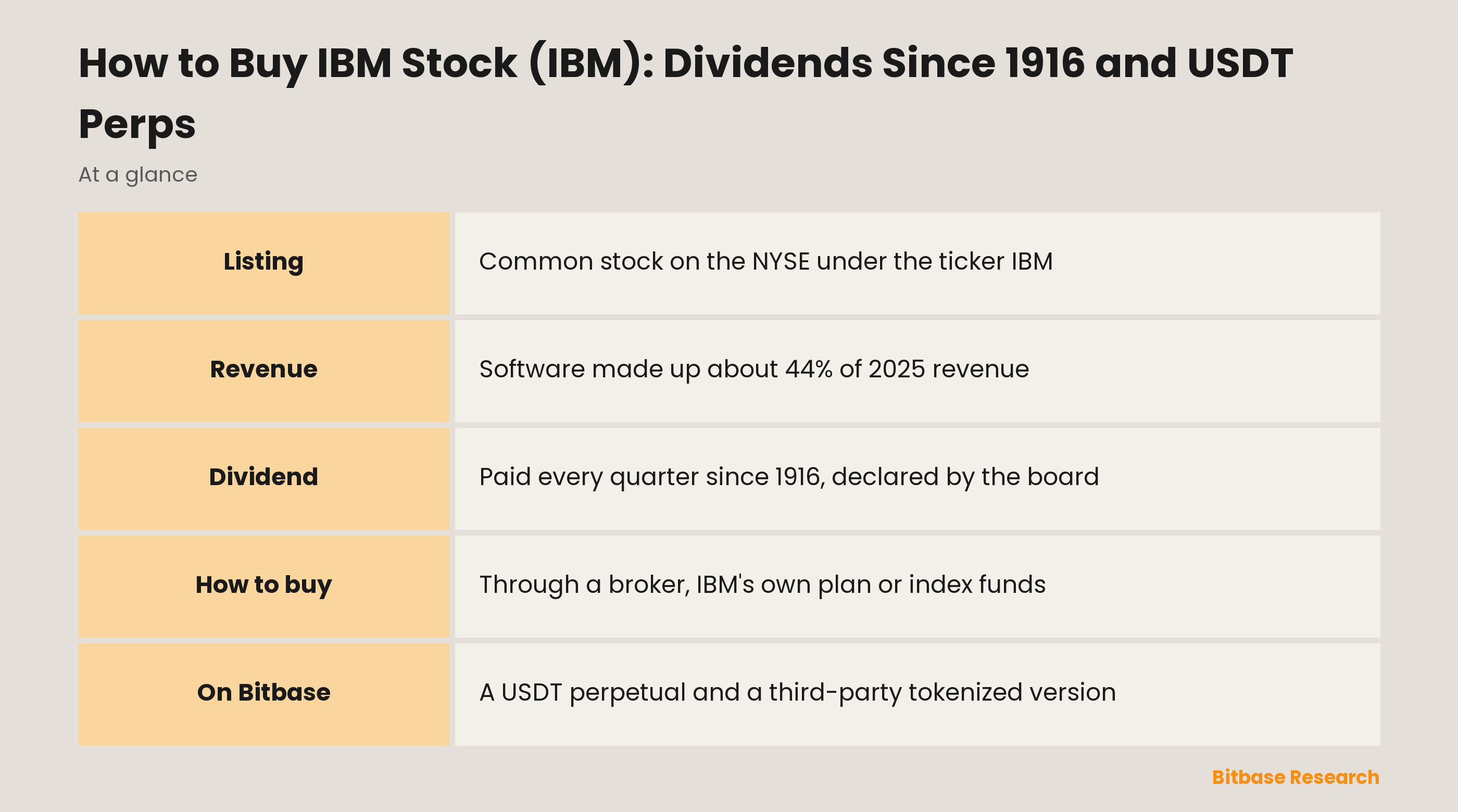
Any broker offering US-listed shares can buy IBM stock for you: it trades on the New York Stock Exchange under the ticker IBM. Incorporated in 1911, the company has paid a dividend every quarter since 1916 and now earns about three-quarters of its revenue from software and consulting. The shares themselves are not sold on Bitbase, which instead offers an IBM perpetual in USDT and a third-party tokenized version on spot.
What Does IBM Do?
IBM sells technology and expertise to large organisations: the software they run on, the consultants who put it in place, and the mainframes, servers and storage underneath. Its 10-K sums up the aim as helping clients "leverage the power of hybrid cloud and artificial intelligence (AI)" across their own data centres and public clouds.
It reports four segments. Software has four areas: Hybrid Cloud, which is Red Hat (Red Hat Enterprise Linux, OpenShift, Ansible); Automation, which includes HashiCorp; Data, built around watsonx and databases; and Transaction Processing, the software behind banking, airline and retail workloads on IBM Z mainframes. Consulting designs and builds systems for clients, then runs some of them. Infrastructure sells IBM Z and LinuxONE mainframes, Power servers and storage, plus support. Financing is a captive lender whose leases and loans help clients pay for IBM products.
IBM was incorporated in New York on 16 June 1911 as the Computing-Tabulating-Recording Co. and renamed in 1924. Deals set its present shape: Red Hat, bought with cash on 9 July 2019; the spin-off of its managed infrastructure services business as Kyndryl on 3 November 2021; HashiCorp on 27 February 2025; and Confluent, an event-streaming software company, on 17 March 2026. The 10-K names Microsoft, Oracle and SAP among its software rivals, Accenture in consulting and Dell Technologies in infrastructure.
How IBM Makes Money
In 2025, a fiscal year that matches the calendar, Software made up about 44% of revenue, Consulting about 31%, Infrastructure about 23% and Financing about 1%. Software, the largest piece, also generated about 61% of the four segments' combined profit, its margin sitting well above Consulting's.
The mix has tilted toward software, which was about 40% of revenue in 2023. In 2025 total revenue grew about 8%, Software about 11% and Infrastructure about 12%, while Consulting grew only slightly. Automation, which now carries HashiCorp, grew about 18%. Transaction Processing was the largest of the four software areas, tying a sizeable slice of software revenue to the installed base of IBM Z machines.
About 60% of 2025 revenue came from outside the United States, and no single client reached 10% of revenue in 2023, 2024 or 2025.
IBM Stock at a Glance
| Item | Detail |
|---|---|
| Exchange | New York Stock Exchange |
| Ticker | IBM |
| Share class | One class of common stock, which IBM calls capital stock |
| Industry | Enterprise software, IT consulting and infrastructure |
| Index membership | S&P 500 and Dow Jones Industrial Average (tracking-fund holdings, 16 October 2026) |
| Headquarters | Armonk, New York |
| Fiscal year | Calendar year, ending 31 December |
| Dividend policy | Quarterly cash dividend, paid consecutively since 1916 |
| Share buybacks | Programme authorised in October 2018, suspended at the Red Hat closing in 2019 |
| Last stock split | 2-for-1, paid on 26 May 1999 |
For the live quote and chart, open the IBM stock page on Bitbase.
How to Buy IBM Stock
At a broker, the steps are:
1. Choose a broker with NYSE access that accepts clients from your country.
2. Open the account and pass verification. Non-US persons should have Form W-8BEN ready.
3. Add funds. Non-dollar deposits are converted, and the exchange rate adds to your cost.
4. Search for IBM and pick an order type. Market orders fill at the going price; limit orders cap what you pay and may never fill.
5. Set the size: whole shares, or a fraction where the broker allows it.
6. Track the position. Dividends land as cash, after any tax withheld.
From outside the US, the security is identical: IBM's listed shares are its own common stock rather than depositary receipts, so no ADR ratio applies. Tax is what varies. According to the IRS, "Most types of U.S. source income received by a foreign person are subject to U.S. tax of 30%," and a tax treaty may lower that rate. A foreign individual gives the payer Form W-8BEN to certify that status, "whether or not you are claiming a reduced rate." This is not tax advice.
IBM's own plan is another route: the annual report points investors to the Computershare Investment Plan, whose brochure covers direct purchase of IBM stock and dividend reinvestment, with eligibility and costs set out there. Index funds tracking the S&P 500 or the Dow give indirect exposure, at a weight that shifts daily.
Trading IBM on Bitbase
Bitbase lists an IBM perpetual futures contract margined and settled in USDT. It tracks IBM's share price yet owns nothing: no share, no dividend, no vote. It can be traded long or short with leverage, overnight and at weekends while the NYSE is shut.
Periodic funding payments between the long and short sides hold the contract near IBM's price, and when margin is exhausted the position is liquidated at the mark price. Since the NYSE is open only part of the week, the contract can drift while the shares sit still and then meet a different opening price. For the full mechanics, see the stock perpetual guide.
Funding interval, margin tiers, leverage limit and the mark price used outside NYSE hours are defined in the contract rules on Bitbase; read them first. Every stock product on Bitbase appears on its TradFi page.
On USDT spot, Bitbase also carries a tokenized version of IBM stock, issued by a third party that its market page names. That issuer's terms decide what the token stands for and whether it can be redeemed; check them before buying.
What Drives IBM Shares
The mainframe cycle. IBM attributes swings in IBM Z revenue to "product cycle dynamics." After the z17 launched in June 2025, IBM Z revenue rose about 52% for the year. In the second quarter of 2026 it fell 42%, which the 10-Q puts down to performance "below expectations" and to comparison with "a historically strong prior-year z17 launch." Transaction Processing software fell that quarter too.
Acquisitions. IBM completed ten acquisitions in 2025, HashiCorp and DataStax among them, then closed Confluent in March 2026. Each adds revenue, along with integration work and amortisation.
Consulting demand. Signings, management's estimate of new contract value, fell about 13% in 2025 after a strong 2024, though IBM says Consulting returned to growth in the second half.
The dollar. With about 60% of revenue earned abroad, currency moves change reported growth; IBM says its hedging programmes "defer, but do not eliminate" the effect.
The calendar. First-quarter revenue has historically trailed the preceding fourth quarter's, and quarter-end ordering makes single periods hard to predict, the company warns.
Risks in IBM's Filings
New technology bets. In growth areas such as AI, the risk factors say, "Client adoption rates and viable economic models are less certain," and failing to commercialise hybrid cloud, AI and quantum innovations quickly enough could cost market share and margins.
Deals and debt. One heading lists what acquisitions can bring: "Integration Challenges, Failure to Achieve Objectives, the Assumption or Retention of Liabilities and Higher Debt Levels."
Suppliers. Some businesses rely on "a single or a limited number of suppliers, including for server processor technology for certain semiconductors."
Pensions and lending. Weak markets can shrink pension trust assets, and the financing arm carries credit, interest-rate and residual-value risk.
The shares. "The market price of IBM common stock is subject to significant volatility," the 10-K warns, and every dividend needs the board's approval.
The Bitbase products. Leverage magnifies losses, funding builds up while a perpetual is held, and a jump at the NYSE open can push a position through its liquidation price; stock perpetual margin and liquidation risk explains how. The tokenized version adds reliance on its issuer.
Where to Check IBM's Numbers
On SEC EDGAR, IBM's CIK is 51143, and its 10-K is split unusually: the risk factors are in the 10-K itself, while the segment descriptions, management discussion and financial statements sit in the Annual Report to Stockholders, filed as Exhibit 13. Quarterly results come as an 8-K exhibit; the 10-K is out by the end of February and the 10-Qs by the end of April, July and October. ibm.com/investor holds the filings and split history.
IBM Stock FAQ
Does IBM pay a dividend?
Yes, quarterly. IBM says it has paid consecutive quarterly dividends since 1916, and the increase declared in April 2026 was the 31st year in a row it raised the payment. The current amount is on IBM's investor site.
Has IBM stock ever split?
Fifteen times. IBM's investor site lists the 2-for-1 split paid on 26 May 1999, record date 10 May 1999, as the last. There have also been 26 stock-dividend distributions, the latest in 1967.
What did IBM shareholders get in the Kyndryl spin-off?
One Kyndryl share for every five IBM shares held at the close of business on 25 October 2021. The separation was completed on 3 November 2021, and Kyndryl trades on the NYSE as KD. Shareholders paid nothing and gave up no IBM shares.
Is IBM in the Dow Jones Industrial Average?
Yes, as of 16 October 2026: on that day IBM was held by DIA, the fund tracking the Dow, and by SPY, the S&P 500 fund. Index members do change, so check the date.
Can I buy IBM stock with crypto?
Not directly. Brokers sell the shares for cash, so crypto must be converted first. With USDT on Bitbase you can trade the IBM perpetual, a derivative that tracks the price but is not stock, or the tokenized version on spot under its issuer's terms. The options are laid out in buying stocks with crypto.
Conclusion
Buying IBM stock takes one broker order; understanding it takes longer. Software supplies most of the segment profit, the mainframe cycle swings the hardware line, and deals from Red Hat to Confluent have reshaped the company since 2019. For USDT price exposure without ownership, the Bitbase perpetual and the tokenized version are separate instruments with their own costs.
Related reading
Other Bitbase articles on this topic:
- How to Buy Hewlett Packard Enterprise Stock (HPE): After Juniper
- How to Buy Lumentum Stock (LITE): Lasers, NVIDIA Stake and Perps
- How to Buy Motorola Solutions Stock (MSI): Radios, Video and 911
Disclaimer: This article is educational content from Bitbase Academy, provided for information only. It explains what a company or fund does and how the instruments referenced here differ from one another; it does not constitute investment, trading, tax, or financial advice, and it is neither a recommendation nor an endorsement of any security, token, or trading strategy. A tokenized stock is issued by a third party and is designed to give economic exposure to an underlying asset: it is not a share, it carries no shareholder rights, and it depends on the issuer's structure, eligibility rules, and redemption terms, which the issuer can change. Perpetual futures are leveraged derivatives that hold no underlying asset and can be liquidated, and trading hours, product availability, and eligibility differ by instrument and by jurisdiction and can change at any time. Written as of October 2026; verify everything yourself through company filings, the issuer's own documentation, and the product pages of the venue you trade on.
References
[1] IBM 2025 Form 10-K (SEC EDGAR) www.sec.gov
[2] IBM 2025 Annual Report, Exhibit 13 (SEC EDGAR) www.sec.gov
[3] IBM 10-Q, second quarter of 2026 (SEC EDGAR) www.sec.gov
[4] IBM first-quarter 2026 results (SEC EDGAR) www.sec.gov
[5] IBM 8-K, November 2021: Kyndryl (SEC EDGAR) www.sec.gov
[6] IBM 8-K, July 2019: Red Hat (SEC EDGAR) www.sec.gov
[7] IBM: stock splits and stock dividends www.ibm.com
[8] State Street: SPY holdings, 16 October 2026 www.ssga.com
[9] State Street: DIA holdings, 16 October 2026 www.ssga.com
[10] IRS: NRA withholding www.irs.gov
[11] IRS: About Form W-8 BEN www.irs.gov





