An IBN order on the New York Stock Exchange is how most investors outside India buy ICICI Bank stock: any broker offering US-listed shares can fill it in dollars, and each American depositary share (ADS) stands for two equity shares traded in Mumbai. Since 2 January 2026 those ADSs also carry a vote, cast by the depositary on holders' instructions instead of at the direction of the bank's board, as before. Behind the ticker is a lender that grew out of a development finance institution founded in 1955 and now controls listed insurers and a fund manager.
What Does ICICI Bank Do?
ICICI Bank Limited dates from 5 January 1994, when it was incorporated in India as part of the ICICI group. The group is older: ICICI was formed in 1955 "at the initiative of the World Bank, the Government of India and Indian industry representatives" to provide long-term project finance to Indian businesses. It became a diversified financial services provider after India liberalised its financial sector in the 1990s, and in 2002 ICICI merged into ICICI Bank.
Commercial banking is the core. Individuals bring deposits and borrow through home loans, car loans, personal loans and credit cards; companies use the bank for working capital, term loans, trade finance, cash management and foreign exchange, and it also lends to farmers. At 31 March 2026 it had 7,511 branches and 12,087 ATMs and cash recycler machines in India, banking subsidiaries in the United Kingdom and Canada, and branches in New York, Hong Kong, Singapore and other centres.
Around the bank sit specialised subsidiaries: the life insurer ICICI Prudential Life, renamed ICICI Life Insurance in 2026, ICICI Lombard General Insurance and ICICI Prudential Asset Management, all listed in India, plus the stockbroker ICICI Securities, wholly owned and delisted since 24 March 2025.
How ICICI Bank Makes Money
Most income is the spread between what loans and investments earn and what funding costs. In fiscal 2026 (April 2025 to March 2026), consolidated net interest income rose 9.1% and the net interest margin stayed at 4.41%, unchanged from a year earlier. Fees, treasury income and insurance premiums make up the rest.
The 20-F divides the group into seven segments defined by the Reserve Bank of India (RBI):
| Segment | What it covers | Share of fiscal 2026 segment profit | Change from fiscal 2025 |
|---|---|---|---|
| Retail banking | Exposures meeting the RBI's retail criteria: individuals and small businesses | 28.9% | +7.5% |
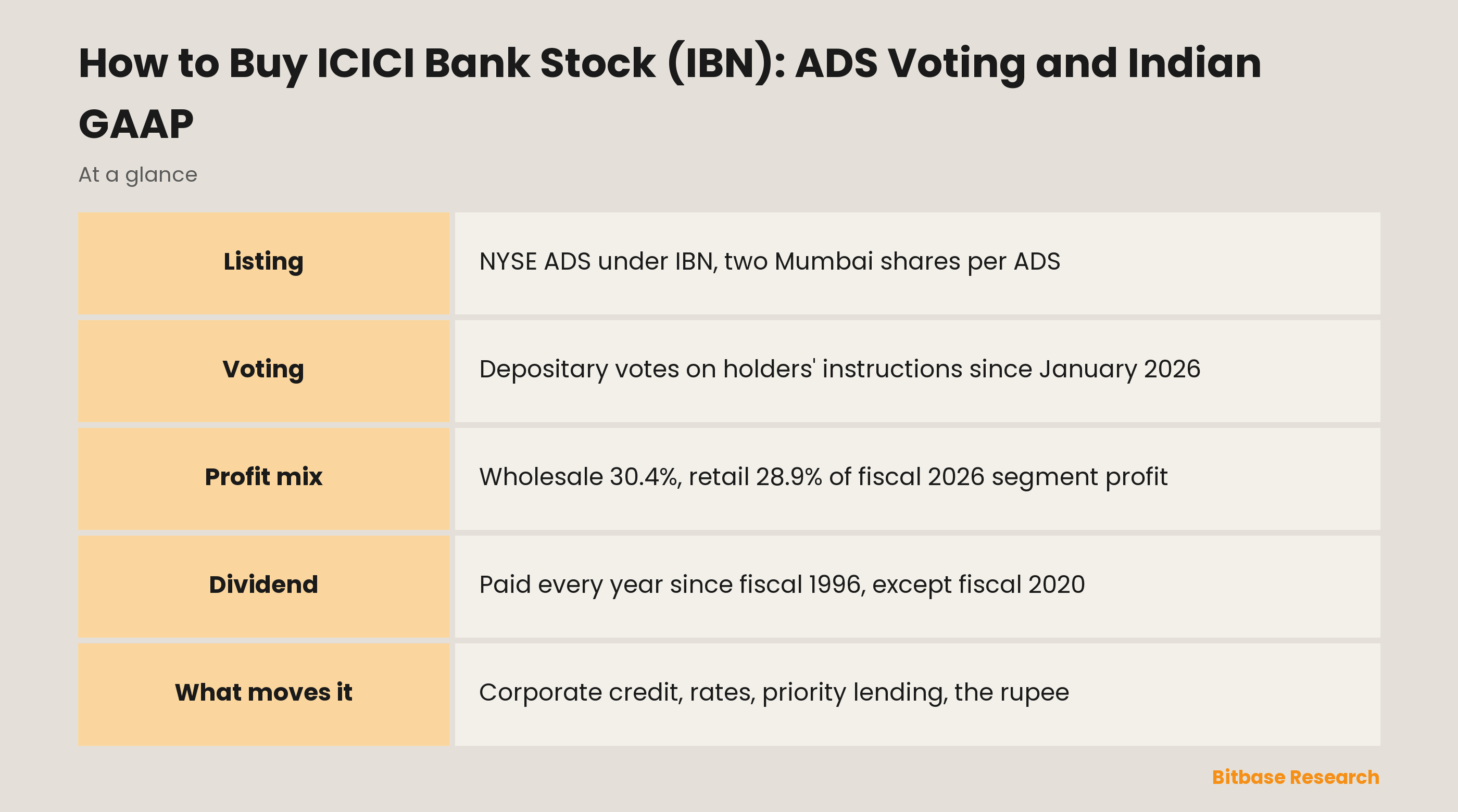
| Wholesale banking | Other lending to companies, trusts and public bodies | 30.4% | +13.6% |
| Treasury | The bank's investment and derivatives portfolio | 21.4% | −8.0% |
| Other banking | Leasing and the UK and Canadian banking subsidiaries | 2.1% | +17.3% |
| Life insurance | ICICI Life Insurance | 2.2% | +35.3% |
| General insurance | ICICI Lombard | 4.5% | +10.2% |
| Others | Brokerage, asset management, home finance and other subsidiaries | 10.4% | +12.9% |
Profit is profit before tax under Indian GAAP; shares are of the seven segments' combined total before inter-segment adjustments.
Retail and wholesale banking earn similar profits by different routes: wholesale lending grew faster with net provision write-backs in both years, while retail booked the bulk of loan-loss provisions. Group profit before tax rose 5.9%, and net profit attributable to shareholders 6.2%.
The loan book shows the same shift. Retail finance fell from 53.1% of gross loans at 31 March 2025 to 51.3% a year later, growing 11.5% against 15.5% for all gross loans. Within retail, home loans, a category that also covers borrowing against property, made up 63.7%, and personal loans and card balances most of the unsecured 21.9%. The 20 largest borrowers accounted for 4.2% of gross loans, and the bank says it has "no specific targets for loan mix or segment-wise loan growth."
IBN Stock at a Glance
| Item | Detail |
|---|---|
| Issuer | ICICI Bank Limited, incorporated in India on 5 January 1994 |
| US listing | ADSs on the NYSE under IBN, first issued in March 2000 |
| ADS ratio | One ADS represents two equity shares of Rs 2 par value |
| Indian listing | National Stock Exchange of India (ICICIBANK) and BSE (532174), in rupees |
| Depositary | Deutsche Bank Trust Company Americas, holding 16.0% of the equity shares at 30 June 2026 |
| ADS voting | Through the depositary, on holders' instructions, since 2 January 2026 |
| Foreign ownership | 50.3% at 30 June 2026; the ceiling for private sector banks is 74% |
| Offices | Corporate office in Mumbai; registered office in Vadodara, Gujarat |
| Fiscal year-end | 31 March |
| 20-F accounts | Indian GAAP, with net income and equity reconciled to US GAAP |
| Dividends | Annual, paid every year since fiscal 1996 except fiscal 2020 |
| Status | Designated a domestic systemically important bank by the RBI |
| SEC reporting | CIK 1103838; annual Form 20-F, current reports on Form 6-K |
Prices move by the minute; for the live quote, open the ICICI Bank stock page on Bitbase.
How to Buy ICICI Bank Stock
ICICI Bank stock comes in two forms: dollar-priced ADSs in New York and rupee-priced equity shares on the NSE and BSE. Buying in India from abroad runs into foreign-investment and exchange rules, so for most non-residents the ADS is the practical route:
1. Open an account with a broker that offers NYSE-listed securities, and check which entity holds it and who regulates it.
2. Fund it in US dollars. Starting from another currency, check the conversion cost, not only the commission.
3. Search for IBN and read the name. It should say ICICI Bank Limited American depositary shares; ICICI Lombard and ICICI Life Insurance have their own shares in India, and owning them is a different investment from owning the bank.
4. Choose how the order executes. A limit order sets the most you will pay; a market order takes the price available when it arrives.
5. Size the position. One ADS is two shares, so compare its price with twice the rupee share price in dollars. Fractions of an ADS depend on the broker.
The ADS and the Mumbai shares. Deutsche Bank Trust Company Americas holds the shares behind the ADSs. Under the amended deposit agreement it votes them as ADS holders instruct, provided they show their holdings comply with Indian banking law. Programmes differ: holders of Sumitomo Mitsui's ADSs can instruct their depositary only when the company asks it to collect instructions. You can surrender IBN ADSs for the shares, but selling them in India, converting the rupees and sending the money abroad may each need RBI approval. Redepositing is restricted too, and the 20-F warns that such limits "increase the risk that the market price of our ADSs will be below that of the equity shares."
Foreign ownership. Foreign investors may own up to 74% of a private sector bank, with stakes above 49% needing government approval. At 30 June 2026 they held 50.3% of ICICI Bank, ADS holders included.
What India taxes. India taxes ADS dividends at 10%, deducted by the payer, and the depositary takes its fee from each cash distribution. A sale of ADSs outside India between two non-residents does not give rise to Indian capital gains tax, and exchanging ADSs for the shares is not a taxable event in India. Your own country may tax both.
Inside a fund. At 30 June 2026 the shareholder table lists Vanguard's Total International Stock Index Fund with 1.1% and its Emerging Markets Stock Index Fund with 1.0%, each owning the bank alongside many other companies.
What Moves IBN Stock
Corporate lending and credit costs. In fiscal 2026 loans to companies grew faster than retail loans and needed no net provisions, while retail absorbed the credit cost. Gross non-performing loans fell from 1.69% to 1.41% of gross loans. With no loan-mix target, how that balance develops feeds straight into profit.
Rates. About 56.0% of domestic loans were linked to external benchmarks at 31 March 2026, so RBI rate cuts reach them quickly, while deposits reprice more slowly. In fiscal 2026 the bank cut the cost of savings deposits from 3.16% to 2.60%, and the margin held.
Directed lending. RBI rules require banks to lend set shares of credit to priority sectors, agriculture among them, and targets can also be met by buying priority-sector lending certificates at a premium. Higher premiums on those certificates were the main reason treasury profit fell 8.0% in fiscal 2026.
The listed subsidiaries. Part of an IBN share is its stakes in listed companies, and 2026 changed one of them: Prudential agreed in May to buy 75% of another Indian life insurer, Bharti Life, the joint venture dropped the Prudential name, and the bank bought a further 2.0% of it in the quarter to 30 September 2026. An RBI direction effective 1 April 2026 also says a form of business should, in principle, sit in one entity per banking group.
Who owns the shares. Foreign investors held 50.3% at 30 June 2026 against 57.2% a year earlier, while Indian investors other than government-controlled ones rose from 37.1% to 44.7%. Flows into Indian funds such as SBI Mutual Fund (6.3%) and decisions by foreign portfolio investors both bear on the price.
The rupee. The ADS trades in dollars, but earnings and dividends are in rupees. The 20-F records a 10.9% depreciation of the rupee against the dollar in fiscal 2026.
IBN Risks: Credit, Regulators and the ADS
Asset quality. "If the level of our non-performing assets increases and the overall quality of our loan portfolio deteriorates, our business will suffer." Project finance, real-estate-linked and commodity sector loans are named as particularly vulnerable.
India's economy. "We are heavily dependent upon the state of the Indian economy," the filing says; domestic operations produced 97.6% of fiscal 2026 revenue.
Supervisors. "The enhanced supervisory and compliance environment in the financial sector increases the risk of regulatory action against us, whether formal or informal." The RBI fined the bank in April and August 2025, and after its annual supervisory review directed an extra provision on agricultural loans whose terms did not fully meet priority-sector rules.
The insurers. "While our insurance businesses are an important part of our business, there can be no assurance of their future rates of growth or levels of profitability."
The ADS itself. Voting through the depositary depends on proving compliance with Indian law, and no single shareholder can exercise more than 26% of the votes. US holders may be shut out of rights issues without a US registration or exemption. And with the SEC reviewing its rules for foreign private issuers, the 20-F says continued US listing "is thus subject to various considerations." Above all, one stock ties the result to one bank and one currency.
How to Research ICICI Bank Yourself
On EDGAR, ICICI Bank files under CIK 1103838; the fiscal 2026 Form 20-F was filed on 20 July 2026. Form 6-K reports, often several a week, copy what the bank tells the Indian exchanges: quarterly results, board decisions, rating actions, tax demands and management changes. Its website is www.icici.bank.in.
Three things trip up comparisons. Accounting: the 20-F follows Indian GAAP, used there since the year to March 2006, and a reconciliation restates net income under US GAAP. The gap moves: US GAAP profit attributable to shareholders was about 3.4% higher in fiscal 2026 and about 38.7% higher in fiscal 2024, mainly on a fair value gain on ICICI Lombard. Against a US lender's 10-K, such as Bank of America's, the reconciled figure is the closer match. Calendars: Indian releases label quarters by fiscal year, so Q2-2027 means July to September 2026. Units: Indian releases count in crore, ten million rupees each. For other companies, browse more US stock pages on Bitbase.
ICICI Bank Stock FAQ
Can IBN ADS holders vote?
Yes, since 2 January 2026. Before then, the depositary voted the shares as the bank's board directed; now it follows holders' instructions, subject to Indian law, including proof that holdings comply with Section 12B of the Banking Regulation Act, and to the 26% ceiling for any one shareholder. Shares without instructions are not voted. In a February 2026 postal ballot, the votes the depositary cast on holders' instructions counted towards the result.
Does ICICI Bank pay a dividend?
Yes, once a year. It has paid every year since fiscal 1996, its second year of operation, except fiscal 2020, when an RBI circular told banks to keep that year's profits. The board proposes the amount, the annual general meeting may approve or lower it, and the fiscal 2026 dividend was approved on 21 August 2026. ADS holders receive it in dollars after Indian withholding.
Can I buy ICICI Bank stock with crypto?
Not directly. Brokers sell IBN for dollars and the Mumbai shares for rupees, so any crypto must first be converted into fiat money and the proceeds moved to the broker by bank transfer or another fiat rail. Depending on where you live, selling the crypto may be taxable.
Is ICICI Bank owned by the Indian government?
No. The 20-F states that "the Government of India has never directly held any of our shares." Government-controlled institutions held 5.0% at 30 June 2026, mostly the Life Insurance Corporation of India with 4.4%. The largest line on the register is the ADS depositary.
Are ICICI Lombard and ICICI Prudential part of ICICI Bank?
They are subsidiaries with their own listings. At 31 March 2026 the bank held 50.9% of the life insurer and 53.0% of ICICI Prudential Asset Management, and it has held more than half of ICICI Lombard since February 2024. Their results are consolidated, but an IBN ADS represents only ICICI Bank shares.
Conclusion
From abroad, buying ICICI Bank usually means one IBN order in New York: two Mumbai shares per ADS and, since January 2026, a vote that follows your instructions. Behind it is a lender whose corporate book is outgrowing its retail book, with stakes in listed insurers, reporting under Indian GAAP and earning in rupees. Read the latest 20-F and the 6-Ks filed since before deciding how large a position in one Indian bank makes sense.
Related reading
Other Bitbase articles on this topic:
- How to Buy Capital One Stock (COF): Card Lender, Discover Network
- How to Buy CIBC Stock (CM): Dividend, Mortgages, Caribbean Sale
- How to Buy Citigroup Stock (C): Five Businesses, Banamex Exit
Disclaimer: This article is educational content from Bitbase Academy, provided for information only. It explains what a company or fund does and how the instruments referenced here differ from one another; it does not constitute investment, trading, tax, or financial advice, and it is neither a recommendation nor an endorsement of any security, token, or trading strategy. A tokenized stock is issued by a third party and is designed to give economic exposure to an underlying asset: it is not a share, it carries no shareholder rights, and it depends on the issuer's structure, eligibility rules, and redemption terms, which the issuer can change. Perpetual futures are leveraged derivatives that hold no underlying asset and can be liquidated, and trading hours, product availability, and eligibility differ by instrument and by jurisdiction and can change at any time. Written as of October 2026; verify everything yourself through company filings, the issuer's own documentation, and the product pages of the venue you trade on.
References
[1] ICICI Bank, Form 20-F for fiscal 2026 (SEC EDGAR) www.sec.gov
[2] ICICI Bank, postal ballot voting results, February 2026 (Form 6-K) www.sec.gov
[3] ICICI Bank, outcome of the annual general meeting of 21 August 2026 (Form 6-K) www.sec.gov
[4] ICICI Bank, amendment to its Japanese annual securities report, September 2026 (Form 6-K) www.sec.gov
[5] ICICI Bank, results for the quarter to 30 September 2026 (Form 6-K) www.sec.gov





