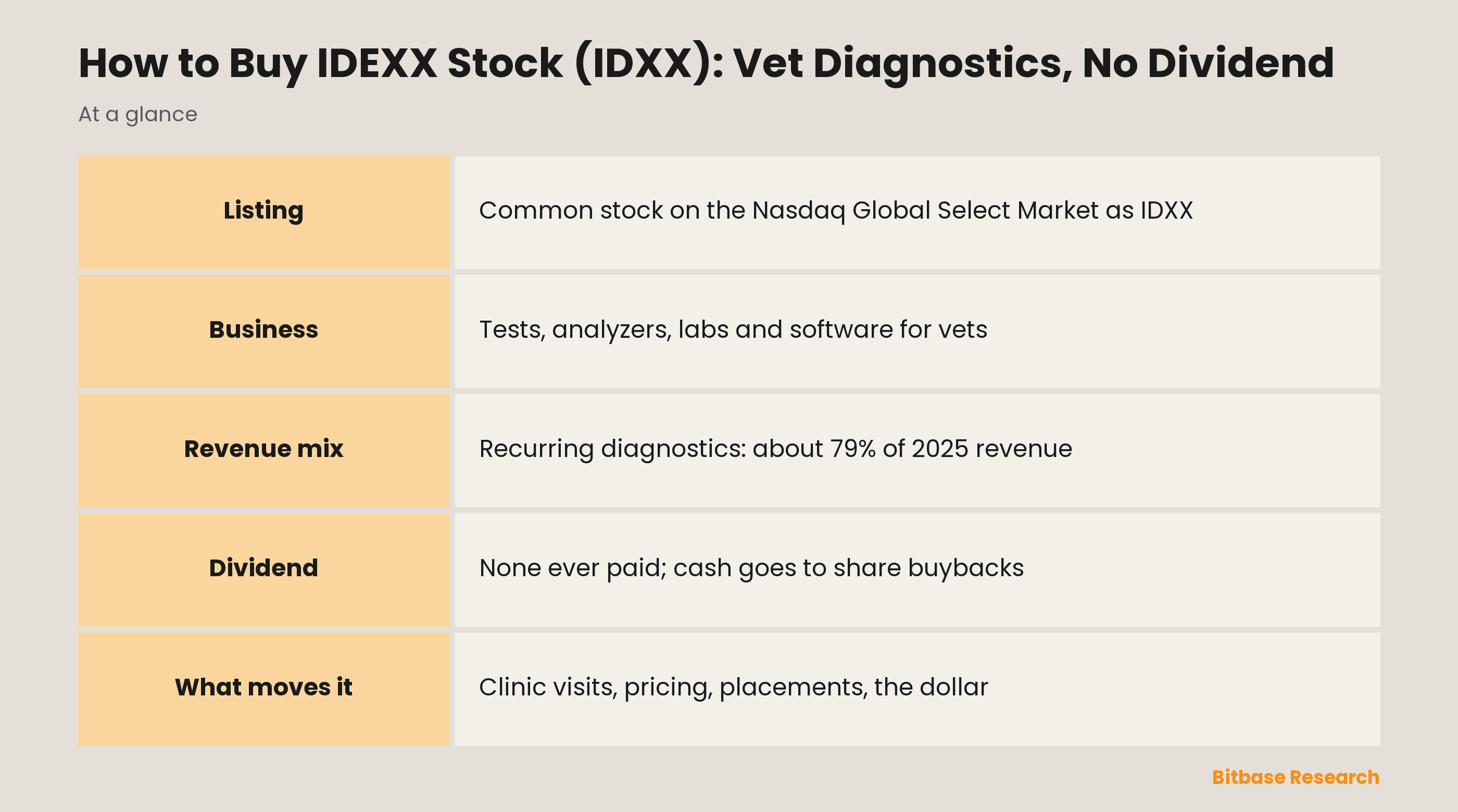
Since IDEXX Laboratories lists its common stock on the Nasdaq Global Select Market as IDXX, any broker that offers US shares can take the order. What the share buys is a business built on repeat testing: in 2025, diagnostics that veterinary practices reorder as they treat patients made up about 79% of IDEXX's revenue, and the company has never paid a cash dividend, returning cash through share buybacks instead. Below: what IDEXX sells, how an order works, and what its filings point to as the forces behind the results, from clinic traffic and corporate hospital chains to currency.
What Does IDEXX Do?
IDEXX was incorporated in Delaware in 1983 and is based in Westbrook, Maine. Its annual report says it develops, manufactures and distributes products and provides services "primarily for the companion animal veterinary; livestock, poultry and dairy; and water testing industries," and that it also makes human medical point-of-care diagnostic products. The company sells in more than 175 countries.
It reports three segments. The Companion Animal Group, or CAG, serves veterinary practices that treat pets. Water sells tests for microbial contamination in water. Livestock, Poultry and Dairy, or LPD, sells tests used to manage the health of farm animals and the quality of milk. A small Other segment holds the human medical diagnostics business and an out-licensing arrangement.
Tests run inside the clinic. The IDEXX VetLab suite is a family of analyzers that sit in the practice. The Catalyst One chemistry analyzer, ProCyte One hematology analyzer, SediVue Dx urinalysis analyzer and IDEXX inVue Dx cellular analyzer all use proprietary AI in their image capture systems, according to the 10-K. The inVue Dx, launched in late 2024, automates cytology and blood cell morphology on a slide-free, load-and-go platform. Next to the analyzers sit the SNAP rapid assays: single-use handheld kits such as SNAP 4Dx Plus, which tests for heartworm and several vector-borne diseases including Lyme disease, and SNAP Feline Triple for cats.
Tests sent out. IDEXX also runs a network of approximately 80 reference laboratories serving practices in the United States, Europe, Canada, Australia, Japan, New Zealand, South Africa and South Korea, and most results come back the same day or the next. In 2025 it launched the IDEXX Cancer Dx Panel in North America, a blood test that screens dogs for lymphoma, and its third-quarter 2026 release describes Cancer Dx as "becoming a multi-cancer panel."
Software and imaging. Practices run scheduling, patient records and billing on IDEXX practice management systems: the cloud-based ezyVet, Animana and IDEXX Neo, and the on-premises Cornerstone. The company also sells digital X-ray systems, with the ImageVue DR50 Plus launched in North America in January 2026, and on 15 September 2026 it acquired CoVet, "a provider of AI-native ambient listening and clinical workflow software for veterinary practices."
Water and farm animals. The main water products, the Colilert, Colilert-18 and Colisure tests, detect total coliforms and E. coli; government laboratories, water utilities and private certified laboratories use them to test drinking water against regulatory standards, including those of the US Environmental Protection Agency. LPD sells tests for cattle and swine diseases such as bovine viral diarrhea and PRRS, pregnancy tests for cattle, and SNAP tests that dairies and processors use to detect antibiotic residues in milk.
The 10-K names its rivals. In North American companion animal diagnostics they include the Mars, Incorporated brands Antech Diagnostics and Heska, and Zoetis with its subsidiary Abaxis. In veterinary software the largest competitor in North America and the UK is Covetrus. In water and livestock testing the list includes Neogen, Charm Sciences, BioChek, Innovative Diagnostics and Thermo Fisher Scientific, which is profiled in our Thermo Fisher stock guide.
On 12 May 2026 Michael (Mike) Erickson became President and Chief Executive Officer, and his predecessor Jay Mazelsky moved to Executive Chair, a transition IDEXX announced in January 2026.
How IDEXX Makes Money
Companion animal products and services produced about 92% of 2025 revenue. Within that segment the money comes from several lines, and the faster-growing ones are the consumables and tests that practices buy again and again:
| Revenue line | Share of 2025 revenue | 2025 growth, as reported | What it covers |
|---|---|---|---|
| IDEXX VetLab consumables | 35% | 14.8% | Supplies used up by the in-clinic analyzers |
| Reference laboratory services | 33% | 6.6% | Samples sent to IDEXX laboratories, plus consulting |
| Rapid assay products | 8% | −3.0% | SNAP test kits |
| Software, services and imaging | 8% | 10.6% | Practice software subscriptions, X-ray systems |
| CAG instruments | 5% | 51.8% | Analyzers placed in clinics |
| CAG services and accessories | 3% | 5.4% | Maintenance agreements and accessories |
| Water | 5% | 8.7% | Water microbiology tests |
| LPD | 3% | 8.0% | Livestock, poultry and dairy tests |
Shares are calculated from the 10-K's revenue breakdown; the small Other segment makes up the remainder.
The model works like a printer and its ink. "Revenues related to capital placements of our point-of-care IDEXX VetLab suite of instruments and our SNAP Pro Analyzer are non-recurring in nature because they are sold to a particular customer only once," the 10-K says, while the consumables, kits, laboratory work and maintenance that follow are recurring. The company adds that "the multi-year consumable revenue stream is significantly more valuable than the placement of the instrument," and that recurring revenues "have significantly higher gross margins than those provided by our instrument sales." Many instruments are placed under customer commitment arrangements, in exchange for multi-year commitments to buy recurring products and services.
That is why the installed base matters. At the end of 2025, IDEXX counted about 78,000 Catalyst chemistry analyzers, 56,000 premium hematology analyzers, 24,000 SediVue Dx units and 6,000 inVue Dx units in the field, and it credited part of the 2025 consumables gain to "12% growth in our installed base of premium instruments." One product line shows how the pieces trade off: rapid assay revenue fell partly because customers moved pancreatic lipase testing from SNAP kits to the Catalyst platform.
Total revenue rose 10.4% in 2025, or 9.6% on an organic basis, which strips out currency and acquisitions. Income from operations reached 31.6% of revenue, up from 29.0% in 2024, and research and development took 5.8% of revenue.
The United States produced about 64% of 2025 revenue. Customers outside it accounted for about 36% overall, and for about 34% of CAG revenue, 81% of LPD revenue and 50% of Water revenue. No single customer accounted for more than a tenth of consolidated revenue.
IDXX Stock at a Glance
| Feature | IDXX |
|---|---|
| Exchange | Nasdaq Global Select Market |
| Ticker | IDXX |
| Security | Common stock, the only class registered under Section 12(b) |
| Sector | Animal health diagnostics, veterinary software, water and livestock testing |
| Index membership | S&P 500 |
| Headquarters | Westbrook, Maine |
| Incorporated | Delaware, 1983 |
| Fiscal year | Calendar year, ending 31 December |
| Dividend | None: no cash dividend has ever been declared or paid |
| Buybacks | Open-market repurchase program first approved in 1999, with no expiration date |
| Stock splits | Two-for-one in November 2007 and in June 2015 |
| SEC identifier | CIK 874716 |
Price, market value and trading volume change constantly; for live figures, see the IDEXX stock page on Bitbase.
How to Buy IDEXX Stock
IDEXX is a US company filing a 10-K, so there is no depositary receipt to think about: the common stock on Nasdaq is the share itself. The purchase takes seven steps:
1. Open an account with a broker that reaches Nasdaq. Abroad, that can be a local broker with US market access or an international one; check which entity holds your account and who regulates it.
2. Pass the identity and tax checks. Non-US individuals usually certify their status on IRS Form W-8BEN; the IRS tells foreign persons to submit it "when requested by the withholding agent or payer."
3. Fund the account. If your money is not in US dollars, the conversion has a price of its own, so compare the exchange rate as well as the commission.
4. Find the right listing. Search IDXX and confirm that the issuer shown is IDEXX Laboratories, Inc., listed on Nasdaq.
5. Choose an order type. FINRA says a market order "provides the most certainty that your order will be executed," while a limit order buys "at or better than a specified price."
6. Decide how much. Some brokers let you buy a fraction of a share for a fixed amount of money; whether that is available for IDXX, and what rights a fractional holder gets, depends on the broker.
7. Keep your records. Trade confirmations establish your cost basis for any later sale.
Tax for buyers abroad. The IRS says that "most types of U.S. source income received by a foreign person are subject to U.S. tax of 30%," with a lower rate or exemption possible under a tax treaty. IDEXX pays no dividend, so today that withholding has nothing to apply to, but the form is still requested and the question would return with any future dividend. Gains on a sale may be taxed where you live.
Holding it through a fund. IDXX is a constituent of the S&P 500, and State Street's daily holdings file for SPY, dated 5 November 2026, lists IDEXX Laboratories Inc. An index fund holds IDEXX as one small position among hundreds.
What Moves IDXX Stock
Clinic traffic against testing depth. IDEXX watches visit and revenue data from a sample of US customers. In 2025, US same-store clinical visits at veterinary practices "declined approximately 2%," hit by practice capacity limits and the economy, yet average diagnostics revenue per practice grew about 6%, faster than overall practice revenue at about 2%. The company's first 2026 outlook expected a similar decline in visits. When fewer pets come in, growth has to come from more testing per visit, new tests and price.
New analyzers in the field. Every placement adds a source of consumables sales. In the third quarter of 2026 IDEXX placed over 1,900 inVue Dx analyzers, taking that installed base to nearly 11,000 instruments, and said its global premium instrument installed base grew 11%.
Pricing power. Among the strategies the 10-K lists as essential is "maintaining premium pricing, including by effectively implementing price increases," in a market where competitors "sell lesser offerings at lower prices." According to the MD&A, higher realized prices helped 2025 growth in consumables, reference laboratory services and software subscriptions, so any sign of push-back from customers matters.
Who owns the clinics. In the United States, the 10-K says, "the number of owners of veterinary hospitals has been declining." Large corporate owners include Mars, Incorporated, which owns Banfield Pet Hospitals, BluePearl Veterinary Partners and VCA, and National Veterinary Associates. Some run their own reference laboratories, and hospitals they acquire generally try to shift testing there.
Currency. About 23% of 2025 revenue came from products made or sourced in US dollars and sold abroad in local currencies. A stronger dollar shrinks both the dollar value of foreign sales and the profit on those exports; the euro, pound, Canadian dollar, yen, renminbi, Australian dollar and Brazilian real are the currencies the 10-K names.
Seasons and guidance. Canine vector-borne disease tests sell more in the first half of the year because of the testing season in the Northern Hemisphere. The quarterly releases carry a full-year outlook; in November 2026 IDEXX raised its 2026 revenue outlook and lowered its operating margin outlook, with the update including acquisition-related impacts. The share price can swing widely as well: by the 10-K's own figures, its 2025 high was more than double its low.
Clinic Visits, Corporate Buyers and Other IDEXX Risks
The 10-K's Item 1A runs long. These are the items that bear most directly on an IDXX share, and the third-quarter 2026 10-Q reports no material changes to them.
Competition. "The companion animal healthcare industry is highly competitive, and we anticipate increasing competition from both existing competitors and new sector entrants given our performance and the industry's strong growth and returns."
Pet population and testing habits. "The growth of our CAG business relies in part on a stable pet population and evolving testing patterns of increasing frequency and depth of diagnostic testing." Vaccines or preventatives for the diseases IDEXX tests for could also reduce testing.
Buying power of large customers. Corporate hospital owners and buying consortiums "often seek to improve profitability by leveraging the buying power they derive from their scale to obtain favorable pricing from suppliers." A decision by a large group to move its purchases to a competitor would cost future revenue.
Sole suppliers. Several important consumables come from a single source, including certain Catalyst chemistry slides made by Ortho-Clinical Diagnostics, a QuidelOrtho subsidiary, under agreements currently set to expire in December 2044. The 10-K warns that some of these items "cannot be readily or easily replaced by alternative sources."
Biologic manufacturing and approvals. Many rapid assay, livestock, water and dairy tests contain antibodies, cells or sera, and "manufacturing biologic products is highly complex." Infectious disease tests need US Department of Agriculture approval before sale in the US, dairy tests need FDA approval and water methods need EPA approval, so agency delays, including those from a government shutdown, can hold back launches.
AI. IDEXX builds AI into its analyzers and software and warns that "AI algorithms and models may be flawed" and that rivals may adopt it faster.
International exposure. With about 36% of revenue from outside the United States, the company carries currency, trade and tariff risk; tariffs on components could raise its costs.
Two risks belong to the share rather than the company. A single stock ties your result to one firm. And an IDEXX shareholder receives no dividend, so the return depends entirely on the share price; buybacks reduce the share count, but the program "may be suspended or discontinued at any time."
Checking IDEXX Filings and Results Yourself
IDEXX files with the SEC under CIK 874716: the 10-K each year, a 10-Q for each of the first three quarters, and 8-Ks for events, including each quarterly earnings release, which in 2026 came on 2 February, 5 May, 4 August and 2 November.
In the 10-K, Item 1 describes the products and names the competitors, Item 1A sets out the risks and Item 5 holds the market listing, the dividend statement and the buyback program. The MD&A carries the installed base table and revenue growth for each CAG line, and Note 3 and Note 17 break revenue down by product, segment and geography.
Three habits help. Separate reported growth from organic growth, a non-GAAP measure that removes currency and acquisitions, and check the reconciliation published with it. Read CAG Diagnostics recurring revenue together with instrument placements, since a strong quarter for instruments can lower the gross margin through mix. And compare a full year, not one quarter, because vector-borne disease testing peaks in the first half. Live quotes are on the stock page linked above, and Bitbase's list of US stock pages covers other listed companies.
IDEXX Stock FAQ
Can I buy IDEXX stock with crypto?
Not directly. IDXX shares are bought through a brokerage account in US dollars, so you would first sell crypto for cash and move the cash to the broker, and that sale may be taxable where you live. A share also gives you rights in a registered company that a crypto asset does not, which is how a share differs from a crypto asset.
Does IDEXX pay a dividend?
No. The 10-K states that IDEXX has "never declared or paid any cash dividends" on its common stock and has "no intention to declare or pay a dividend at this time." It returns cash through open-market share repurchases under a program running since 1999.
Has IDEXX stock ever split?
Yes. IDEXX's filings record a two-for-one split effected as a stock dividend distributed on 26 November 2007 and another two-for-one split whose new shares were distributed on 15 June 2015. Per-share figures before each date were adjusted, so check that any older data you compare is split-adjusted.
Is IDXX in the S&P 500?
Yes. State Street's daily holdings file for SPY, the ETF that tracks the S&P 500, listed IDEXX Laboratories Inc on 5 November 2026. Index weights change every day.
Who are IDEXX's main competitors?
In North American pet diagnostics the 10-K names Antech Diagnostics and Heska, both Mars, Incorporated brands, and Zoetis with Abaxis; in software, Covetrus; in water and livestock testing, companies such as Neogen and Thermo Fisher Scientific.
Who is the CEO of IDEXX?
Michael (Mike) Erickson, who became President and Chief Executive Officer on 12 May 2026 after joining IDEXX in 2011. Jay Mazelsky, the previous chief executive, became Executive Chair.
Conclusion
IDEXX sells analyzers, but the analyzer is only the start of the business. What the share really rests on is what happens after installation. IDEXX earns most of its money from tests that veterinary practices repeat on installed analyzers and send to its laboratories, it pays no dividend, and its results lean on clinic traffic, pricing and the strength of the dollar. Read the latest 10-K and quarterly release, look at recurring revenue and placements together, and decide how much one diagnostics company should weigh in your portfolio.
Related reading
Other Bitbase articles on this topic:
- How to Buy BeOne Medicines Stock (ONC): The Former BeiGene
- How to Buy Genmab Stock (GMAB): ADS Ratio and DARZALEX Royalties
- How to Buy Roivant Stock (ROIV): The Vants Behind LISRAYA
- How to Buy Zoetis Stock (ZTS): Pet Drugs Spun Off From Pfizer
Disclaimer: This article is educational content from Bitbase Academy, provided for information only. It explains what a company or fund does and how the instruments referenced here differ from one another; it does not constitute investment, trading, tax, or financial advice, and it is neither a recommendation nor an endorsement of any security, token, or trading strategy. A tokenized stock is issued by a third party and is designed to give economic exposure to an underlying asset: it is not a share, it carries no shareholder rights, and it depends on the issuer's structure, eligibility rules, and redemption terms, which the issuer can change. Perpetual futures are leveraged derivatives that hold no underlying asset and can be liquidated, and trading hours, product availability, and eligibility differ by instrument and by jurisdiction and can change at any time. Written as of November 2026; verify everything yourself through company filings, the issuer's own documentation, and the product pages of the venue you trade on.
References
[1] IDEXX Laboratories Form 10-K for 2025 (SEC EDGAR) www.sec.gov
[2] IDEXX 2025 Form 10-K, XBRL cover page (SEC EDGAR) www.sec.gov
[3] IDEXX 2025 Form 10-K, XBRL revenue by product and service (SEC EDGAR) www.sec.gov
[4] IDEXX 2025 Form 10-K, XBRL revenue by geographic area (SEC EDGAR) www.sec.gov
[5] IDEXX Form 10-Q for the third quarter of 2026 (SEC EDGAR) www.sec.gov
[6] IDEXX third-quarter 2026 earnings release, filed with Form 8-K (SEC EDGAR) www.sec.gov
[7] IDEXX Form 8-K of 13 January 2026: CEO transition (SEC EDGAR) www.sec.gov
[8] IDEXX Form 10-K for 2015: 2015 stock split (SEC EDGAR) www.sec.gov
[9] IDEXX Form 10-K for 2007: 2007 stock split (SEC EDGAR) www.sec.gov
[10] State Street SPDR S&P 500 ETF Trust (SPY): fund page and daily holdings www.ssga.com
[11] FINRA: Order Types www.finra.org
[12] IRS: NRA Withholding www.irs.gov
[13] IRS: About Form W-8 BEN www.irs.gov





