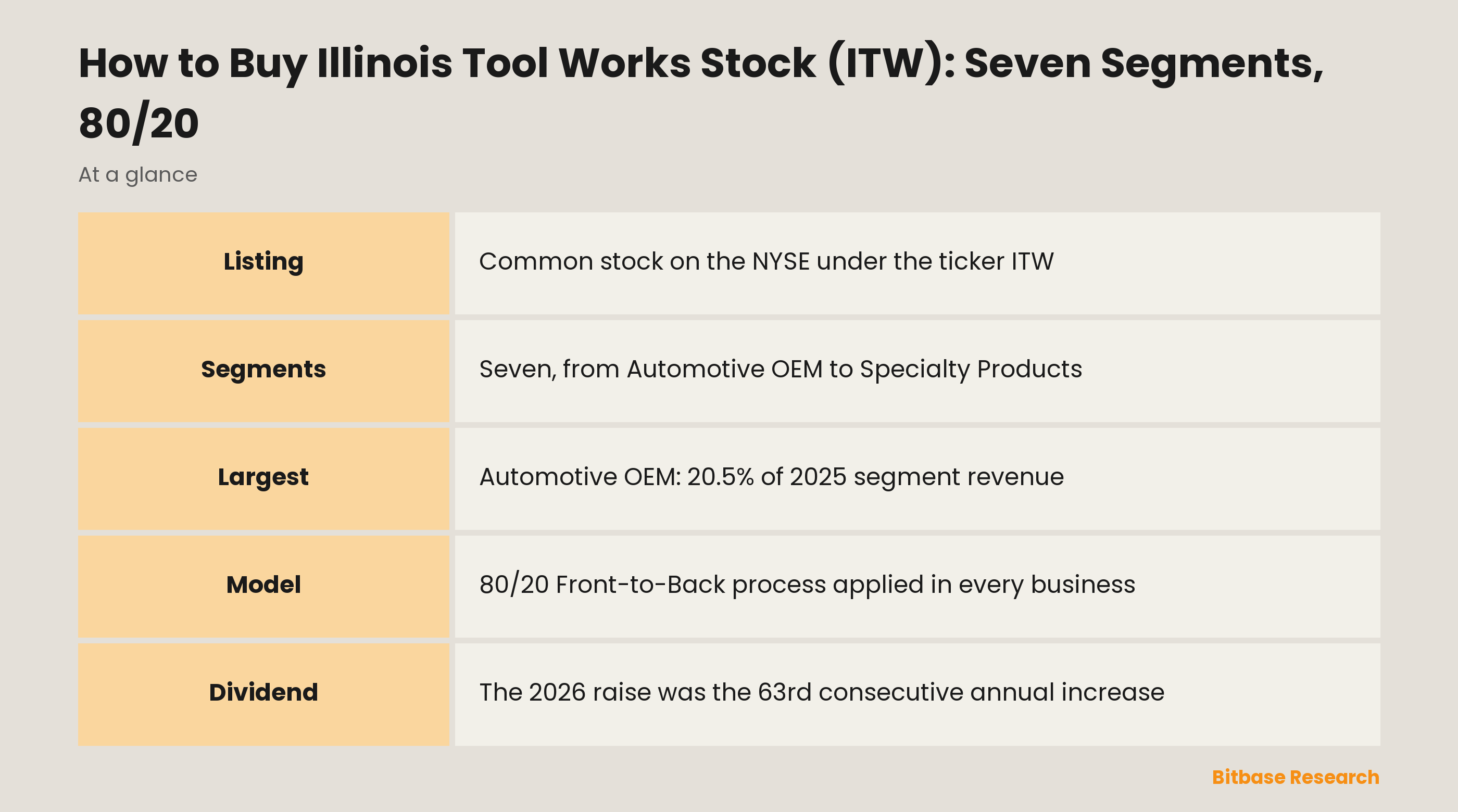
Wherever you hold a brokerage account that reaches the New York Stock Exchange, you can buy Illinois Tool Works common stock under the ticker ITW. The Glenview, Illinois manufacturer runs 88 divisions in 49 countries, grouped into seven segments that stretch from car fasteners and commercial dishwashers to welding machines and metal truss plates, and every division is managed with the same 80/20 Front-to-Back process. In the third quarter of 2026 its board raised the dividend again, which the company counts as the 63rd consecutive year of increases.
What Does Illinois Tool Works Do?
Illinois Tool Works Inc., usually shortened to ITW, describes itself in its annual report as "a global manufacturer of a diversified range of industrial products and equipment." It was founded in 1912 and incorporated in 1915, is based in Glenview, Illinois, and employed about 43,000 people at the end of 2025, roughly 16,000 of them in the United States. Its businesses sell mainly to industrial manufacturers, directly or through independent distributors.
The work is reported in seven segments:
Automotive OEM makes plastic and metal components, fasteners and assemblies for carmakers and their tier suppliers.
Food Equipment sells warewashing, cooking, refrigeration and food processing equipment to restaurants, retailers and institutions, and maintains it.
Test & Measurement and Electronics builds equipment, consumables and software for testing materials and structures, plus electronic assembly equipment, clean room static control products and pressure sensitive adhesives.
Welding produces arc welding equipment, consumables and accessories for fabrication, shipbuilding, construction and energy work.
Polymers & Fluids supplies adhesives, sealants, lubricating and cutting fluids, and car care and body repair products.
Construction Products sells fasteners and tools for wood, metal and concrete, metal plate truss components and packaged hardware for retail.
Specialty Products covers line automation for food and beverage plants, the plastic carriers that multi-pack cans and bottles, product coding and marking, appliance components, airport ground support equipment and medical device parts.
Trademarks the 10-K singles out include Hobart, Instron, Miller, Rain-X, Paslode and Hi-Cone.
What ties the seven together is the ITW Business Model. Its centerpiece is the 80/20 Front-to-Back process, which the 10-K says was "initially introduced as a manufacturing efficiency tool in the 1980s" and is now "the operating system that is applied in every ITW business." Each business uses data to find its largest and best opportunities, the "80," and to eliminate "cost, complexity and distractions associated with the less profitable opportunities," the "20." The other two elements are Customer-back Innovation, which the filing links to about 21,800 granted and pending patents, and a decentralized culture that gives each division wide room to run itself. Christopher A. O'Herlihy has been president and chief executive since 2024.
How ITW Makes Money Across Seven Segments
No segment dominates. Automotive OEM is the largest at about a fifth of revenue, and the smallest four each bring in roughly a ninth:
| Segment | Main products | Share of 2025 segment revenue | 2025 organic growth | 2025 operating margin |
|---|---|---|---|---|
| Automotive OEM | Auto components and fasteners | 20.5% | Up 2.0% | 21.1% |
| Test & Measurement and Electronics | Test systems, electronics assembly | 17.6% | Down 1.4% | 24.6% |
| Food Equipment | Commercial kitchen equipment and service | 16.8% | Up 0.8% | 27.9% |
| Welding | Arc welding equipment and consumables | 11.8% | Up 2.0% | 32.9% |
| Construction Products | Fasteners, tools, truss components | 11.3% | Down 5.1% | 30.2% |
| Specialty Products | Packaging, coding, appliance parts | 11.1% | Up 1.0% | 31.2% |
| Polymers & Fluids | Adhesives, fluids, car care | 11.0% | Down 0.2% | 27.9% |
Shares are calculated from the 10-K's segment revenue table before intersegment eliminations; growth and margins are as reported.
Organic growth is ITW's yardstick for the underlying business: it counts only operations owned for more than 12 months and holds currency constant. Company revenue rose 0.9% in 2025, which the 10-K attributes "primarily" to "the favorable effect of foreign currency translation"; organic revenue was flat, and product line simplification, the 80/20 habit of pruning smaller product lines and customers, took 60 basis points off it. Operating margin was 26.3%, down 50 basis points because 2024 included a one-time benefit from an inventory accounting change.
The margin column shows that sales do not turn into profit evenly: Automotive OEM brings in the most revenue but had the lowest margin, while Welding had the highest.
More than half of sales go to customers outside the United States. By customer location, the United States produced 46.1% of 2025 revenue, Europe, the Middle East and Africa 25.9%, Asia Pacific 19.2%, Canada and Mexico 6.8% and South America 2.0%.
ITW Stock at a Glance
| Fact | ITW |
|---|---|
| Exchange | New York Stock Exchange |
| Ticker | ITW |
| Security | Common stock, the only equity line on the 10-K cover |
| Other NYSE listings | Six series of euro-denominated notes, ITW27 to ITW34, which are debt |
| Sector | Diversified industrial manufacturing |
| Index membership | S&P 500 |
| Headquarters | Glenview, Illinois |
| State of incorporation | Delaware |
| Founded | 1912, incorporated in 1915 |
| Fiscal year | Calendar year, ending 31 December |
| Dividend policy | Quarterly cash dividend; the 2026 increase was the 63rd consecutive annual rise |
| SEC identifier | CIK 49826 |
| CUSIP | 452308109 |
Price, market capitalization and yield move all day, so check them on the Illinois Tool Works stock page on Bitbase.
How to Buy Illinois Tool Works Stock
ITW is an American company listed in the United States, so there is no depositary receipt to weigh against a home-market share. The brokerage route, step by step:
1. Pick a broker with NYSE access. Abroad, use a domestic broker that routes orders to US exchanges or a global one; confirm which entity keeps custody and who regulates it.
2. Submit the tax form. The IRS says to give Form W-8BEN "to the withholding agent or payer if you are a foreign person and you are the beneficial owner of an amount subject to withholding"; in practice that is your broker.
3. Fund the account in dollars. Currency conversion has a spread, so compare it as well as the commission.
4. Search for ITW. Confirm the result reads Illinois Tool Works Inc. common stock on the NYSE, not one of the euro notes whose symbols also start with ITW.
5. Choose the order type. FINRA says brokers "typically enter your order as a market order unless you specify otherwise"; a limit order sets the worst price you accept, with the catch that "there's a chance your order doesn't get executed at all."
6. Think about fractions. Some brokers sell fractional shares for a fixed sum, but FINRA warns that "at the moment, you can't transfer fractional shares to another brokerage firm."
7. Keep the trade confirmation. It fixes your cost basis; later statements record each dividend and any tax withheld.
Orders placed outside regular hours can fill at different prices; this explainer on how pre-market, after-hours and regular-session prices relate shows which quote is which.
If you live outside the United States, expect US tax on dividends. The IRS says "most types of U.S. source income received by a foreign person are subject to U.S. tax of 30%," and a tax treaty can lower or remove that rate; the W-8BEN is how you claim it. Your home country may tax the dividend again.
Owning ITW through a fund is the indirect route. The SPDR S&P 500 ETF Trust (SPY) lists ITW in the holdings file State Street published for 29 October 2026, so an S&P 500 index fund gives you exposure to it alongside the rest of the index.
What Moves ITW Stock
Car production. ITW measures Automotive OEM against auto builds. In the third quarter of 2026 the segment's organic revenue fell 2.1% while worldwide builds declined 2%; builds for the Detroit 3, where the 10-Q says ITW has higher content, dropped 7%. Builds by foreign carmakers in China, another high-content group, fell 39%, yet the segment's organic revenue in China slipped only 1.4%, helped by electric vehicle demand.
Chip and electronics spending. Test & Measurement and Electronics swung from a 1.4% organic decline in 2025 to 15.8% organic growth in the third quarter of 2026, which the 10-Q attributes mainly to "higher demand in the semiconductor and electronics end markets." The results release calls Welding and this segment the "capex-related segments," so both follow how much customers spend on equipment.
Housing and commercial building. Construction Products organic revenue fell 5.1% in 2025, including a 6.4% drop in the US residential market. In the third quarter of 2026, US residential was down 3.1% while US commercial rose 18.7%.
A tornado at two welding plants. Tornado damage to two Welding facilities in late July 2026 cut third-quarter revenue. Reported Welding organic growth was 6.9%; the company estimates about 15% without the disruption, and says the lost operating income "was largely offset by business interruption insurance."
Prices against materials and tariffs. Steel, resins and chemicals are the main inputs. On the tariffs announced in April 2025, the 10-K said ITW was "well positioned to minimize the impact" because "its businesses generally manufacture products in the markets where they are sold." For the third quarter of 2026, the release says "price increases and other actions more than offset rising raw material costs."
The dollar. With more than half of sales made abroad, a stronger dollar shrinks reported revenue and a weaker one lifts it; currency translation added 0.8% to revenue in 2025.
Cash returned to shareholders. The 10-K calls share repurchases "a significant component" of capital allocation, and in August 2026 the board approved a new open-ended buyback authorization. Average shares outstanding in the third quarter of 2026 were about 2% lower than a year earlier, and the dividend rose 7%.
How the Downside Shows Up at ITW
Item 1A of the 10-K sorts its risk factors into four groups. These bear most directly on an ITW share:
Economic cycles. "The Company's results are impacted by global economic conditions." Slower growth, supply chain disruption, rapid inflation and armed conflict can all cut demand, and rising interest rates "could have a dampening effect on overall economic activity."
Operating in 49 countries. "Over 50% of the Company's net sales are derived from customers outside the United States." The section covers currency swings, tariffs and retaliation, sanctions and export controls, naming sanctions against Russia and U.S.-China trade relations.
The strategy itself. ITW warns that "the benefits from the Company's enterprise strategy may not be as expected," and product line simplification is "expected to have a negative impact on the Company's overall organic revenue growth in the short term."
Raw materials. "Raw material price increases and supply shortages could adversely affect results," and the company "may not be able to pass along increased raw material and components parts prices to its customers."
Buybacks can slow. Repurchases depend on market conditions, the share price, financing and "the availability of U.S. cash," so their pace can be cut or paused.
Further down come goodwill impairment, pensions, cyber attacks and lawsuits. Then there are the risks of any single stock: the result rests on one company, the board can change the dividend, and if you spend a currency other than the dollar, the share price and every dividend reach your own currency at the going exchange rate.
How to Research ITW Yourself
ITW files with the SEC under CIK 49826, and its 10-K, 10-Q and 8-K reports are also free on itw.com. The fiscal year is the calendar year; in 2026 quarterly results arrived by 8-K in early February and late April, July and October.
In the 10-K, the segments and business model sit in Item 1, the risk factors in Item 1A, and Item 7 splits each segment's revenue change into organic growth, acquisitions and currency. Do not expect an order backlog: the 10-K says it is generally not significant because "relatively short delivery periods and rapid inventory turnover are characteristic of most of their products."
Item 5 names the 17-company peer group ITW uses for its performance comparison, among them Caterpillar, Deere, 3M, Emerson Electric and Parker-Hannifin; it is a ready list for setting ITW's margins and growth beside other industrials. For quotes on other US companies, browse Bitbase's US stock pages.
Illinois Tool Works Stock FAQ
Does Illinois Tool Works pay a dividend?
Yes, every quarter. ITW raised its dividend 7% in the third quarter of 2026, and the results release calls that "the 63rd consecutive year of dividend increases." Amounts and dates are in the 10-Q filings.
Can I buy Illinois Tool Works stock with crypto?
Not directly. A broker sells ITW shares for US dollars, so crypto must be converted to cash and transferred before you can order; depending on where you live, that conversion can be taxable. For crypto-funded stock purchases in general, see a separate explainer on buying stocks with crypto.
Is ITW in the S&P 500?
Yes. State Street's SPY holdings file dated 29 October 2026 includes ITW under CUSIP 452308109. The shares trade on the NYSE, not on Nasdaq.
Are ITW27 and the other ITW-coded listings shares?
No. The 10-K cover also registers six series of ITW's euro-denominated notes on the NYSE, with symbols from ITW27 to ITW34 that follow their maturity years. They are bonds that pay interest and repay principal, with no ownership in the company. The share is the line coded simply ITW.
Who competes with Illinois Tool Works?
It depends on the segment. The 10-K says many of ITW's markets are fragmented and each segment generally faces several main competitors plus numerous smaller ones; the only rivals it names are Lincoln Electric Holdings and ESAB Corporation, which compete globally with its Welding segment.
Conclusion
Buying ITW takes a broker that reaches the NYSE, a check that the line says common stock rather than a euro note, and a market or limit order. What you get is a stake in seven industrial businesses run under one 80/20 playbook, none much larger than a fifth of revenue, yet exposed together to auto builds, housing, chip equipment spending and the dollar. Read the latest 10-K and quarterly release before deciding how much of a portfolio one diversified industrial deserves.
Related reading
Other Bitbase articles on this topic:
- How to Buy Eaton Stock (ETN): Data Centers, Irish Tax, Dana Deal
- How to Buy Emerson Stock (EMR): Valves, Sensors and AspenTech
- How to Buy Fastenal Stock (FAST): Vending, Onsites and Splits
Disclaimer: This article is educational content from Bitbase Academy, provided for information only. It explains what a company or fund does and how the instruments referenced here differ from one another; it does not constitute investment, trading, tax, or financial advice, and it is neither a recommendation nor an endorsement of any security, token, or trading strategy. A tokenized stock is issued by a third party and is designed to give economic exposure to an underlying asset: it is not a share, it carries no shareholder rights, and it depends on the issuer's structure, eligibility rules, and redemption terms, which the issuer can change. Perpetual futures are leveraged derivatives that hold no underlying asset and can be liquidated, and trading hours, product availability, and eligibility differ by instrument and by jurisdiction and can change at any time. Written as of October 2026; verify everything yourself through company filings, the issuer's own documentation, and the product pages of the venue you trade on.
References
[1] Illinois Tool Works Form 10-K for 2025 (SEC EDGAR) www.sec.gov
[2] Illinois Tool Works Form 10-Q for the quarter ended 30 September 2026 (SEC EDGAR) www.sec.gov
[3] ITW third-quarter 2026 results release, filed with Form 8-K on 27 October 2026 (SEC EDGAR) www.sec.gov
[4] State Street: SPY daily holdings, 29 October 2026 www.ssga.com
[5] FINRA: Order Types www.finra.org
[6] FINRA: Investing in Fractional Shares www.finra.org
[7] IRS: NRA Withholding www.irs.gov
[8] IRS: About Form W-8 BEN www.irs.gov





