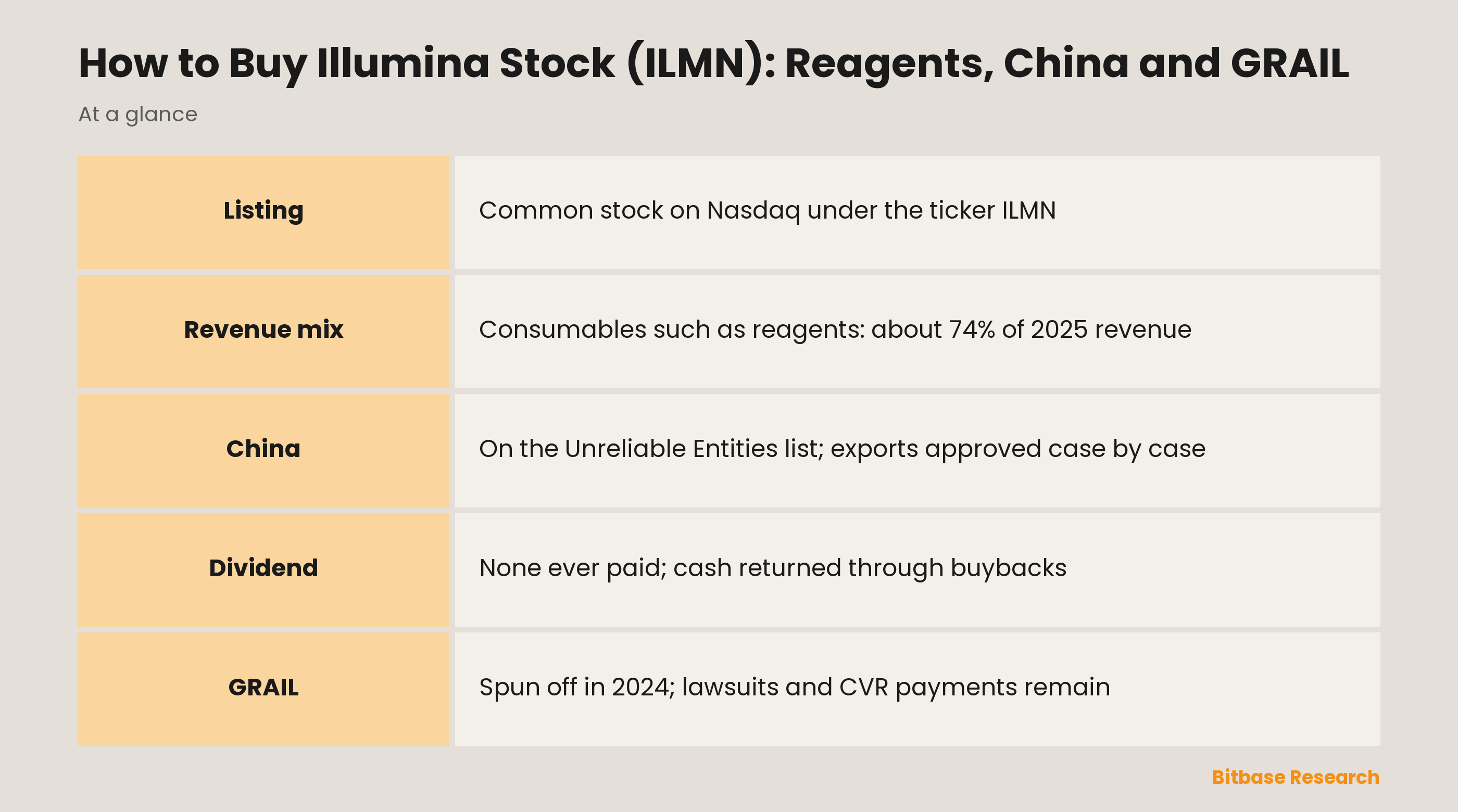
Because ILMN is listed on Nasdaq as plain common stock, any broker that offers US shares can buy Illumina stock for you, in whole shares or, where the broker allows it, in fractions. What sets the company apart is where its money comes from: in 2025, consumables such as reagents and flow cells made up about 74% of revenue, so most sales arrive after a sequencer is installed rather than when it is shipped. Below: what Illumina makes, how an order works, and the pressures its filings return to, from China to US research budgets and the GRAIL deal.
What Does Illumina Do?
Illumina builds the instruments and the chemistry that read DNA. Its annual report describes the company as "a global leader in sequencing- and array-based solutions for genetic and genomic analysis." It was incorporated in California in April 1998, reincorporated in Delaware in July 2000, and has its head office at 5200 Illumina Way in San Diego.
Sequencing means working out the order of the four bases, A, C, G and T, in a DNA sample. Illumina's method, called sequencing by synthesis, follows labelled nucleotides as a strand is copied "in a massively parallel fashion." According to the 10-K, its latest version, XLEAP-SBS, lets a single instrument sequence more than 20,000 human genomes a year. The machines range from the benchtop MiSeq i100 series, launched in 2024, to the production-scale NovaSeq X Plus, launched in 2023, and depending on the model one run yields anything from 500 megabases to 16 terabases of data.
The second technology is the microarray. Illumina's BeadArray chips check millions of known genetic markers in one pass and are used for genotyping in agriculture, pharmacogenomics and consumer genetics. Software such as BaseSpace and DRAGEN manages runs and analyses the data.
The 10-K lists its customers as "leading genomic research centers, academic institutions, government laboratories, and hospitals, as well as pharmaceutical, biotechnology, commercial molecular diagnostic laboratories, and consumer genomics companies." The clinical side covers oncology, including tumour profiling and blood tests that look for traces of cancer, inherited and rare disease, and reproductive health, where the main focus is noninvasive prenatal testing.
The newest push is what the company calls multiomics, reading more than DNA from the same samples. In 2025 it launched a single-cell RNA workflow in January, a sequencing-based protein assay in September and a "5-base" product for genomic and epigenomic data in October. On 30 January 2026 it bought SomaLogic from Standard BioTools, a business the 10-Q describes as "a proteomics company that provides high-throughput protein measurement technology and related data analysis services."
At the end of 2025 Illumina had about 8,600 full-time employees, and its largest leased sites, both used for manufacturing, were in San Diego and Singapore. The 10-K names no competitors but expects "continued intense competition."
How Illumina Makes Money
The business runs on an installed base: a lab buys a sequencer once, then keeps buying the reagents and flow cells each run uses. The 10-K splits 2025 revenue three ways, and the gap between instruments and consumables has widened:
| Revenue line | 2025 | 2023 | What it covers |
|---|---|---|---|
| Consumables | 74% | 68% | Reagents, flow cells and library preparation kits |
| Instruments | 11% | 16% | Sequencers and array scanners |
| Services and other | 15% | 16% | Support contracts, sequencing and genotyping services, partnerships |
By technology, sequencing brought in 92% of 2025 revenue and arrays 8%.
The 2025 numbers show the model at work. Consumables revenue rose 2% as customers continued to move to NovaSeq X, while instrument revenue fell 4% on fewer high- and mid-throughput shipments, with the company citing "capital and cash flow constraints" on its customers. Total revenue slipped 1%, mainly because GRAIL's revenue no longer counted after its 2024 separation. Gross margin was 66.1%, and research and development took 22.3% of revenue.
By customer location, the United States produced about 52% of 2025 revenue and customers abroad the other 48%. On the 10-K's regional split, the Americas came to about 55%, Europe 29%, Asia-Pacific, Middle East and Africa 10%, and China about 6%, down from about 9% in 2023; Chinese revenue alone fell about 21% in 2025. No single customer reached 10% of revenue in any of the last three years, although the risk factors note that "a small number of large, centralized laboratory customers" account for a growing part of sales.
Fiscal 2026 has started better. In the first nine months revenue rose 6%, helped by NovaSeq X consumables and instruments and by SomaLogic, which lifted services. Third-quarter revenue was up 4.2%, and chief executive Jacob Thaysen said "healthy clinical demand and robust NovaSeq X placements drove results above our guidance."
The calendar is unusual. Illumina's fiscal year is 52 or 53 weeks ending on the Sunday closest to 31 December, so fiscal 2025 ended on 28 December 2025, and fiscal 2026 ends on 3 January 2027.
ILMN Stock at a Glance
| Feature | ILMN |
|---|---|
| Exchange | Nasdaq (The Nasdaq Stock Market) |
| Ticker | ILMN |
| Security | Common stock, the only class registered under Section 12(b) |
| Sector | Life science tools: DNA sequencing, arrays and analysis software |
| Index membership | S&P 500 |
| Headquarters | San Diego, California |
| Incorporated | Delaware since 2000 (California, 1998) |
| Fiscal year | 52 or 53 weeks, ending on the Sunday closest to 31 December |
| Reporting segment | One, Core Illumina, since the GRAIL spin-off |
| Payouts | No dividend has ever been paid; share buybacks instead |
| SEC identifier | CIK 1110803 |
Quotes, market value and trading volume change by the second; the Illumina stock page on Bitbase shows them live.
How to Buy Illumina Stock
Illumina is a Delaware company with one class of common stock on a US exchange, so there is no depositary receipt to choose between. The steps:
1. Find a broker that reaches Nasdaq. Abroad, check which legal entity holds your account and who regulates it.
2. Pass the account checks. Brokers verify identity, and non-US individuals are normally asked for IRS Form W-8BEN, which the IRS says to submit "when requested by the withholding agent or payer."
3. Fund the account. Deposits in another currency add a conversion cost, so compare rates as well as commissions.
4. Search for ILMN. The result should read Illumina, Inc. common stock on Nasdaq. GRAIL has been a separate public company since June 2024, so buying ILMN gives you no GRAIL shares.
5. Choose an order type. A market order fills at the prevailing price, which can differ from the last quote you saw; a limit order fixes the most you will pay and may not fill at all.
6. Decide the size. Some brokers sell fractional shares; whether they do, and on what terms, varies by firm.
7. Keep your records. Trade confirmations document your cost basis. Since Illumina pays no dividend, the gain or loss when you sell is what your records will mostly need to show.
Taxes for investors abroad. The IRS states that "most types of U.S. source income received by a foreign person are subject to U.S. tax of 30%," unless a lower rate or exemption applies under the tax code or a tax treaty. Because Illumina pays no dividend, that withholding has no dividend to apply to for now. How a gain on sale is taxed depends on the rules where you live.
Through index funds. ILMN is in the S&P 500, so funds that track that index hold it as one small position; it appeared in the daily holdings of State Street's SPY on 9 November 2026. It is not in the Nasdaq-100, so funds tracking that index do not.
What Moves ILMN Stock
The NovaSeq X installed base. With consumables most of revenue, the number of high-throughput machines in the field matters more than one quarter's instrument sales. The 2025 consumables growth came from customers moving to NovaSeq X, and in the third quarter of 2026 the 10-Q again credited consumables growth to "continued growth of the NovaSeq X installed base," partly offset by lower mid-throughput consumables.
China. On 4 February 2025, regulators in China added Illumina to the List of Unreliable Entities. On 4 March 2025 they told the company it could no longer export sequencing instruments to China. On 5 November 2025 they decided that from 10 November 2025 Illumina could again export sequencers to Chinese companies, with each deal still approved case by case. The company says it cannot predict how long it will stay on the list, and its third-quarter 2026 10-Q still cites the listing as the main cause of lower Greater China revenue.
Research funding. Much lab spending depends on grants. The 10-K points to cuts in US funding of the National Institutes of Health and says some research customers "continue to manage inventory and capital more conservatively" while some labs delay projects.
Tariffs and refunds. The largest tariff cost, the company says, comes from importing products from its manufacturing plant in Singapore. In February 2026 the US Supreme Court held that the International Emergency Economic Powers Act does not authorize tariffs, and refunds followed. In the third quarter of 2026 Illumina booked the refunds it expects to recover against cost of revenue and reduced revenue for the part it expects to pass back to customers; gross margin for the quarter was 73.5%, against 67.6% a year earlier.
Clinical adoption and reimbursement. Clinical demand helped the third quarter, but the 10-K warns that doctors and patients may not order tests unless payers such as managed care organizations, Medicare and Medicaid "pay a substantial portion of the test price."
Multiomics and SomaLogic. The protein, single-cell and 5-base products widen what customers can measure on Illumina systems. The 10-Q says SomaLogic lifted services revenue but also pulled gross margin toward lower-margin sales, so integration affects profit as well as growth.
Buybacks. With no dividend, capital is returned through share repurchases. The board approved a new programme in April 2026 on top of the one authorized in August 2024.
Where Illumina's Filings Flag Trouble
These items from the 10-K's risk factors bear most directly on an ILMN share:
Cheaper sequencing, uncertain volume. Illumina's own technology keeps cutting the price of a genome. "If, as we expect, the cost of sequencing continues to fall, we cannot be sure that the demand for related products and services will increase at least proportionately," the company writes.
Competition and big buyers. It reports "increased pricing pressure from competitors who offer sequencing products" and longer sales cycles, and warns that increasing customer concentration "may result in greater pricing pressure, reduced negotiating leverage, and increased exposure to credit risk."
China. Further penalties under the unreliable entity rules "could have a material adverse effect on our revenue and results of operations," and leaving the market could bring impairment charges.
Regulation. Clinical products need FDA clearance or approval and, in Europe, compliance with the EU's IVDR. If products labelled "For Research Use Only" are used to diagnose disease, regulators could argue they need clearance.
The GRAIL legacy. Illumina bought GRAIL in 2021 and spun it off in 2024. All US and EU regulatory proceedings over the acquisition had ended by 6 September 2024, and the European Commission withdrew its fine, but securities class actions and shareholder derivative suits over the deal are still pending; in the California state case a class was certified in May 2026 and trial is scheduled for March 2028. Illumina also remains the obligor on contingent value rights issued in the acquisition, which pay holders a share of certain GRAIL revenues each year through August 2033. And if the IRS decided the spin-off was not tax-free, "the resulting tax liability to the Company and its shareholders could be substantial."
Above the business, the usual stock risks apply: one company's shares concentrate your exposure, and since Illumina pays no dividend, any return depends on the share price.
How to Research ILMN Yourself
Illumina's filings are on SEC EDGAR under CIK 1110803. The 10-K for fiscal 2025 was filed on 12 February 2026; 10-Qs cover the first three quarters, and 8-Ks carry each earnings release, which in 2026 came on 5 February, 30 April, 30 July and 29 October. The same documents are free on illumina.com.
In the 10-K, the business overview explains platforms and markets, the risk factors cover China, funding and competition, note 2 breaks revenue down by product and region, note 8 describes the GRAIL spin-off, and note 9 lists the lawsuits. When you compare regions, note that from the first quarter of 2026 Illumina reports four new regions, among them US and Canada, and has restated earlier periods to match, so older tables use different groupings.
The third-quarter 2026 earnings release shows results with and without tariff refunds, so compare like with like. For other companies selling to labs, see our Thermo Fisher stock guide and Danaher stock guide. Live prices are on the ILMN page linked above, and the full list of US stock pages on Bitbase covers other listed companies.
Illumina Stock FAQ
Can I buy Illumina stock with crypto?
Not directly. ILMN is bought through a brokerage account in US dollars, so crypto has to be sold for cash and the money moved to the broker, and that sale may be taxable where you live. A share also differs from a token in what it gives you, as explained in how stocks differ from crypto assets.
Does Illumina pay a dividend?
No. The 10-K states: "We have never paid cash dividends and have no present intention to pay cash dividends in the foreseeable future." It returns cash through buybacks instead.
Is ILMN in the S&P 500?
Yes. Illumina, Inc. appeared in the daily holdings file of State Street's SPY, which tracks the S&P 500, on 9 November 2026. It is not in the Nasdaq-100: ILMN was not among the 106 holdings that Invesco listed for QQQ on the same date.
Does Illumina still own GRAIL?
No. On 24 June 2024 Illumina distributed about 85.5% of GRAIL's shares to its own shareholders, one GRAIL share for every six Illumina shares, and kept about 14.5%. The 10-Q for the third quarter of 2026 says Illumina sold the rest of that stake during 2026. What remains are the contingent value rights from the 2021 acquisition, the lawsuits and the commercial agreements between the two companies.
Can Illumina sell sequencers in China?
Yes, again, with conditions. Since 10 November 2025, exports of sequencing instruments to Chinese companies have been allowed but need approval case by case, and Illumina is still on the List of Unreliable Entities. Greater China accounted for about 6% of 2025 revenue.
Conclusion
Illumina is a reagent business with a hardware front end: each NovaSeq X placed in a lab feeds years of consumable orders, which is why the installed base, not one quarter's machine sales, drives the numbers. The share carries other weights too: a Chinese market that is open again only case by case, US research budgets, tariff refunds that cloud 2026 comparisons, and GRAIL-era lawsuits and payments still on the books. Read the latest 10-K and quarterly release, separate the one-off refunds from the trend, and decide how much a single genomics company should weigh in your portfolio.
Related reading
Other Bitbase articles on this topic:
- How to Buy Alcon Stock (ALC): Same Share on SIX and the NYSE
- How to Buy Centene Stock (CNC): Medicaid, Ambetter and Wellcare
- How to Buy Dexcom Stock (DXCM): G7, Stelo and Medicare Bidding
- How to Buy Medline Stock (MDLN): Class A Shares and Prime Vendor
Disclaimer: This article is educational content from Bitbase Academy, provided for information only. It explains what a company or fund does and how the instruments referenced here differ from one another; it does not constitute investment, trading, tax, or financial advice, and it is neither a recommendation nor an endorsement of any security, token, or trading strategy. A tokenized stock is issued by a third party and is designed to give economic exposure to an underlying asset: it is not a share, it carries no shareholder rights, and it depends on the issuer's structure, eligibility rules, and redemption terms, which the issuer can change. Perpetual futures are leveraged derivatives that hold no underlying asset and can be liquidated, and trading hours, product availability, and eligibility differ by instrument and by jurisdiction and can change at any time. Written as of November 2026; verify everything yourself through company filings, the issuer's own documentation, and the product pages of the venue you trade on.
References
[1] Illumina Form 10-K for fiscal 2025 (SEC EDGAR) www.sec.gov
[2] Illumina 2025 Form 10-K, XBRL cover page (SEC EDGAR) www.sec.gov
[3] Illumina 2025 Form 10-K, revenue by product and region, XBRL (SEC EDGAR) www.sec.gov
[4] Illumina Form 10-Q for the third quarter of 2026 (SEC EDGAR) www.sec.gov
[5] Illumina third-quarter 2026 results release, Form 8-K (SEC EDGAR) www.sec.gov
[6] Illumina Form 8-K on completing the SomaLogic acquisition, 30 January 2026 (SEC EDGAR) www.sec.gov
[7] State Street SPY daily holdings, 9 November 2026 www.ssga.com
[8] Invesco QQQ holdings data, 9 November 2026 dng-api.invesco.com
[9] IRS: NRA withholding www.irs.gov
[10] IRS: About Form W-8 BEN www.irs.gov





