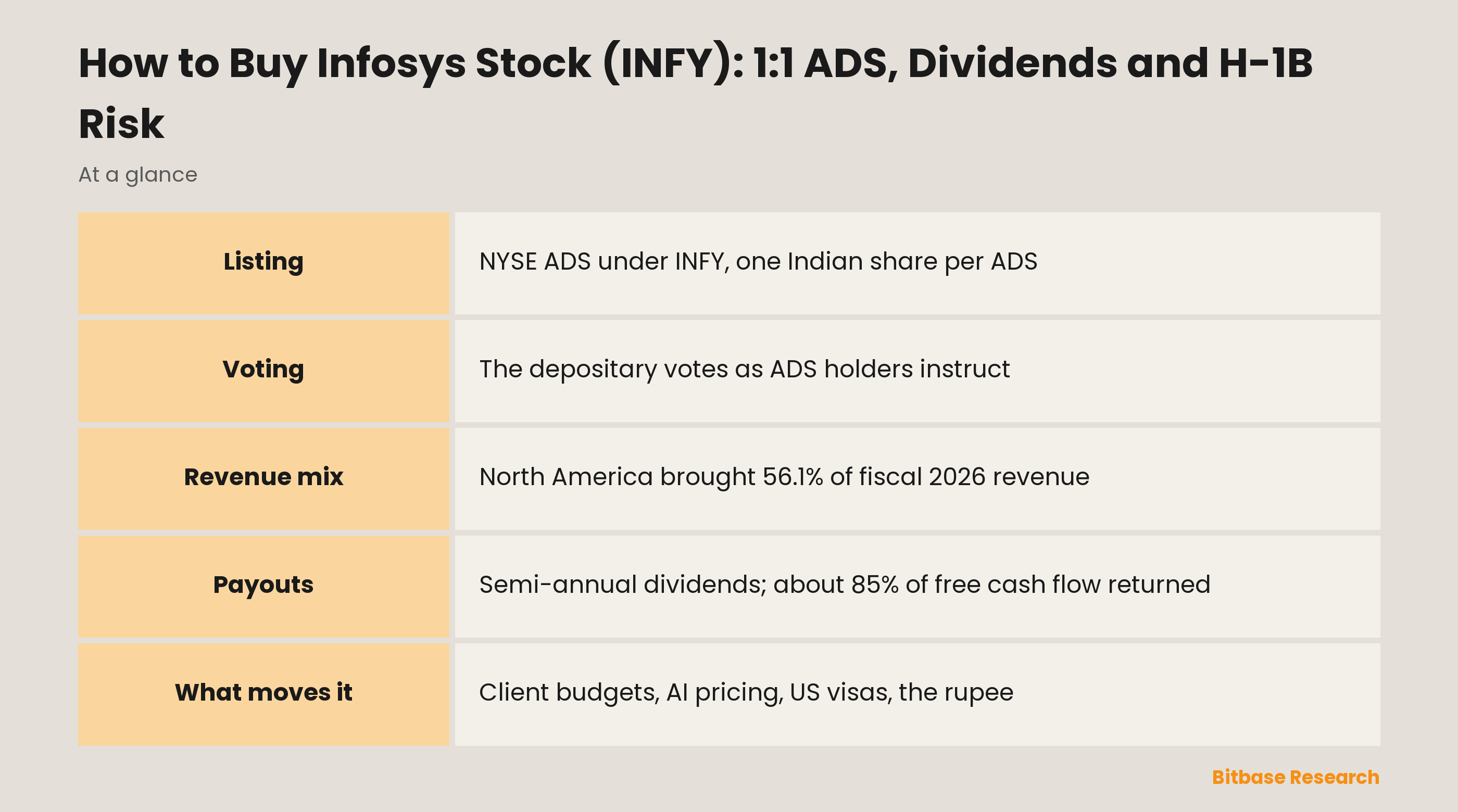
One INFY order on the New York Stock Exchange is the usual way to own Infosys from outside India: any broker that offers US-listed stocks can buy the American depositary shares (ADSs) in dollars, and each one stands for exactly one equity share traded in India. Behind the ticker is a Bengaluru technology services company that earned 56.1% of its fiscal 2026 revenue in North America and had no debt at March 31, 2026, so US visa rules and the rupee matter to the shares as much as its deal flow.
What Does Infosys Do?
Infosys does technology and outsourcing work for large companies: it builds and maintains their software, moves systems to the cloud, tests code, runs back-office processes such as finance and procurement through Infosys BPM, and sells consulting. A smaller part of the business is products and platforms, the best known being Finacle, a digital banking platform, alongside Infosys McCamish for insurers and Stater for mortgage servicing.
The company was incorporated on July 2, 1981 in Pune as Infosys Consultants Private Limited. It became a public company in 1992, listed in India in June 1993 and took its current name, Infosys Limited, in June 2011. Its headquarters campus is in Electronics City, Bengaluru, and it employed 328,594 people at March 31, 2026.
Its current pitch is artificial intelligence. The 20-F calls Infosys a provider of "AI-first business consulting and technology services," built around a suite called Infosys Topaz, and says it is "already collaborating with 90 percent of our top 200 clients on their AI journeys." Nandan M. Nilekani has chaired the board since August 2017, and Salil Parekh has been chief executive since January 2018.
How Infosys Makes Money
Almost all revenue is billed for people's time and project work. In fiscal 2026, the year to March 31, 2026, software services including business process management made up 95.2% of revenue and products and platforms 4.8%. Fixed-price contracts accounted for 54%. About three-quarters of the effort, 76.8%, was delivered offshore in India; the rest was onsite, where rates and costs are both higher.
Infosys reports eight industry segments. Below, for fiscal 2026, are each segment's slice of group revenue and its own profit margin, both as printed in the 20-F.
| Segment | Share of revenue | Segment profit margin |
|---|---|---|
| Financial services | 27.9% | 25.3% |
| Manufacturing | 16.3% | 22.1% |
| Energy, utilities, resources and services | 13.3% | 25.1% |
| Retail | 12.9% | 30.7% |
| Communication | 12.2% | 17.7% |
| Hi-tech | 7.8% | 23.1% |
| Life sciences | 6.9% | 20.0% |
| All other segments | 2.7% | 14.8% |
Banks and insurers are the largest customer group, while retail earns the widest margin. Manufacturing revenue grew 10.1% in fiscal 2026; life sciences shrank 1.2%.
By geography, North America supplied 56.1% of revenue, Europe 32.1%, the rest of the world 8.9% and India just 2.9%. Total revenue grew 4.6% in dollars and 3.1% in constant currency. The operating margin slipped to 20.3% from 21.1%, which the 20-F puts down to lower utilization, pay rises, investment in talent, AI and sales, and a charge from India's new Labour Codes. Net profit still rose 4.9%, helped by a lower tax charge.
INFY Stock at a Glance
| Item | Detail |
|---|---|
| Issuer | Infosys Limited, incorporated in India in 1981 |
| US listing | American depositary shares on the NYSE, ticker INFY |
| ADS ratio | One ADS represents one equity share of ₹5 par value |
| Home market | BSE and National Stock Exchange of India, in rupees |
| Depositary | Deutsche Bank Trust Company Americas |
| ADS voting | Through the depositary, on the holder's instructions |
| Held as ADSs | About 7.5% of equity shares at May 20, 2026 |
| Share classes | One class of equity shares |
| Largest holder | Life Insurance Corporation of India, 10.81% at May 20, 2026 |
| Fiscal year | April 1 to March 31 |
| 20-F accounting | IFRS |
| Dividends | Semi-annual, under a policy of returning about 85% of free cash flow |
| SEC filer | CIK 1067491; Form 20-F and Form 6-K |
Live INFY prices and a chart are on the Infosys stock page on Bitbase.
How to Buy Infosys Stock
There are two places to buy Infosys: New York, where the ADS is quoted in dollars, and India's BSE and NSE, where the equity shares are quoted in rupees. Investors abroad usually go through New York.
1. Pick a broker with NYSE access. INFY trades like any other US-listed security, in New York hours.
2. Deposit dollars. Converting from another currency has its own cost, so weigh it alongside the commission.
3. Look up INFY. Confirm the issuer shown is Infosys Limited and the security is an ADS or ADR.
4. Set the order. A limit order caps what you pay, while a market order takes the price on offer at that moment; how market orders get filled explains the trade-off.
5. Decide how many ADSs. With a one-to-one ratio, one ADS tracks one rupee share converted into dollars. Not every broker sells part of an ADS; FINRA notes that some firms offer fractional trading only on a limited range of securities.
The ADS and the Indian share. Deutsche Bank Trust Company Americas holds the underlying shares under a deposit agreement dated March 10, 1999 and restated on June 28, 2017. Infosys ADSs carry a vote: the depositary sends meeting notices and "will endeavor to vote" as holders instruct, although ADSs with no instructions are not voted. Indian law allows foreign investors to hold up to 100% of the company's share capital, and converting ADSs into shares or back is subject to that limit.
Indian tax. Dividends are paid in rupees and converted into dollars by the depositary, after Indian withholding tax at the rate set by Indian law or an applicable tax treaty, and after depositary fees. According to the 20-F, India does not tax gains when a non-resident sells ADSs to another non-resident outside India.
Buybacks and funds. ADS holders cannot tender into an Infosys buyback as ADS holders: in the last one, which retired 100,000,000 shares and closed on December 4, 2025, they first had to cancel their ADSs and take the underlying shares before the record date. Funds that hold Infosys give indirect exposure; check a fund's holdings page first.
What Moves INFY Stock
Client budgets. Many contracts can be ended "with or without cause and with short notice periods of 0 to 90 days," so cuts in discretionary technology spending reach revenue quickly. The five largest clients produced 12.9% of fiscal 2026 revenue, and the ten largest about 20.5%.
AI pricing. AI creates new consulting and integration work, but the 20-F also warns that recent advances have "democratized the availability of such technologies, leading to reduced entry barriers for new competitors," and that clients expect efficiency gains to show up in what they pay.
US immigration policy. A significant portion of Infosys staff in the US and Europe rely on work visas. A presidential proclamation signed on September 19, 2025 imposed a fee on new H-1B visa applications, subject to certain exclusions. The US Department of Justice is investigating how the company classified certain H-1B visa-recipient employees in immigration filings, and Infosys says it cannot predict the outcome. On October 10, 2026, the company said the US Department of Labor had suspended new and pending applications by certain companies, including Infosys, under its Permanent Labor Certification programme; Infosys said it did not expect a material impact.
The rupee. Most expenses are in rupees and dollars, while most revenue comes in foreign currencies such as the dollar, euro, pound and Australian dollar. In fiscal 2026, the 20-F says, every percentage point of movement in the rupee against the dollar changed incremental operating margins by about 0.44%. Dividends are also declared in rupees, while the ADS is quoted in dollars.
Utilization. Margins depend on keeping engineers billed. Utilization including trainees fell to 81.1% in fiscal 2026 from 83.4%.
Capital returns. Since fiscal 2025 the policy has been to return about 85% of free cash flow over five years through dividends and buybacks, while progressively raising the annual dividend per share. India stopped allowing open-market buybacks from April 1, 2025, so buybacks now go through tender offers, which the 20-F says may limit the boost to earnings per share.
Where the Infosys Risk Factors Point
Demand. "Spending on technology products and services by our clients and prospective clients fluctuates depending on many factors," the filing says, naming technology shifts, geopolitics, tariffs and the economy.
Visas. "Changes in immigration laws, their interpretation or enforcement, increase in visa fees, or delays in getting visas" could raise costs, disrupt work and stop Infosys bidding for or delivering projects.
Cyber incidents. In November 2023, ransomware encrypted systems at Infosys McCamish Systems, a subsidiary, and data was accessed and taken. A class-action settlement won final court approval on December 18, 2025, but the 20-F says further costs from indemnities or claims cannot yet be estimated.
The ADS itself. Voting materials may reach ADS holders too late, US holders may be unable to exercise pre-emptive rights, and US court judgments cannot be enforced directly in India. Large holdings also bring India's takeover rules into play. And like any single stock, INFY ties your result to one company.
How to Research Infosys Yourself
Infosys's SEC filings sit on EDGAR under CIK 1067491. Its fiscal 2026 annual report on Form 20-F, filed on June 15, 2026, contains the segment data, risk factors, a tax summary and the ADS terms. Form 6-K reports carry quarterly results and the company's letters to the BSE, NSE and NYSE on dividends, board changes and events such as the October 2026 labour certification statement.
Two habits help. Check the currency: the 20-F reports in dollars under IFRS, while Infosys also publishes results in rupees, so growth rates differ depending on which you read; constant-currency growth strips out exchange-rate swings. And watch the dates: Infosys's fiscal 2026 covered April 1, 2025 through March 31, 2026, a year Indian documents label FY 2025-26.
Infosys Stock FAQ
Is one INFY ADS the same as one Infosys share in India?
Economically, yes: each ADS represents one equity share of ₹5 par value, held by the depositary. The ADS trades in dollars on the NYSE, dividends arrive in dollars after Indian tax and depositary fees, and you vote by instructing the depositary rather than directly.
Does Infosys pay a dividend?
Yes. Infosys pays semi-annual dividends: an interim dividend declared by the board and a final dividend approved at the annual general meeting. For fiscal 2026 the board recommended a final dividend on April 23, 2026, for approval at the June 23, 2026 meeting.
Can I buy Infosys stock with crypto?
No. A broker sells you INFY for dollars, and the shares in India cost rupees, so you would first have to turn crypto into cash, and depending on where you live, cashing out crypto can trigger tax.
Is Infosys listed on the NYSE or Nasdaq?
The NYSE. Infosys ADSs began trading on Nasdaq on March 11, 1999 and moved to the New York Stock Exchange on December 12, 2012. They were also listed in London and Paris from 2013 until July 5, 2018, when the company delisted them there for low trading volume.
Who is Infosys's largest shareholder?
Life Insurance Corporation of India, with 10.81% of equity shares at May 20, 2026. Directors and officers held 2.53%, and the 20-F says Infosys is not owned or controlled by any government, company or individual.
Conclusion
Outside India, owning Infosys usually starts with an INFY order in New York, where each ADS equals one Indian share and votes through the depositary. The company behind it is a debt-free outsourcer whose growth depends on corporate technology budgets, whose margins move with the rupee and utilization, and whose US workforce depends on visa rules now under scrutiny. For a US-listed peer, Accenture's NYSE shares offer a useful contrast. Before sizing a position, go through the most recent 20-F and the 6-Ks filed since.
Related reading
Other Bitbase articles on this topic:
- How to Buy Bending Spoons Stock (BSP): Evernote, AOL and Vimeo
- How to Buy Cognizant Stock (CTSH): Banks, Health Care and India
- How to Buy Corpay Stock (CPAY): Fuel Cards to Cross-Border FX
- How to Buy Veeva Systems Stock (VEEV): Pharma Cloud and Vault CRM
Disclaimer: This article is educational content from Bitbase Academy, provided for information only. It explains what a company or fund does and how the instruments referenced here differ from one another; it does not constitute investment, trading, tax, or financial advice, and it is neither a recommendation nor an endorsement of any security, token, or trading strategy. A tokenized stock is issued by a third party and is designed to give economic exposure to an underlying asset: it is not a share, it carries no shareholder rights, and it depends on the issuer's structure, eligibility rules, and redemption terms, which the issuer can change. Perpetual futures are leveraged derivatives that hold no underlying asset and can be liquidated, and trading hours, product availability, and eligibility differ by instrument and by jurisdiction and can change at any time. Written as of November 2026; verify everything yourself through company filings, the issuer's own documentation, and the product pages of the venue you trade on.
References
[1] Infosys, Form 20-F for fiscal 2026 (SEC EDGAR) www.sec.gov
[2] Infosys 20-F for fiscal 2026, XBRL cover page (R1) www.sec.gov
[3] Infosys 20-F for fiscal 2026, XBRL segment data (R153) www.sec.gov
[4] Infosys, company statement on the US Permanent Labor Certification programme, October 10, 2026, Form 6-K (SEC EDGAR) www.sec.gov
[5] FINRA: Investing in Fractional Shares www.finra.org





