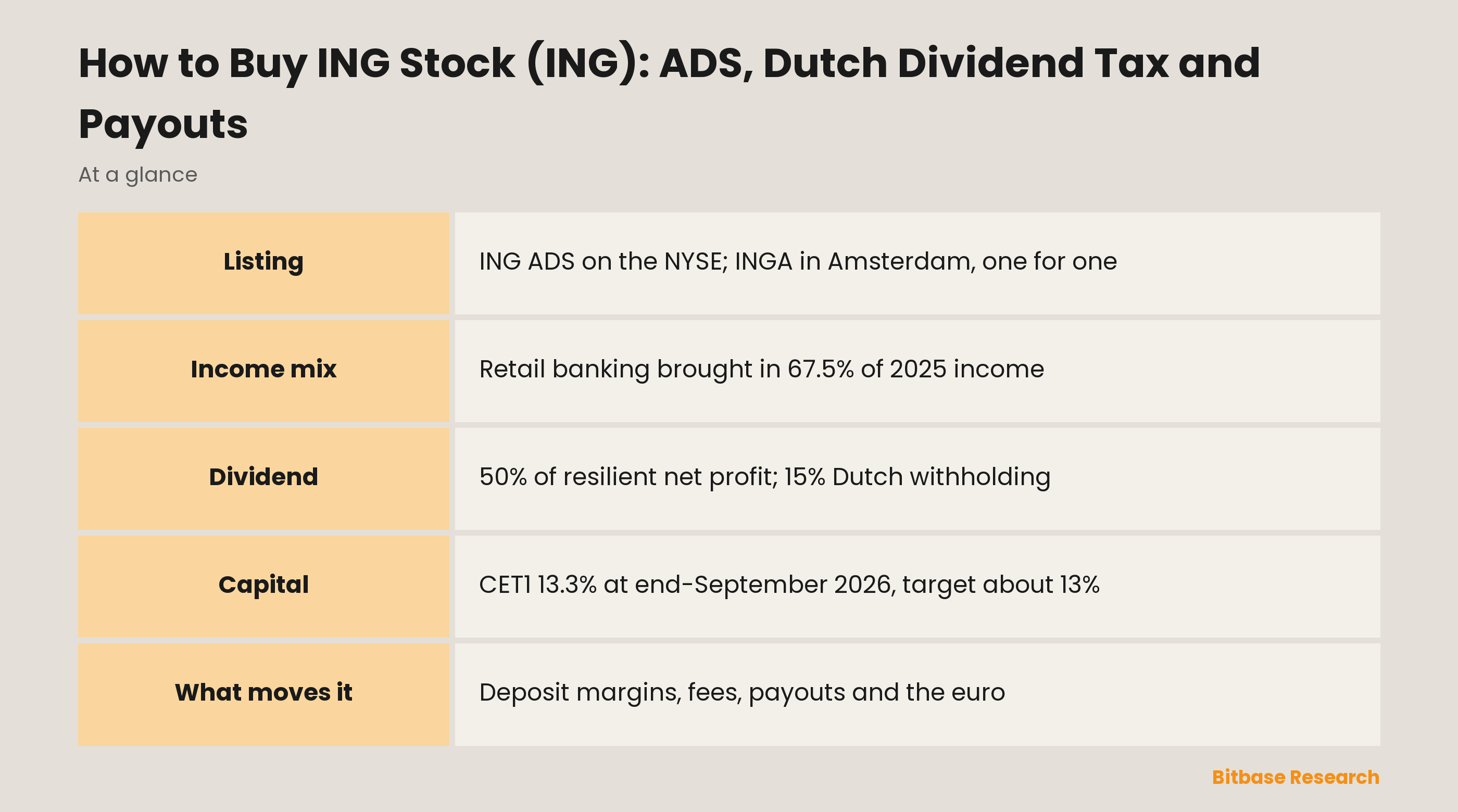
While ING Groep N.V.'s home market is Euronext Amsterdam, where its shares trade as INGA, the simplest route from outside Europe is the New York Stock Exchange: ING is the NYSE ticker of its American depositary shares (ADSs), each representing one ordinary share held by JPMorgan Chase Bank, N.A. as depositary. Behind the ticker is a retail bank first, with 67.5% of 2025 income coming from retail banking in markets that run from the Netherlands and Germany to Australia and Türkiye. This guide covers how ING earns that income, the buying steps, the 15% Dutch dividend tax, the two profit figures it publishes and the risks its 20-F names.
What Does ING Do?
ING is a Dutch bank holding company. ING Groep N.V. was established as a public limited liability company (naamloze vennootschap) on 4 March 1991, is based at Bijlmerdreef 106 in Amsterdam and provides its banking services through its operating company, ING Bank. Its 20-F describes a group "serving 40 million customers, corporate clients and financial institutions in 38 countries."
The business has two halves. Retail Banking serves private individuals, small and medium-sized companies through Business Banking, and wealthier clients through Private Banking & Wealth Management, selling savings, payments, investments, loans and mortgages. Wholesale Banking works with large corporates, multinationals and institutions; its main products are lending, payments and cash management, working capital solutions, trade finance, financial markets, corporate finance and treasury.
For reporting, retail is cut by country. Retail Netherlands and Retail Belgium (which includes Luxembourg) are separate segments, and so is Retail Germany. Retail Other gathers two groups the filing calls Other Challengers (Australia, Italy, Spain and Portugal) and Growth Markets (Poland, Romania and Türkiye). In the Netherlands, its largest market, the 20-F names ABN AMRO Bank and Rabobank as the main competitors.
The same filing calls ING "a digital-first bank." In 2025, 87% of its customers chose mobile as their primary channel, and the number of mobile primary customers, meaning people who use the app or mobile site at least once a quarter, grew by over one million to 15.4 million.
The group also holds stakes it does not run. At the end of June 2026 it owned about 13% of Bank of Beijing, which sits in the Corporate Line together with investments in TMBThanachart Bank and Van Lanschot Kempen. In Poland, ING Bank Śląski bought the remaining 55% of the asset manager Goldman Sachs TFI in the first half of 2026. With its third-quarter 2026 results, ING said it is "refocusing and simplifying Wholesale Banking," and it has scheduled a strategy update for a Capital Markets Day on 14 June 2027.
How ING Makes Money
Most of ING's income is the spread between what its loans and investments earn and what its deposits and other funding cost. In the 2025 segment note, net interest income was 63.7% of total income, net fees and commissions 20.0%, and investment and other income, mostly from Financial Markets and Treasury, 16.3%.
| Segment | Share of 2025 total income |
|---|---|
| Wholesale Banking | 30.4% |
| Retail Netherlands | 21.6% |
| Retail Other | 21.3% |
| Retail Germany | 13.0% |
| Retail Belgium | 11.6% |
| Corporate Line | 2.1% |
Shares are of total income in the segment note, which ING prepares under IFRS as adopted by the EU (the research section below explains why that matters).
Taken together, the four retail segments brought in 67.5% of income, and Retail Banking produced 71.6% of the group's 2025 result before tax. Cut by geography instead, with wholesale activity assigned to each country, the Netherlands produced 27.7% of income, Germany 15.3%, the Growth Markets 15.2%, Belgium 14.9% and Wholesale Banking's rest-of-world network 13.8%.
The mix is tilting toward fees. Total income rose 1.9% in 2025, yet net interest income fell 2.3%. Lending income grew because higher volumes more than offset a lower average lending margin, while income on deposits shrank because "strong deposit growth could not fully offset the impact of lower average margins on retail deposits." Net fee and commission income climbed 15%. In Retail Banking, fees from investment products rose with more investment accounts and more customer trading, and daily banking fees rose with customer growth and updated pricing for payment packages. Retail Germany's fee income jumped 46%, and Wholesale Banking's rose 8.8%.
Credit losses stayed contained. Risk costs in 2025 equalled 19 basis points of average customer lending, below the through-the-cycle average of 20 basis points that ING uses as its yardstick.
ING Stock at a Glance
| Item | Detail |
|---|---|
| Issuer | ING Groep N.V., incorporated in the Netherlands |
| US security | American depositary shares on the NYSE, ticker ING |
| ADS ratio | One ADS represents one ordinary share |
| ADS depositary | JPMorgan Chase Bank, N.A. |
| Home listings | Euronext Amsterdam (ticker INGA) and Euronext Brussels |
| Listed options | Euronext Amsterdam derivatives market and the Chicago Board Options Exchange |
| Other NYSE symbols | 17 series of senior notes, from ING27 to ING36; these are bonds, not shares |
| Sector | Banking: retail and wholesale |
| Index | Held by the SPDR EURO STOXX 50 ETF (FEZ) as of 29 October 2026 |
| Headquarters | Bijlmerdreef 106, Amsterdam |
| Financial year | Calendar year, reported in euros |
| Dividend policy | Pay-out of 50% of resilient net profit through interim and final dividends, plus extra distributions when capital allows |
| Supervisor | European Central Bank |
| SEC identifier | CIK 1039765; Form 20-F and Form 6-K |
The dollar price of the ADS, with charts, is on the ING stock page on Bitbase.
How to Buy ING Stock
Two lines lead to the same share: the ING ADS, bought in US dollars on the NYSE, or the ordinary share, bought in euros in Amsterdam as INGA (it is also listed in Brussels).
1. Pick the line, then the broker. Any broker with NYSE access can buy the ADS; for INGA you need one that reaches Euronext Amsterdam.
2. Complete the account checks. Brokers verify your identity and record your tax residence, and that record affects how your dividends are taxed.
3. Fund the account. Send dollars for the ADS or euros for INGA, and compare the currency conversion cost as well as the commission.
4. Confirm the security. Search for ING and check that the description reads ING Groep N.V. American depositary shares. Symbols such as ING27 or ING33 belong to senior notes. Because the ticker spells a common English word ending, and a stock symbol identifies one security at a time, read the full name before you order.
5. Choose the order type. A limit order sets the highest price you will pay; a market order fills at the best price available at that moment.
6. Decide the size. One ADS equals one share. Some brokers sell fractions of an ADS, others only whole units.
The ADS versus the Amsterdam share. JPMorgan Chase Bank, N.A. holds the ordinary shares behind the ADSs under a deposit agreement dated 4 October 2018. ING declares cash dividends in euros; the depositary converts them into dollars and deducts its expenses and fees. Payment can also lag the home market: the 2026 interim dividend was paid on 10 August on Euronext Amsterdam and on 17 August on the NYSE. ADS holders vote by instructing the depositary, "subject to any applicable provisions of Dutch law," and the deposit agreement "may at any time be amended by us and the depositary without your consent." Santander's NYSE ADS also represents one share, so the same one-for-one arithmetic applies there.
Dutch dividend tax. The 20-F is direct: "The Netherlands imposes a withholding tax on a distribution of a dividend at the statutory rate of 15%." For Dutch tax purposes, ADS holders are treated as owners of the underlying shares. The treaty reductions it describes for US holders apply mainly to companies owning at least 10% of the voting power and to qualifying pension trusts and exempt organisations, and anti-dividend-stripping rules can block any reduction. How much is withheld from your own payment, and whether you can reclaim any of it, is a question for your broker or tax adviser.
Through a fund. ING Groep NV, listed under its Amsterdam ticker INGA, appeared in the 29 October 2026 holdings of State Street's SPDR EURO STOXX 50 ETF (FEZ), so funds that track that index carry it alongside other eurozone heavyweights.
What Moves the ING Share Price
Deposit margins and euro interest rates. With net interest income at 63.7% of income, the gap between what ING pays on savings and what it earns on the money is the core of its results. The 2025 drop in net interest income came from deposits rather than loans. The 20-F states the risk plainly: "Inflation and deflation scenarios, as well as interest rate volatility and changes may adversely affect our business, results and financial condition."
Fee growth. ING describes higher fees as part of its "ambition to further diversify our income mix." After the 15% rise in 2025, fee income in the third quarter of 2026 was up 9.3% year on year, and assets under management and e-brokerage were up 22%.
How much capital it hands back. The policy pays out 50% of resilient net profit and adds distributions when capital is structurally in excess. At the end of September 2026 the CET1 ratio, the core measure of a bank's loss-absorbing capital, stood at 13.3%, against ING's target of about 13% and a prevailing requirement of 11.10%. Having completed the buyback announced in April 2026, ING announced another distribution on 29 October 2026: a share buyback due to end no later than 26 April 2027, plus a cash payment on 14 January 2027. In late October it also reported that the ECB's 2026 supervisory review left its Pillar 2 capital requirement unchanged. Significant risk-transfer deals, which free up risk-weighted assets, belong to what the bank calls its "capital velocity" ambitions.
A reshaped wholesale bank. The third-quarter 2026 release said ING is "refocusing and simplifying Wholesale Banking," the segment behind 30.4% of 2025 income. The fuller strategy update is set for the Capital Markets Day on 14 June 2027.
Russia. ING agreed in January 2025 to sell ING Bank (Eurasia) JSC, then terminated the agreement in April 2026 because it saw "no realistic expectation that the buyer will obtain the necessary approvals." The Russian unit therefore stays in the group, with the legal exposure described below.
The euro-dollar rate. The ADS trades in dollars while the share, the dividend and the accounts are in euros, so a dollar-based holder's return also moves with the exchange rate.
Threats to ING's Profits and Payouts
Financial crime and its aftermath. In September 2018 ING reached a settlement with the Dutch Public Prosecution Service over investigations into client on-boarding and the prevention of money laundering and corrupt practices, and it says it has since faced "heightened scrutiny from authorities in various countries." Investors who sued over related disclosures lost in the Amsterdam district court in November 2025 and appealed against ING in February 2026. The 20-F's general warning: "Non-compliance with laws and/or regulations could result in fines and other liabilities, penalties or consequences for us, which could materially affect our business and reputation and reduce our profitability."
Supervision and capital. "We are subject to the regulatory supervision of the ECB and other regulators and public bodies with extensive supervisory and investigatory powers." Distributions also require a CET1 ratio at or above the Maximum Distributable Amount level after the payout, so a weaker capital position would limit what can be returned.
Russian courts. The mid-2026 report notes that "Russian parties are holding Western banks liable in Russian courts" for complying with sanctions, and that in some cases Russian courts have ruled in the Russian party's favour.
The holding company. "As a holding company, ING Groep N.V. is dependent for liquidity on payments from its subsidiaries, many of which are subject to regulatory and other restrictions on their ability to transact with affiliates."
Shareholder-level risks. The filing warns that "holders of ING shares may experience dilution of their holdings and may be impacted by any share buyback programme," and that because ING is incorporated in the Netherlands and many of its board members and officers live outside the United States, US court judgments against them may be hard to enforce.
Beyond these, ING is still a single stock: its dividend depends on board decisions and on capital, and the 20-F says the distribution policy "may be changed at any time."
Checking ING's Numbers Yourself
ING's filings sit on EDGAR under CIK 1039765. The Form 20-F arrives once a year (the latest was filed on 26 February 2026), and Form 6-K carries the half-year report, quarterly results, weekly buyback updates and announcements such as the yearly SREP outcome.
Know which profit you are reading. ING's results releases and its segment note use IFRS as adopted by the EU, including the "IAS 39 carve-out," which allows hedge accounting for its mortgage and savings portfolios. The 20-F also reports under IFRS as issued by the IASB, where those hedges get no hedge accounting. The gap can be wide: in 2025 the IFRS-IASB net result rose 56% while the IFRS-EU net result slipped about 1%, a difference the filing attributes mainly to "changes in market interest rates" on derivatives used for asset-liability management. Pay-outs are based on resilient net profit, which for 2025 equalled the IFRS-EU result.
Two smaller traps: results in Türkiye are restated under hyperinflation accounting (IAS 29), which runs through the Corporate Line, and quarterly releases mix year-on-year and quarter-on-quarter comparisons, so check which one a growth rate uses. For other listed companies, browse more stock pages on Bitbase.
ING Stock FAQ
Is an ING ADS the same as an ING share in Amsterdam?
Economically, yes, one for one. Every ADS stands for one ordinary share held by JPMorgan Chase Bank, N.A. The differences are practical: the ADS is priced in dollars on the NYSE, dividends reach you converted from euros minus the depositary's charges and can arrive days later, and you vote through instructions to the depositary rather than directly.
Does ING pay a dividend?
Yes. ING pays an interim dividend for the first half and a final dividend after the annual general meeting, under a policy of paying out 50% of resilient net profit, the majority in cash, plus extra distributions when it holds excess capital. The Netherlands withholds dividend tax at a statutory 15%, and the policy itself "may be changed at any time."
Can I buy ING stock with crypto?
Not directly. A broker sells you the ING ADS for dollars or the INGA share for euros, so crypto has to be turned into cash first, and selling crypto can be a taxable event where you live.
What do ING, INGA and ING27 mean?
They are different securities from the same issuer. ING is the NYSE ticker of the ADS, INGA is the ordinary share on Euronext Amsterdam, and ING27 is one of 17 series of senior notes ING has listed on the NYSE, with symbols running up to ING36. Only the first two give you a share in the company; the notes are debt. The ordinary shares are registered with the NYSE too, but only to support the ADSs, not for trading.
Is ING in the EURO STOXX 50?
It was on 29 October 2026: ING GROEP NV appears, under the ticker INGA, in that day's holdings of the SPDR EURO STOXX 50 ETF, a State Street fund that tracks the index. Index membership is reviewed over time, so check a current holdings list.
Does ING still own a bank in Russia?
Yes, as of its mid-2026 report. ING Bank (Eurasia) JSC was to be sold to Global Development JSC under a January 2025 agreement, but ING terminated that agreement in April 2026 because it saw no realistic prospect of the buyer obtaining approvals, and it says it continues to reduce its exposure to Russian clients.
Conclusion
Buying ING is straightforward once you pick the line: the ADS in dollars on the NYSE or the INGA share in euros in Amsterdam, one for one, with the same 15% Dutch withholding on dividends. The harder work is reading the bank behind it, one whose income leans on interest margins, whose fees are growing faster and whose payouts follow a CET1 target of about 13%. Check those figures in the latest 20-F and 6-Ks, on the accounting basis you mean to use, before you decide whether a single bank belongs in your portfolio and at what size.
Related reading
Other Bitbase articles on this topic:
- How to Buy Capital One Stock (COF): Card Lender, Discover Network
- How to Buy CIBC Stock (CM): Dividend, Mortgages, Caribbean Sale
- How to Buy Citigroup Stock (C): Five Businesses, Banamex Exit
Disclaimer: This article is educational content from Bitbase Academy, provided for information only. It explains what a company or fund does and how the instruments referenced here differ from one another; it does not constitute investment, trading, tax, or financial advice, and it is neither a recommendation nor an endorsement of any security, token, or trading strategy. A tokenized stock is issued by a third party and is designed to give economic exposure to an underlying asset: it is not a share, it carries no shareholder rights, and it depends on the issuer's structure, eligibility rules, and redemption terms, which the issuer can change. Perpetual futures are leveraged derivatives that hold no underlying asset and can be liquidated, and trading hours, product availability, and eligibility differ by instrument and by jurisdiction and can change at any time. Written as of October 2026; verify everything yourself through company filings, the issuer's own documentation, and the product pages of the venue you trade on.
References
[1] ING Groep N.V., Form 20-F for 2025 (SEC EDGAR) www.sec.gov
[2] ING 20-F for 2025, exhibit: description of securities and ADSs www.sec.gov
[3] ING 20-F for 2025, XBRL cover page (R1) www.sec.gov
[4] ING Group interim report for the first half of 2026 (Form 6-K, 30 July 2026) www.sec.gov
[5] ING third-quarter 2026 results release (Form 6-K, 29 October 2026) www.sec.gov
[6] ING announces new distribution programme (Form 6-K, 29 October 2026) www.sec.gov
[7] ING Group 2026 SREP process completed (Form 6-K, 28 October 2026) www.sec.gov
[8] State Street: SPDR EURO STOXX 50 ETF (FEZ), daily holdings as of 29 October 2026 www.ssga.com





