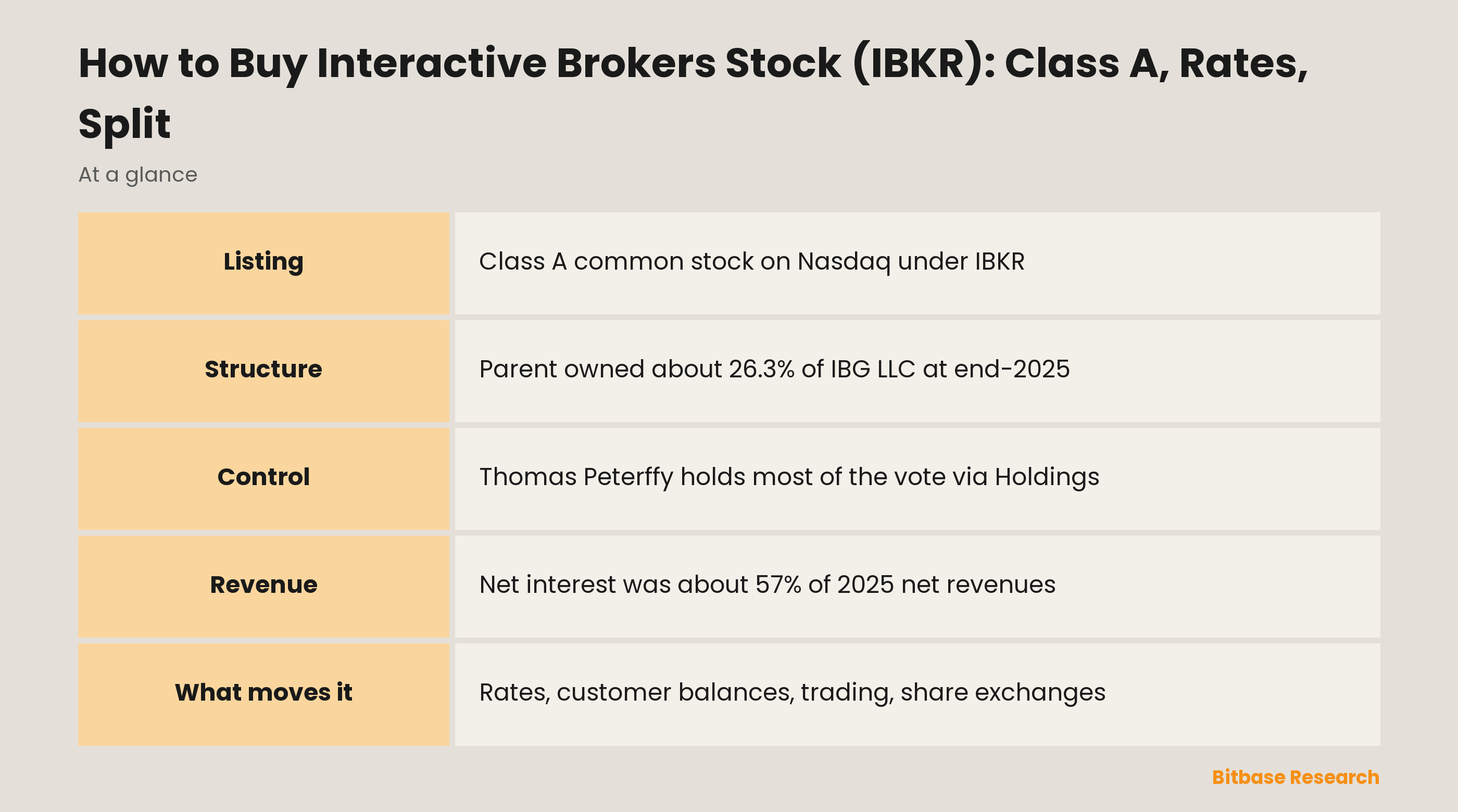
One brokerage account with Nasdaq access is all you need to buy Interactive Brokers stock: the ticker is IBKR, and every share sold to the public is Class A common stock of Interactive Brokers Group, Inc. That parent is a holding company, which at the end of 2025 owned about 26.3% of IBG LLC, the business that runs the brokerage, while a company controlled by founder Thomas Peterffy owned the rest and held most of the votes. Net interest brought in about 57% of 2025 net revenues, so interest rates count as much as trading volume.
What Does Interactive Brokers Do?
Interactive Brokers describes itself as "an automated global broker." It executes, clears and settles trades and holds the positions for individual investors, hedge funds, mutual funds, ETFs, registered investment advisers, proprietary trading groups, and introducing brokers that pass their own customers' orders through its systems. Its 2025 annual report counts more than 170 electronic exchanges and market centers in 40 countries and 29 currencies, reachable from one account, for stocks, options, futures, forex, bonds, funds, precious metals and forecast contracts.
Automation is the business model. The company traces its roots to a market-making business Thomas Peterffy founded on the floor of the American Stock Exchange in 1977; the electronic brokerage followed in 1993, and what remains of market making is, in the 10-K's words, "not material." In the United States the firm is "entirely self-cleared." Risk control is automated too: if an account's equity falls below its margin requirement, the systems "automatically liquidate positions on a real-time basis."
Two further lines sit beside the core brokerage. Customers can trade certain cryptocurrencies, but third-party providers, Paxos Trust Company or Zero Hash LLC, execute, clear and hold the coins; the company also owns a strategic stake in Zero Hash Holdings. ForecastEx, a wholly owned subsidiary registered with the CFTC as an exchange and clearinghouse, lists forecast contracts that pay out on the yes-or-no outcome of a question.
The listed parent went public on Nasdaq in May 2007 and is based in Greenwich, Connecticut. Peterffy has chaired the board since 2006; Milan Galik, who joined as a software developer in 1990, has been chief executive since October 2019. On 28 August 2025 the stock joined the S&P 500.
How Interactive Brokers Makes Money
Net revenues grew 20% in 2025, and interest, not commissions, made up the larger part:
| Revenue line | Share of 2025 net revenues | Change from 2024 | What drives it |
|---|---|---|---|
| Net interest income | 57.4% | Up 13% | Margin loans, segregated customer cash and securities lending, less interest paid on customer cash |
| Commissions | 34.6% | Up 27% | Customer orders in stocks, options and futures |
| Other fees and services | 4.7% | Up 4% | Market data, risk exposure fees, FDIC sweep fees, exchange-mandated order flow programs |
| Other income | 3.3% | Volatile | Currency diversification, investments, principal transactions |
Percentages are worked out from the dollar figures in the 10-K, to one decimal place.
Interest is earned on both sides of the balance sheet. The firm lends to customers against their securities, invests the customer cash it must keep segregated, mostly in short-term US government securities, and earns income from lending out shares that short sellers want to borrow; against that, it pays interest on customer cash. In US dollars it starts paying once the federal funds effective rate is above 0.50%, which leaves it its "full 0.50% spread." In 2025 the Federal Reserve cut three times and margin loans earned 4.62% on average against 5.63% a year earlier, yet net interest income grew 13%, because average customer margin loans rose about 31% and average customer credit balances about 28%. Other brokers lean on interest too; the Charles Schwab stock guide covers one that earns it largely on uninvested client cash.
Commissions follow trading activity. Customers choose between a bundled fixed rate, a tiered rate that passes exchange and regulatory fees through, and IBKR Lite, with no commission on US exchange-listed stocks and ETFs; payments from the market makers that receive Lite orders are booked as commissions too. In 2025 customer volumes rose 38% in stocks, 26% in options and 12% in futures, and daily average revenue trades (DARTs) rose 40%, while the average commission per cleared order fell 6%, partly because orders got smaller. Listed brokers split their revenue between activity and interest in very different proportions.
Costs stay low because the firm's own software runs most functions: non-interest expenses equalled 23% of net revenues in 2025, and the pretax profit margin reached 77%, up from 71%.
What reaches a Class A holder is the adjustment that matters most. The listed parent consolidates all of IBG LLC, so the headline figures describe the whole brokerage. More than three quarters of 2025 consolidated net income went to the noncontrolling interest, Holdings' stake, and the 10-K puts the listed company's share of IBG LLC's net income at "approximately 26.0%." Per-share figures are built on the remainder, net income available for common stockholders.
IBKR Stock at a Glance
| Item | Detail |
|---|---|
| Exchange | Nasdaq Global Select Market |
| Ticker | IBKR |
| Security | Class A common stock of Interactive Brokers Group, Inc., the only security registered on the 10-K cover |
| Class B stock | 400 shares, all held by IBG Holdings LLC, with no public market |
| Parent's stake in IBG LLC | About 26.3% at the end of 2025 and about 26.5% at 30 June 2026 |
| Voting control | Thomas Peterffy, through Holdings: about 73.7% of the combined vote at the end of 2025 |
| Sector | Financials: electronic brokerage, clearing and custody |
| Index membership | S&P 500, since 28 August 2025 |
| Headquarters | Greenwich, Connecticut |
| Incorporated | Delaware |
| Fiscal year | Calendar year, ending 31 December |
| Dividend policy | Quarterly cash dividend since 2011; raised in April and again in October 2026 |
| Stock split | Four-for-one, for holders of record on 16 June 2025 |
| SEC identifier | CIK 1381197 |
Nothing in this table moves with the market. For the current quote, check the Interactive Brokers stock page on Bitbase.
How to Buy Interactive Brokers Stock
IBKR is the common stock of a US company listed on Nasdaq, so there is no depositary receipt and no second share line to choose between. One point is particular to this company: being an Interactive Brokers customer and owning Interactive Brokers stock are unrelated. Any broker that reaches Nasdaq can fill the order, and this guide does not compare brokers. The steps:
1. Choose where the shares will be held. Outside the United States that usually means a local broker offering US equities, or an international one; find out which entity keeps your account and who supervises it.
2. Open the account and declare your tax status. Non-US individuals generally sign IRS Form W-8BEN, the certificate of foreign status that the broker, as withholding agent, uses to apply the right rate to dividends.
3. Fund it. IBKR trades in US dollars, and a currency conversion can cost more than the commission, so compare the two.
4. Confirm the security. Search for IBKR and check that the result reads Interactive Brokers Group, Inc. Class A common stock on Nasdaq. Only one security is registered, so there is no preferred line to mix it up with, but quotes from before mid-June 2025 are pre-split unless the source says otherwise; divide them by four. The way a split shows up on a chart is covered in how to read crypto stock prices.
5. Set the order type. A market order fills promptly but, as the SEC's Investor.gov notes, "does not guarantee the execution price." A limit order names your ceiling: "A buy limit order can only be executed at the limit price or lower."
6. Choose whole shares or a cash amount. Some brokers sell fractions of a share; whether they do, which order types they allow for fractions and whether a fraction votes all vary by broker.
7. Keep the confirmations. They record your cost basis and every dividend for your tax return at home.
Dividends for holders outside the United States are taxed before they arrive. Under IRS rules, most US-source income paid to a foreign person is subject to a flat 30% tax, generally withheld from the payment, and a tax treaty between your country and the United States can reduce or remove it. Your own country may tax the dividend again.
Holding it through a fund is the indirect route. Funds that track the S&P 500 hold IBKR; State Street's SPY and its Financial Select Sector SPDR ETF (XLF) both listed the Class A shares in holdings files dated 28 October 2026, as one position among many.
What Moves IBKR Stock
Interest rates and customer balances. The 10-K estimates that, from balances at the end of 2025, a move of a quarter of a percentage point in US dollar rates would change annualized net interest income by about 2.2% of the 2025 total, in either direction; other currencies' benchmark rates add a smaller effect. Balances can outweigh rates, as 2025 showed, and the pattern held into the third quarter of 2026: net interest income rose 19% from a year earlier, with customer margin loans up 36% and credit balances up 20%.
Trading activity. The 10-K is blunt: "Because our revenues and profitability depend on trading volume and interest rate levels, they are prone to significant fluctuations and are difficult to predict." Volatility tends to help, since it "often correlates positively with customer trading activity"; the average VIX rose 22% in 2025. The mix can turn quickly. In the third quarter of 2026 customer stock volumes fell 24% and futures volumes rose 13%, yet commissions grew 12%, helped by 18% more DARTs and by regulatory fees passed through to customers.
Account growth. Accounts rose 32% in 2025 and customer equity 37%; by the end of the third quarter of 2026 the account count was 35% above a year earlier.
Holdings exchanges. Members of Holdings can redeem their interests over time as the company sells new Class A shares, offerings the 10-K expects "at least annually." Taken to completion, the exchanges could create about 2.8 times as many new shares as were outstanding when the 10-K was filed. Each one swaps IBG LLC interests for an equivalent number of Class A shares, so the listed company's stake rises, from 26.3% at the end of 2025 to 26.5% by mid-2026, while more stock becomes tradable.
The currency basket. The company holds its equity in a basket of ten currencies it calls the GLOBAL, so about 25% of it was outside the US dollar at the end of 2025. In 2025 the GLOBAL gained 2.05% against the dollar, which added to comprehensive earnings.
Prediction markets and crypto. The 10-K warns of "emerging legal and regulatory risks related to prediction markets": ForecastEx operates under a framework it calls "uncertain," with heightened scrutiny of contracts on sports and elections and a risk of action by state gaming authorities. Crypto access depends on outside providers and on crypto rules.
Risks to Weigh Before Buying IBKR
These risk factors from Item 1A of the 10-K bear most directly on a Class A holder:
Control. "Control by Mr. Thomas Peterffy of a majority of the combined voting power of our common stock may give rise to conflicts of interests." Through Holdings he can elect the entire board, and as a "controlled company" under Nasdaq rules the firm need not keep a majority of independent directors.
Supply of new shares. "Future sales of our common stock in the public market could lower our stock price," the filing warns, and the Holdings exchanges above are the expected source of such sales.
Holding-company dependence. "We depend on IBG LLC to distribute cash to us in amounts sufficient to pay our tax liabilities and other expenses." Dividends come out of the same distributions, which IBG LLC pays to all members in proportion to their interests, and under a tax receivable agreement the parent pays Holdings 85% of certain tax savings as they are realized.
Market shocks. "Our business could be harmed by a systemic market event." Overleveraged participants hit by a sudden move may fail to pay their brokers, who may then fail their own counterparties.
Competition. "Our direct market access clearing and non-clearing brokerage operations face intense competition," from prime brokers to zero-commission brokers.
Systems. "We do not have fully redundant systems. System failures could harm our business." The same in-house software routes orders, checks margin and clears trades.
These risks have a record. In July 2025 IB LLC settled with OFAC over sanctions-compliance problems it had disclosed itself, and in June 2026 a court gave final approval to the settlement of a 2015 class action over the automated liquidation system.
Then come the risks of the share itself: a single stock ties your result to one firm, each dividend is a board decision, and anyone measuring returns in another currency carries exchange-rate moves on top.
How to Research IBKR Yourself
Interactive Brokers files with the SEC under CIK 1381197 and posts the same reports in the investor relations section of its website. The 10-K is annual, 10-Qs cover the first three quarters, and 8-Ks carry events and each quarterly results release, including the one of 15 October 2026 that raised the dividend.
In the 10-K, Item 1 has the ownership chart and a table of IBG LLC interests held by the parent and by Holdings; the noncontrolling interest discussion in the MD&A gives the parent's share of net income; Item 7A sets out the rate sensitivity; and the Item 5 return graph benchmarks IBKR against the S&P 500 and the Nasdaq Financial-100 Index.
Three checks prevent misreadings. Read the right profit line: most headline net income belongs to Holdings, and per-share data rest on net income available for common stockholders. Adjust older per-share data for the split of 16 June 2025; the latest 10-K restates prior periods, but earlier filings and price histories may not. And the 10-K/A of 31 March 2026 changed only a date in the auditor's report. For other companies, open the stock pages for US-listed companies on Bitbase.
Interactive Brokers Stock FAQ
Does Interactive Brokers pay a dividend?
Yes, quarterly in cash. The company has paid one every quarter since the second quarter of 2011, raised it in April 2026 and again in its results release of 15 October 2026. The 10-K still cautions that "we may not always pay dividends on our common stock," since payment depends on distributions from IBG LLC and on the board. Amounts and record dates are in the 8-K filings.
Can I buy Interactive Brokers stock with crypto?
Not directly. IBKR shares are bought through a brokerage account and settle in US dollars, so any crypto has to be sold for cash first, and that sale may be taxable where you live. Interactive Brokers' own platform lets customers trade certain cryptocurrencies through third-party providers, but that is a brokerage service, not a way to pay for the stock.
Why does Interactive Brokers have Class A and Class B stock?
The two classes date from the 2007 public offering. The public owns Class A, the shares that trade as IBKR. All 400 Class B shares belong to IBG Holdings LLC, which also owns most of the operating company, and at the end of 2025 they carried about 73.7% of the combined vote. Per share, both classes have identical rights to earnings, dividends and liquidation proceeds, so what separates them is control.
Did IBKR stock split?
Yes, four-for-one in June 2025. Each holder of record at the close of market on 16 June 2025 received three additional shares, a step the company said was meant "to make stock ownership more accessible to investors." The latest 10-K restates earlier per-share figures; documents published before the split are not adjusted.
Is IBKR in the S&P 500?
Yes, since 28 August 2025. The 10-K says the addition "has resulted in increased ownership by index funds and exchange-traded funds that track the index," and State Street's SPY holdings file dated 28 October 2026 lists the Class A shares.
Conclusion
Buying IBKR takes a broker with Nasdaq access, the Class A line and a market or limit order. Understanding it takes longer. The share is a stake in a holding company that owns about a quarter of the brokerage, controlled by a founder who holds most of the vote, in a business whose earnings ride on interest rates, customer balances and trading activity. Read the latest 10-K and quarterly release with those three things in mind before deciding how much of one broker belongs in your portfolio.
Related reading
Other Bitbase articles on this topic:
- How to Buy KKR Stock (KKR): Buyouts, Credit and Global Atlantic
- How to Buy Moody's Stock (MCO): Ratings, Analytics and Berkshire
- How to Buy Nasdaq Stock (NDAQ): Its Own Listing, 5% Vote Cap
Disclaimer: This article is educational content from Bitbase Academy, provided for information only. It explains what a company or fund does and how the instruments referenced here differ from one another; it does not constitute investment, trading, tax, or financial advice, and it is neither a recommendation nor an endorsement of any security, token, or trading strategy. A tokenized stock is issued by a third party and is designed to give economic exposure to an underlying asset: it is not a share, it carries no shareholder rights, and it depends on the issuer's structure, eligibility rules, and redemption terms, which the issuer can change. Perpetual futures are leveraged derivatives that hold no underlying asset and can be liquidated, and trading hours, product availability, and eligibility differ by instrument and by jurisdiction and can change at any time. Written as of October 2026; verify everything yourself through company filings, the issuer's own documentation, and the product pages of the venue you trade on.
References
[1] Interactive Brokers Group Form 10-K, fiscal 2025 (SEC EDGAR) www.sec.gov
[2] Interactive Brokers Group Form 10-K/A, 31 March 2026: correction of a date in the auditor's report (SEC EDGAR) www.sec.gov
[3] Interactive Brokers Group Form 10-Q for the quarter ended 30 June 2026 (SEC EDGAR) www.sec.gov
[4] Interactive Brokers Group third-quarter 2026 results release, 15 October 2026 (Form 8-K) www.sec.gov
[5] Interactive Brokers Group Form 8-K, 15 April 2025: four-for-one stock split announced (SEC EDGAR) www.sec.gov
[6] Interactive Brokers Group Form 8-A, 2 May 2007: Class A common stock registered on Nasdaq (SEC EDGAR) www.sec.gov
[7] State Street SPDR S&P 500 ETF Trust (SPY): fund page and daily holdings www.ssga.com
[8] State Street Financial Select Sector SPDR ETF (XLF): fund page and daily holdings www.ssga.com
[9] Investor.gov (SEC): Types of Orders www.investor.gov
[10] IRS: NRA Withholding www.irs.gov
[11] IRS: About Form W-8 BEN www.irs.gov





