
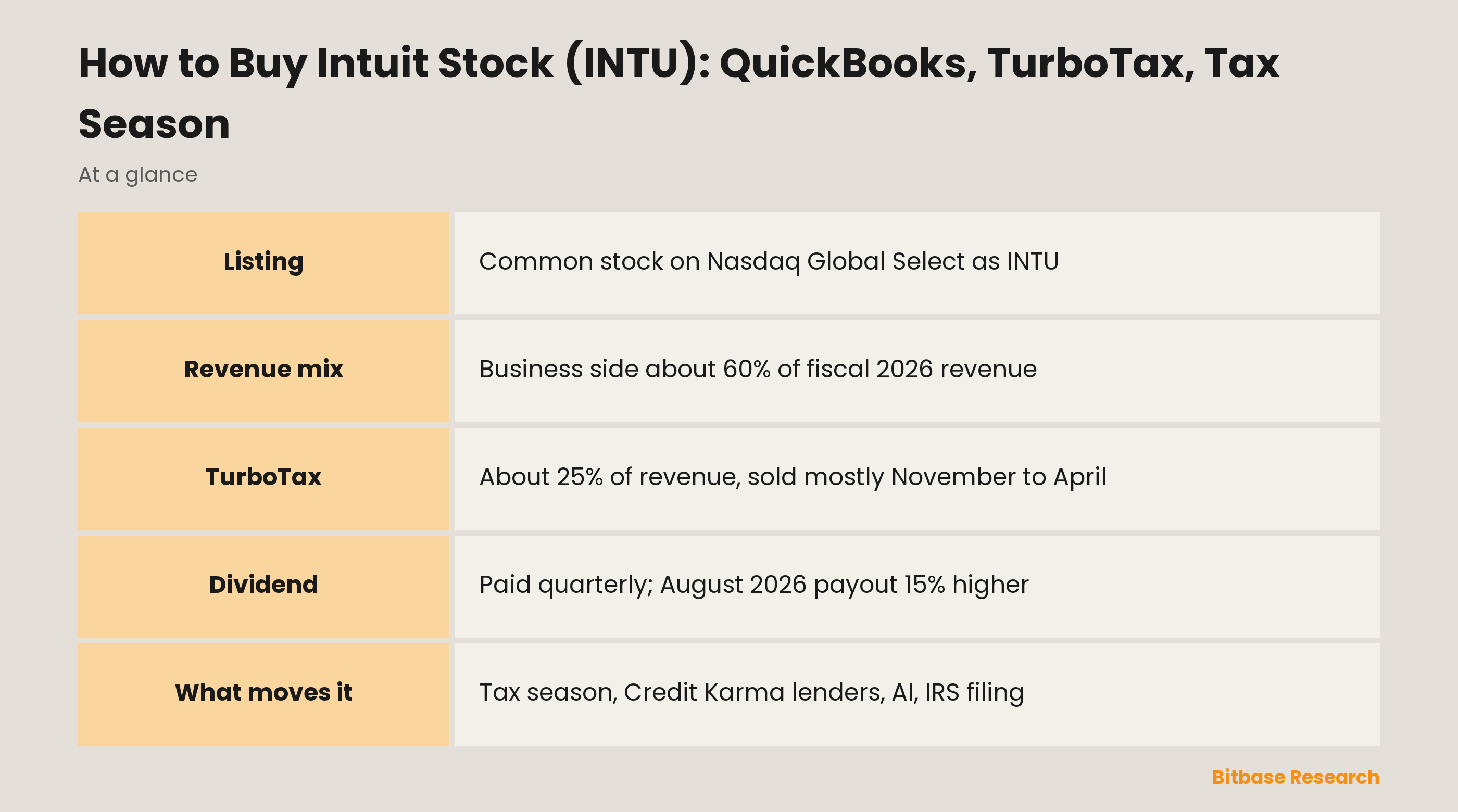
Intuit is listed on the Nasdaq Global Select Market under the ticker INTU, so any brokerage account with access to US shares can buy it, with no depositary receipt in between. Most people know the company through TurboTax, yet in fiscal 2026, the year to 31 July 2026, about 60% of its revenue came from the business side: QuickBooks, payments, payroll, small-business lending and Mailchimp. Tax filing season still sets the rhythm of every reporting year. This guide covers both segments, the order itself, and what the filings say moves the stock.
What Does Intuit Do?
Intuit makes financial software and services for consumers, small and mid-market businesses, and the accountants who work for both. It describes itself as "a global financial technology platform with a mission to power prosperity around the world" and says it serves about 93 million customers. Founded by Scott Cook and Tom Proulx, it began operations in March 1983 and went public in March 1993, when it also reincorporated from California to Delaware. It is based in Mountain View, California; Sasan Goodarzi has been chief executive since January 2019 and chairman since January 2026.
Since 1 August 2025 the business has been reported as two segments.
Global Business Solutions serves small and mid-market businesses and their accountants. At its centre is QuickBooks, sold online in tiers from a free plan up to QuickBooks Online Advanced, and as desktop software on subscription. Around the books sit the services that turn accounting software into a platform: payment processing, bill pay, a checking account through a partner bank, payroll and HR under the QuickBooks Workforce name, and QuickBooks Capital, which provides business loans through an originating bank partner. Intuit Enterprise Suite takes the same base to more complex mid-market companies, and Mailchimp adds email and marketing automation.
Consumer brings together three brands that were reported separately until fiscal 2025. TurboTax prepares and files US and Canadian income tax returns, either as do-it-yourself software or with an AI-enabled human expert, and sells money products such as early access to refunds. Credit Karma gives users their credit scores and recommends credit cards, loans and insurance from partner institutions. ProTax supplies software to professional preparers, including Lacerte and ProSeries in the US and ProFile in Canada.
Credit Karma joined on 3 December 2020 and Mailchimp on 1 November 2021. The structure is changing again: Intuit began managing Mailchimp as a separate operating segment on 1 August 2026, and from fiscal 2027 it will be reported on its own.
How Intuit Makes Money
Revenue rose 14% in fiscal 2026. Global Business Solutions grew 16% and Consumer 11%, leaving the split at about 60% business and 40% consumer. The 10-K breaks each segment into revenue lines:
| Revenue line | Segment | Share of fiscal 2026 revenue | Growth vs fiscal 2025 |
|---|---|---|---|
| QuickBooks Online Accounting | Global Business Solutions | 24% | 23% |
| Online Services: payments, payroll, lending, Mailchimp | Global Business Solutions | 23% | 16% |
| QuickBooks Desktop Accounting | Global Business Solutions | 8% | 8% |
| Desktop Services and Supplies | Global Business Solutions | 5% | 4% |
| TurboTax | Consumer | 25% | 7% |
| Credit Karma | Consumer | 12% | 20% |
| ProTax | Consumer | 3% | 4% |
Shares are calculated from segment revenue in the 10-K and rounded; growth rates are as reported.
The business side earns mainly subscriptions and transaction fees. The company credits the growth of QuickBooks Online Accounting to "higher effective prices, customer growth, and mix shift," while Online Services grew on payments volume, QuickBooks Capital loans and payroll. Two metrics show where that growth came from: Online Ecosystem revenue per customer rose 15%, while paying customers rose 3%. And excluding Mailchimp, the earnings release says, Online Ecosystem revenue grew 23% rather than 19%.
On the consumer side, TurboTax is still the largest single line, but its growth now comes from selling more help per return rather than handling more returns. US federal TurboTax units fell 2% to about 39 million, while TurboTax Live, the expert-assisted tier, grew 37% and reached 53% of TurboTax revenue. Credit Karma, the fastest-growing of the three consumer brands, is paid by partners: per completed action, such as a credit card issued or a personal loan funded, and per click or lead, mainly in home loans and insurance.
Service revenue made up 88% of the total, and international revenue was about 8% in each of the last three fiscal years, so this is overwhelmingly a US business. It is also a seasonal one: TurboTax and ProTax sales are "typically heavily concentrated in the period from November through April," which lifts the fiscal quarters ending 31 January and 30 April, and in fiscal 2026 Intuit employed an average of about 12,300 seasonal workers from January to April.
INTU Stock at a Glance
| Item | Detail |
|---|---|
| Exchange | Nasdaq Global Select Market |
| Ticker | INTU |
| Security | Common stock, the only class registered on the 10-K cover |
| Sector | Financial software: accounting, tax, payments, consumer finance |
| Index membership | S&P 500 and Nasdaq-100 |
| Headquarters | Mountain View, California |
| Incorporated | Delaware |
| Fiscal year | Ends 31 July; fiscal 2026 ran from August 2025 to July 2026 |
| Seasonal peak | Second and third fiscal quarters, during US tax season |
| Dividend policy | Quarterly cash dividend, declared by the board each time |
| Share repurchases | Ongoing program with no expiration date |
| Stock splits | Three: 1995, 1999 and 2006 |
| SEC identifier | CIK 896878 |
Quotes, market value and yield change through every session, so they are left out here; the Intuit stock page on Bitbase shows them live.
How to Buy Intuit Stock
INTU is the common stock of a US company, so the share you buy on Nasdaq is the share itself, with no ADR or second share class to weigh. The usual route:
1. Choose a broker with US market access. Outside the US, that can be a local broker routing orders to Nasdaq or an international one; find out which legal entity keeps your account and which authority oversees it.
2. Open and verify the account. Non-US individuals normally complete IRS Form W-8BEN so the broker can apply any treaty rate to US dividends.
3. Fund it. Depositing in another currency adds a conversion cost, so compare the exchange spread as well as the commission.
4. Search for INTU and read the name. It should say Intuit Inc. common stock. Intuitive Surgical, a different company that is also in the S&P 500, trades as ISRG.
5. Pick an order type. A market order fills at the available price; a limit order caps what you pay but may not fill, which matters around earnings releases, when the price can jump between sessions.
6. Decide on size. Where fractional shares are offered, you can invest a cash amount instead of whole shares; voting and order types for fractions depend on the broker.
7. Keep the confirmations as your record of cost basis and dividends.
Outside the United States, dividends carry US withholding tax. The IRS says that "most types of U.S. source income received by a foreign person are subject to U.S. tax of 30%," and a treaty between your country and the US can lower or remove that rate. Your home country can tax the same payment as well.
Through a fund, you hold INTU without picking it. State Street's SPY, which tracks the S&P 500, and Invesco's QQQ, which tracks the Nasdaq-100, both listed Intuit in their holdings on 29 October 2026, as one position among many.
What Moves INTU Stock
Filing season and the mix of help. The reports for the quarters ending in January and April carry most of the TurboTax news. The number to follow is not only how many returns are filed but how many filers pay for expert help: in fiscal 2026 units slipped 2% while TurboTax Live grew 37%. Dates set by others matter too; the 10-K warns that "unanticipated changes to federal and state tax filing deadlines may further exacerbate the impact of the seasonality."
Government filing programs. Intuit's risk factors say that "although the IRS free direct filing system was suspended, proponents of these programs continue to advocate for them," and that governments "are or could become publicly funded direct competitors of the U.S. tax services industry and of Intuit." Any revival or expansion of free government filing, including what the filing calls the legacy IRS Free File Program, bears directly on TurboTax.
Small-business pricing and credit. Business-side growth has leaned more on revenue per customer than on customer numbers, so pricing and add-on services are the lever to watch; for a different pricing model, the Salesforce profile describes a vendor that bills per user and is starting to bill AI agents by the work they do. Lending adds credit risk: for its capital products the 10-K says "We purchase some or all of those loans from the lender," so Intuit carries the chance that borrowers do not repay.
Lenders' appetite at Credit Karma. Credit Karma earns when partners approve and fund offers. The 10-K is blunt: "Some financial institutions and other entities have in the past decreased or suspended their activity on Credit Karma's platform and could do so in the future." Higher interest rates, it adds, "may make offers from Credit Karma's partners less attractive to Credit Karma's users." Its 20% growth in fiscal 2026 came from personal loans, credit cards and insurance.
AI, from both directions. Intuit has built its strategy around being an "AI-driven expert platform" since 2019 and is putting AI agents into QuickBooks, TurboTax and Credit Karma. Yet its competitor list includes "platform companies and providers of general purpose AI technologies," and the risk factor on the share price names "perceptions about the impact of evolving technologies, including AI, on our business."
Reorganisation and reporting. In May 2026 Intuit announced a plan to cut its full-time workforce by about 17%, with the actions expected to be substantially complete in the first quarter of fiscal 2027. From that year Mailchimp is reported outside Global Business Solutions; excluding it, the segment grew 18% in fiscal 2026 instead of 16%.
Capital returns. Intuit pays a quarterly dividend and buys back shares; repurchases cut the weighted-average diluted share count by 2% in fiscal 2026. The filing cautions that "any changes in the amounts or frequency of share repurchases or dividends may also adversely affect our stock price."
Intuit's Weak Spots, in Its Own Words
The risk factors in the fiscal 2026 10-K run long. These stand out:
Competition, including free products. Intuit expects competition "to continue to intensify in the future," including "from providers of free and low-cost offerings, particularly in our tax, accounting, payments and personal finance platform businesses."
Scrutiny of tax preparation. "The tax preparation industry continues to receive heightened attention from federal and state governments," and new rules or litigation could restrict what Intuit offers or the prices it charges.
Litigation. The FTC case over how Intuit marketed free tax preparation is winding down (see the FAQ), but an Ontario class action was certified on 24 July 2026, which Intuit expects to appeal, and two shareholder class actions filed in July and August 2026 allege materially false and misleading statements in 2025 and 2026. Intuit says it cannot estimate a reasonably possible loss.
Security and fraud. Intuit holds tax returns, credit files and bank details, and Credit Karma's use of user data is under an FTC order requiring a comprehensive security program and independent assessments every two years through 2034. If fraud is not contained, the 10-K warns, it could lead to "federal or state tax authorities refusing to allow us to process our customers' tax returns electronically."
Borrowers and debt. Adverse conditions such as inflation and higher rates "may increase the likelihood that the borrowers are unable to repay their loans." Intuit also carries debt, issued new senior notes in June 2026, and lists borrowing among its risks for "increasing our vulnerability to downturns in our business."
AI spending. If Intuit is "unable to realize the benefits of these investments, our business and financial performance could be harmed."
Two more risks belong to the share itself: a single stock concentrates your money in one company, however many brands it runs, and dividends are declared one quarter at a time and are never guaranteed.
How to Research INTU Yourself
Intuit files with the SEC under CIK 896878. Its year ends on 31 July, so the 10-K arrives in early September; the fiscal 2026 report was filed on 9 September 2026. Quarterly 10-Qs cover periods ending in October, January and April, and results arrive in 8-Ks: over the past year on 21 August and 20 November 2025, then 26 February, 20 May and 25 August 2026.
In the 10-K, Item 1 covers the products, Item 1A the risks, Note 13 the legal proceedings including the FTC case, and Note 14 segment revenue by line.
Two habits help with this company. Fiscal labels run ahead of the calendar: "fiscal 2026" ended in July 2026 and holds the 2026 filing season in its third quarter. Segment history is recast when the structure changes, as it was for the 2025 Consumer combination and will be for Mailchimp, so take comparisons from the latest filing.
The investor relations site, investors.intuit.com, carries earnings materials and an FAQ with the split history. For quotes, use the stock page above; for other companies, open the full list of US stock pages on Bitbase.
Intuit Stock FAQ
Does Intuit pay a dividend?
Yes, quarterly. The dividend declared in August 2026, payable on 16 October 2026, was 15% higher than a year earlier. The 10-K says Intuit expects "to continue to pay comparable cash dividends on a quarterly basis," but each payment is the board's decision; the latest 8-K gives the amount and dates.
Can I buy Intuit stock with crypto?
Not directly. INTU trades in US dollars through brokerage accounts, so the crypto has to become cash first and the cash has to reach the broker. Treat that sale as its own decision: in many countries selling crypto is a taxable event, reported separately from anything you later do with the shares.
Has Intuit stock ever split?
Yes, three times: two-for-one in August 1995, three-for-one in September 1999 and two-for-one in June 2006. Together they turned one original share into 12, so prices from before mid-2006 need adjusting before comparison.
Is INTU in the S&P 500 and the Nasdaq-100?
Yes. The SPY and QQQ holdings files both listed Intuit on 29 October 2026. Index weights change every trading day.
Why are Intuit's quarterly results so uneven?
Because of the US tax calendar. With TurboTax and ProTax revenue concentrated between November and April, the April quarter is the strongest: in fiscal 2026 it brought in about 40% of the year's revenue. Compare each quarter with the same quarter a year earlier.
What happened in the FTC case over TurboTax's free filing ads?
An FTC administrative law judge ruled against Intuit in 2023, and in January 2024 the Commission issued a final order on marketing practices, with no monetary penalty. Intuit appealed, and on 20 March 2026 the Fifth Circuit vacated the order and sent the case back to the FTC. With the appeal deadline passed, Intuit asked a federal court on 31 August 2026 to dismiss the FTC's remaining lawsuit as moot; the FTC agreed not to oppose, and a ruling was pending when the 10-K was filed.
Conclusion
Buying INTU takes a broker with Nasdaq access and a careful look at the order screen. Knowing what you own takes more: a small-business software and payments company that brings in about 60% of revenue, joined to a consumer franchise whose year is largely decided between November and April. The filings spell out what can go wrong, from government filing programs and Credit Karma's lenders to AI competition and open lawsuits. Read the latest 10-K and quarterly releases with the July fiscal year in mind before deciding how much of your portfolio one company should hold.
Related reading
Other Bitbase articles on this topic:
- How to Buy Cloudflare Stock (NET): Share Classes and 24/7 Perps
- How to Buy Datadog Stock (DDOG): Usage Pricing, Nevada and Perps
- How to Buy DoorDash Stock (DASH): Dashers, Deliveroo, Instacart
Disclaimer: This article is educational content from Bitbase Academy, provided for information only. It explains what a company or fund does and how the instruments referenced here differ from one another; it does not constitute investment, trading, tax, or financial advice, and it is neither a recommendation nor an endorsement of any security, token, or trading strategy. A tokenized stock is issued by a third party and is designed to give economic exposure to an underlying asset: it is not a share, it carries no shareholder rights, and it depends on the issuer's structure, eligibility rules, and redemption terms, which the issuer can change. Perpetual futures are leveraged derivatives that hold no underlying asset and can be liquidated, and trading hours, product availability, and eligibility differ by instrument and by jurisdiction and can change at any time. Written as of October 2026; verify everything yourself through company filings, the issuer's own documentation, and the product pages of the venue you trade on.
References
[1] Intuit Form 10-K, fiscal 2026 (SEC EDGAR) www.sec.gov
[2] Intuit fiscal 2026 results release, 25 August 2026 (Form 8-K) www.sec.gov
[3] Intuit Form 8-K, 20 May 2026: restructuring plan www.sec.gov
[4] Intuit Form 8-K, 1 November 2021: Mailchimp acquisition completed www.sec.gov
[5] Intuit investor relations: FAQ investors.intuit.com
[6] State Street: SPY daily holdings, 29 October 2026 www.ssga.com
[7] Invesco: QQQ, which tracks the Nasdaq-100 www.invesco.com
[8] IRS: NRA Withholding www.irs.gov





