
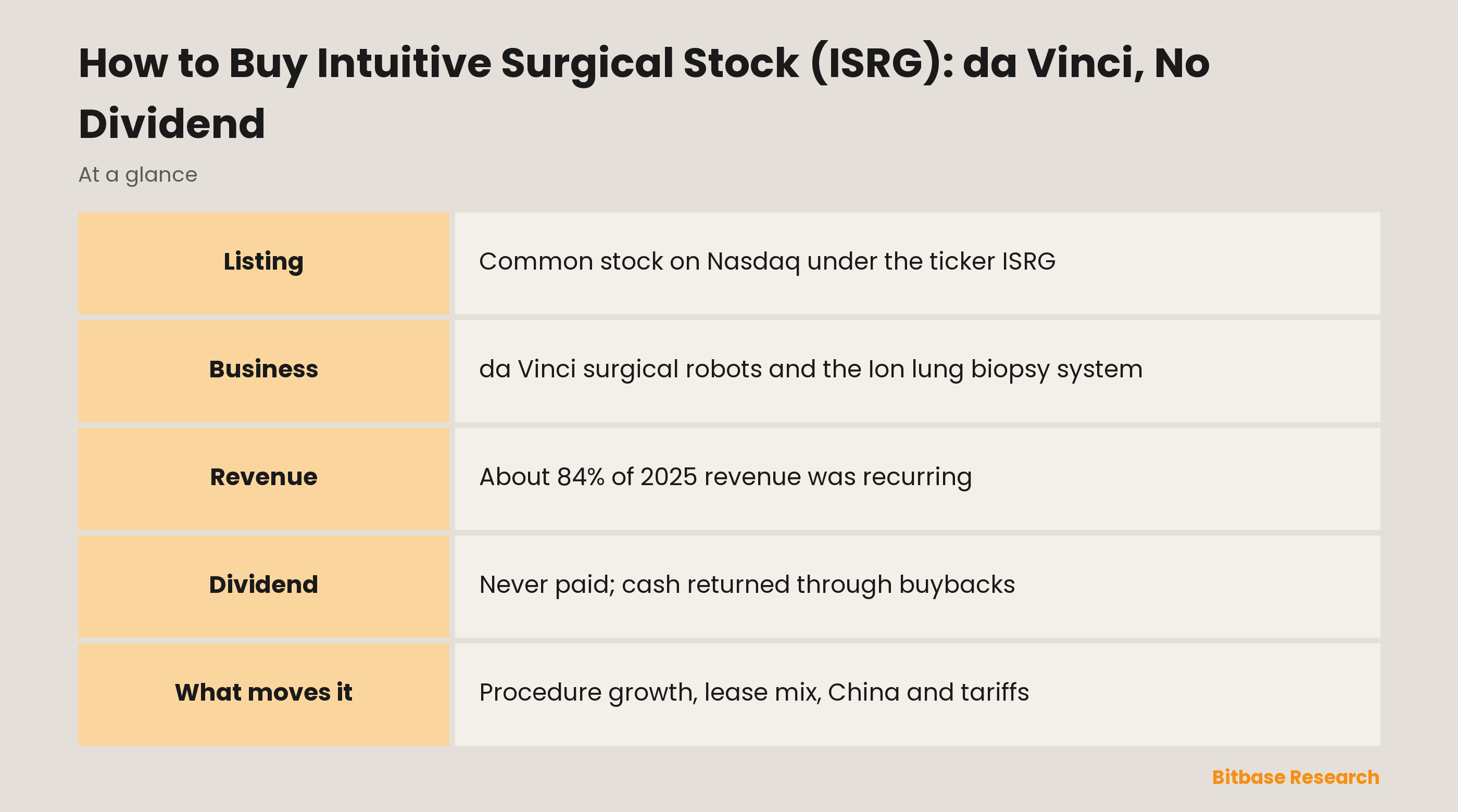
With any brokerage account that reaches Nasdaq, you can buy Intuitive Surgical stock, which trades there under the ticker ISRG. The company makes the da Vinci surgical robot, yet most of its money arrives after the robot is installed: about 84% of 2025 revenue was recurring, from instruments that wear out, service contracts and system leases. This guide explains that model, the order steps, why the stock has never paid a dividend, and the risks its own filings put first.
What Does Intuitive Surgical Do?
Intuitive Surgical builds robotic systems for minimally invasive care, plus the instruments and service that go with them. The 10-K states that it "was founded in 1995" and is a Delaware corporation; it is based in Sunnyvale, California, went public in 2000 and reports a single business segment.
The da Vinci surgical system came first: launched in 1999, cleared by the FDA in 2000 for general laparoscopic surgery. The surgeon sits at a console viewing a three-dimensional image of the surgical field, and the system turns hand movements into smaller, steadier movements of instruments held by robotic arms. It is used for soft-tissue surgery between the pelvis and the neck, mainly general, gynecologic, urologic, cardiothoracic, and head and neck procedures. Customers run several generations; the newest, da Vinci 5, adds force feedback so the surgeon can sense the force applied to tissue.
The Ion endoluminal system, cleared by the FDA in 2019, took the company from surgery into diagnosis. It steers a thin robotic catheter into the lung to biopsy small nodules. Most Ion procedures are performed in the US, where the company estimates Ion's share of lung biopsies is approaching the halfway point.
Around both platforms sits a consumables business built to repeat: each da Vinci instrument carries a chip that "generally will not allow the instrument to be used for more than the prescribed number of procedures." Instruments and accessories are made in Sunnyvale and in Mexicali, Mexico. Dave Rosa, who joined in 1996, has been chief executive since 1 July 2025.
How Intuitive Surgical Makes Money
A system is placed once; instruments are bought again with every operation. The fiscal 2025 10-K splits revenue three ways:
| Revenue line | Share of 2025 revenue | Growth from 2024 | What it covers |
|---|---|---|---|
| Instruments and accessories | 59.8% | 19% | Instruments, staplers, energy instruments, drapes, Ion catheters and needles |
| Systems | 24.6% | 26% | da Vinci and Ion systems sold or leased, including operating lease revenue equal to 8.7% of the total |
| Service | 15.6% | 20% | Installation, repair, maintenance and technical support contracts |
Shares are calculated from the 10-K's figures; growth rates are the company's.
Instruments and accessories "have limited lives and will either expire or wear out as they are used in surgery," so this line moves with surgical volume. In 2025 da Vinci procedures grew about 18%, roughly 15% in the US and 23% elsewhere, and Ion procedures about 51%. Service follows the installed base: a system sale generally includes five years of service.
Intuitive counts instruments and accessories, service and operating lease revenue as recurring: 84% of 2025 revenue, as in 2024, while total revenue rose 20.5%.
Leasing is a large part of how systems reach hospitals. Intuitive has leased systems directly since 2013, and 51% of the da Vinci systems placed in 2025 went out under operating leases. Some leases are fixed-payment; others are usage-based, so the hospital pays as procedures are performed, and these "generally contain no minimum payments." Because lease revenue is spread over time, a period with more leasing reports less systems revenue, even if as many robots went out.
By geography, 68% of 2025 revenue came from the US and 32% from other markets. China is served through a majority-owned joint venture with Fosun Pharma, and in March 2026 Intuitive bought its distributors' businesses in Italy, Spain, Portugal, Malta and San Marino to sell there directly.
ISRG Stock at a Glance
| Field | ISRG |
|---|---|
| Exchange | The Nasdaq Global Select Market |
| Ticker | ISRG |
| Security | Common stock, the only security registered on the 10-K cover |
| Sector | Healthcare: medical devices for robotic-assisted surgery and lung biopsy |
| Index membership | S&P 500 and Nasdaq-100 |
| Headquarters | Sunnyvale, California |
| Incorporated | Delaware; founded 1995, public since 2000 |
| Fiscal year | Calendar year, ending 31 December |
| Dividend policy | No cash dividend ever declared; share repurchase program since March 2009 |
| Share changes on record | One-for-two reverse split in July 2003; three-for-one splits in October 2017 and October 2021 |
| SEC identifier | CIK 1035267 |
Quotes and market value move all session, so they belong on a live page rather than in a guide: open the Intuitive Surgical stock page on Bitbase for them.
How to Buy Intuitive Surgical Stock
Intuitive Surgical is a US company with one listed class of stock, so no depositary receipt or second share class is involved. In practice the purchase takes seven steps:
1. Choose where the shares will be held. Any broker that lists Nasdaq stocks can execute the trade; if you live outside the US, find out which legal entity will keep your account and which regulator oversees it.
2. Complete the account checks. Brokers ask non-US individuals for IRS Form W-8BEN, which certifies foreign status for withholding.
3. Move money in. Savings held in another currency carry a conversion cost of their own, so look at the rate offered and not only the commission.
4. Confirm the security. Type ISRG and make sure the match is Intuitive Surgical common stock on Nasdaq. The company has only one registered security, so no bond series shares the symbol.
5. Pick an order type. Investor.gov explains that a market order "guarantees that the order will be executed, but does not guarantee the execution price," while a limit order fills only "at a specific price or better."
6. Set the amount. Buying a fraction of a share allows a fixed cash investment, though "not every brokerage firm offers fractional share investing," some firms "only allow market orders" for fractional trades, and fractional holders "may not have voting rights."
7. Place the order and file the paperwork. Trade confirmations establish your cost basis. Since ISRG has paid no dividend so far, the only cash it returns arrives when you sell.
For investors abroad, the IRS sets out the withholding rule: "most types of U.S. source income received by a foreign person are subject to U.S. tax of 30%," and a treaty can reduce it. ISRG currently pays no dividend for that rule to reach, and tax on a capital gain depends on your country of residence.
Via a fund, Intuitive Surgical comes as a small slice of a basket. It belongs to the S&P 500 (State Street's SPY, an S&P 500 tracker, listed it in its holdings file dated 28 October 2026) and to the Nasdaq-100, the index that Invesco's QQQ and QQQM are built to follow.
What Drives ISRG Stock
Procedure volume. Most revenue rises and falls with the number of operations. Growth has slowed in 2026: da Vinci procedures grew about 18% in 2025 and about 14% in the third quarter of 2026, Ion procedures about 51% and then about 31%.
Weight-loss drugs. The 10-K says that "the availability and effectiveness of weight loss drugs have reduced the number of bariatric procedures performed, including those bariatric procedures performed using our da Vinci surgical system." US da Vinci bariatric procedures fell by a high-single-digit percentage in 2025, and the filing calls the long-term impact difficult to predict.
The da Vinci 5 rollout. FDA clearance came in March 2024, Japan followed in June 2025 and the European Union in July 2025, there without force feedback. In 2025 the new model made up 870 of the 1,721 da Vinci placements.
China. A healthcare governance campaign launched in July 2023 has led hospitals to cancel or delay tenders, competition from domestic robot makers is increasing, and the company placed fewer systems in China in 2025 than it expected. Its third-quarter 2026 report adds "a unified national pricing framework in China" to the uncertainties.
Tariffs. Most instruments are made in Mexico, and new US tariffs helped push down the 2025 product gross margin; after the Supreme Court struck down the emergency-powers tariffs in February 2026, other duties replaced them.
Competition. The 10-K names 14 companies that have introduced robotic-assisted products or said they intend to, including Medtronic and Johnson & Johnson, whose own business is covered in the Johnson & Johnson stock guide.
Disputes over instrument repair. In October 2026 Intuitive agreed, without admitting liability, to settle a hospital antitrust class action over the servicing of its instruments, with a one-time payment and agreed injunctive relief; the settlement still needs court approval. In a related case, the Ninth Circuit reversed a judgment in Intuitive's favor in August 2026, and the company has asked for a rehearing. With instruments at almost 60% of revenue, how far third parties may repair or remanufacture them reaches the core of the model.
Risks in Intuitive Surgical's Own Filings
From Item 1A of the 10-K, these bear most directly on an ISRG share:
Alternatives to robotic surgery. Open surgery, conventional laparoscopy, drugs and radiation all compete with a da Vinci operation, and "technological advances could make such treatment options more effective or less expensive than using our products."
Usage-based arrangements. "We are increasingly offering usage-based arrangements as part of our business model. As a result, we are exposed to an increased risk of losses of revenue in any period where the usage decreases."
Reimbursement and site of care. "To the extent that there is a shift from inpatient settings to outpatient settings, we may experience pricing pressure and a reduction in the number of procedures performed."
Litigation and supply. "Product liability claims have been brought against us by, or on behalf of, individuals alleging that they have sustained personal injuries," and some components come from sole- or single-sourced suppliers.
Above the business, a single stock ties your result to one company, and the 10-K warns that the share price "has experienced fluctuations and may fluctuate significantly in the future." If your home currency is not the dollar, the exchange rate moves the result too.
How to Check ISRG in the Filings
On EDGAR, Intuitive Surgical's reports sit under CIK 1035267: a 10-K each year, a 10-Q each quarter, and 8-Ks for events in between, earnings releases included. Item 1 of the 10-K covers the products, Item 1A the risks, and the management discussion carries the tables worth tracking: procedures by specialty and region, placements, the installed base and how many placements were leases. The contingencies note in the latest 10-Q follows the antitrust and product liability cases.
Three checks prevent misreadings: read systems revenue next to placements and the lease share. Treat procedure counts as estimates: the company derives them from installed-system data with methods that "involve estimates and judgments." And adjust per-share history from before October 2017 or October 2021 for the splits. Live prices are on the stock page linked above, and Bitbase's US stock pages cover other companies.
Intuitive Surgical Stock FAQ
Does Intuitive Surgical pay a dividend?
No. The 10-K states: "We have never declared or paid any cash dividends on our common stock," and the company intends to keep earnings for running and expanding the business. It returns cash through a share repurchase program instead, set up in March 2009 and last enlarged in April 2026.
Can I buy Intuitive Surgical stock with crypto?
Not directly. The shares sit in a brokerage account and Nasdaq trades settle in US dollars, so any crypto must first be converted to cash and transferred to the broker. Depending on your jurisdiction, selling crypto can be a taxable event, which makes the crypto sale and the share purchase two decisions with separate records.
Has ISRG stock ever split?
Yes. Its filings record a three-for-one split in October 2017 and another whose shares were distributed on 4 October 2021. Earlier, a one-for-two reverse split took effect on 1 July 2003, alongside the acquisition of Computer Motion. Per-share prices from before those dates need adjusting before comparison.
Is ISRG in the S&P 500 and the Nasdaq-100?
Yes, both. Nasdaq's Nasdaq-100 constituent list dated 29 October 2026 includes ISRG, and State Street's SPY holdings file dated 28 October 2026 lists Intuitive Surgical. Index weights change every day.
Who are Intuitive Surgical's competitors?
The 10-K's list of 14 companies in robotic-assisted procedures includes Medtronic, Johnson & Johnson, CMR Surgical, Karl Storz and Medicaroid, along with Chinese makers such as Shanghai Microport Medbot and Shenzhen Edge Medical. Open surgery, laparoscopy, drugs and radiation compete too.
Conclusion
Placing the trade is the simple part: a Nasdaq-capable broker, the ISRG line confirmed as Intuitive Surgical common stock, then a market or limit order. Understanding the holding takes longer, because the company is paid mostly as operations happen and has never paid a dividend. Before sizing a position in a single medical-device company, read the procedure tables, the lease mix and the litigation note in the latest 10-K and 10-Q.
Related reading
Other Bitbase articles on this topic:
- How to Buy Cencora Stock (COR): Ex-AmerisourceBergen, Walgreens
- How to Buy Cigna Stock (CI): Express Scripts and Rebate Reform
- How to Buy CVS Health Stock (CVS): Insurer, PBM and Drugstores
Disclaimer: This article is educational content from Bitbase Academy, provided for information only. It explains what a company or fund does and how the instruments referenced here differ from one another; it does not constitute investment, trading, tax, or financial advice, and it is neither a recommendation nor an endorsement of any security, token, or trading strategy. A tokenized stock is issued by a third party and is designed to give economic exposure to an underlying asset: it is not a share, it carries no shareholder rights, and it depends on the issuer's structure, eligibility rules, and redemption terms, which the issuer can change. Perpetual futures are leveraged derivatives that hold no underlying asset and can be liquidated, and trading hours, product availability, and eligibility differ by instrument and by jurisdiction and can change at any time. Written as of October 2026; verify everything yourself through company filings, the issuer's own documentation, and the product pages of the venue you trade on.
References
[1] Intuitive Surgical Form 10-K, fiscal 2025: business, revenue, procedures, leasing and risk factors (SEC EDGAR) www.sec.gov
[2] Intuitive Surgical Form 10-Q for the quarter ended 30 September 2026: litigation, tariffs and share repurchases (SEC EDGAR) www.sec.gov
[3] Intuitive Surgical third-quarter 2026 results release, 20 October 2026 (Form 8-K, Exhibit 99.1) www.sec.gov
[4] Intuitive Surgical press release, 2 March 2026: direct operations in Italy, Spain, Portugal, Malta and San Marino (Form 8-K, Exhibit 99.1) www.sec.gov
[5] Intuitive Surgical Form 8-K, May 2025: David J. Rosa appointed chief executive effective 1 July 2025 (SEC EDGAR) www.sec.gov
[6] Intuitive Surgical Form 10-K, fiscal 2023: note on the three-for-one stock split distributed on 4 October 2021 (SEC EDGAR) www.sec.gov
[7] Intuitive Surgical Form 10-K, fiscal 2017: three-for-one stock split in October 2017 (SEC EDGAR) www.sec.gov
[8] Intuitive Surgical Form 10-K, fiscal 2003: one-for-two reverse split effective 1 July 2003 and the 2000 initial public offering (SEC EDGAR) www.sec.gov
[9] Nasdaq: Nasdaq-100 index constituents www.nasdaq.com
[10] State Street SPDR S&P 500 ETF Trust (SPY): fund page and daily holdings www.ssga.com
[11] Investor.gov (SEC): Types of Orders www.investor.gov
[12] Investor.gov (SEC): Investor Bulletin on fractional share investing www.investor.gov
[13] IRS: NRA Withholding www.irs.gov





