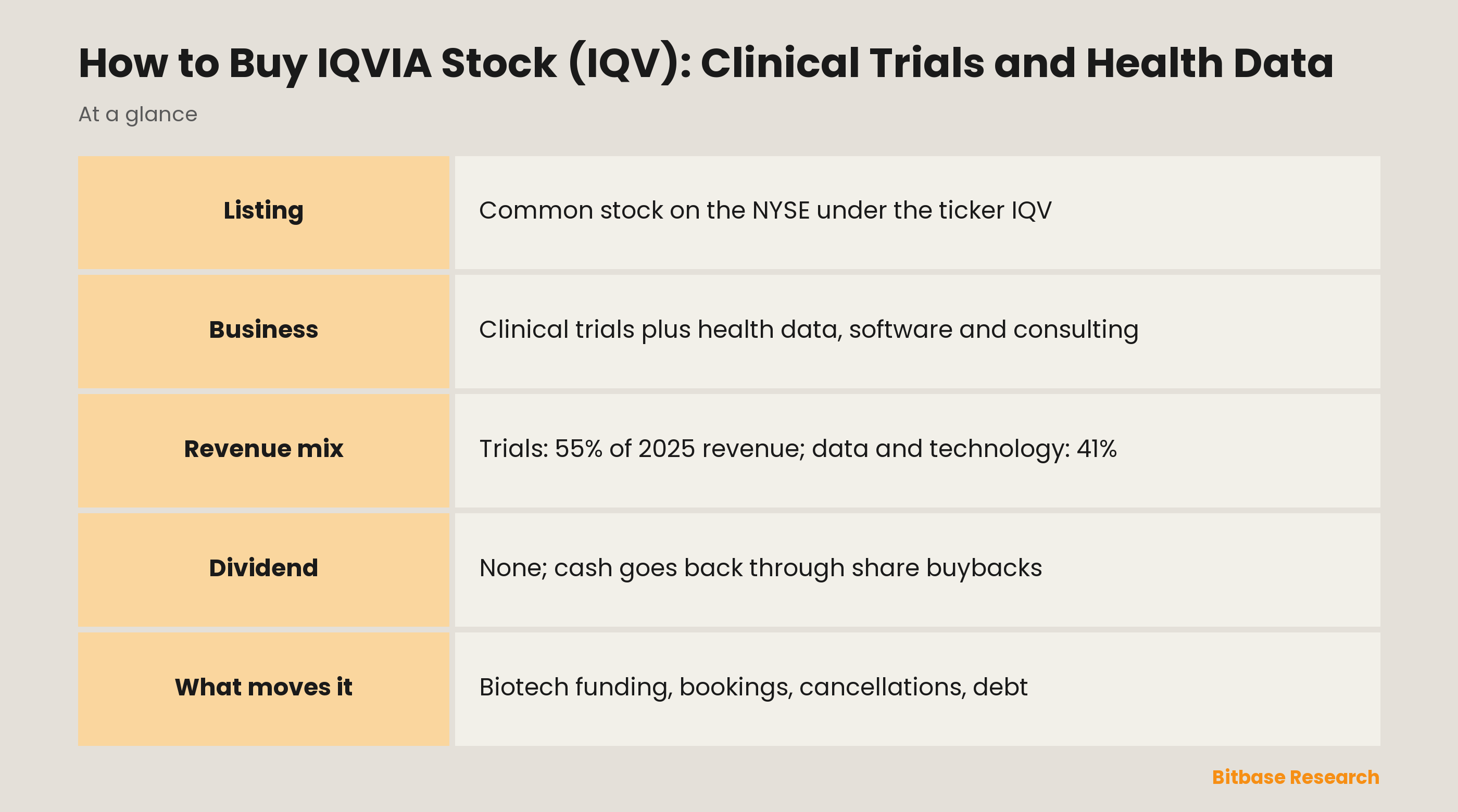
An IQVIA share can be bought through any broker with access to the New York Stock Exchange, where IQVIA Holdings Inc. lists its common stock under the ticker IQV. The company runs clinical trials for drug makers and sells data and software built on more than 1.2 billion non-identified patient records, and in 2025 the trial business brought in about 55% of its revenue. Below: how it earns that money, the steps of a purchase, why the share pays no dividend, and what the 10-K warns about.
What Does IQVIA Do?
IQVIA's 2025 annual report calls it "a leading global provider of clinical research services, commercial insights and healthcare intelligence to the life sciences and healthcare industries." Drug makers hire it to run trials, then buy its data and software to sell the medicines that reach the market.
The company comes from a 2016 merger. Quintiles was founded in 1982 by Dennis Gillings, a biostatistics professor at the University of North Carolina at Chapel Hill, and grew into a contract research organization, or CRO: a firm that runs trials for the companies that sponsor them. It went public on the NYSE in May 2013 under the symbol Q. On 3 October 2016 it completed a "merger of equals" with IMS Health, a supplier of pharmaceutical sales and prescription data; IMS Health was merged into Quintiles and its shares were delisted. The combined company became IQVIA Holdings Inc. on 6 November 2017, and the shares started trading as IQV on 15 November 2017.
The data business is what IMS Health brought. The 10-K describes "one of the largest and most comprehensive collections of healthcare information in the world," from prescriptions and sales to medical claims, electronic medical records and genomics. IQVIA counts more than 1.2 billion unique non-identified patient records and says it delivers information on approximately 90% of the world's pharmaceuticals, measured by 2024 sales. For its syndicated research, suppliers or trusted third parties render the data non-identified before it reaches IQVIA.
The trial business is what Quintiles brought: protocol design, site start-up, patient recruitment, monitoring and laboratories. A smaller third line supplied contract sales representatives and nurse-led patient support programs to drug makers.
IQVIA had approximately 93,000 employees at the end of 2025 and more than 10,000 clients in over 100 countries. Nearly all of the top 100 pharmaceutical and biotechnology companies are clients, yet no single client reached 10% of revenue in 2025, 2024 or 2023; the largest accounted for approximately 5% in 2025.
How IQVIA Makes Money
IQVIA sells services, not goods; the 10-K says it has no material product revenues. In 2025 it reported three segments:
| Segment | Share of 2025 revenue | Revenue growth in 2025 | Share of 2025 segment profit | What it sells |
|---|---|---|---|---|
| Research & Development Solutions | 55% | 4.3% | 53% | Outsourced clinical trials, laboratories, trial design |
| Technology & Analytics Solutions | 41% | 7.6% | 45% | Health data, cloud software, real-world evidence, consulting |
| Contract Sales & Medical Solutions | 5% | 9.7% | 1% | Contract sales teams, patient and medical services |
The percentages are worked out from the segment figures in the 10-K. Total revenue rose 5.9%.
Margins differ. Technology & Analytics kept about 24% of its revenue as segment profit, the trial business about 21% and contract sales about 6%. In 2025 trial revenue grew while trial segment profit fell 3.9%, because costs rose faster.
Trial contracts often run for years, so IQVIA reports a contracted backlog for that segment; at the end of 2025 it expected about 25% of it to become revenue within twelve months. Part of trial revenue is pass-through: "reimbursed expenses," which the 10-K says are "principally of payments to investigators who oversee clinical trials and travel expenses." That is why the October 2026 release gives third-quarter trial growth both ways: 8.7%, or 6.8% excluding those expenses.
By region, the Americas produced about 47% of 2025 revenue, Europe and Africa 32% and Asia-Pacific 21%. About 30% of revenue was in currencies other than the US dollar.
The segments changed on 1 January 2026. Contract Sales & Medical Solutions was folded into Technology & Analytics Solutions, renamed Commercial Solutions, and some real-world evidence work moved to Research & Development Solutions. In the first nine months of 2026, Commercial Solutions provided 41% of revenue and Research & Development Solutions 59%.
IQV Stock at a Glance
| Feature | IQV |
|---|---|
| Exchange | New York Stock Exchange |
| Ticker | IQV (Q until November 2017) |
| Security | Common stock, the only class registered under Section 12(b) |
| Sector | Life sciences services: clinical research, health data and technology |
| Index membership | S&P 500 |
| Headquarters | Durham, North Carolina |
| Incorporated | Delaware |
| Listed since | May 2013, as Quintiles |
| Fiscal year | Calendar year, ending 31 December |
| Dividend | None; the company buys back shares instead |
| SEC identifier | CIK 1478242 |
Price and market value change all day; for live figures, see the IQVIA stock page on Bitbase.
How to Buy IQVIA Stock
Because IQVIA is incorporated in Delaware and listed in New York, you buy the common stock itself, with no depositary receipt in between. The purchase has six steps:
1. Pick a broker that reaches the NYSE. Abroad, check which entity holds your account and who regulates it.
2. Complete account checks. Brokers ask investors outside the US for IRS Form W-8BEN, which the IRS says to submit "when requested by the withholding agent or payer."
3. Fund it. Compare currency conversion costs as well as commissions.
4. Search for IQV. Confirm the result is IQVIA Holdings Inc. common stock on the NYSE; old charts may still show the ticker Q.
5. Choose the order type. FINRA says a market order "provides the most certainty that your order will be executed," while a limit order fills only "at or better than a specified price."
6. Decide the size. Fractional shares let you invest a fixed sum, but some firms offer them only for "large-cap stocks or ETFs," and "as a fractional share owner, you might not have shareholder voting rights."
Taxes abroad. The IRS says "most types of U.S. source income received by a foreign person are subject to U.S. tax of 30%," with lower rates possible under a tax treaty. IQVIA pays no dividend, so your return comes from the sale price, which your home country may tax.
Through index funds. IQVIA is in the S&P 500, so funds that track it, State Street's SPY among them, hold IQV as one position among hundreds.
What Moves IQV Stock
Drug developers' budgets. The 10-K says smaller clients "may rely on funding from venture capital and other sources," and when that funding shrinks they "have been and may in the future be forced to reduce their outsourced R&D and commercialization expenditures." In October 2026 chief executive Ari Bousbib said "multiple demand indicators continue to validate the strengthening market environment."
Bookings and backlog. For a CRO, contracts signed today are revenue for years. Third-quarter 2026 net new bookings rose 15% from a year earlier, IQVIA's strongest clinical quarterly bookings since 2022. In the same quarter it refined how it counts inactive trials, which cut the backlog figure; it said next-twelve-month revenue from backlog should still grow 10%.
Cancellations. Most trial clients "can terminate our contracts upon 30 to 90 days' notice," and the 10-K calls terminations and delays "a regular part" of the business.
Policy and consolidation. Drug pricing reform, limits on drug marketing and mergers among clients all appear in the risk factors; after a merger, services bought separately "are usually purchased only once by the combined entity."
Currency, debt and buybacks. A stronger dollar lowers reported results. IQVIA carries substantial debt, some at variable rates, and in September 2026 sold new notes due 2034, partly to redeem notes due in 2026. Instead of a dividend it buys back stock: 7.4 million shares in 2025 and 5.5 million in the first nine months of 2026, and in May 2026 the board enlarged the authorization.
Views on AI. The 10-K lists "changes in investor perception regarding the role, effectiveness, risks or regulatory implications of artificial intelligence" among factors that can move the share price.
Cancelled Trials, Data Licenses and Debt in IQVIA's 10-K
These items from Item 1A bear most directly on an IQV share:
Contracts. "The potential loss or delay of our large contracts or of multiple contracts could adversely affect our results," and wind-down fees "may not be sufficient" to replace what a cancelled project would have earned.
Data supply. At renewal, data suppliers "may increase restrictions on our use of such data, increase the price they charge us for data or refuse altogether to license the data to us."
Competition. The 10-K names CRO rivals ICON, Parexel, Syneos Health and Pharmaceutical Product Development, part of Thermo Fisher Scientific (see our Thermo Fisher stock guide). On the data side it lists Accenture, covered in our Accenture stock guide, along with Veeva and Oracle Health.
Debt. Its loan and bond terms limit its ability to "pay dividends or distributions or redeem or repurchase capital stock," and "because we have variable rate debt, increases in interest rates will lead to increases in our borrowing costs."
Two risks sit with the share itself. Owning one company's stock concentrates your money in one business. And with "no current plans to pay regular cash dividends," the 10-K says, "stockholders may not receive any return on investment unless they sell their common stock for a price greater than that which they paid for it."
How to Research IQV Yourself
IQVIA's filings are on SEC EDGAR under CIK 1478242: the 10-K, 10-Qs and 8-Ks, including the quarterly earnings releases, which in 2026 came on 5 February, 5 May, 28 July and 27 October.
In the 10-K, Item 1 describes the offerings and competitors, Item 1A the risks and Item 5 the dividend policy and buybacks; the MD&A gives segment results and the trial backlog, and Note 2 splits revenue by region.
Two habits help. Compare segments on the same basis: the 10-Qs recast 2025 into the two new segments, so the 10-K's three-segment table will not line up with 2026 figures. And read backlog with its definition, which changed in 2026. For quotes, use the IQVIA page linked in the table section; Bitbase's index of US stock pages lists the rest.
IQVIA Stock FAQ
Can I buy IQVIA stock with crypto?
Not directly. A broker settles IQV purchases in US dollars, so any crypto must first be converted to cash, and that conversion can trigger tax in your country. Owning IQV makes you a part-owner of a registered company with a vote, which is the core of the difference between stocks and crypto.
Does IQVIA pay a dividend?
No. The 10-K says the company does "not currently intend to pay dividends" and that none were declared or paid in 2025 or 2024. It returns cash through buybacks.
Is IQV in the S&P 500?
Yes. The holdings list State Street published for SPY, its S&P 500 fund, as of 6 November 2026 includes IQVIA Holdings Inc. under IQV.
What was IQVIA called before?
Until October 2016 it was Quintiles Transnational Holdings, listed in 2013 as Q. After the IMS Health merger it traded as Quintiles IMS Holdings, and in November 2017 it became IQVIA Holdings Inc. under the ticker IQV.
Who are IQVIA's competitors?
In clinical research the 10-K names ICON, Parexel, Syneos Health and Thermo Fisher's PPD; in data and technology, firms such as Accenture, Veeva and McKinsey.
Conclusion
IQVIA's revenue rises and falls with how much drug developers spend on research, because it is a trial operator and a health data company in one, and it pays no dividend while carrying meaningful debt. The order takes minutes; reading the business takes longer. Start with the newest 10-K and earnings release, track bookings and backlog on a like-for-like basis, and then size the position for what it is: a single healthcare services business.
Related reading
Other Bitbase articles on this topic:
- How to Buy Alcon Stock (ALC): Same Share on SIX and the NYSE
- How to Buy Centene Stock (CNC): Medicaid, Ambetter and Wellcare
- How to Buy Dexcom Stock (DXCM): G7, Stelo and Medicare Bidding
- How to Buy Natera Stock (NTRA): Signatera, Panorama, No Dividend
Disclaimer: This article is educational content from Bitbase Academy, provided for information only. It explains what a company or fund does and how the instruments referenced here differ from one another; it does not constitute investment, trading, tax, or financial advice, and it is neither a recommendation nor an endorsement of any security, token, or trading strategy. A tokenized stock is issued by a third party and is designed to give economic exposure to an underlying asset: it is not a share, it carries no shareholder rights, and it depends on the issuer's structure, eligibility rules, and redemption terms, which the issuer can change. Perpetual futures are leveraged derivatives that hold no underlying asset and can be liquidated, and trading hours, product availability, and eligibility differ by instrument and by jurisdiction and can change at any time. Written as of November 2026; verify everything yourself through company filings, the issuer's own documentation, and the product pages of the venue you trade on.
References
[1] IQVIA Form 10-K for 2025 (SEC EDGAR) www.sec.gov
[2] IQVIA 2025 Form 10-K, XBRL cover page (SEC EDGAR) www.sec.gov
[3] IQVIA Form 10-Q for the third quarter of 2026 (SEC EDGAR) www.sec.gov
[4] IQVIA third-quarter 2026 earnings release, filed with Form 8-K (SEC EDGAR) www.sec.gov
[5] Quintiles initial public offering prospectus, May 2013 (SEC EDGAR) www.sec.gov
[6] Form 8-K on the completed Quintiles and IMS Health merger, October 2016 (SEC EDGAR) www.sec.gov
[7] Form 8-K on the IQVIA name change and IQV ticker, November 2017 (SEC EDGAR) www.sec.gov
[8] State Street SPDR S&P 500 ETF Trust (SPY): fund page and daily holdings www.ssga.com
[9] FINRA: Order Types www.finra.org
[10] FINRA: Investing in Fractional Shares www.finra.org
[11] IRS: NRA Withholding www.irs.gov
[12] IRS: About Form W-8 BEN www.irs.gov





