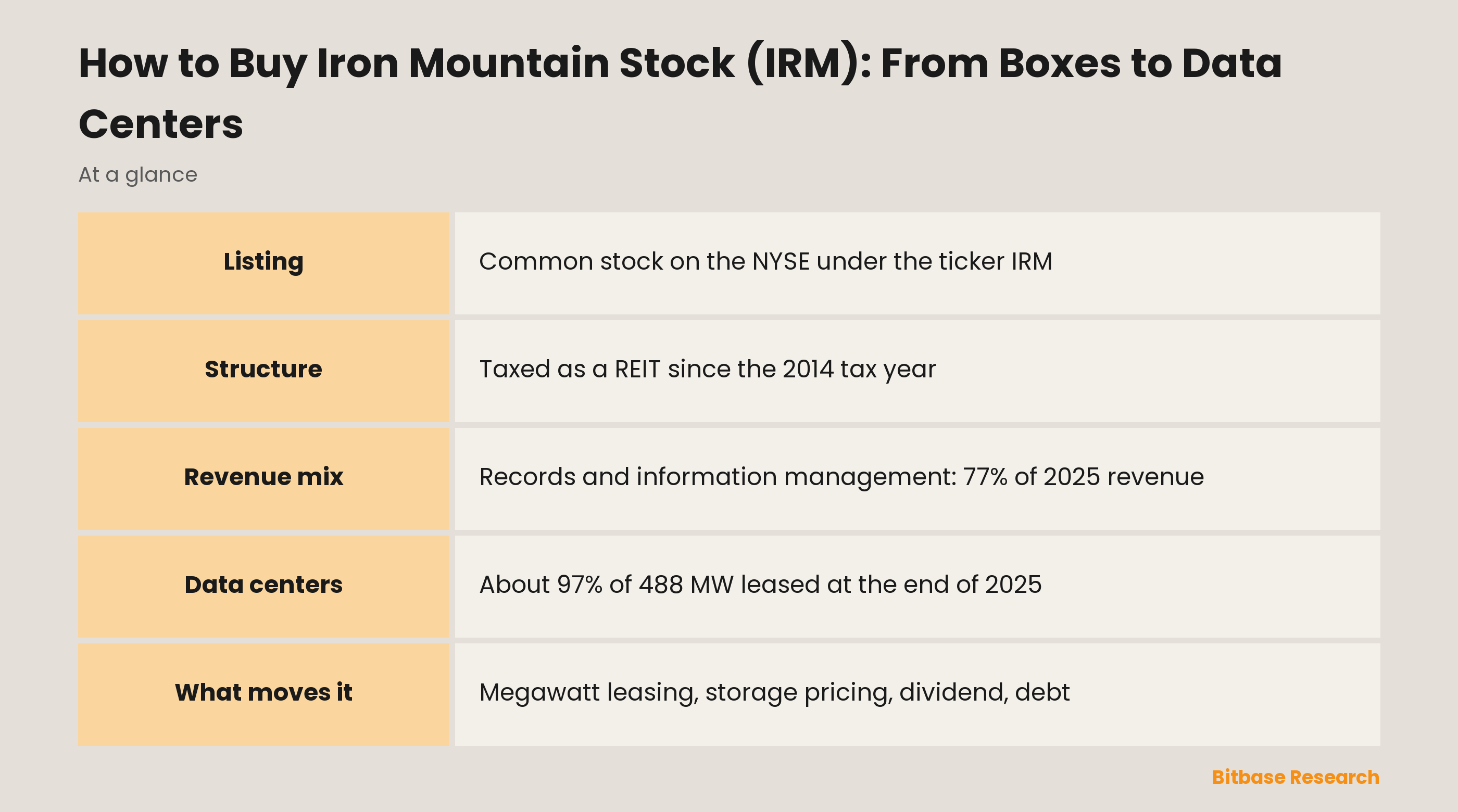
Getting an Iron Mountain share into a portfolio takes a brokerage account that can reach the New York Stock Exchange, where the common shares trade as IRM, and a buy order paid in US dollars. The company began in 1951 by storing business records in an underground facility near Hudson, New York, and its records and information management segment still brought in about 77% of 2025 revenue, while data center revenue grew about 30% that year. Iron Mountain has been taxed as a real estate investment trust since 2014, so the dividend and its tax treatment are part of what you buy.
What Does Iron Mountain Do?
Iron Mountain stores and manages information for organizations, on paper and in digital form, and rents data center capacity to some of the largest technology companies. The 10-K counts more than 240,000 customers in 61 countries, "including approximately 95% of the Fortune 1000." Its roots are literal: the company "was founded in an underground facility near Hudson, New York in 1951 where it stored business records."
Global Records and Information Management (Global RIM), the first of two segments, is the original business, now a bundle of related services. Records Management stores paper files and handles courier runs and the destruction of sensitive documents. Data Management keeps and rotates backup tapes for disaster recovery. Global Digital Solutions scans documents and stores the digital copies; in October 2025 it launched version 2.0 of its Insight DXP platform, which adds smart document processing and AI agents. Secure Shredding collects office paper and shreds it at plants or in purpose-built trucks, and smaller lines store physical media for entertainment clients and offer valet storage to households.
Global Data Center builds and leases "enterprise-class data center facilities and hyperscale-ready capacity." It counts "five of the largest global hyperscalers among our customers," without naming them. At the end of 2025 it operated 31 data centers in 21 markets, directly or through joint ventures, and about 97% of their 488 megawatts (MW) of existing capacity was leased. Another 852 MW was under construction or held for development, for a potential 1,340 MW in land and buildings it owns or operates.
Corporate and Other holds asset lifecycle management (ALM), which takes servers and other IT hardware out of service for cloud operators and companies, erases the data and recycles or resells the equipment, plus a fine art storage business. ALM ran 34 facilities in 8 markets at the end of 2025.
The physical footprint explains the REIT label. Iron Mountain has about 1,340 locations, operates more than 98 million square feet of real estate, and at the end of 2025 it held more than 740 million cubic feet of stored material. In data centers it competes with "numerous data center developers, owners and operators" on "availability of power, security measures, location, connectivity and rental rates."
How Iron Mountain Makes Money
Revenue arrives in two forms. Storage rental, the recurring rent for boxes, tapes and data center space, made up about 59% of 2025 revenue; service fees for retrieval, scanning, shredding, transport and ALM work made up the other 41%. Total revenue rose 12% in 2025.
| Business | Share of 2025 revenue | Revenue growth in 2025 | What it sells |
|---|---|---|---|
| Global RIM | 77% | 6% | Records and tape storage, digitization, shredding, media archives, consumer storage |
| Global Data Center | 12% | 30% | Data center space and power for enterprises and large cloud companies |
| Corporate and Other | 12% | 47% | IT asset lifecycle management and fine art services |
Shares are calculated from the 10-K segment figures and rounded.
The two segments earn at different rates. On Adjusted EBITDA, the non-GAAP profit measure Iron Mountain uses for its segments, Global RIM accounted for 85% of the two segments' 2025 total and Global Data Center for 15%. The data center margin, though, widened to 51.8% from 45.6% in 2024 as new leases began, against 44.7% for Global RIM. Data centers also tie up a far larger share of capital: at the end of 2025 they held about 38% of the company's total assets while bringing in 12% of revenue.
Inside Global RIM, the 10-K credits the 5.4% organic rise in storage rental revenue to "revenue management," and says volumes "were relatively steady in 2025." Contracts for records storage generally run one to five years, and the company states that "historically, economic downturns have not significantly affected our storage rental business." Data center leases are longer, with a weighted average remaining term of 10.3 years at the end of 2025, and that segment grew on new lease commencements, better pricing and more pass-through power.
The customer base is spread thin: no single customer accounted for more than about 3% of 2025 revenue, and only about 5% of customers bought from more than one business unit. By customer location, the United States produced about 66% of revenue, the United Kingdom about 7% and Canada about 4%.
REIT yardsticks. Iron Mountain also reports funds from operations (FFO), which strips real estate depreciation out of net income, and adjusted FFO (AFFO), a non-GAAP measure it defines itself. Its releases tie the dividend to AFFO: the November 2026 increase was announced as "based on continued strong growth in AFFO."
IRM Stock at a Glance
| Feature | IRM |
|---|---|
| Exchange | New York Stock Exchange (NYSE) |
| Ticker | IRM |
| Security | Common stock, the only class registered on the exchange |
| Structure | Real estate investment trust (REIT) since the 2014 tax year |
| Sector | Records and information management, data centers, IT asset lifecycle services |
| Index membership | S&P 500, MSCI REIT index, FTSE EPRA Nareit Global Real Estate Index |
| Headquarters | Portsmouth, New Hampshire |
| Incorporated | Delaware |
| Fiscal year | Calendar year, ending 31 December |
| Dividend | Quarterly cash dividend, set by the board each quarter |
| Ownership limit | 9.8% for any single holder, under the charter's REIT rules |
| SEC identifier | CIK 1020569 |
Quotes, market value and yield move all day; the Iron Mountain stock page on Bitbase shows them live.
How to Buy Iron Mountain Stock
What trades on the NYSE is the common stock of a Delaware corporation, with no depositary receipt in between. A typical purchase goes like this:
1. Find a broker that reaches the NYSE. Outside the US that can be a local broker with a US-shares service or an international platform; check which entity holds your account and who regulates it.
2. Open the account and complete the tax form. Non-US individuals generally file IRS Form W-8BEN, which the IRS says to submit "when requested by the withholding agent or payer," whether or not a reduced rate is claimed.
3. Fund it. Paying in another currency adds a conversion cost on top of commissions.
4. Search for IRM. Make sure the result reads Iron Mountain Incorporated common stock on the NYSE.
5. Choose the order. FINRA describes a market order as the one that "provides the most certainty that your order will be executed," while a limit order fills only "at or better than a specified price."
6. Decide on whole or fractional shares. Some brokers sell fractions of a share; FINRA notes that others offer them only for "large-cap stocks or ETFs," and that a fractional holder "might not have shareholder voting rights."
7. Track the dividends. Statements show each payment and the tax withheld, which you need when you file at home.
How REIT dividends are taxed. This is general information, not tax advice. REIT distributions "generally are not treated as 'qualified dividends'," the 10-K says, so US individuals do not get the lower rate that applies to many corporate dividends. For investors abroad, the IRS says "most types of U.S. source income received by a foreign person are subject to U.S. tax of 30%," and a tax treaty may reduce that. Iron Mountain's own tax summary, filed with the SEC in March 2026, adds a caveat specific to REITs: under some treaties, the lower rates for ordinary dividends from US corporations "may not apply to ordinary income dividends from a REIT or may apply only if the REIT meets specified additional conditions." Your home country may tax the same payment again, so ask a tax adviser.
Through an index fund. Funds that track the S&P 500 hold Iron Mountain inside a much larger basket; a fund unit is not an IRM share in your name.
What Moves IRM Stock
Data center leasing and power. Investors follow how many megawatts Iron Mountain signs. In the third quarter of 2026 it leased 102 MW, bringing the year-to-date total to 137 MW, and the data center segment's revenue rose 34.0% on the year. Turning signed leases into revenue means finishing buildings and securing electricity; the 10-K names "constrained supplies of new power," construction delays and "high interest rates" among the things that could change the cost or timing of its projects.
Pricing in the records business. With Global RIM volumes roughly steady, growth there depends on raising storage rates and selling more services to the same customers. The risk factors note that records and tapes are "becoming less active and more archival," which cuts retrieval work while many costs stay fixed. Global RIM revenue still rose 7% in the third quarter of 2026.
The newer service lines. Data center, digital and ALM revenue "collectively grew more than 30% year over year in the third quarter" of 2026, according to the earnings release. ALM is more cyclical than storage: much of its revenue comes from "a limited number of clients," many buyers of used components are "geographically concentrated, particularly in China," and scrap metal prices feed into results. Shredding is tied to paper prices, since the company sells shredded paper for recycling.
The dividend and AFFO. The board raised the quarterly dividend in 2023, in 2024 and twice in 2025, and on 5 November 2026 it declared an increase of 15%, payable on 6 January 2027. The 10-K says the company is "committed to growing our dividends" and has said so publicly, yet warns that it "may not be able to meet our public commitments with respect to dividend growth." Each release puts AFFO per share next to the dividend.
Debt and interest rates. Iron Mountain carries substantial debt, and at the end of 2025 its balance sheet showed a stockholders' deficit rather than positive equity. The 10-K warns the debt could bring "limits on our distributions to stockholders" and "restrictions on our ability to refinance our indebtedness on commercially reasonable terms."
What Could Go Wrong at Iron Mountain
Of the long list of risk factors in the 10-K, these bear most directly on an IRM share.
Less paper over time. "A significant shift by our customers to storage of data through non-paper or non-tape-based technologies ... could adversely affect our businesses." Digitization also "may shift our revenue mix from the more predictable storage revenue to service revenue, which is inherently more volatile."
Outages at data centers. Service could be interrupted by "human error; equipment failure; physical, electronic and cybersecurity breaches; fire, hurricane, flood, earthquake" and other events, and the company buys "significant amounts of electricity and water for cooling from suppliers."
Building ahead of demand. "Expanding our Global Data Center Business requires significant capital," and resources are committed long before a new site earns revenue. "There can be no assurance we will have sufficient customer demand to support the data centers we have acquired or built."
REIT status. If Iron Mountain failed to remain qualified, it "will be subject to tax at corporate income tax rates and will not be able to deduct distributions to stockholders." Keeping the status means distributing at least 90% of its REIT taxable income each year, and the charter caps any one holder at 9.8% in value of its shares.
Dividends. "Our cash distributions are not guaranteed and may fluctuate," the 10-K states; the board sets the amount each quarter.
Then there is the risk of any single stock: one company's results decide what the share is worth.
How to Research IRM Yourself
Iron Mountain files with the SEC under CIK 1020569: the annual 10-K, three 10-Qs a year and 8-Ks for events. Each quarterly earnings 8-K carries the press release, the call presentation and a supplemental financial information package; in 2026 they arrived on 12 February, 30 April, 5 August and 5 November. The same reports are free in the Investors section of ironmountain.com.
In the 10-K, the business section gives the megawatt counts and customer figures and the segment note sets revenue and Adjusted EBITDA side by side. The supplemental package adds a page on global storage volume, which shows whether the material in storage is growing or shrinking.
AFFO, FFO (Normalized) and Adjusted EBITDA are non-GAAP measures, reconciled to net income in each release. The data center business is easier to judge next to landlords that do only that: our Equinix stock guide and Digital Realty stock guide cover two data center REITs. Live prices sit on the stock page linked above, and Bitbase's list of US stock pages covers other companies.
Iron Mountain Stock FAQ
Can I buy Iron Mountain stock with crypto?
Not directly. IRM shares are bought through a brokerage account in US dollars, so crypto must first be sold for cash, a sale that may be taxable where you live. The share itself is a stake in a registered company with dividend and voting rights, which is how a stock differs from a crypto asset.
Is Iron Mountain a REIT?
Yes. The 10-K says the company has been "organized and have operated as a REIT beginning with our taxable year ended December 31, 2014." It must generally distribute at least 90% of its REIT taxable income each year.
Does Iron Mountain pay a dividend?
Yes, every quarter. The board sets each payment, and it raised the dividend by 15% in November 2026. Check the latest release for the current amount and dates.
Is IRM in the S&P 500?
Yes. The 10-K names Iron Mountain as a constituent of the S&P 500, the MSCI REIT index and the FTSE EPRA Nareit Global Real Estate Index. The stock is listed on the NYSE rather than Nasdaq, so it is not part of the Nasdaq-100.
Who uses Iron Mountain's data centers?
The company does not name its tenants, but it says "five of the largest global hyperscalers" are among its customers, and its strategy is to lease unsold capacity to hyperscale customers.
Conclusion
Iron Mountain asks a buyer to judge two businesses through one share: a records operation whose volumes barely move and whose storage growth rests on pricing, and a data center arm that grew about 30% in 2025 but needs heavy capital and new power. The dividend ties them together, rising with AFFO while resting on a balance sheet in stockholders' deficit. Read the latest 10-K, the quarterly supplemental package and the megawatt counts in each release, and size the position knowing that one company, however steady its boxes, carries that leverage.
Related reading
Other Bitbase articles on this topic:
- How to Buy CBRE Stock (CBRE): Deals, Buildings and No Dividend
- How to Buy Crown Castle Stock (CCI): A Tower REIT, Fiber Sold
- How to Buy Extra Space Storage Stock (EXR): Rent and Reinsurance
- How to Buy Vivmark Residential Stock (VMRK): EQR and AVB Combined
Disclaimer: This article is educational content from Bitbase Academy, provided for information only. It explains what a company or fund does and how the instruments referenced here differ from one another; it does not constitute investment, trading, tax, or financial advice, and it is neither a recommendation nor an endorsement of any security, token, or trading strategy. A tokenized stock is issued by a third party and is designed to give economic exposure to an underlying asset: it is not a share, it carries no shareholder rights, and it depends on the issuer's structure, eligibility rules, and redemption terms, which the issuer can change. Perpetual futures are leveraged derivatives that hold no underlying asset and can be liquidated, and trading hours, product availability, and eligibility differ by instrument and by jurisdiction and can change at any time. Written as of November 2026; verify everything yourself through company filings, the issuer's own documentation, and the product pages of the venue you trade on.
References
[1] Iron Mountain Form 10-K for 2025 (SEC EDGAR) www.sec.gov
[2] Iron Mountain 2025 Form 10-K, XBRL cover page (SEC EDGAR) www.sec.gov
[3] Iron Mountain 2025 Form 10-K, segment revenue and Adjusted EBITDA (XBRL) www.sec.gov
[4] Iron Mountain 2025 Form 10-K, revenue by geography (XBRL) www.sec.gov
[5] Iron Mountain Form 10-Q for the quarter ended 30 September 2026 (SEC EDGAR) www.sec.gov
[6] Iron Mountain third quarter 2026 results release, 5 November 2026 (SEC EDGAR) www.sec.gov
[7] Iron Mountain, Material US Federal Income Tax Considerations, filed 9 March 2026 (SEC EDGAR) www.sec.gov
[8] IRS: NRA Withholding www.irs.gov
[9] IRS: About Form W-8 BEN www.irs.gov
[10] FINRA: Order Types www.finra.org
[11] FINRA: Investing in Fractional Shares www.finra.org





