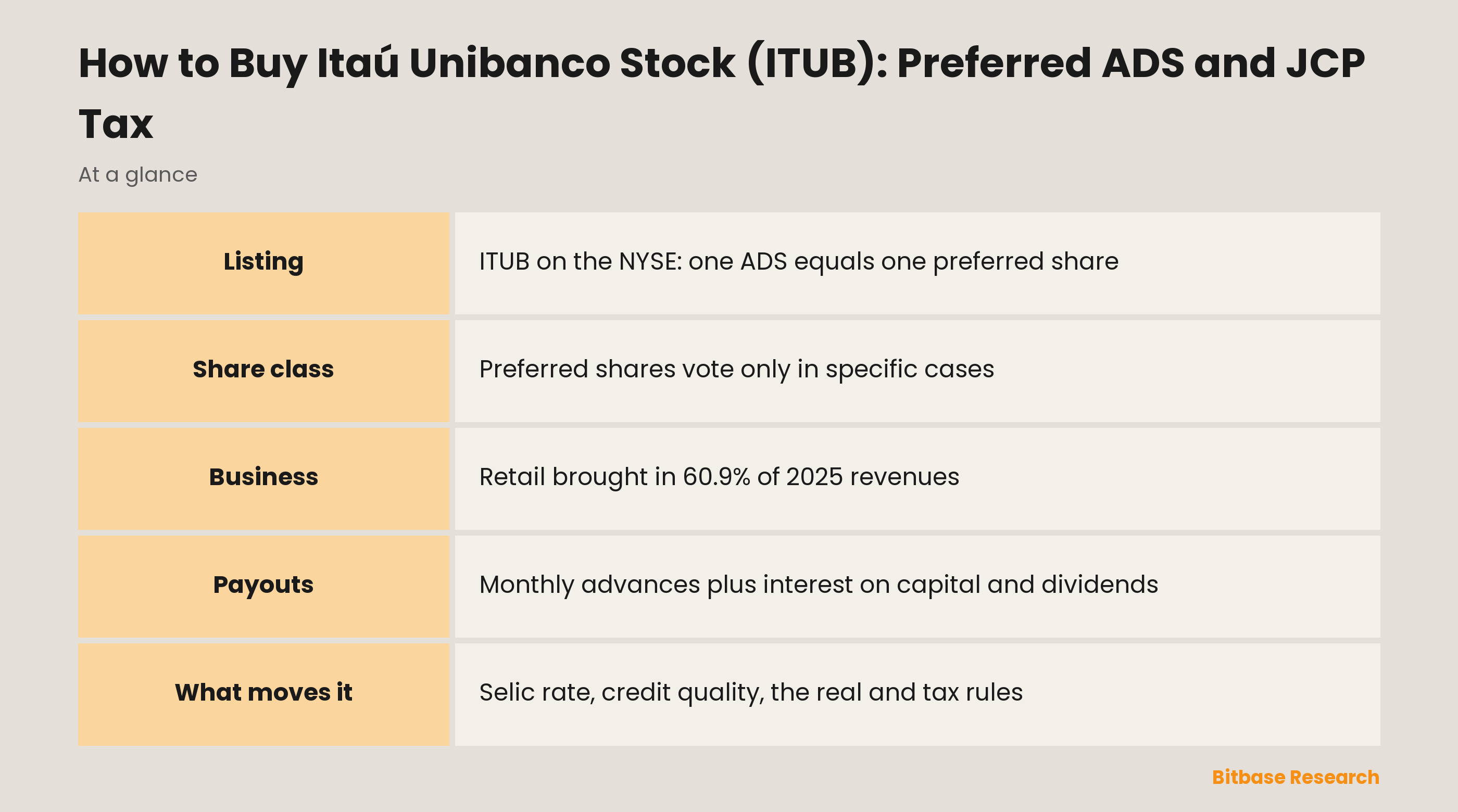
Either of two lines puts Itaú Unibanco in an ordinary brokerage account: the ITUB American depositary share (ADS) on the New York Stock Exchange, or the ITUB4 preferred share on B3 in São Paulo, one ADS standing for one preferred share. Both carry the same trade-off: preferred shares vote only in specific cases, and control rests with IUPAR, a holding company of the Itaúsa and Moreira Salles groups. Central Bank data in the latest annual report ranked Itaú first among Brazilian banks by total assets at the end of 2025.
What Does Itaú Unibanco Do?
Itaú Unibanco is a universal bank based in São Paulo, selling accounts, loans, cards, investments, insurance and investment banking to individuals and companies. Unibanco grew out of Casa Moreira Salles, which obtained a banking license in 1924; Banco Itaú began as Banco Central de Crédito, founded in 1943 by the Egydio de Souza Aranha family. They combined in 2008 in what the annual report calls "the largest merger in Brazil's history in terms of asset value."
There are three segments. Retail Business serves individuals in three tiers (Retail, Uniclass and Personnalité) and smaller companies through Itaú Empresas. Wholesale Business covers Itaú BBA's corporate and investment banking, the middle market, private banking and the units abroad. Activities with the Market + Corporation collects the return on excess capital and treasury results.
Abroad, Itaú operates in Chile, Colombia, Paraguay and Uruguay and owns 67.42% of Banco Itaú Chile. It announced the sale of its Argentine bank in 2023, and on 31 July 2026 Itaú Colombia handed its retail banking for individuals to Banco de Bogotá to focus on corporate clients.
The 20-F names Caixa Econômica Federal, Banco do Brasil, Bradesco and Banco Santander (Brasil), part of the Santander group, as its main retail rivals, with Nubank, Mercado Pago and Banco Inter pressing in cards. At the end of 2025 Itaú held 10.7% of loans to individuals, the most of any private bank, and led in card balances with a 21.4% share.
How Itaú Unibanco Makes Money
Interest is the core. In the managerial figures of the 2025 segment note, interest margin made up 67.5% of operating revenues, commissions and fees 25.4%, and insurance and pensions 7.1%.
| Segment | Share of 2025 revenues | Share of 2025 net income |
|---|---|---|
| Retail Business | 60.9% | 40.8% |
| Wholesale Business | 34.0% | 49.1% |
| Activities with the Market + Corporation | 5.2% | 10.0% |
Shares are of the segments' managerial totals, which start from Brazilian accounting and differ from the IFRS statements.
Retail earns most of the revenue but less than half the profit because lending to households costs more: cost of credit absorbed 28.2% of Retail's revenues in 2025, against 8.0% in Wholesale. The money is overwhelmingly Brazilian: in the IFRS geographic table, Brazil produced 83.7% of interest income and 87.4% of fees. IFRS net income rose 9.2% in 2025.
ITUB Stock at a Glance
| Item | Detail |
|---|---|
| Issuer | Itaú Unibanco Holding S.A., incorporated in Brazil in 1924 |
| US security | ADS on the NYSE since 21 February 2002, ticker ITUB |
| ADS ratio | One ADS represents one preferred share |
| Brazilian lines | ITUB4 (preferred) and ITUB3 (common) on B3 |
| ADS depositary | JPMorgan Chase Bank, N.A. |
| Sector | Banking |
| Headquarters | São Paulo |
| Financial year | Calendar year; IFRS in the 20-F |
| Dividend policy | At least 25% of adjusted net income, with monthly advances |
| SEC identifier | CIK 1132597; Forms 20-F and 6-K |
For the live ADS price, open the Itaú Unibanco stock page on Bitbase.
How to Buy Itaú Unibanco Stock
The ADS needs a broker with NYSE access; ITUB4 needs one that reaches B3.
1. Pick the line. ITUB trades in dollars in New York, ITUB4 in reais in São Paulo; both are the preferred class.
2. Open and verify an account with a broker licensed where you live.
3. Fund it, checking the currency spread as well as the commission.
4. Find the right security. The 20-F cover lists a single trading symbol, ITUB, so there is one US line.
5. Choose an order type. A limit order caps your price; a market order fills at the next one available.
6. Set the size. Fractional ADSs depend on the broker.
ADS or ITUB4. Behind the ADS, Itaú keeps the preferred shares in Brazil as custodian and JPMorgan receives payouts abroad, passing them on after its fees. Residents abroad held about 75% of the preferred shares at the end of 2025. Holding ITUB4 directly means registering with Brazil's Central Bank before payouts can leave the country, and the 20-F warns that surrendering ADSs for shares may cost remittance rights and some tax advantages.
Brazilian withholding. Itaú pays in two forms. Interest on capital, called JCP (juros sobre capital próprio), is a distribution Brazilian law allows on top of dividends; since 1 January 2026 it bears 17.5% withholding, up from 15%, or 25% in low-tax jurisdictions. Dividends paid abroad bear 10% under a law published in November 2025, except profits earned up to 2025 whose distribution was approved by 31 December 2025. Brazil and the US have no income tax treaty, so how your country treats the payment is a question for your broker or tax adviser; the Petrobras guide shows the same rules at another issuer.
Through a fund. The iShares MSCI Brazil ETF's schedule of investments at 31 May 2026 listed both Itaú share classes.
What Moves ITUB Stock
The Selic rate. With interest margin at two-thirds of revenues, policy rates matter. The central bank lifted the Selic to 15.00% in June 2025, held it through year-end and cut it to 14.75% in March 2026; tight policy, the 20-F notes, restricts credit.
Credit quality. Loan-loss allowances fell to 4.5% of loans at the end of 2025 from 4.8%. Retail carries most of the cost of credit, so household defaults show up there first.
The real. One ADS equals one ITUB4 share, so its dollar price follows São Paulo converted at the exchange rate. The real gained about 11.1% against the dollar in 2025.
Tax policy. Interest on capital lowers the bank's own income tax, and the 20-F says the possible end of that deductibility remains subject to "potential legislative and regulatory changes."
Capital and buybacks. CET1 was 12.3% at the end of 2025, down from 13.7%, against 8.1% required including buffers; a bank below its buffers cannot pay dividends or interest on capital. In February 2026 the board approved buying back up to about 3.74% of free-float preferred shares by August 2027.
Deals. Itaú took control of Avenue, a US-based digital brokerage, in January 2026, and in October agreed to buy NeoSpace, a Brazilian artificial intelligence startup, pending CADE and Central Bank approval.
Stumbling Blocks for ITUB Holders
Brazil itself. "The Brazilian Government has exercised, and continues to exercise, influence over the Brazilian economy," and inflation, politics and the sovereign rating feed into the bank.
Government bonds. Brazilian public debt made up 19.0% of all assets and 53.6% of the securities portfolio at the end of 2025.
Competition. "The Brazilian market for financial services is highly competitive," and switching, data-sharing and instant-payment rules make leaving easier.
A controlling shareholder. IUPAR, with 26.35% of total capital and a majority of the votes, has "the power to appoint and remove our directors and officers."
ADS-holder limits. Preferred shares "do not have voting rights, except in specific circumstances," preemptive rights may not reach US holders, and the board can suspend the mandatory dividend if paying it would be incompatible with the bank's financial condition.
Beyond the filing, one stock concentrates your money, and a dollar-priced ADS adds currency risk.
How to Research ITUB Yourself
Itaú files under CIK 1132597: the annual 20-F, the latest on 30 April 2026, and 6-Ks for results, material facts and interest-on-capital notices. In the 20-F, Item 3D lists the risks, Item 7A the shareholders, Item 8A the payout rules, Item 10E the taxes and Item 12D the ADS terms.
Two traps: the mandatory dividend is set on Brazilian accounting profit, which "may differ significantly" from IFRS, and per-share history needs adjusting for the 2025 bonus shares. For other companies, browse more stock pages on Bitbase.
Itaú Unibanco Stock FAQ
What share do I get when I buy ITUB?
A preferred share, held for you by the depositary. It has no vote except in specific cases, such as minimum dividends going unpaid for the period set in the bylaws, at most three years. In return it has priority for a minimum dividend, receives at least the common share's dividend and carries 80% tag-along rights in a change of control.
Does Itaú Unibanco pay a dividend?
Yes. The bylaws require at least a quarter of adjusted net income, part of it advanced monthly, with JPMorgan announcing the ADS record dates. Larger sums come as interest on capital and dividends: in 2026 the board declared interest on capital in February and May, paid on 28 August at the same amount for ITUB3 and ITUB4.
Can I buy Itaú Unibanco stock with crypto?
Not directly. ITUB settles in dollars and ITUB4 in reais, so crypto has to be sold for cash and moved to a broker first; depending on where you live, that sale can be taxable.
Who controls Itaú Unibanco?
IUPAR, which owned 51.71% of the common shares at the end of 2025. It is jointly controlled by Itaúsa, controlled by the Egydio de Souza Aranha family (the Setubal and Villela families), and Cia. E. Johnston, controlled by the Moreira Salles family. Itaúsa also held 39.21% of the common shares directly.
Has Itaú Unibanco stock ever split?
Not as a classic split, but both classes received bonus shares: one for every 10 held from 20 March 2025, and three for every 100 from 30 December 2025. One ADS still equals one preferred share.
Conclusion
Buying Itaú Unibanco takes one decision before the order: ITUB in dollars or ITUB4 in reais, either way a non-voting preferred share. What it earns depends on Brazilian rates, borrowers and the real, while control stays with IUPAR. Read the latest 20-F and payout notices, and check how JCP and dividend withholding apply to you before deciding how much one Brazilian bank should weigh in your portfolio.
Related reading
Other Bitbase articles on this topic:
- How to Buy Citigroup Stock (C): Five Businesses, Banamex Exit
- How to Buy Deutsche Bank Stock (DB): Same Share as Frankfurt's DBK
- How to Buy HDFC Bank Stock (HDB): Three Shares per ADS, No Vote
Disclaimer: This article is educational content from Bitbase Academy, provided for information only. It explains what a company or fund does and how the instruments referenced here differ from one another; it does not constitute investment, trading, tax, or financial advice, and it is neither a recommendation nor an endorsement of any security, token, or trading strategy. A tokenized stock is issued by a third party and is designed to give economic exposure to an underlying asset: it is not a share, it carries no shareholder rights, and it depends on the issuer's structure, eligibility rules, and redemption terms, which the issuer can change. Perpetual futures are leveraged derivatives that hold no underlying asset and can be liquidated, and trading hours, product availability, and eligibility differ by instrument and by jurisdiction and can change at any time. Written as of October 2026; verify everything yourself through company filings, the issuer's own documentation, and the product pages of the venue you trade on.
References
[1] Itaú Unibanco Holding, Form 20-F for 2025 (SEC EDGAR) www.sec.gov
[2] Itaú Unibanco 20-F for 2025, XBRL cover page (R1) www.sec.gov
[3] Itaú Unibanco, material fact on the stock buyback program, 4 February 2026 (Form 6-K) www.sec.gov
[4] Itaú Unibanco, notice to shareholders on paying interest on capital, 4 August 2026 (Form 6-K) www.sec.gov
[5] Itaú Unibanco, announcement on completing the Itaú Colombia transaction, 31 July 2026 (Form 6-K) www.sec.gov
[6] Itaú Unibanco, material fact on acquiring NeoSpace, 26 October 2026 (Form 6-K) www.sec.gov
[7] iShares MSCI Brazil ETF, schedule of investments as of 31 May 2026 (Form N-PORT, SEC EDGAR) www.sec.gov





