
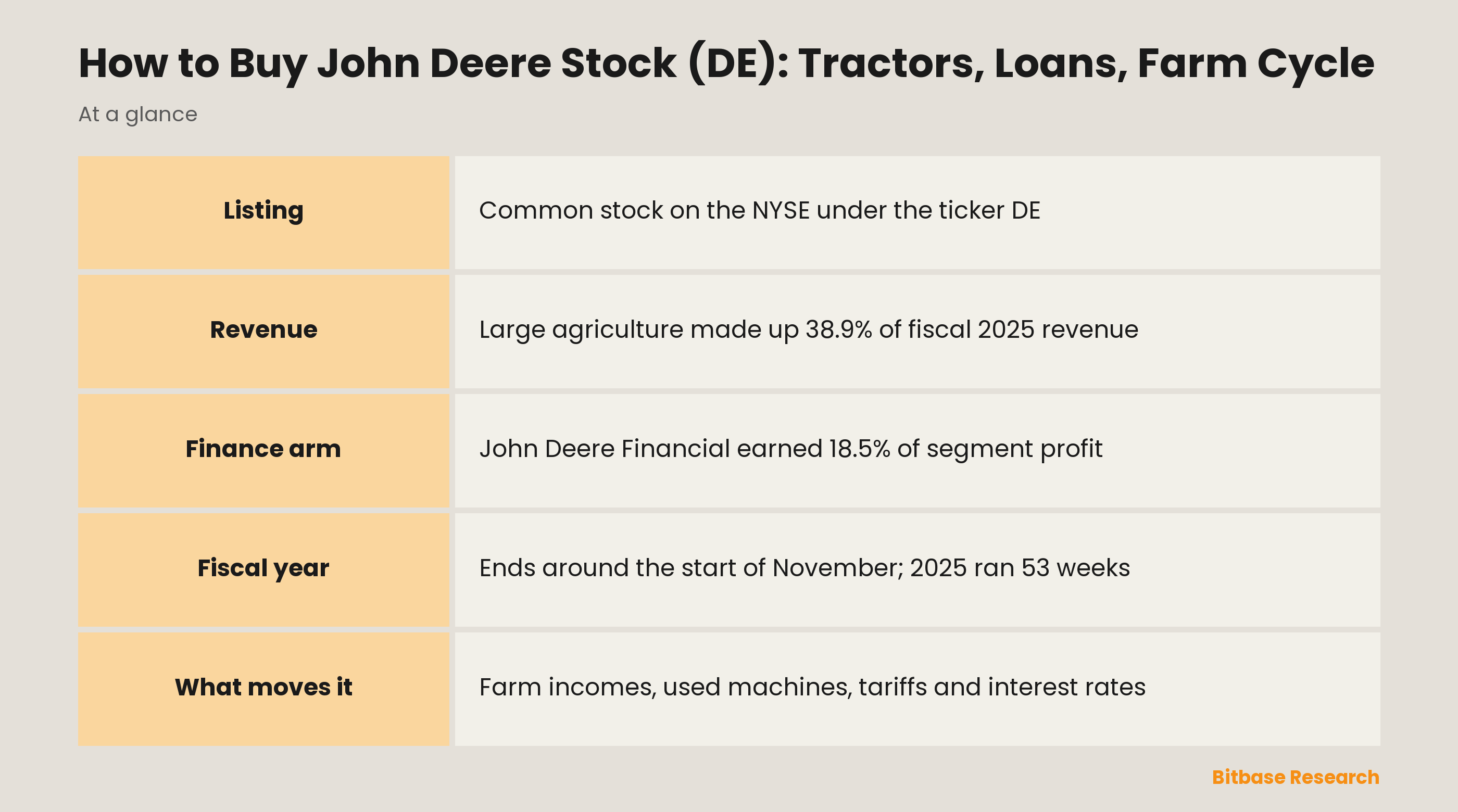
The name on the machines is John Deere, but the shares belong to Deere & Company, which trades on the New York Stock Exchange as DE, and any broker with access to US stocks can place the order. Deere builds farm, turf, construction and forestry equipment, sells it through dealers, and through John Deere Financial lends much of the money customers and dealers use to pay for it. That mix shaped fiscal 2025: net sales and revenues fell about 12% as demand for large farm machines weakened, while the finance arm earned more. This guide covers where the revenue comes from, the steps of an order and the forces behind DE's share price.
What Does John Deere Do?
John Deere is the brand; Deere & Company is the listed parent whose shares you buy. Its annual report uses "John Deere" for Deere & Company and its subsidiaries together, so John Deere stock and Deere stock are the same shares. "John Deere has manufactured agricultural equipment since 1837," the 10-K says; Deere & Company itself was incorporated in Delaware in 1958 and has its head office in Moline, Illinois.
The company reports four segments. Three build and sell machines, and the fourth finances them.
Production & Precision Agriculture serves growers of corn and soy, wheat and other small grains, cotton and sugarcane on a production scale. It makes large tractors, combines, cotton pickers, sugarcane harvesters, and tillage, seeding and spraying equipment. Deere's precision technology starts here, from guidance and telematics to automation such as the See & Spray targeted spraying solution, linked through the John Deere Operations Center, the company's digital management system for farm and jobsite data.
Small Agriculture & Turf covers utility and compact tractors, hay and forage equipment for dairy and livestock producers, mowers, golf course equipment and utility vehicles. Dealers sell most of it, though some turf products are built for The Home Depot and Lowe's.
Construction & Forestry sells excavators, dozers, loaders, motor graders and articulated dump trucks, compact machines such as skid steers, and forestry equipment. Its roadbuilding line, sold under Wirtgen and sister brands such as Vögele and Hamm, mills, paves and compacts roads, and brought in about 30% of the segment's fiscal 2025 revenue.
Financial Services, branded John Deere Financial, buys the retail loan contracts that dealers write when customers finance a machine. It also offers leases and revolving credit, lends to dealers so they can carry inventory, and sells extended warranties. In the US the main lender is John Deere Capital Corporation; elsewhere some financing runs through partners, and in fiscal 2025 the Brazilian bank Bradesco became a 50% owner of Banco John Deere. The 10-K states the purpose plainly: the financing options "are designed to enhance sales of our products and generate financing income."
Machines reach customers through about 2,050 independent dealer locations in the US and Canada and through dealers and distributors in more than 100 other countries. The 10-K names AGCO, CLAAS, CNH Industrial, Kubota and Toro among farm and turf competitors, and Caterpillar, Komatsu and Volvo Construction Equipment among many in construction and forestry.
How Deere Makes Money
Fiscal 2025 ended on 2 November 2025, ran 53 weeks and was a down year: net sales and revenues fell about 12%, and net income attributable to Deere fell about 29%. The revenue note in the 10-K shows where the money came from:
| Segment | Main products | Share of fiscal 2025 net sales and revenues | Change from fiscal 2024 |
|---|---|---|---|
| Production & Precision Agriculture | Large tractors, combines, planters, sprayers | 38.9% | Net sales down 17% |
| Small Agriculture & Turf | Compact and utility tractors, hay tools, mowers | 22.9% | Net sales down 7% |
| Construction & Forestry | Earthmoving, roadbuilding and forestry machines | 25.5% | Net sales down 12% |
| Financial Services | Retail loans, leases, dealer financing, warranties | 12.7% | Revenue down 3% |
Shares are calculated from the 10-K's net sales and revenues by segment and rounded to one decimal.
Large agriculture is the swing factor. In Production & Precision Agriculture, sales volumes fell 30% in the US and Canada while Brazil's rose 22%, and the segment's operating profit dropped 41%. Small Agriculture & Turf also found growth outside North America, with volumes up 26% in India. Construction & Forestry gave up price: price realization in the US and Canada fell 3% because of "incremental incentive programs deployed to address pressures from the competitive environment."
By market, the United States supplied about 52% of fiscal 2025 net sales and revenues, Western Europe about 14% and Latin America about 12%.
The finance arm runs on a different engine. Broadly, its earnings are finance income from customer payments minus interest expense and depreciation on leased equipment, so loans already on its books keep paying when machine sales slow. In fiscal 2025 Financial Services produced about 18.5% of total segment operating profit, up from 9.8% a year earlier, and its net income rose 28%, helped by special items, lower expenses and favorable financing spreads.
Technology is central to the pitch but not yet its own revenue line: revenue from software-as-a-service products "did not represent a significant percentage of our revenues in 2025." After the sale, Deere keeps supplying parts, many of them proprietary.
The most recent 10-Q, covering the nine months to 2 August 2026, shows the segments pulling apart. Construction & Forestry net sales rose 26% and Small Agriculture & Turf 16%, while Production & Precision Agriculture fell 7%; total net sales and revenues were up 7%.
DE Stock at a Glance
| Field | DE |
|---|---|
| Listing | NYSE (New York Stock Exchange) |
| Ticker | DE |
| Security | Common stock |
| Other listed security | DE28, the 6.55% debentures due 2028, which is a bond and not the stock |
| Sector | Farm, turf, construction and forestry machinery, plus equipment finance |
| Index membership | S&P 500, per SPY holdings on 16 October 2026; not one of the 30 Dow stocks |
| Headquarters | Moline, Illinois |
| Incorporated | Delaware, 1958 |
| Fiscal year | Ends on the last Sunday of the reporting period, generally near the end of October (52 or 53 weeks) |
| Dividend policy | Quarterly cash dividend, declared by the board |
| SEC identifier | CIK 315189 |
For the live price and chart, open the John Deere stock page on Bitbase.
How to Buy John Deere Stock
Deere is incorporated in Delaware and the NYSE line is its common stock itself, so no depositary receipt is involved. A brokerage account that reaches the NYSE is all the plumbing you need:
1. Choose a broker with US market access. Outside the US, that can be a local firm that routes orders to New York or an international one; find out which regulator supervises the entity holding your account.
2. Complete the account checks. Non-US individuals usually complete IRS Form W-8BEN, which documents foreign status for withholding on US dividends.
3. Fund it. If your money starts in another currency, the conversion is a cost alongside the commission.
4. Search DE and check the name. A two-letter ticker is easy to mistype, so confirm the result reads Deere & Company common stock on the NYSE and not the DE28 bond. Each exchange symbol identifies one listed security, which is not true of crypto tickers, which can collide.
5. Pick an order type. A market order "guarantees that the order will be executed, but does not guarantee the execution price"; a limit order fills only "at a specific price or better." The same trade-off between certainty and price explains how market orders fill on any venue.
6. Size the position. Some brokers sell fractions of a share, but "not every brokerage firm offers fractional share investing," some limit fractions to market orders, and a holder of a fraction "may not have voting rights."
7. Keep the records. Trade confirmations and dividend statements are what you will need at tax time.
Investors outside the United States. Tax is withheld from US dividends before they reach you. The IRS puts it this way: "most types of U.S. source income received by a foreign person are subject to U.S. tax of 30%," though "a reduced rate, including exemption, may apply" where the tax code or a treaty provides one; Form W-8BEN is how your broker applies the right rate. Your own country may also tax the dividend; take this as general information rather than tax advice.
Through an index fund. As an S&P 500 constituent, Deere is held by funds that track that index, for example SPY from State Street, as one position among hundreds. It is not in the Dow Jones Industrial Average, so a Dow tracker such as DIA does not hold it.
What Moves DE Stock
The farm income cycle. The risk factors open with it: "Our financial results largely depend upon the agricultural market business cycle, as well as general economic conditions and outlook." The 10-K lists what drives it, from commodity prices and world grain stocks to input costs, farmland values, interest rates and government support. In fiscal 2025, it says, unfavorable conditions "resulted in lower sales volumes, greater reliance on sales incentives, and elevated receivable write-offs." Retail sales to farmers also follow planting and harvest, so compare a quarter with the same quarter a year earlier.
Used machines and dealer stock. In the US, Canada and Australia most new farm machines are sold together with trade-ins, and the 10-K counts the value, age and level of used equipment among the key factors for new sales. Dealers also adjust what they hold: "When the total inventory levels of our dealers are higher than they desire, dealers have postponed equipment purchases from us," the filing warns.
Tariffs and trade. Deere describes itself as a net exporter of agriculture and turf equipment from the US and says nearly 80% of its domestic sales are assembled there. In fiscal 2025 higher tariffs, together with lower factory volumes, lifted the cost of sales to 72.4% of net sales from 68.8%. Then on 20 February 2026 the US Supreme Court invalidated tariffs imposed under the International Emergency Economic Powers Act, and Deere began recording refunds.
Interest rates and credit. Rates reach Deere twice: through what farmers and contractors pay to finance a machine, and through John Deere Financial's own funding costs. Changing rates "have affected our financing spreads," the 10-K says, meaning the gap between what the lender earns and what it pays.
Construction and infrastructure. Construction & Forestry follows a different cycle. The 10-K ties its sales to residential, commercial and public construction, infrastructure investment, rental fleets and the forestry products industry, and in the first nine months of fiscal 2026 that segment grew while large agriculture shrank.
Right to repair. In January 2025 the Federal Trade Commission and five states sued Deere over access to the repair tools its authorized dealers use. On 8 July 2026 Deere settled, agreeing among other things to provide certain repair resources to farmers and independent repairers on "fair and reasonable terms" and to report to the FTC. A class action over repair services, described in the 10-K, is a separate matter.
Technology adoption. The 10-K lists the "marketplace pace of adoption and monetization of technologies we have invested in" among the items that could affect results; how quickly farmers pay for automation and data is still an open question.
Risks in Owning Deere Shares
The risk factors run long; these bear most directly on a DE share:
Cyclical demand. Farming "has been cyclical," and so sales of agricultural equipment "are also cyclical and generally reflect the economic health of the agricultural industry." Construction and turf demand fall with the wider economy.
Credit losses at the lender. Financial Services "provides financing for a significant portion of our sales worldwide," and its allowance for credit losses rose in 2025 "primarily due to higher expected losses on agriculture and turf customer accounts." It also depends on borrowing at a reasonable cost.
Trade policy. "We face risks associated with international, national, and regional trade laws, regulations, and policies that could materially impair our profitability." Tariffs, export controls and retaliation all sit under that heading.
Legal and regulatory costs. Antitrust, product liability, patent and employment claims are the most common, and emissions rules for off-road engines require "significant investment in the development of new engine technologies and after-treatment systems."
Connected machines. The Operations Center holds large volumes of customer data, and the 10-K warns that "any unauthorized control or manipulation of our products' systems could result in a loss of confidence in us and our products."
Labor. About 7,600 US production and maintenance workers are covered by a United Auto Workers agreement that expires on 1 November 2027.
Above the business sit the usual stock risks: one company concentrates your money, the board declares each dividend, and if your home currency is not the dollar, the exchange rate moves both price and dividends.
How to Check Deere's Filings Yourself
Deere's SEC filer number (CIK) is 315189. It publishes a 10-K each December, 10-Qs for the first three fiscal quarters and 8-Ks for earnings releases and other events. In the 10-K, the business section covers segments and competitors, the management discussion gives segment results with volume and price changes by region, and the revenue note breaks net sales and revenues down by market and product line, the source of the shares above.
Two details are worth knowing. The 10-K shows equipment operations and financial services side by side in supplemental consolidating data because, in its words, "the two businesses are capitalized differently and have separate performance metrics." And John Deere Capital Corporation, the main US finance subsidiary, files its own 10-K and 10-Qs with the SEC.
The 10-K's total return chart compares DE with the S&P 500 and the S&P 500 Industrials, the benchmarks the company itself chose. Quotes for Deere's listed peers are on Bitbase's US stock pages.
John Deere Stock FAQ
Does John Deere pay a dividend?
Yes, every quarter. The 10-K says Deere has "a history of paying quarterly cash dividends" and that future payments depend on earnings, capital requirements, financial condition and other factors the board considers relevant. The latest 10-Q records a declaration on 26 August 2026, payable on 9 November 2026; the amount is in that filing.
Can I buy John Deere stock with crypto?
Not directly. A broker buys DE with US dollars, so any crypto would first be sold and the proceeds sent to the brokerage account, and that sale can be a taxable disposal in your country. Treat it as two decisions, selling a crypto asset and owning a share of a machinery company, and weighing crypto against stocks covers how the two differ.
Is Deere in the S&P 500 or the Dow?
The S&P 500, yes: State Street's SPY holdings file for 16 October 2026 lists Deere & Company. The Dow Jones Industrial Average, no: the DIA holdings file for the same day lists 30 companies, and Deere is not among them. Index lists change, so check the date.
Why does Deere's fiscal year end in October or November?
Deere uses a 52- or 53-week year ending on the last Sunday of its reporting period, generally near the end of October, and adds a week every five or six years to stay aligned with the calendar. Fiscal 2025 was a 53-week year ending on 2 November 2025; fiscal 2026 ends on 1 November 2026. Full-year results therefore arrive in late November: 26 November 2025 for fiscal 2025, with the 10-K on 18 December.
Has Deere stock ever split?
Yes. The fiscal 2007 annual report records a two-for-one split effective 26 November 2007, made in the form of a 100% stock dividend. Per-share figures from before that date need adjusting before any comparison.
Conclusion
Buying Deere stock is a standard NYSE order: a broker with US access, the DE common stock rather than the DE28 bond, and a market or limit order. The thinking goes into the business underneath, with farm machines that swing with crop incomes, a construction arm on its own cycle and a lender whose profit rose in 2025 while equipment sales fell. Read the latest 10-K and 10-Q with Deere's fiscal calendar in mind before deciding how much of a portfolio one machinery company should take.
Related reading
Other Bitbase articles on this topic:
- How to Buy Eaton Stock (ETN): Data Centers, Irish Tax, Dana Deal
- How to Buy Emerson Stock (EMR): Valves, Sensors and AspenTech
- How to Buy Fastenal Stock (FAST): Vending, Onsites and Splits
Disclaimer: This article is educational content from Bitbase Academy, provided for information only. It explains what a company or fund does and how the instruments referenced here differ from one another; it does not constitute investment, trading, tax, or financial advice, and it is neither a recommendation nor an endorsement of any security, token, or trading strategy. A tokenized stock is issued by a third party and is designed to give economic exposure to an underlying asset: it is not a share, it carries no shareholder rights, and it depends on the issuer's structure, eligibility rules, and redemption terms, which the issuer can change. Perpetual futures are leveraged derivatives that hold no underlying asset and can be liquidated, and trading hours, product availability, and eligibility differ by instrument and by jurisdiction and can change at any time. Written as of October 2026; verify everything yourself through company filings, the issuer's own documentation, and the product pages of the venue you trade on.
References
[1] Deere & Company Form 10-K, fiscal 2025 (SEC EDGAR) www.sec.gov
[2] Deere & Company Form 10-Q for the quarter ended 2 August 2026 (SEC EDGAR) www.sec.gov
[3] Deere & Company Form 8-K, 26 November 2025: fiscal 2025 results (SEC EDGAR) www.sec.gov
[4] Deere & Company Form 10-K, fiscal 2007: two-for-one stock split (SEC EDGAR) www.sec.gov
[5] John Deere Capital Corporation Form 10-K, fiscal 2025 (SEC EDGAR) www.sec.gov
[6] State Street: SPY daily holdings, 16 October 2026 www.ssga.com
[7] State Street: DIA daily holdings, 16 October 2026 www.ssga.com
[8] Investor.gov (SEC): Types of Orders www.investor.gov
[9] Investor.gov (SEC): Investor Bulletin on fractional share investing www.investor.gov
[10] IRS: NRA Withholding www.irs.gov





