
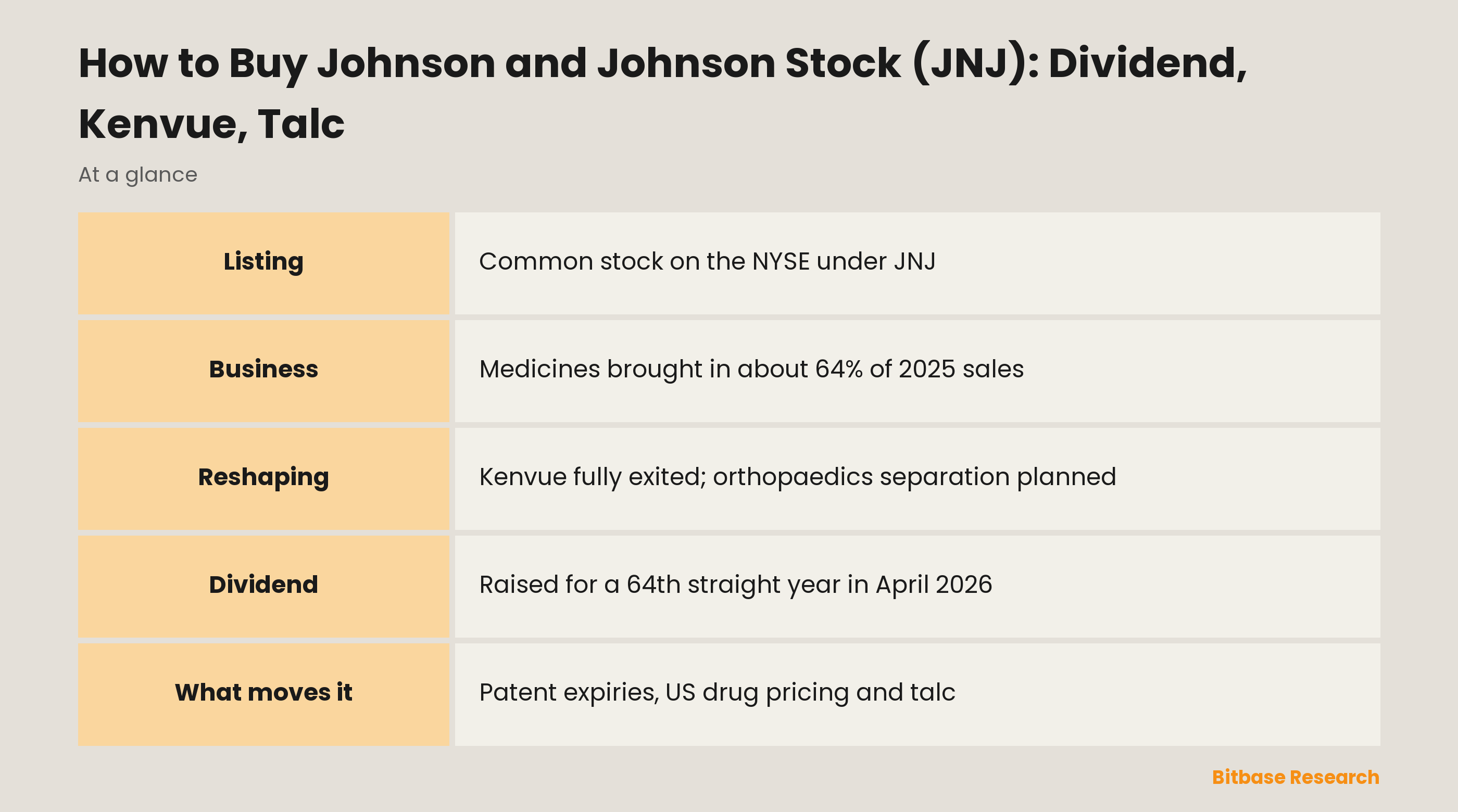
You can buy Johnson & Johnson stock through any brokerage account with access to the New York Stock Exchange, where the common shares trade under the ticker JNJ. The company behind them has been narrowing on purpose: consumer health left as Kenvue in 2023, and orthopaedics is slated to follow. What remains is prescription medicines, about 64% of fiscal 2025 sales, and medical technology. This guide covers how J&J earns its revenue, how to place the order, and what its filings flag most clearly: patent expiries, US drug pricing and talc litigation.
What Does Johnson & Johnson Do?
Johnson & Johnson researches, makes and sells healthcare products. Its annual report describes the parent as "a holding company, with operating companies conducting business in virtually all countries of the world." It was incorporated in New Jersey in 1887 and is headquartered in New Brunswick.
The business now reports two segments. Innovative Medicine is the pharmaceutical side, working in oncology, immunology, neuroscience, pulmonary hypertension, infectious diseases, and cardiovascular and metabolism. Its prescription medicines include the multiple myeloma treatment Darzalex, the immunology drugs Stelara and Tremfya, and the anticoagulant Xarelto. MedTech makes products "used in cardiovascular, orthopaedics, surgery, and vision": heart-rhythm and heart-pump technology, joint and trauma products, surgical staplers and robotics, and Acuvue contact lenses.
Consumer health, once a segment of its own, became Kenvue. After Kenvue's initial public offering on 8 May 2023, J&J disposed of a further 80.1% on 23 August 2023 through an exchange offer, taking back its own shares in return for Kenvue stock. It exchanged the remaining stake in May 2024 and now "no longer owns any shares of Kenvue Common Stock." A JNJ share bought today carries no Kenvue exposure.
A second separation is under way. On 14 October 2025 J&J announced its intent to separate the orthopaedics business, which would then operate on its own as DePuy Synthes. The company is exploring "multiple paths" and targets completion within 18 to 24 months of the announcement; its quarterly report for the period ended June 2026 still described the separation as planned.
How Johnson & Johnson Makes Money
Medicines brought in about 64% of fiscal 2025 sales and MedTech about 36%. The segment note splits that further:
| Area | Segment | Share of 2025 sales | Products and lines named in the 10-K |
|---|---|---|---|
| Oncology | Innovative Medicine | 26.9% | Darzalex, Carvykti, Erleada |
| Immunology | Innovative Medicine | 16.7% | Stelara, Tremfya, Simponi |
| Neuroscience | Innovative Medicine | 8.3% | Invega, Spravato, Caplyta |
| Pulmonary hypertension | Innovative Medicine | 4.7% | Opsumit, Uptravi |
| Cardiovascular, metabolism, other | Innovative Medicine | 4.0% | Xarelto |
| Infectious diseases | Innovative Medicine | 3.4% | Edurant, Prezista |
| Surgery | MedTech | 10.8% | Advanced and general surgery |
| Orthopaedics | MedTech | 9.8% | Hips, knees, trauma, spine |
| Cardiovascular | MedTech | 9.5% | Electrophysiology, Abiomed, Shockwave |
| Vision | MedTech | 5.8% | Contact lenses, surgical vision |
Shares are calculated from fiscal 2025 segment sales and rounded to one decimal.
A few products carry much of the total. The 10-K names Darzalex, counted with its subcutaneous form Darzalex Faspro, as the largest product at about 15% of fiscal 2025 revenues, followed by Stelara at about 6.5% and Tremfya at about 5.5%. Darzalex's economics are also shared: J&J licenses two patent families on the drug from Genmab and pays Genmab royalties.
Little of the money comes straight from patients. Three wholesalers serving both segments accounted for about 21.8%, 15.5% and 11.1% of gross revenues in 2025, and what the products finally earn depends on "reimbursements by third-party payors such as government healthcare programs, private insurance plans and managed care organizations." Those payers push down on prices.
About 43% of fiscal 2025 sales came from outside the United States, so exchange rates run through reported results. The portfolio turns over steadily too: products launched within the previous five years made up about 25% of 2025 sales.
JNJ Stock at a Glance
| Item | Detail |
|---|---|
| Exchange | New York Stock Exchange (NYSE) |
| Ticker | JNJ |
| Security | Common stock, the only share class registered on the 10-K cover |
| Other listed securities | Ten series of notes with their own symbols, such as JNJ28 |
| Sector | Healthcare: pharmaceuticals and medical technology |
| Index membership | S&P 500 and Dow Jones Industrial Average |
| Headquarters | New Brunswick, New Jersey |
| Incorporated | New Jersey, 1887 |
| Fiscal year | 52 or 53 weeks, ending on the Sunday nearest the end of December |
| Dividend policy | Quarterly cash dividend; April 2026 brought the 64th consecutive year of increases |
| SEC identifier | CIK 200406 |
Price, market value and yield move with every trade; for those, open the Johnson & Johnson stock page on Bitbase.
How to Buy Johnson & Johnson Stock
J&J is a US company listed in New York, so there is no depositary receipt to consider: the NYSE share is the common stock itself. The route runs through a broker:
1. Pick a broker that offers NYSE-listed stocks. Outside the US, that means a local broker with US market access or an international one; check which entity holds your account and who regulates it.
2. Open and verify the account. A non-US individual documents foreign status on IRS Form W-8BEN, which the broker uses to apply any treaty rate to US dividends.
3. Fund it. Converting from another currency costs money too, so compare the exchange rate as well as the commission.
4. Find the right security. Search JNJ and confirm the result reads Johnson & Johnson common stock on the NYSE. Symbols such as JNJ28 belong to the company's notes, which are bonds.
5. Choose an order type. A market order "guarantees that the order will be executed, but does not guarantee the execution price"; a limit order executes only "at a specific price or better."
6. Decide on the size. Fractional shares let you invest a cash amount, but "not every brokerage firm offers fractional share investing," some firms allow only market orders for them, and you "may not have voting rights" on a fraction.
7. Submit and keep the records. Confirmations and statements are your record of cost basis and dividends received.
If your broker takes orders outside the regular session, remember that regular and extended-hours quotes can differ; a limit order caps what you pay when trading is thin.
Outside the United States, dividends are taxed at source. The IRS states that "most types of U.S. source income received by a foreign person are subject to U.S. tax of 30%," and that "a reduced rate, including exemption, may apply" under a tax treaty, which is why brokers ask for Form W-8BEN. Your home country may tax it again.
Through an index fund, you hold J&J without picking it: as a constituent of the S&P 500 and the Dow Jones Industrial Average, it sits in funds that replicate either index, such as State Street's SPY and DIA, as one holding among many.
What Moves JNJ Stock
Patent expiries and biosimilars. The 10-K warns that "loss of patent exclusivity for a product often is followed by a substantial reduction in sales," and 2025 showed it. Stelara sales fell 41.3% as biosimilars arrived and Medicare Part D was redesigned; the company put the drag on worldwide operational sales at about 6.2%, and immunology overall dropped 11.8%. Total sales still rose 6.0%, carried by oncology growth of 22.1%.
The filing also dates what comes next. The two Genmab patent families on Darzalex expire in the US in 2029, though J&J holds separate patents on Darzalex Faspro. A Tremfya composition patent family is projected to expire in the US in 2031, generic competition for Opsumit is expected in 2026, and at least two Simponi biosimilars are seeking US approval. Every large drugmaker faces this cycle, as the Eli Lilly profile describes; J&J's 10-K at least names the products and the years.
US drug pricing. The Inflation Reduction Act lets the government set Medicare prices for certain high-spend drugs. The first "Selected Drug" list, published in 2023, included Xarelto, Stelara and Imbruvica, which have carried a government-established Medicare price from 2026. Medicare's administrator, CMS, has indicated that Xarelto and Stelara leave the list from 2027, while the 2028 list, published in January 2026, includes Erleada. The pressure shows in the 2025 sales bridge: volume added 8.4% and price took away 3.1%.
Talc litigation. J&J faces "numerous lawsuits arising out of the use of body powders containing talc, primarily JOHNSON'S Baby Powder," and does not buy third-party product liability insurance, relying on a wholly owned captive insurer. On 27 July 2026 it announced an agreement with the plaintiff firms leading the federal multi-district litigation to resolve the ovarian talc claims, conditioned on, among other things, participation by at least 95% of the remaining claims. The first payment would fall in 2027, with nothing more due before 2028. The October 2026 earnings release still called it proposed; whether the threshold is met is the milestone to watch.
Portfolio changes. The orthopaedics separation will change what a JNJ share represents, and its structure is not fixed. Acquisitions push the other way: Shockwave joined on 31 May 2024, and Intra-Cellular Therapies, which brought the psychiatric drug Caplyta, on 2 April 2025. Trial results and regulatory decisions matter for the same reason: each expiring product needs a successor.
Risks to Weigh Before Buying JNJ
Item 1A of the 10-K is long; these headings bear most directly on a JNJ share:
Competition. "The Company's businesses operate in highly competitive product markets and competitive pressures could adversely affect the Company's earnings."
Pricing and reform. Sales "may be negatively impacted by healthcare reforms and increasing pricing pressures," in the US and in markets such as the EU, Japan and China, where governments fund much of healthcare.
Legal proceedings. The company "is subject to significant legal proceedings that can result in significant expenses, fines and reputational damage," talc among them.
Manufacturing and safety. "Interruptions and delays in manufacturing operations could adversely affect the Company's business, sales and reputation," and product safety concerns can bring recalls and lawsuits.
Separation execution. The latest quarterly report flags "the Company's ability to satisfy the necessary conditions to consummate the planned separation of the Company's Orthopaedics business on a timely basis or at all."
Above the business sit two more. A single stock concentrates your money in one company's outcomes, however varied that company is inside. And a dividend record is history, not a guarantee: the board declares each payment, and if you hold the shares in another currency, both price and dividend reach you through an exchange rate.
How to Research JNJ Yourself
J&J files with the SEC under CIK 200406. The 10-K is the annual report, 10-Qs are quarterly, and 8-Ks carry events in between, including the April 2026 dividend increase, the July 2026 talc announcement and every quarterly earnings release.
In the 10-K, Item 1 describes the business, Item 1A the risks, the segment note gives sales by area and franchise, and the legal proceedings note covers talc, patent and government cases. The shareholder return graphs show which benchmarks the company uses: the S&P 500, the S&P Pharmaceutical Index and the S&P Healthcare Equipment Index, one for each side of the business plus the market.
Two checks avoid common mistakes. The structured cover of the fiscal 2025 report, R1.htm, lists eleven registered securities, and only the common stock trades as plain JNJ. And fiscal years 2020 and 2026 are 53 weeks long; a 53-week year, the company notes, "includes additional shipping days," so a comparison across one is not like for like. For quotes, use the stock page above, and for other companies browse more US stock pages on Bitbase.
Johnson & Johnson Stock FAQ
Does Johnson & Johnson pay a dividend?
Yes, quarterly. The April 2026 increase was, in the company's words, its 64th year of consecutive increases, and its October 2025 separation announcement listed "annually increasing competitive dividends" among its capital allocation priorities. The board declares each payment; amounts and dates are in the latest 8-K.
Can I buy Johnson & Johnson stock with crypto?
Not directly. JNJ shares are bought through a brokerage account and NYSE trades settle in US dollars, so crypto has to be sold for cash and the cash moved to your broker first; depending on where you live, that sale may be taxable. Treat the two steps as separate decisions, since a share is a registered claim on the company with dividend and voting rights, which is what separates a share from a crypto asset.
Is JNJ in the S&P 500 and the Dow?
Yes, both. State Street's daily holdings files for its S&P 500 trust (SPY) and its Dow Jones Industrial Average trust (DIA) each listed Johnson & Johnson in October 2026. Weights change daily.
What happened to Johnson & Johnson's consumer health business?
It became Kenvue, and J&J exited it through two exchanges, in August 2023 and May 2024. According to its July 2026 release, J&J agreed before the separation to keep all talc-related liabilities and cover Kenvue's costs from such litigation in the United States and Canada.
Has Johnson & Johnson stock ever split?
Yes. The company's 2001 filings record a two-for-one split effected in June 2001. Per-share figures from before it need adjusting before comparison.
Conclusion
Buying JNJ is mechanically simple: a broker with NYSE access, the right line on the order screen, a market or limit order. The harder part is knowing what the share holds now — medicines and medical technology, without Kenvue and, if the plan completes, without orthopaedics. The filings date most of what matters, from the 2029 Darzalex patent expiry to the talc threshold; read the latest 10-K and 8-Ks before deciding how much belongs in one healthcare stock.
Related reading
Other Bitbase articles on this topic:
- How to Buy Bristol Myers Squibb Stock (BMY): Eliquis and Opdivo
- How to Buy GSK Stock (GSK): Two-Share ADS, HIV and Haleon
- How to Buy Moderna Stock (MRNA): Vaccines, Cancer Trial and Perps
Disclaimer: This article is educational content from Bitbase Academy, provided for information only. It explains what a company or fund does and how the instruments referenced here differ from one another; it does not constitute investment, trading, tax, or financial advice, and it is neither a recommendation nor an endorsement of any security, token, or trading strategy. A tokenized stock is issued by a third party and is designed to give economic exposure to an underlying asset: it is not a share, it carries no shareholder rights, and it depends on the issuer's structure, eligibility rules, and redemption terms, which the issuer can change. Perpetual futures are leveraged derivatives that hold no underlying asset and can be liquidated, and trading hours, product availability, and eligibility differ by instrument and by jurisdiction and can change at any time. Written as of October 2026; verify everything yourself through company filings, the issuer's own documentation, and the product pages of the venue you trade on.
References
[1] Johnson & Johnson Form 10-K, fiscal 2025: business, segment sales, risk factors and legal proceedings (SEC EDGAR) www.sec.gov
[2] Johnson & Johnson Form 10-Q for the quarter ended 28 June 2026: status of the planned Orthopaedics separation (SEC EDGAR) www.sec.gov
[3] Johnson & Johnson press release, 14 October 2025: intent to separate the Orthopaedics business as DePuy Synthes (Form 8-K, Exhibit 99.3) www.sec.gov
[4] Johnson & Johnson Form 8-K, 14 April 2026: quarterly dividend increase, the 64th consecutive year (SEC EDGAR) www.sec.gov
[5] Johnson & Johnson press release, 27 July 2026: proposed resolution of ovarian talc litigation (Form 8-K, Exhibit 99.1) www.sec.gov
[6] Johnson & Johnson third-quarter 2026 results release (Form 8-K, Exhibit 99.1) www.sec.gov
[7] Johnson & Johnson Form S-4, 2001: note on the two-for-one stock split effected in June 2001 (SEC EDGAR) www.sec.gov
[8] State Street SPDR S&P 500 ETF Trust (SPY): fund page and daily holdings www.ssga.com
[9] State Street SPDR Dow Jones Industrial Average ETF Trust (DIA): fund page and daily holdings www.ssga.com
[10] Investor.gov (SEC): Types of Orders www.investor.gov
[11] Investor.gov (SEC): Investor Bulletin on fractional share investing www.investor.gov
[12] IRS: NRA Withholding www.irs.gov





