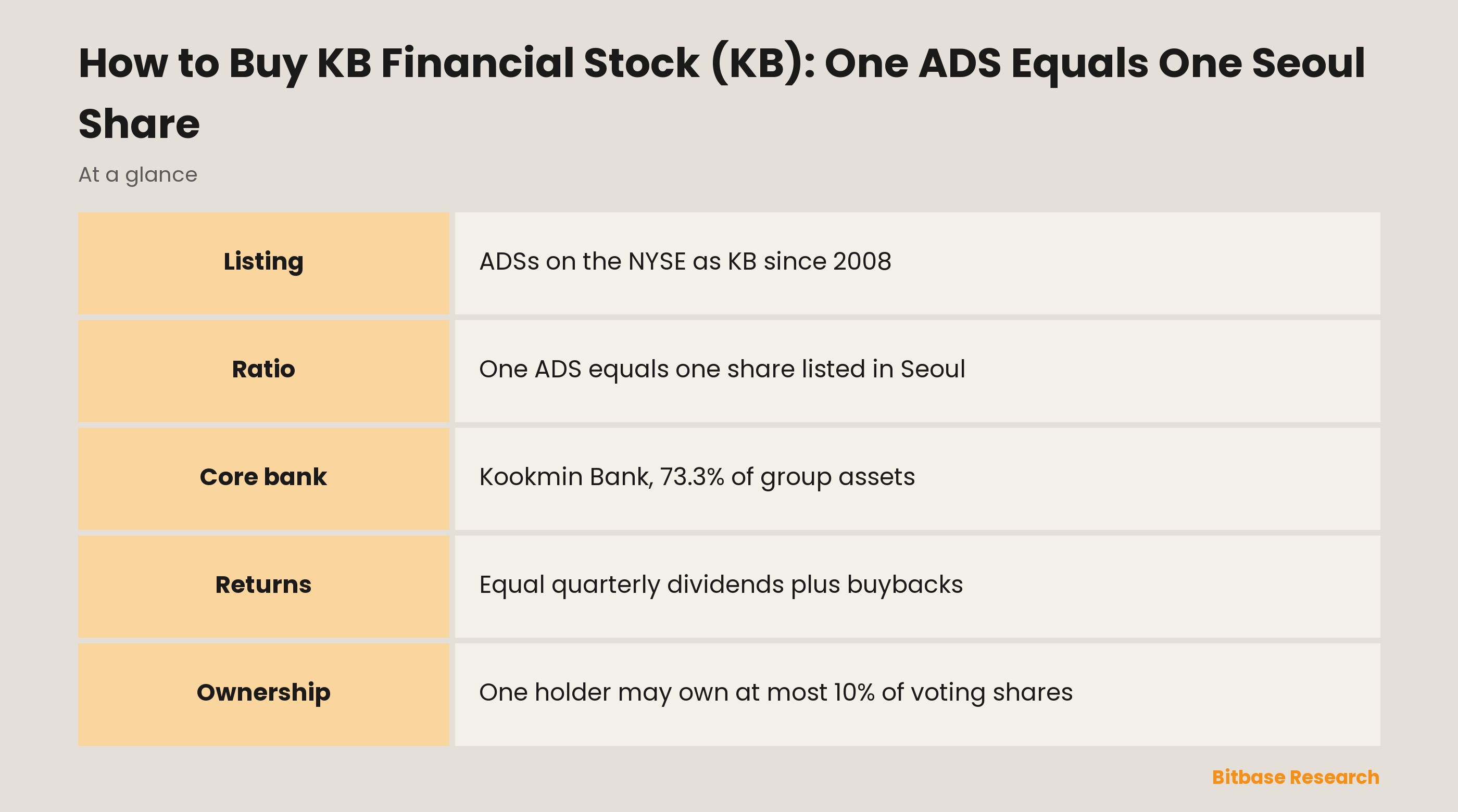
Because KB Financial Group's American depositary shares (ADSs) trade on the New York Stock Exchange under the ticker KB, any broker with NYSE access can buy them, and each ADS stands for one common share listed in Seoul under code 105560. The company is the holding group above Kookmin Bank, and Korean law caps any single investor at 10% of its voting shares, ADSs included.
What Does KB Financial Do?
KB Financial Group is a financial holding company based in Seoul. Its 20-F calls it "one of the largest financial holding companies in Korea, in terms of consolidated total assets."
The core is Kookmin Bank, about 73.3% of group assets at the end of 2025. It traces back to Citizens National Bank, set up by the Korean government in 1963, and to a housing lender founded in 1967; the two merged in 2001. KB Financial Group was created on 29 September 2008, when Kookmin Bank shareholders swapped each share for one share of the new holding company.
At the end of 2025 the group ran 771 bank branches and served about 39.0 million retail customers, "over one-half of the Korean population." It calls itself "the largest private sector mortgage lender in Korea." Corporate loans made up 47.9% of total loans and retail loans 40.5%.
Around the bank sit KB Securities (formerly Hyundai Securities, bought in 2016), KB Insurance, KB Kookmin Card (spun off from the bank in 2011) and KB Life Insurance, plus asset management, leasing and a savings bank. Abroad it owns KB PRASAC Bank in Cambodia and 67% of PT Bank KB Indonesia. At home it also faces internet-only banks such as Kakao Bank, in which Kookmin Bank held a 4.9% stake.
How KB Financial Makes Money
Most income still comes from the gap between what borrowers pay and what depositors receive. In 2025 net interest income rose 1.9% and made up 76.1% of net interest and net fee income combined. The net interest margin narrowed to 1.95% from 2.02% as Korean rates fell.
Net fee and commission income grew 6.4%, led by a 16.7% jump in securities commissions and a 24.3% rise in foreign-currency fees, which the 20-F ties to busier trading in Korean securities. Card fees fell 5.5% after merchant fee rates came down.
| Segment | Share of 2025 net operating revenue | Share of 2025 segment profit | What it covers |
|---|---|---|---|
| Retail banking | 22.1% | 22.3% | Household loans and deposits |
| Corporate banking | 26.1% | 23.8% | Lending to companies |
| Other banking | 13.3% | 13.0% | Treasury and funding |
| Credit card | 10.6% | 5.1% | KB Kookmin Card |
| Securities | 12.3% | 10.5% | KB Securities |
| Non-life insurance | 6.9% | 12.0% | KB Insurance |
| Life insurance | 1.9% | 2.1% | KB Life Insurance |
| Other | 6.6% | 11.1% | Asset management, leasing and others |
Shares are calculated from the 20-F segment table, before consolidation adjustments.
The three banking segments brought in 61.6% of segment revenue and 59.1% of segment profit. Group profit for the year rose 16.1%, helped by the absence of a 2024 one-off: compensation Kookmin Bank paid customers who lost money on equity-linked securities (ELS) tied to the Hang Seng China Enterprises Index.
KB Stock at a Glance
| Item | Detail |
|---|---|
| Listed company | KB Financial Group Inc., incorporated in Korea in 2008 |
| US listing | ADSs on the NYSE, ticker KB, since 29 September 2008 |
| ADS ratio | One ADS represents one share of common stock |
| Seoul listing | KRX KOSPI Market, code 105560, since 10 October 2008 |
| Depositary | JPMorgan Chase Bank, N.A. |
| Ownership cap | 10% of voting shares per holder and affiliates, ADSs included |
| Fiscal year | Calendar year; accounts under IFRS |
| Shareholder returns | Equal quarterly dividends, plus buybacks with cancellation |
| SEC filings | CIK 1445930; Form 20-F and Form 6-K |
For the live price, market value and yield, see the KB Financial stock page on Bitbase.
How to Buy KB Financial Stock
1. Choose the line. A broker with NYSE access buys KB ADSs in dollars; the won-priced shares need a broker that reaches the Korea Exchange.
2. Open the account. Foreigners buying on the Korea Exchange must first identify themselves with a Legal Entity Identifier, or a passport number for individuals.
3. Fund it. Currency conversion has a cost that often hides in the exchange rate.
4. Check the ticker. KB should show as KB Financial Group ADSs; in Seoul, look up 105560.
5. Pick an order type. A market order fills at the going price; a limit order caps what you pay.
6. Keep records. Confirmations and dividend statements show your cost and the tax withheld.
ADSs or Seoul shares. JPMorgan Chase Bank, N.A. is the depositary. An ADS carries the economics of one share, but some rights run through the depositary: dissent and appraisal rights require withdrawing the shares first, and preemptive rights reach ADS holders only if registration or an exemption allows it. The 20-F also warns that "if a holder surrenders ADSs and withdraws common stock, it may not be able to deposit the stock again to obtain ADSs."
Tax on dividends. Korea withholds 22.0% of dividends, local income surtax included. Under the Korea-United States treaty, qualifying US residents pay 16.5% or 11.0% depending on their shareholding. Gains on ADSs transferred outside Korea are generally exempt from Korean tax, but not if you convert to shares first and then sell. Your home country may tax both.
Through funds. Holdings reports for 31 August 2026 show the iShares MSCI South Korea ETF and the iShares MSCI Emerging Markets ETF both owned KB Financial's Seoul shares.
What Moves KB Stock
Korean interest rates. The Bank of Korea cut its policy rate from 3.50% to 2.50% between October 2024 and May 2025, pulling loan yields down. Regulators have also pushed for more competition since banks' wide spreads and profits "became a point of public interest."
The Seoul stock market. Brokerage and currency fees rise when Koreans trade more. In the first nine months of 2026, profit attributable to KB Securities' shareholders rose 113.98% on a preliminary basis, against 13.09% for the group.
Capital and buybacks. Under its Corporate Value Enhancement Plan, KB returns capital above a 13% common equity Tier 1 (CET1) ratio through equal quarterly dividends and buybacks, with a second step above 13.5%. Its CET1 ratio was 13.82% at the end of 2025. Cancellations cut the issued share count by 4.87% between April and July 2026, and a trust buyback runs until 16 December 2026.
Leadership. Chairman and chief executive Jong Hee Yang's term ends on 20 November 2026, when an extraordinary shareholders' meeting is expected to vote on Jae Keun Lee, a former Kookmin Bank chief executive nominated as his successor.
Fines. The Financial Supervisory Service finished its sanctions review over the ELS sales in February 2026, with final penalties expected during the year. The Fair Trade Commission also fined Korea's four largest banks, Kookmin Bank among them, over shared loan-to-value data; the banks are challenging that in court.
Where KB Financial's 20-F Sees Trouble
Household credit. "Future changes in market conditions as well as other factors may lead to increases in delinquency levels of our retail loan portfolio." Non-performing retail loans rose in each year from 2023 to 2025.
Property. The filing names exposure to "Korean real estate project financing, construction, shipbuilding and shipping," with project-finance loans at 1.66% of total loans.
Competition. "Competition in the Korean financial industry is intense, and we may lose market share and experience declining margins as a result." Internet-only banks and pressure to lend to vulnerable borrowers weigh on margins.
Ownership. The National Pension Service, the largest shareholder with 8.68% of issued shares at the end of 2025, holds a stake "which it may sell at any time."
Holding ADSs. "The market value of an investment in our ADSs may fluctuate due to the volatility of the Korean securities market," and the won moves the dollar value of each dividend. In an emergency, Korean authorities may restrict converting dividends into dollars.
Following KB Through Its 20-F and 6-K Reports
KB files under CIK 1445930: the annual Form 20-F, most recently on 28 April 2026, and Form 6-K for quarterly results, dividends, buybacks and shareholder meetings.
In the 20-F, the operating review explains the margin and segments, the financial information section covers dividends and lawsuits, the taxation section sets out Korean withholding, and a monthly table lists share purchases. Quarterly 6-K figures are preliminary and "subject to change." For a Japanese bank listed the same way, see our Mizuho stock guide, where five ADSs make one share. Bitbase's US stock directory lists other quote pages.
KB Financial Stock FAQ
Is KB Financial the same as Kookmin Bank?
No. KB Financial Group is the listed holding company; Kookmin Bank is its wholly owned bank, alongside securities, insurance and card subsidiaries.
How many KB Financial shares does one KB ADS represent?
One. The 20-F cover describes the ADSs as "each representing one share of Common Stock."
Does KB Financial pay a dividend?
Yes, four times a year: three quarterly dividends and an annual one approved in March. The total dividend per share for 2025 was 37.6% higher than for 2024. Korean withholding tax comes off first.
Can I buy KB Financial stock with crypto?
Not directly. KB ADSs settle in dollars, so crypto has to be sold for cash and moved into a brokerage account first, a sale that may be taxable where you live. A share also carries rights a token does not; see how stocks and crypto assets differ.
Can one investor own more than 10% of KB Financial?
Generally not. One holder and its affiliates may own no more than 10% of the voting shares, and non-financial business groups face a 4% limit. Shares behind ADSs count.
Conclusion
KB Financial is mainly a stake in Korean households and companies borrowing from Kookmin Bank, with the non-bank units, from securities and cards to insurance, adding about two-fifths of segment profit. Its earnings also lean on how busy the Seoul market is and on a payout plan tied to the CET1 ratio. Read the latest 20-F and later 6-Ks, watch the leadership vote on 20 November 2026, and decide how much weight one Korean banking group deserves in your portfolio.
Related reading
Other Bitbase articles on this topic:
- How to Buy Bradesco Stock (BBD): Two ADSs and Monthly Payouts
- How to Buy Citizens Financial Stock (CFG): Private Bank Growth
- How to Buy Credicorp Stock (BAP): BCP, Yape and Dividends in Soles
- How to Buy Scotiabank Stock (BNS): Latin America and KeyCorp
Disclaimer: This article is educational content from Bitbase Academy, provided for information only. It explains what a company or fund does and how the instruments referenced here differ from one another; it does not constitute investment, trading, tax, or financial advice, and it is neither a recommendation nor an endorsement of any security, token, or trading strategy. A tokenized stock is issued by a third party and is designed to give economic exposure to an underlying asset: it is not a share, it carries no shareholder rights, and it depends on the issuer's structure, eligibility rules, and redemption terms, which the issuer can change. Perpetual futures are leveraged derivatives that hold no underlying asset and can be liquidated, and trading hours, product availability, and eligibility differ by instrument and by jurisdiction and can change at any time. Written as of November 2026; verify everything yourself through company filings, the issuer's own documentation, and the product pages of the venue you trade on.
References
[1] KB Financial Group Form 20-F for 2025 (SEC EDGAR) www.sec.gov
[2] KB Financial Group 6-K, High-Dividend Company status, 27 March 2026 www.sec.gov
[3] KB Financial Group 6-K, buyback completed, 9 April 2026 www.sec.gov
[4] KB Financial Group 6-K, buyback completed, 16 July 2026 www.sec.gov
[5] KB Financial Group 6-K, trust agreement for share buyback, 23 July 2026 www.sec.gov
[6] KB Financial Group 6-K, third-quarter 2026 results, 29 October 2026 www.sec.gov
[7] KB Financial Group 6-K, notice of extraordinary meeting, 28 October 2026 www.sec.gov
[8] iShares MSCI South Korea ETF, Form N-PORT holdings at 31 August 2026 www.sec.gov
[9] iShares MSCI Emerging Markets ETF, Form N-PORT holdings at 31 August 2026 www.sec.gov





