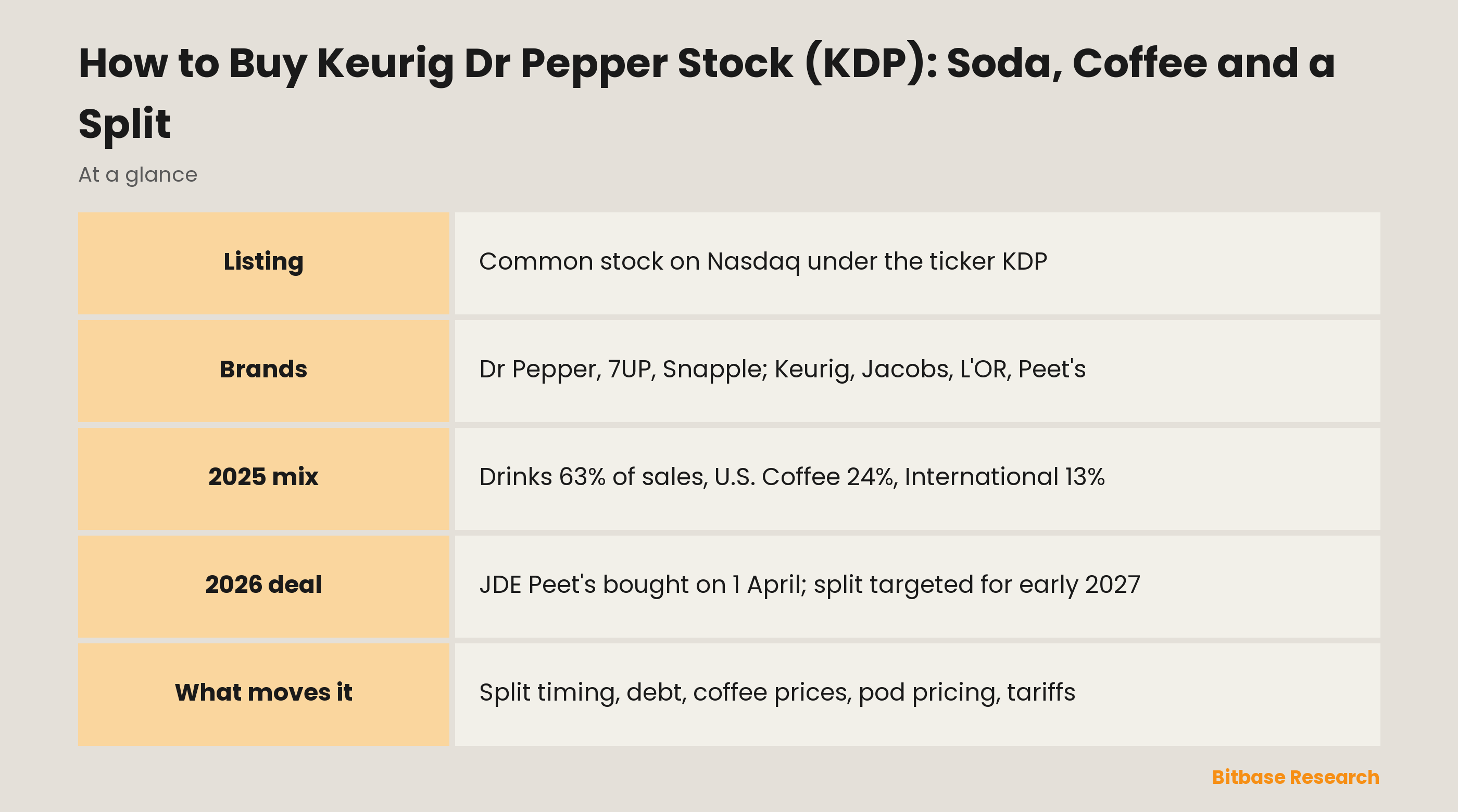
Anyone after Keurig Dr Pepper shares can buy them through a broker that reaches Nasdaq, where the common stock trades under the ticker KDP. What sets the stock apart is that it is changing shape: the company bought the coffee group JDE Peet's on 1 April 2026 and plans to split into a drinks company and a coffee company, targeting early 2027. Below: what it sells, how an order works, and what its filings say could move the share.
What Does Keurig Dr Pepper Do?
Keurig Dr Pepper makes and sells cold drinks and coffee. Its 2025 annual report calls it "a leading beverage company in North America that manufactures, markets, distributes, and sells hot and cold beverages and single serve brewing systems." The company in its current form dates from 9 July 2018, when the business of Keurig, the single-serve coffee maker, was combined with Dr Pepper Snapple Group, which the 10-K describes as "a company built over time through a series of strategic acquisitions."
The cold side owns familiar names: Dr Pepper, Canada Dry, 7UP, A&W, Snapple, Mott's, Peñafiel, Clamato, Core Hydration and the energy drink GHOST, of which it has held 60% since the end of 2024 and has agreed to buy the remaining 40% in 2028. It makes concentrates and syrups that it sells to independent bottlers or uses in its own plants, and it delivers finished drinks through its own direct-store-delivery network. Some of those bottlers belong to the Coca-Cola or PepsiCo systems. One detail surprises many readers: the 10-K says "the Dr Pepper trademark and formula is owned by Coca-Cola in some countries outside North America."
The hot side starts with the Keurig brewer and its K-Cup pods. The company makes "100% of the K-Cup pods of our owned and licensed brands," such as Green Mountain Coffee Roasters and The Original Donut Shop, and also produces pods for partner brands including Starbucks, Dunkin' and Folgers. Most brewers are designed in-house and built by contract manufacturers in Asia. The 10-K said the Keurig Alta brewer and plastic- and aluminum-free K-Rounds pods were expected to launch in late 2026.
On 1 April 2026 the company completed its purchase of JDE Peet's, whose brands include Jacobs, L'OR and Peet's. It sells single-serve, ground, instant and whole bean coffee, plus tea, through retailers, its own and licensed stores, and coffee services for offices. By the company's description, the combined coffee business now serves more than 100 markets.
The 10-K names its main competitors as Coca-Cola, PepsiCo, Starbucks, J.M. Smucker, Kraft Heinz and Nestlé, and adds that "many are also our partners or customers, as they purchase products directly from us."
How Keurig Dr Pepper Makes Money
Until the JDE Peet's deal, the company reported three segments. In 2025 they looked like this:
| Segment | Share of 2025 net sales | Share of 2025 segment operating income | What it sells |
|---|---|---|---|
| U.S. Refreshment Beverages | 63% | 66% | Soft drinks, juice, water, energy and hydration drinks in the US |
| U.S. Coffee | 24% | 22% | Keurig brewers, K-Cup pods and other coffee in the US |
| International | 13% | 12% | Drinks in Canada, Mexico and the Caribbean, plus Keurig coffee in Canada |
The profit column divides each segment's operating income, as reported in the 10-K segment note, by the total of all three, before unallocated corporate costs.
In 2025 the drinks side carried the growth. Net sales rose 8.2% and U.S. Refreshment Beverages grew 11.9%, while U.S. Coffee sales rose only 0.6% and its operating income fell about 11%. The United States produced about 87% of total sales, and Walmart alone "represented approximately 16% of our consolidated net sales in 2025." Ingredients and packaging, from green coffee to aluminum cans, make up about 55% of cost of sales.
From the second quarter of 2026 a fourth segment, JDE Peet's, appears in the results. In the third quarter, net sales rose 70.6% from a year earlier; excluding the acquisition, the legacy business grew 8.6%. JDE Peet's brought in about 36% of that quarter's sales, U.S. Refreshment Beverages 41%, U.S. Coffee 14% and International 9%. Coffee now makes up roughly half of sales, the line along which the split is planned.
Two 2026 arrangements also change how profits reach common shareholders. On 30 March the company placed its K-Cup manufacturing assets in a joint venture in which funds managed by Apollo, KKR and Goldman Sachs took 49% and the company kept 51%. The same day it issued convertible preferred stock that carries a 4.75% dividend and ranks ahead of the common stock.
KDP Stock at a Glance
| Feature | KDP |
|---|---|
| Exchange | Nasdaq Global Select Market |
| Ticker | KDP |
| Security | Common stock, the only class registered under Section 12(b) |
| Sector | Beverages: soft drinks, juice, water and coffee |
| Brands | Dr Pepper, Canada Dry, 7UP, Snapple, Keurig, Green Mountain Coffee Roasters, Jacobs, L'OR, Peet's |
| Index membership | S&P 500 and Nasdaq-100 |
| Headquarters | Two head offices: Frisco, Texas and Burlington, Massachusetts |
| Incorporated | Delaware |
| Fiscal year | Calendar year, ending 31 December |
| Dividend | Regular quarterly cash dividend |
| Corporate event | Planned separation into a beverage company and a coffee company, targeted for early 2027 |
| SEC identifier | CIK 1418135 |
For live price, market value and yield, see the Keurig Dr Pepper stock page on Bitbase.
How to Buy Keurig Dr Pepper Stock
Keurig Dr Pepper is a Delaware corporation listed in the United States, so there is no depositary receipt in the picture: the Nasdaq line is the company's own common stock. Seven steps get you there:
1. Choose a broker that offers US shares. Abroad, that means a local or international broker with Nasdaq access; check who regulates it.
2. Get the account approved. Investors who are not US persons usually certify their status on IRS Form W-8BEN; the IRS says to "submit Form W-8 BEN when requested by the withholding agent or payer."
3. Fund it. If you deposit in another currency, compare the conversion rate as well as the commission.
4. Find the right line. Search KDP and confirm that the result reads Keurig Dr Pepper Inc. common stock on Nasdaq. The convertible preferred shares issued in 2026 were sold privately and are not what you buy on the exchange.
5. Choose an order type. FINRA says a market order "provides the most certainty that your order will be executed," while a limit order fills only "at or better than a specified price."
6. Decide on size. Fractional shares let you invest a fixed sum, but some firms offer them only for "large-cap stocks or ETFs" or not at all, and FINRA warns that "as a fractional share owner, you might not have shareholder voting rights."
7. Keep the records. Trade confirmations and monthly statements show what you paid and what dividends arrived, which will matter more if the separation goes ahead and one holding becomes two.
Tax for investors abroad. According to the IRS, "most types of U.S. source income received by a foreign person are subject to U.S. tax of 30%," and a tax treaty can lower or remove that rate, which is why brokers ask for the W-8BEN. Your home country may tax the same dividend again.
Through index funds. Because KDP belongs to the S&P 500 and to the Nasdaq-100, any fund replicating one of those benchmarks, State Street's SPY or Invesco's QQQ for instance, owns a slice of it alongside hundreds of other companies. For another drinks maker, see our PepsiCo stock guide.
What Moves KDP Stock
The separation timetable. The company plans to become "two independent, U.S.-listed publicly traded companies": a North American drinks business, provisionally called Beverage Co., and Global Coffee Co., to be spun off in what the company calls a "tax-free spin." Timing depends on "appropriate leverage levels at each company, and supportive market conditions." Chief executive Tim Cofer is due to lead Beverage Co., and on 3 November 2026 Russ Torres joined as head of the coffee unit and future chief executive of Global Coffee Co. Any shift in the early-2027 target is news for the share.
Paying for JDE Peet's. The deal was financed with new bonds, a term loan, the preferred stock and the joint venture, and the 10-K warns that the company "will incur and assume significant debt" as a result. How fast it pays that down feeds into when the split can happen.
Coffee prices and pod pricing. In the third quarter of 2026, U.S. Coffee sales grew 2.7%: volume and mix rose 6.9% while net prices fell 4.2%, and the company revised its full-year expectations for the segment. Green coffee is bought at "a premium above the 'C' price of coffee," so that benchmark reaches margins with a lag.
Soft drink momentum. U.S. Refreshment Beverages grew 10.9% in the same quarter. Energy and hydration drinks such as GHOST and Electrolit sit here, and so does the fountain business, where Dr Pepper accounts for most of the volume.
Tariffs and taxes. Brewers are built in Asia, and the company named tariff refunds as the main driver of U.S. Coffee's adjusted profit growth in the third quarter. In the International segment, adjusted operating income slipped, with cost pressures that included the Mexico beverage tax.
Bottlers, Coffee Beans and Split Risk at Keurig Dr Pepper
Of the risk factors in Item 1A of the 10-K, updated in the second-quarter 2026 10-Q, these bear most directly on a KDP holder.
Keurig adoption. "A significant portion of our business is attributable to sales of K-Cup pods for use with Keurig brewing systems. Continued acceptance of Keurig brewers to further increase household penetration is a significant factor in our growth plans."
Bottlers it does not control. "We depend on third-party bottling and distribution companies for a significant portion of our business." Some "are also our direct competitors," and "in most cases, they are able to terminate their bottling and distribution arrangements with us without cause."
Changing tastes and health rules. The company cites shifts in "consumer lifestyles and consumption patterns, including from the use of weight loss drugs," and says concerns about calories, synthetic colors or sweeteners could bring lawsuits, new taxes or limits on benefit programs such as SNAP.
The split itself. "The Separation may not be completed on the terms or timeline currently contemplated, if at all." And if it is, "the price of our common stock may decline compared to its level immediately prior to, as it will no longer include the value of the separated business."
Preferred stock ahead of you. The convertible preferred ranks senior to the common stock and votes alongside it on an as-converted basis. If its dividends are deferred, the company "will not be able to declare or pay any dividends on or make repurchases of our common stock, subject to certain conditions."
Above all this, a single stock concentrates your money in one company, and the dividend, though regular, is not promised.
How to Research KDP Yourself
Everything the company files with the SEC is listed under CIK 1418135. In the 2025 10-K, Item 1 covers brands, bottlers and customers, Item 1A the risks, and the segment note sales and profit by segment. The 2026 10-Qs add the JDE Peet's segment, the joint venture and the preferred stock, and the 8-Ks carry each results release (in 2026: 24 February, 23 April, 6 August and 3 November) and separation news.
Two checks help. First, compare like with like: 2026 figures include JDE Peet's only from 1 April, so the releases split out "legacy KDP" growth. Second, watch for the separation documents; the terms on which common shareholders would receive Global Coffee Co. stock have not yet been filed. For a coffee peer, see our Starbucks stock guide. For quotes, use the KDP page linked earlier; for other names, browse the full list of US stock pages on Bitbase.
Keurig Dr Pepper Stock FAQ
Can I buy Keurig Dr Pepper stock with crypto?
Not directly. A broker settles KDP purchases in US dollars, so any crypto first has to be converted into cash and transferred, and that conversion can trigger tax in your country. What you end up holding also differs in kind: dividend and voting rights in a registered company, which is how a share differs from a crypto asset.
Does Keurig Dr Pepper pay a dividend?
Yes. The board pays a regular cash dividend each quarter and "expects to continue to pay such dividends on a quarterly basis." Declarations were filed on 20 May and 16 September 2026, for example; check the latest 8-K for the amount and dates.
Is KDP in the S&P 500 and the Nasdaq-100?
Yes, both. Keurig Dr Pepper was listed in State Street's SPY holdings file dated 5 November 2026 and in Invesco's QQQ holdings for the same day; QQQ follows the Nasdaq-100. Index weights shift every day.
What happens to KDP stock if the company splits?
The plan is a tax-free spin-off of Global Coffee Co., with the beverage business as the other company and both listed in the United States. How many coffee shares each KDP holder would receive, and when, has not been filed yet. The 10-K warns that the remaining stock "may decline" once it no longer includes the coffee business.
Does Keurig Dr Pepper own Peet's coffee?
Yes. Peet's came with JDE Peet's, acquired on 1 April 2026 along with Jacobs and L'OR. Peet's was already a K-Cup partner brand before the deal.
Conclusion
A KDP share today is a stake in a company that plans to split itself in two, so the real question is what each half will hold. The pieces are a soft drink business that grew strongly in 2025, a K-Cup business under price pressure, and a large coffee acquisition paid for with debt and preferred stock. Read the latest 10-Q and results release, follow the separation filings, and decide how much one company about to become two should weigh in your portfolio.
Related reading
Other Bitbase articles on this topic:
- How to Buy Diageo Stock (DEO): Four Shares per ADS and Guinness
- How to Buy Dollar General Stock (DG): Small Towns, Thin Margins
- How to Buy Estee Lauder Stock (EL): Class A Shares, Family Control
Disclaimer: This article is educational content from Bitbase Academy, provided for information only. It explains what a company or fund does and how the instruments referenced here differ from one another; it does not constitute investment, trading, tax, or financial advice, and it is neither a recommendation nor an endorsement of any security, token, or trading strategy. A tokenized stock is issued by a third party and is designed to give economic exposure to an underlying asset: it is not a share, it carries no shareholder rights, and it depends on the issuer's structure, eligibility rules, and redemption terms, which the issuer can change. Perpetual futures are leveraged derivatives that hold no underlying asset and can be liquidated, and trading hours, product availability, and eligibility differ by instrument and by jurisdiction and can change at any time. Written as of November 2026; verify everything yourself through company filings, the issuer's own documentation, and the product pages of the venue you trade on.
References
[1] Keurig Dr Pepper Form 10-K for 2025 (SEC EDGAR) www.sec.gov
[2] Keurig Dr Pepper 2025 Form 10-K, XBRL cover page (SEC EDGAR) www.sec.gov
[3] Keurig Dr Pepper 2025 Form 10-K, XBRL segment results (SEC EDGAR) www.sec.gov
[4] Keurig Dr Pepper Form 10-Q for the second quarter of 2026 (SEC EDGAR) www.sec.gov
[5] Keurig Dr Pepper third-quarter 2026 results release, Form 8-K (SEC EDGAR) www.sec.gov
[6] Keurig Dr Pepper release on completing the JDE Peet's acquisition, Form 8-K, 1 April 2026 (SEC EDGAR) www.sec.gov
[7] Keurig Dr Pepper release naming the future CEO of Global Coffee Co., Form 8-K, 1 October 2026 (SEC EDGAR) www.sec.gov
[8] State Street, SPY daily holdings www.ssga.com
[9] Invesco, QQQ holdings dng-api.invesco.com
[10] FINRA: Types of Orders www.finra.org
[11] FINRA: Investing in Fractional Shares www.finra.org
[12] IRS: NRA Withholding www.irs.gov
[13] IRS: About Form W-8 BEN www.irs.gov





