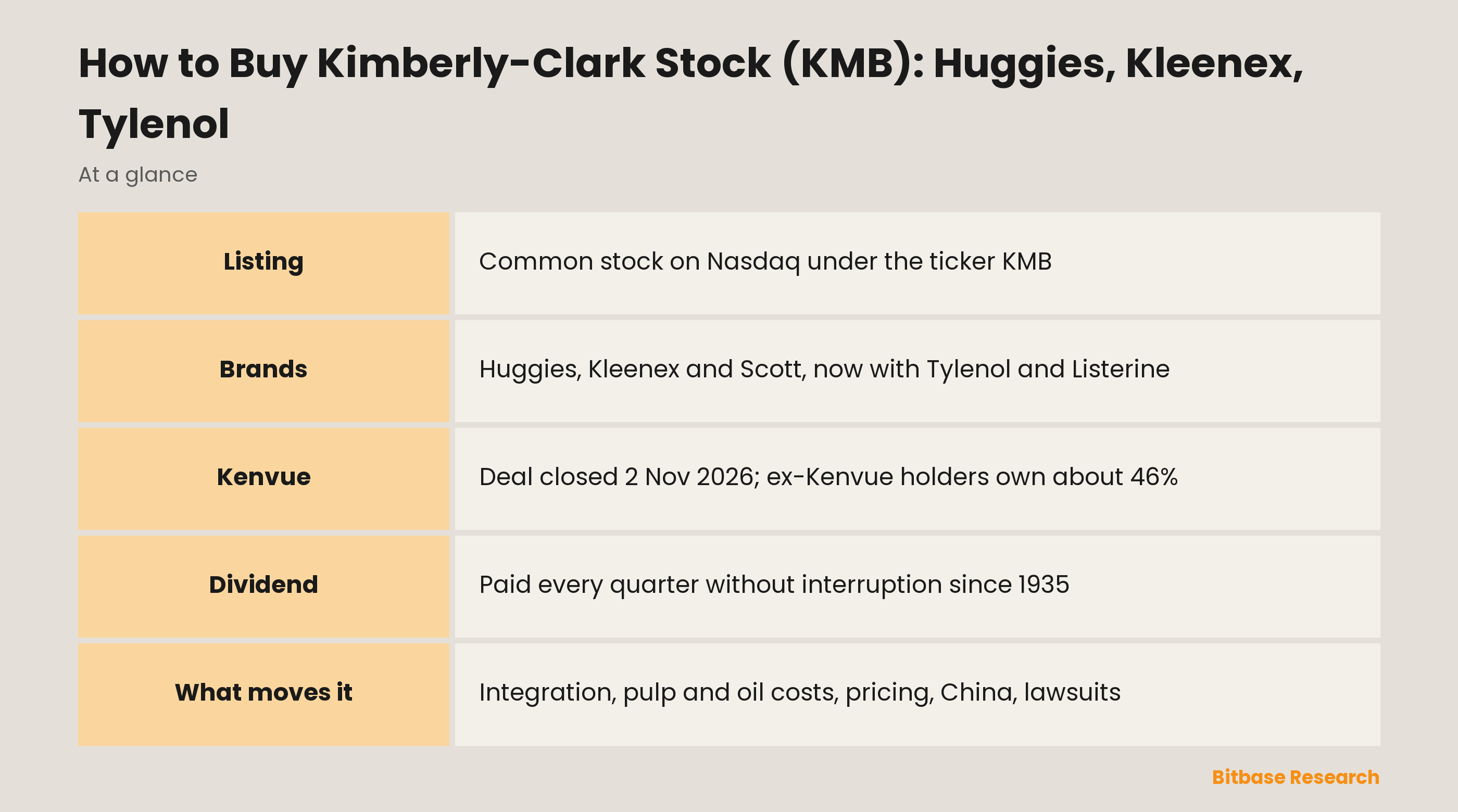
On Nasdaq, Kimberly-Clark stock trades under the ticker KMB, so any broker selling US equities can take the order. The company behind it changed in 2026: its international tissue and professional business went into a joint venture with Suzano on 1 July, and on 2 November it completed the purchase of Kenvue, the maker of Tylenol, paying partly in new KMB shares that leave former Kenvue holders with roughly 46% of the company.
What Does Kimberly-Clark Do?
Kimberly-Clark makes everyday personal care products; the 10-K says the company "was founded in 1872 and incorporated in Delaware in 1928" and works with "advanced technologies in fibers, nonwovens and absorbency." In practice that means diapers and training pants, tissue products, incontinence and feminine care products, and wipers for professional use.
Its brands, among them Huggies, Pull-Ups, Kleenex, Scott, Cottonelle, Kotex, Depend and Poise, are sold in more than 175 countries and territories and hold the No. 1 or No. 2 position in about 70 countries.
Two deals rebuilt the company within four months. On 1 July 2026 substantially all of the former International Family Care and Professional business, tissue and workplace products sold outside North America, went into a joint venture in which Suzano holds 51% and Kimberly-Clark keeps 49%.
On 2 November 2026 Kimberly-Clark completed the acquisition of Kenvue, the consumer health company separated from Johnson & Johnson in 2023. Each Kenvue share became 0.14625 of a KMB share plus cash, and Kenvue's own stock, KVUE on the NYSE, stopped trading that day. The combined company now counts ten brands with more than a billion dollars in sales each, Tylenol, Listerine and Neutrogena among them. The third-quarter 10-Q admits: "We have not historically operated an OTC drug business of this scale."
How Kimberly-Clark Makes Money
The 2025 figures describe the company before Kenvue and without the joint venture business, in two segments:
| Segment | Share of 2025 net sales | Share of 2025 segment operating profit |
|---|---|---|
| North America | 65% | 76% |
| International Personal Care | 35% | 24% |
Diapers lead the mix. Baby & Child Care made up about 41% of 2025 net sales, Family Care (tissue products) 25%, Adult Care 12%, Professional 11% and Feminine Care 10%. The United States alone produced about 61%.
Sales run mostly through retailers, which concentrates revenue: Walmart, the largest customer, accounted for about 16% of net sales in both 2025 and 2024.
Growth came from volume, not price. Net sales fell 2.1% in 2025, mostly because of business exits, including the private label diapers it had made for US retailers, and currency. Organic sales, which strip out those effects, rose 1.7% on volume gains of 2.5%.
Kenvue changes the proportions. The company says it will run four segments: North America, Asia Pacific Focus Markets, Europe, Middle East and Africa, and Enterprise Markets, which groups Latin America, India, Southeast Asia and Japan. On the two companies' combined 2025 sales, North America accounts for about 57%.
KMB Stock at a Glance
| Feature | KMB |
|---|---|
| Exchange | Nasdaq since May 2025; previously the NYSE |
| Ticker | KMB |
| Security | Common stock, the only class registered under Section 12(b) |
| Sector | Household and personal care, now with over-the-counter health brands |
| Index membership | S&P 500 |
| Headquarters | Dallas, Texas area |
| Incorporated | Delaware, 1928 (founded 1872) |
| Fiscal year | Calendar year, ending 31 December |
| Dividend | Quarterly, paid without interruption since 1935 |
| SEC identifier | CIK 55785 |
Quotes, market value and yield shift all day long; the Kimberly-Clark stock page on Bitbase shows them live.
How to Buy Kimberly-Clark Stock
Kimberly-Clark is a Delaware corporation, so no depositary receipt sits in between: the share on Nasdaq is the common stock itself.
1. Choose a broker with Nasdaq access. Abroad, check which legal entity holds your account and who regulates it.
2. Get verified. Investors outside the US usually complete IRS Form W-8BEN; the agency's instruction is to hand it in "when requested by the withholding agent or payer."
3. Fund it. Compare exchange rates as well as commissions.
4. Find the right line. Search KMB and confirm it reads Kimberly-Clark Corporation common stock. The old KVUE ticker no longer trades.
5. Pick market or limit. In FINRA's words, a market order "provides the most certainty that your order will be executed," while a limit order fills only "at or better than a specified price."
6. Decide the size. Some brokers offer fractional shares only for "large-cap stocks or ETFs" or not at all, and "as a fractional share owner, you might not have shareholder voting rights."
7. Save the paperwork. Trade confirmations and statements are your record of what you paid and what you were paid.
Tax for non-US investors. The IRS says "most types of U.S. source income received by a foreign person are subject to U.S. tax of 30%," and a tax treaty may lower the rate. Your home country may tax the same dividends again.
Through index funds. KMB is in the S&P 500, so funds tracking it, such as State Street's SPY, hold it alongside hundreds of other companies.
What Moves KMB Stock
Kenvue integration. A Kenvue Integration Program began on 2 November 2026 and is expected to run until the end of 2029, covering supply chains, technology systems and staffing; the 8-K says it is intended to deliver operating profit synergies by 2030. Kenvue still relies on Johnson & Johnson to supply some products, including Tylenol and Zyrtec, under transition agreements that must be replaced.
Pulp and oil. Diapers and tissue are built from wood pulp and petroleum-based materials. The 10-K says "pulp prices have experienced significant volatility," and the third-quarter 10-Q adds that conflict in the Middle East has pushed up prices for some petroleum-derived inputs.
Price competition. In the third quarter of 2026 organic sales fell 1.3%, mainly on lower pricing, with more promotions in North America.
China. In the second quarter of 2026, says the 10-Q, "false allegations regarding the quality of certain diaper brands in the China market emerged and were carried across social media channels." Chinese authorities refuted them, but the company expects further impact on sales and profits in the near term; it put the drag on third-quarter organic sales at about 270 basis points.
Trade and currency. Tariffs and currency swings are listed foreign market risks; one-time tariff refunds helped margins in the first nine months of 2026.
Pulp Costs, Private Labels and Tylenol Lawsuits at Kimberly-Clark
These risk factors from the 10-K and the third-quarter 10-Q bear most directly on a KMB share:
Integration. "We may encounter difficulties integrating our and Kenvue's businesses and operations and, therefore, may fail to realize the projected benefits and cost savings of the Kenvue Acquisition, which could adversely affect the value of our common stock."
Debt and dividends. "The Kenvue Acquisition increased the amount of our debt resulting in additional interest expense." More shares also mean "additional cash will be required for any dividends declared."
Acetaminophen claims. Lawsuits allege that exposure to acetaminophen, the active ingredient in Tylenol, before birth is linked to autism or ADHD, and the Attorney General of Texas has also sued. The company is "unable to reasonably estimate the likelihood or magnitude of potential liability."
Talc and other ingredients. J&J indemnifies talc claims for products sold in the US and Canada, but liabilities from products sold elsewhere, including the UK, "remain our responsibility." The FDA has also proposed removing oral phenylephrine, used in Sudafed PE, from its over-the-counter monograph.
Competition and costs. The company competes "against well-known, branded products and low-cost or private label products," and higher input costs "without corresponding increases in our selling prices, could adversely affect our financial results."
Above the business: one stock ties your money to one company, and a long dividend record is not a promise, since the board declares each payment.
Checking KMB in the SEC Filings
Kimberly-Clark reports to the SEC under CIK 55785: a 10-K each year, a 10-Q after each of the first three quarters and 8-Ks when something happens, earnings releases included; in 2026 those releases came on 27 January, 28 April, 4 August and 5 November. The third-quarter 10-Q carries the new risk factors.
In the 10-K, Item 1A lists the risks and Item 5 the dividend record. Compare like with like: the 2025 figures exclude both the joint venture business and Kenvue. Kenvue's past inside J&J is covered in our Johnson & Johnson stock guide, and another US household products company in our Procter & Gamble stock guide.
One trap: Kimberly-Clark de Mexico, 47.9% owned, is a separate company listed in Mexico, not KMB. For other companies, browse Bitbase's index of US stock pages.
Kimberly-Clark Stock FAQ
Can I buy Kimberly-Clark stock with crypto?
Not directly. A broker settles KMB purchases in US dollars, so the crypto has to be sold first and the cash moved across, and in your country that sale may count as a taxable event. What you then hold is a share with dividend and voting rights in a registered company, the point where a share and a crypto asset part ways.
Does Kimberly-Clark pay a dividend?
Yes. The 10-K says quarterly dividends "have been paid continually since 1935," usually around the second business day of January, April, July and October. Each payment's size is the board's decision; the latest earnings release has the current one.
What happened to Kenvue stock?
Kenvue became a wholly owned subsidiary of Kimberly-Clark on 2 November 2026. Each KVUE share was converted into 0.14625 of a KMB share plus cash, and KVUE stopped trading on the NYSE that day.
Is KMB listed on Nasdaq or the NYSE?
Nasdaq. Kimberly-Clark moved its listing from the NYSE in May 2025 and kept the ticker KMB. It is also in the S&P 500.
What brands does Kimberly-Clark own?
Huggies, Kleenex, Scott, Cottonelle, Kotex and Depend, among others, and since November 2026 Kenvue's brands, including Tylenol, Listerine, Neutrogena and Johnson's Baby.
Conclusion
Kimberly-Clark after Kenvue is no longer the company described in its 2025 annual report, and that is the first thing to take in before buying KMB. Tylenol now sits next to Huggies, and both the share count and the debt are larger. Read the third-quarter 10-Q, compare the first combined results with the 2025 base, and decide how large a place one consumer goods company deserves in what you own.
Related reading
Other Bitbase articles on this topic:
- How to Buy Diageo Stock (DEO): Four Shares per ADS and Guinness
- How to Buy Dollar General Stock (DG): Small Towns, Thin Margins
- How to Buy Estee Lauder Stock (EL): Class A Shares, Family Control
Disclaimer: This article is educational content from Bitbase Academy, provided for information only. It explains what a company or fund does and how the instruments referenced here differ from one another; it does not constitute investment, trading, tax, or financial advice, and it is neither a recommendation nor an endorsement of any security, token, or trading strategy. A tokenized stock is issued by a third party and is designed to give economic exposure to an underlying asset: it is not a share, it carries no shareholder rights, and it depends on the issuer's structure, eligibility rules, and redemption terms, which the issuer can change. Perpetual futures are leveraged derivatives that hold no underlying asset and can be liquidated, and trading hours, product availability, and eligibility differ by instrument and by jurisdiction and can change at any time. Written as of November 2026; verify everything yourself through company filings, the issuer's own documentation, and the product pages of the venue you trade on.
References
[1] Kimberly-Clark Form 10-K for 2025 (SEC EDGAR) www.sec.gov
[2] Kimberly-Clark 2025 Form 10-K, XBRL cover page (SEC EDGAR) www.sec.gov
[3] Kimberly-Clark 2025 Form 10-K, XBRL segment data (SEC EDGAR) www.sec.gov
[4] Kimberly-Clark 2025 Form 10-K, XBRL sales by product category (SEC EDGAR) www.sec.gov
[5] Kimberly-Clark 2025 Form 10-K, XBRL customer and country data (SEC EDGAR) www.sec.gov
[6] Kimberly-Clark Form 10-Q for the third quarter of 2026 (SEC EDGAR) www.sec.gov
[7] Kimberly-Clark Form 8-K on completing the Kenvue acquisition, 2 November 2026 (SEC EDGAR) www.sec.gov
[8] Kimberly-Clark news release on completing the Kenvue acquisition, 2 November 2026 (SEC EDGAR) www.sec.gov
[9] Kimberly-Clark third-quarter 2026 earnings release (SEC EDGAR) www.sec.gov
[10] Kimberly-Clark Form 8-K on moving its listing to Nasdaq, May 2025 (SEC EDGAR) www.sec.gov
[11] State Street SPDR S&P 500 ETF Trust (SPY), fund page www.ssga.com
[12] FINRA: Types of Orders www.finra.org
[13] FINRA: Investing With Fractional Shares www.finra.org
[14] IRS: NRA Withholding www.irs.gov
[15] IRS: About Form W-8 BEN www.irs.gov





