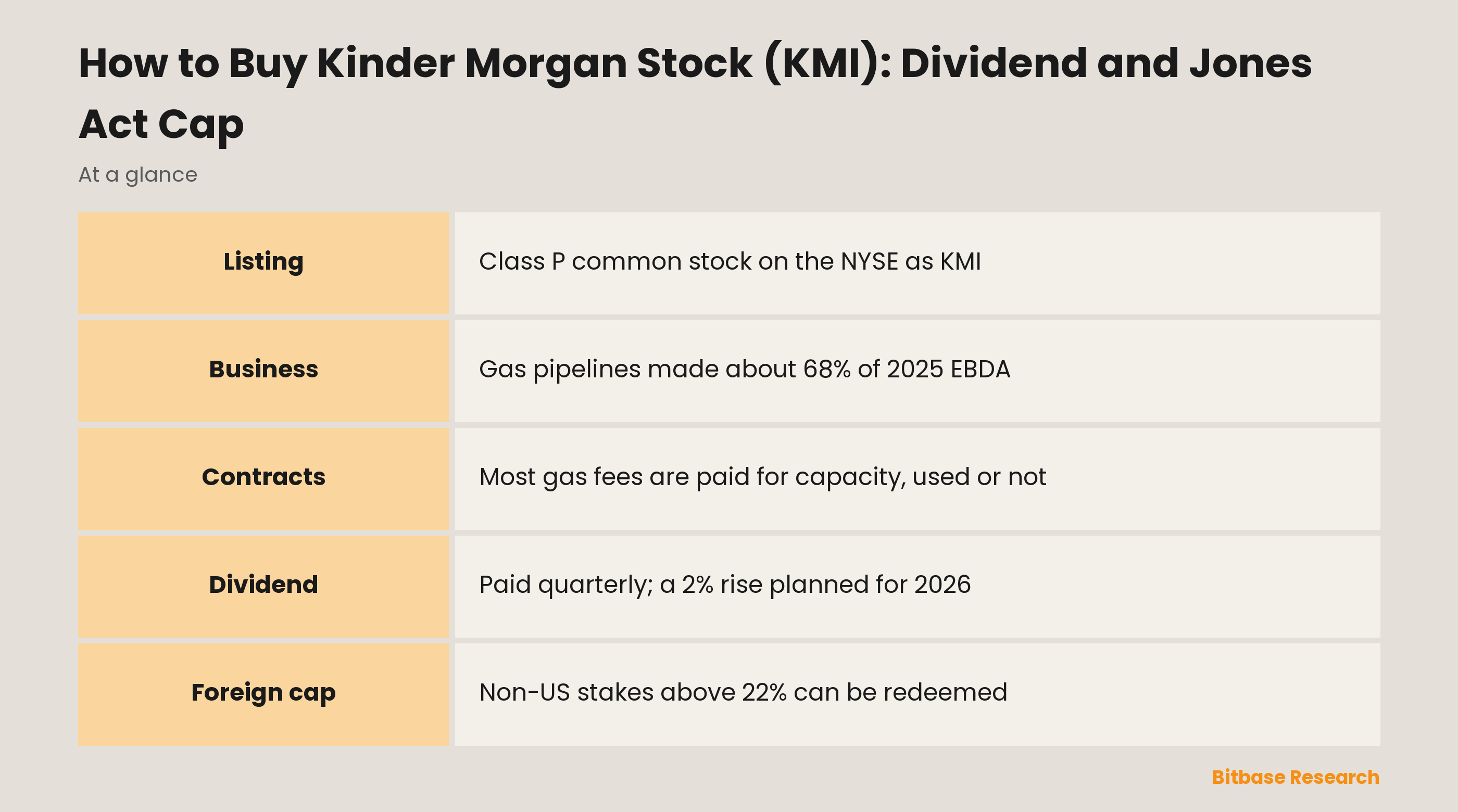
Over the phone or in a trading app, any broker with access to the New York Stock Exchange can buy Kinder Morgan stock for you: the company's Class P common shares trade there under the ticker KMI. For a buyer outside the United States, one clause matters more than usual. Because the company runs tankers under the Jones Act, its charter lets it redeem shares held by non-US citizens if their combined stake goes above 22%. The business behind the shares is a Houston pipeline and terminal operator whose natural gas segment produced about 68% of its 2025 segment earnings.
What Does Kinder Morgan Do?
Kinder Morgan, Inc. moves and stores energy. According to its annual report, its pipelines carry natural gas, refined petroleum products, crude oil, condensate, CO2 and renewable fuels, and its terminals handle fuels, chemicals, petroleum coke, metals and ethanol. At the end of 2025 it owned an interest in or operated about 78,000 miles of pipelines and 136 terminals. The company is incorporated in Delaware, based in Houston and reports four business segments.
Natural Gas Pipelines is the core: interstate and intrastate gas pipelines, underground storage, LNG liquefaction and terminal facilities and NGL fractionation, some regulated by the Federal Energy Regulatory Commission (FERC) and some not. Its systems include Tennessee Gas Pipeline (TGP), El Paso Natural Gas, the Texas intrastate network and gathering assets in basins such as the Haynesville and the Bakken.
Products Pipelines carries gasoline, diesel and jet fuel on lines in the West Coast and the Southeast, as well as crude oil and condensate, with terminals on those lines and plants that process condensate and separate mixed fuels.
Terminals stores refined products, chemicals and renewable fuels at 47 liquids terminals and handles petroleum coke, metals and ores at 24 bulk terminals. It also owns 16 Jones Act tankers that sail between US ports, the reason for the ownership clause discussed below.
CO2 produces carbon dioxide and pipes it to oil producers, who inject it into mature fields "as a flooding medium for recovering crude oil." The segment also owns oil fields in West Texas, SACROC being the largest, and renewable natural gas plants.
Richard D. Kinder has led Kinder Morgan companies since 1997, when he became chairman and chief executive of the general partner of Kinder Morgan Energy Partners (KMP), a listed partnership. After a 2007 going-private transaction, KMI returned to the market through an initial public offering in February 2011. It bought El Paso Corporation on 24 May 2012, and on 26 November 2014 it completed the acquisitions of KMP, Kinder Morgan Management (KMR) and El Paso Pipeline Partners (EPB) under three separate merger agreements, bringing the listed partnerships into one corporation.
Kinder has been executive chairman since June 2015. Kimberly Dang became chief executive on 1 August 2023 and Dax Sanders president on 31 January 2026; the three form the Office of the Chairman, which the 10-K names as the chief operating decision maker. Kinder is also the largest holder in the 2026 proxy statement's ownership table, with 11.60% of the common stock as of 16 March 2026.
How Kinder Morgan Makes Money
Mostly by selling capacity. Gas pipeline, storage and LNG terminal revenue is "primarily received under long-term fixed contracts" that "specify that we receive the majority of our fee for making the capacity available, whether or not the customer actually chooses to utilize that capacity." At the end of 2025 the gas transportation contracts had about seven years left on a weighted average basis, the LNG contracts about 12. Liquids terminals sign long-term contracts under which customers pay "regardless of whether they use the capacity," and refined products pipelines charge regulated tariffs adjusted each year in line with the US Producer Price Index and a FERC index rate.
Commodity prices reach the results in narrower places. Gathering volumes "are impacted by producer rig count and drilling activity," CO2 is sold at "a delivered price tied to the price of crude oil," and part of the oil from the company's own fields is hedged. Services made up about 56% of 2025 revenue and commodity sales about 43%, and management judges each segment by EBDA, earnings before depreciation, depletion and amortization, which also leaves out overheads, interest and income tax:
| Segment | Share of 2025 revenue | Share of 2025 segment EBDA | EBDA change vs 2024 |
|---|---|---|---|
| Natural Gas Pipelines | 64.9% | 67.6% | Up 12.7% |
| Products Pipelines | 15.9% | 12.9% | Down 0.6% |
| Terminals | 12.4% | 12.7% | Up 4.0% |
| CO2 | 6.9% | 6.8% | Down 10.7% |
Shares are calculated from external revenue and the four segments' combined EBDA in the fiscal 2025 10-K, using that report's restated 2024 figures.
In total, segment EBDA rose 7.8% in 2025, revenue 12.2% and net income attributable to KMI 17.0%. The gas segment did most of the work: the 10-K credits TGP's gains partly to "higher LNG exports and power demand," and gas transport volumes were 5.3% higher than in 2024. CO2 went the other way, on lower realized CO2 prices and volumes and a 2024 gain on selling oil fields that did not recur. No single external customer reached 10% of revenue in 2023, 2024 or 2025.
KMI Stock at a Glance
| Item | Detail |
|---|---|
| Exchange | New York Stock Exchange (NYSE) |
| Ticker | KMI |
| Security | Class P common stock, the only stock on the 10-K's 12(b) cover; a note due 2027 is registered there under another symbol |
| Legal form | Corporation incorporated in Delaware |
| Headquarters | Houston, Texas |
| Sector | Midstream energy: gas pipelines, products pipelines, terminals, CO2 |
| Index membership | S&P 500: held by SPY on 29 October 2026; also in the energy sector fund XLE |
| Fiscal year | Calendar year, ending 31 December |
| Dividend | Quarterly, generally paid around the 15th of February, May, August and November; not cumulative |
| Foreign ownership | Charter allows redemption of shares held by non-US citizens above 22% |
| SEC identifier | CIK 1506307 |
For live quotes and the price chart, open the Kinder Morgan stock page on Bitbase.
How to Buy Kinder Morgan Stock
KMI has one class of listed common stock and no depositary receipt, so there is only one line to buy:
1. Pick a broker that reaches the NYSE. Local or international, check who regulates it and who holds your shares.
2. Open the account and complete the checks. Non-US individuals usually sign IRS Form W-8BEN, which lets the broker apply a treaty rate to US dividends.
3. Add money. Converting into US dollars costs an exchange spread on top of any commission.
4. Search for KMI and check the line. It should read Kinder Morgan, Inc. Class P common stock on the NYSE, not the 2027 note.
5. Choose the order type. FINRA says a market order "provides the most certainty that your order will be executed," while a limit order is one "to buy or sell a security at or better than a specified price."
6. Settle on the size. "The availability of fractional share trading varies by brokerage firm," FINRA notes, and owners of fractions "might not have shareholder voting rights."
7. Keep the trade confirmations for your tax return.
The Jones Act clause. This step is particular to KMI. Its tankers work in the US coastwise trade, and the Jones Act requires "that at least 75% of our common stock be owned at all times by U.S. citizens," in the 10-K's words. As a safeguard, the certificate of incorporation lets the company redeem shares owned by non-US citizens if their total passes 22%, bringing it back to 22%. The company says it monitors foreign ownership and warns that these provisions "may adversely impact the marketability of our common stock, particularly in markets outside of the U.S.," and that affected holders "would not have control over the timing of such redemption." The 10-K does not say how close foreign ownership is to that line, so buyers abroad should read its ownership risk factors first.
Dividends from abroad. For dividends paid to nonresident aliens, the IRS tells withholding agents to "withhold at 30% or lesser tax treaty rate," and the lower rate is claimed by giving Form W-8BEN to the withholding agent, usually your broker. Your home country may tax the dividend again; a tax adviser can explain how the two interact.
Through a fund. On 29 October 2026, State Street's SPY, which tracks the S&P 500, and its energy sector fund XLE both listed KMI among their holdings. XLE's holdings also include oil companies like Exxon Mobil and Chevron, so there KMI is one slice of a wider energy basket, with the fund's own costs on top.
What Moves KMI Stock
Gas demand from LNG and power. In the third-quarter 2026 results, Kinder said: "Our natural gas business in particular is benefiting from increasing LNG exports, rising power demand, and industrial expansion." Gas transport volumes were 3% higher than a year earlier, helped by LNG deliveries on TGP, and gathering volumes 14% higher, mostly on KinderHawk, a Haynesville gathering system. The second phase of Evangeline Pass, built to supply Venture Global's Plaquemines LNG plant, came into service in July 2025.
New long-haul pipelines. More than three-quarters of the expansion backlog is tied to power generation and local gas distribution companies, and the third-quarter 2026 release reported final investment decisions on two large gas lines: Southern Natural Gas's Southeast Connector, roughly 470 miles of new pipe to carry Marcellus and Utica gas to the Southeast from the fourth quarter of 2030, and NGPL's Permian Link, which will serve new power generation for "an A-rated hyperscaler" from the third quarter of 2030. KMI also holds 35.1% of the planned Western Gateway products pipeline with Phillips 66 and HF Sinclair, designed to deliver refined products to Arizona and, "for the first time via pipeline, to California," from 2029. Every date assumes timely permits, and the 10-K warns that permits, rights-of-way, public opposition and cost overruns can all delay a project.
What regulators allow. Interstate gas pipelines charge the rates in FERC-approved tariffs, and the index that caps products pipeline rates is reset every five years. "Regulators and shippers on our pipelines have rights to challenge, and have challenged, the rates we charge," the 10-K says, and a successful challenge "could materially adversely affect our future earnings, cash flows, and financial condition."
Oil prices, through CO2. The CO2 segment is the part most directly tied to crude: its CO2 is priced off oil, and it pumps oil from its own fields. Its EBDA fell 10.7% in 2025, although the company says its hedges "substantially mitigate commodity price sensitivities in the near-term."
The dividend and the debt behind it. KMI announces its expected dividend in advance: for 2026, a 2% increase, and the third-quarter 2026 dividend was 2% above a year earlier. But "the guidance we provide for our anticipated dividends is based on estimates," the 10-K says, and the board has cut before. The quarterly dividend approved in January 2016 was about a quarter of the third-quarter 2015 rate, a step signalled in guidance on 8 December 2015; Kinder called it "a direct result of the rapid and significant disconnect between the performance of our business and the performance of our stock." The 10-K describes the company's debt as "substantial," and KMI and nearly all of its wholly owned US subsidiaries guarantee one another's debts.
Reading Kinder Morgan's Risk Factors as a Shareholder
Item 1A of the 2025 10-K runs from the business to the capital stock. The passages closest to an investor:
What flows through the pipes. "Our businesses are dependent on the supply of and demand for the products we handle." The 10-K also names a shift toward renewable energy and electric vehicles.
Steel and tariffs. The business "requires access to steel and other materials to construct and maintain our pipelines," and tariffs on imported steel "could increase our construction costs and our costs to maintain our assets."
A dividend without a guarantee. The board "may decide to address those matters by reducing our anticipated dividends," and since nothing in the company's documents or credit agreements bars "borrowing to pay dividends," it could also borrow to keep paying. Dividends "are not cumulative," so a skipped payment is not owed later.
Foreign owners and one large holder. The Jones Act provisions "may result in non-U.S. citizens being required to sell their shares at a loss." And Kinder's 11.60% stake is the biggest in the proxy's table; part of it is pledged for a margin loan that, the proxy says, he used "solely for the purchase of additional shares of our common stock."
On top come the usual single-stock limits: one company, one industry and, from abroad, dollar returns converted at the going exchange rate.
Verifying KMI Facts at the Source
Kinder Morgan files with the SEC under CIK 1506307. In the 2025 10-K, Items 1 and 2 list the assets segment by segment, with mileage, capacity and contract terms; Item 1A holds the Jones Act and dividend risks; the MD&A sets out the dividend plan; and Note 15 gives the segment revenue and EBDA used above. The structured cover page, R1.htm, shows the two NYSE securities: the Class P common stock and the 2027 note.
The 2026 proxy statement has the ownership table, and each quarterly results release, filed as an 8-K, reports the new dividend and projects; kindermorgan.com posts the same filings. For trading data, use the stock page linked above; Bitbase's US stock pages cover other listed companies.
Kinder Morgan Stock FAQ
Does Kinder Morgan pay a dividend?
Yes, every quarter. The declared dividend per share rose in both 2024 and 2025, the company plans a 2% increase for 2026, and the third-quarter 2026 dividend was 2% higher than a year before. Dividends are not cumulative, and in early 2016 the board cut the payout by about three-quarters.
Can I buy Kinder Morgan stock with crypto?
Not directly. Brokers sell KMI for US dollars, so crypto has to be converted to cash first, possibly a taxable event in your country, and the money then sent to the brokerage account. What you then hold is registered common stock with a dividend and a vote, one of the ways stocks and crypto differ.
Is Kinder Morgan an MLP?
No. KMI is a Delaware corporation, and its listed security is Class P common stock. Its listed affiliates, including the partnerships KMP and EPB, were taken in on 26 November 2014, when KMI completed its acquisitions of Kinder Morgan Energy Partners, Kinder Morgan Management and El Paso Pipeline Partners. KMI reports its own income tax expense and pays dividends rather than partnership distributions.
Is KMI in the S&P 500?
Yes. SPY, State Street's S&P 500 fund, held KMI on 29 October 2026, and so did XLE, its energy sector fund.
Who owns the most Kinder Morgan stock?
Richard D. Kinder, the executive chairman, with 11.60% of the common stock as of 16 March 2026, according to the 2026 proxy statement. The same table shows The Vanguard Group with 9.05%, BlackRock with 6.88% and State Street with 5.72%, and directors and executive officers together with 12.72%.
Can investors outside the US buy KMI?
Yes, through any broker with NYSE access, but two things differ from a domestic purchase: US withholding tax on dividends, at 30% or a lower treaty rate claimed with Form W-8BEN, and the Jones Act clause that lets KMI redeem shares held by non-US citizens once their combined stake exceeds 22%.
Conclusion
Buying KMI comes down to a broker with NYSE access, the ticker and a choice between a market and a limit order. What you get is a mostly fee-based network of gas pipelines, products lines and terminals, plus a smaller oil-linked CO2 business, and a dividend the company plans to raise but has cut before. If you live outside the US, read the Jones Act passage in the latest 10-K and check how your broker handles Form W-8BEN before placing the order.
Related reading
Other Bitbase articles on this topic:
- How to Buy Diamondback Energy Stock (FANG): Viper and the Permian
- How to Buy Enbridge Stock (ENB): Pipelines, Dividend, Line 5
- How to Buy Eni Stock (E): Two-Share ADRs, State Stake, Dividends
Disclaimer: This article is educational content from Bitbase Academy, provided for information only. It explains what a company or fund does and how the instruments referenced here differ from one another; it does not constitute investment, trading, tax, or financial advice, and it is neither a recommendation nor an endorsement of any security, token, or trading strategy. A tokenized stock is issued by a third party and is designed to give economic exposure to an underlying asset: it is not a share, it carries no shareholder rights, and it depends on the issuer's structure, eligibility rules, and redemption terms, which the issuer can change. Perpetual futures are leveraged derivatives that hold no underlying asset and can be liquidated, and trading hours, product availability, and eligibility differ by instrument and by jurisdiction and can change at any time. Written as of October 2026; verify everything yourself through company filings, the issuer's own documentation, and the product pages of the venue you trade on.
References
[1] Kinder Morgan Form 10-K, fiscal 2025 (SEC EDGAR) www.sec.gov
[2] Kinder Morgan 10-K, fiscal 2025: XBRL cover page (SEC EDGAR) www.sec.gov
[3] Kinder Morgan 2026 proxy statement (SEC EDGAR) www.sec.gov
[4] Kinder Morgan third-quarter 2026 results release (Form 8-K exhibit) www.sec.gov
[5] Kinder Morgan Form 8-K, 26 November 2014: KMP, KMR and EPB acquisitions completed www.sec.gov
[6] Kinder Morgan fourth-quarter 2015 results release, 20 January 2016 (Form 8-K exhibit) www.sec.gov
[7] State Street, SPDR S&P 500 ETF Trust (SPY): daily holdings, 29 October 2026 www.ssga.com
[8] State Street, Energy Select Sector SPDR ETF (XLE): daily holdings, 29 October 2026 www.ssga.com
[9] FINRA: Order Types www.finra.org
[10] FINRA: Investing in Fractional Shares www.finra.org
[11] IRS: withholding on other US-source income paid to nonresident aliens www.irs.gov





