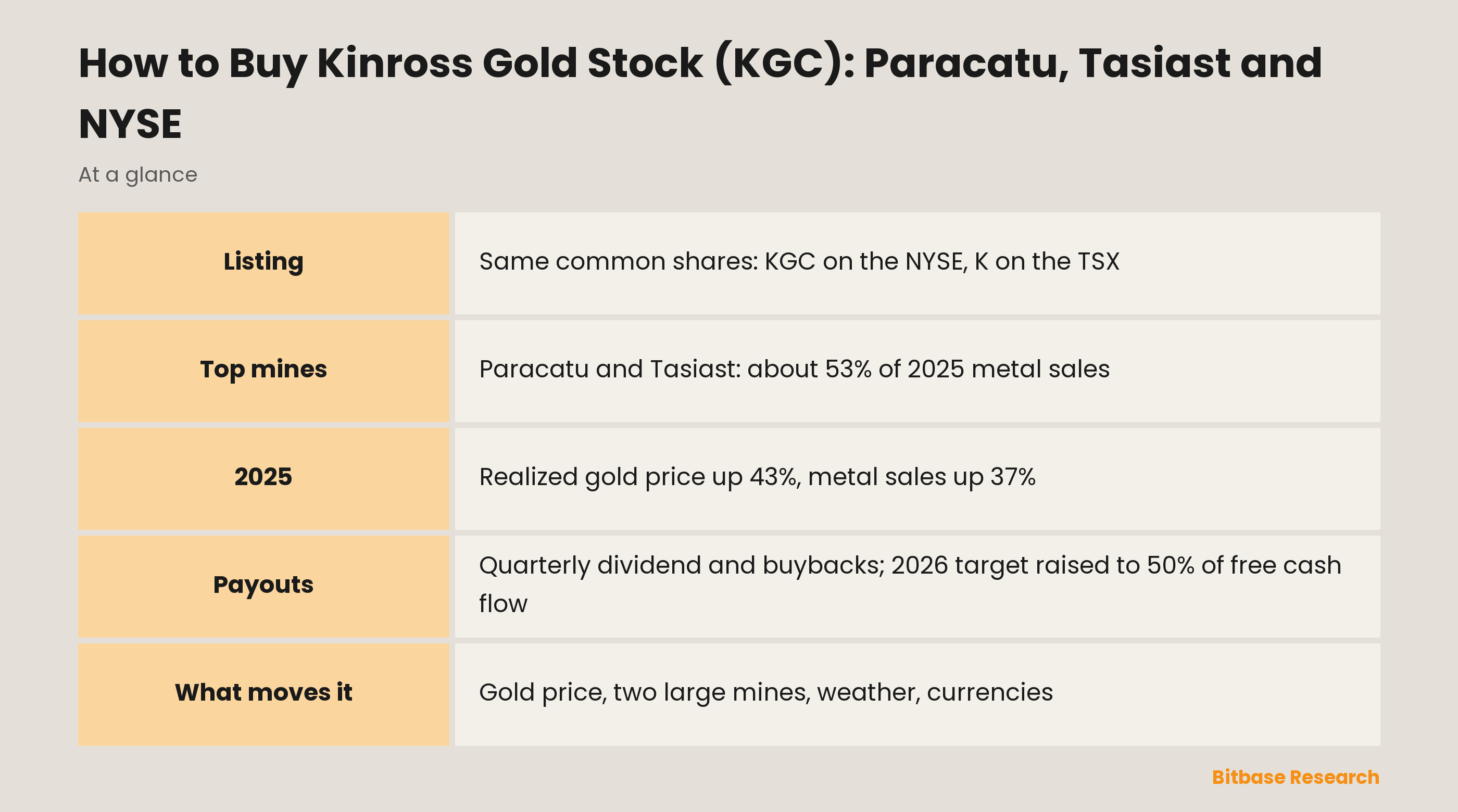
Owning a piece of Kinross Gold takes a brokerage account that can reach the New York Stock Exchange, where its common shares trade as KGC, or the Toronto Stock Exchange, where the same shares trade as K. Two mines on two continents, Paracatu in Brazil and Tasiast in Mauritania, brought in about 53% of its 2025 metal sales, and a 43% rise in the realized gold price lifted those sales by 37% even though fewer ounces were sold. Below: the mines, the order steps, the payout policy and the risks its filings name.
What Does Kinross Gold Do?
Kinross Gold Corporation finds, builds and operates gold mines, then sells the metal. Its annual information form (AIF) says it "is engaged in gold mining and related activities," from exploration and acquisition to processing ore and reclaiming old sites. The mines pour doré, a semi-refined bar, which third-party refineries in Canada, Switzerland and the United States turn into good-delivery gold and silver bars for the open market. Silver is a by-product: about 98% of the gold-equivalent ounces sold in 2025 were gold.
The company was assembled by amalgamation. It was created in May 1993 from CMP Resources, Plexus Resources and a numbered Ontario company, and later absorbed TVX Gold, Echo Bay Mines and, in January 2025, its subsidiary EastWest Gold. It is governed by Ontario's Business Corporations Act, keeps its registered office at 25 York Street in Toronto, and had about 7,100 employees at the end of 2025.
Its operating map spans four countries. In Brazil, Paracatu in Minas Gerais is an open pit with two process plants, and since 2018 two hydroelectric plants in neighbouring Goiás have supplied a large part of its power. In Mauritania, Tasiast came with the purchase of Red Back Mining in September 2010, and an expansion commissioned in June 2023 raised its mill to roughly 24,000 tonnes a day. In the United States there are Fort Knox near Fairbanks, Alaska, Manh Choh near Tok, 70% owned since 2020 with Contango ORE holding the rest, and Round Mountain and Bald Mountain in Nevada, wholly owned since Kinross bought out Barrick in January 2016. In Chile, La Coipa produces, while Maricunga has been shut since 2016.
The pipeline adds two more names. Great Bear, in Ontario's Red Lake district, was acquired on 24 February 2022, and a preliminary economic assessment in September 2024 outlined a combined open pit and underground mine with an initial life of about 12 years. Curlew, in Washington state, is a high-grade underground deposit about 40 kilometres from the company's idle Kettle River mill. The portfolio has also shrunk where risk rose: Kinross divested its Russian operations in June 2022 and sold its 90% stake in Ghana's Chirano mine that August.
How Kinross Gold Makes Money
Kinross sells refined metal and doré, generally in the period it is produced, at prices based on prevailing spot gold and silver prices. Revenue follows ounces delivered and the price per ounce, and in 2025 price won. Gold-equivalent production fell 5% and ounces sold fell 4%, but the average realized gold price rose 43% and metal sales rose 37%.
Each mine is its own reporting segment, and the segment note in the audited statements shows how unevenly revenue is spread:
| Segment | Country | Share of 2025 metal sales | 2025 output against 2024 |
|---|---|---|---|
| Paracatu | Brazil | 29% | up 14% |
| Tasiast | Mauritania | 24% | down 19% |
| Fort Knox, including Manh Choh | United States (Alaska) | 20% | up 9% |
| La Coipa | Chile | 12% | down 6% |
| Bald Mountain | United States (Nevada) | 9% | down 1% |
| Round Mountain | United States (Nevada) | 7% | down 33% |
Shares are rounded from the segment note; output is gold-equivalent ounces produced, as listed in the AIF.
Paracatu overtook Tasiast as the largest earner in 2025. By the location of the mining assets, the United States produced about 35% of metal sales, Brazil 29%, Mauritania 24% and Chile 12%.
Buyers are concentrated too: six customers each took more than 10% of 2025 metal sales, about 73% together.
Some costs rise with gold, too. At Tasiast, Mauritania collects a 3% royalty under the mine's Mining Convention plus a sliding-scale royalty that steps up as gold rises, and a Franco-Nevada subsidiary holds a further 2% royalty on life-of-mine gold. Paracatu pays royalties too.
KGC Stock at a Glance
| Item | Detail |
|---|---|
| Exchanges | New York Stock Exchange as KGC; Toronto Stock Exchange as K |
| Security | Common shares without par value, one vote each; the class registered on the NYSE |
| On the NYSE since | 3 February 2003 |
| Industry | SEC code 1041 (gold and silver ores) |
| Incorporated | Ontario, Canada |
| Head office | Toronto, Ontario |
| Fiscal year | Ends 31 December |
| Reporting | IFRS, in US dollars; Form 40-F each year, Form 6-K in between |
| S&P 500 | Not a member (SPY holdings file, 10 November 2026) |
| Dividend policy | Quarterly cash dividend at the board's discretion |
| Auditor | KPMG LLP, Toronto |
| SEC identifier | CIK 701818 |
For live quotes, see the Kinross Gold stock page on Bitbase.
How to Buy Kinross Gold Stock
Kinross is a Canadian company, but there is no depositary receipt in the chain: the AIF says the common shares themselves trade on the TSX as K and on the NYSE as KGC. What you pick is a venue and a currency, not a security.
1. Decide where to buy. A broker with NYSE access sells KGC in US dollars; one with TSX access sells K in Canadian dollars. Check who regulates the firm holding your account.
2. Open the account and confirm your tax residence. That declaration later decides how much is withheld from each dividend.
3. Fund the account. Starting from a third currency, compare the conversion spread with the commission.
4. Search the ticker and check the name. KGC should come up as Kinross Gold Corp common shares on the NYSE. Over-the-counter lines with similar names are not the listed shares.
5. Choose the order type. A market order takes the best available price now; a limit order caps what you pay and may never execute.
6. Set the size. Fractional shares depend on the broker, and fractions may lack voting rights.
7. File the confirmations. They record your cost basis in the currency you paid.
Dividends for holders abroad. Kinross declares its dividend in US dollars. Its October 2026 dividend release says the payment is an "eligible dividend" for Canadian income tax purposes, "while dividends paid to shareholders outside Canada (non-resident investors) will be subject to Canadian non-resident withholding taxes." The rate depends on any tax treaty between Canada and your country, so ask the broker what it will withhold and what form it needs; your home country may tax the dividend again.
Through funds. Kinross is not in the S&P 500, so funds tracking that index do not hold it; a fund that does own it names it in its published holdings file.
What Moves KGC Stock
The gold price, passed through. Sales are priced off spot, and the audited statements say the company may use derivatives to manage short-term metal price risk but had no such contracts outstanding at the end of 2025 or 2024. The AIF is blunt that the price of the shares "is likely to be significantly affected by changes in the gold price." The 2025 figures show the leverage: a 43% higher realized price on fewer ounces produced a 37% sales gain.
Two mines carrying the portfolio. Paracatu and Tasiast supplied about 53% of 2025 metal sales, and the third-quarter 2026 release says they accounted for more than half of that quarter's production while remaining the two lowest-cost operations. When either has a weaker year, as Tasiast did in 2025 with output down 19%, group results feel it.
Weather and the smaller sites. On 23 September 2026 Kinross said it now expected 2026 and 2027 production 2% to 3% below the low end of its earlier guidance, a cut concentrated at La Coipa and Round Mountain and blamed on extreme weather and operational challenges. At La Coipa, winter storms disrupted mining and milling, and some ore carried more copper and recovered less gold than planned. By late October it reported La Coipa had stabilised and Round Mountain was moving that way.
Currencies. Metal is sold in US dollars while costs run in Canadian dollars, Brazilian reais, Chilean pesos and Mauritanian ouguiyas as well. The 2025 MD&A expects about 66% of 2026 production to come from outside the United States, and the company hedges some currency exposure.
Cash returned to shareholders. In September 2026 Kinross raised its 2026 target for returning capital from 40% to 50% of free cash flow, and by 28 October it said buybacks since April 2025 had retired about 5% of its shares. In August 2026 S&P Global Ratings upgraded its credit rating to BBB from BBB-.
The next mines. On 15 January 2026 Kinross said it was proceeding with construction of Round Mountain Phase X, Bald Mountain Redbird 2 and Curlew, and first gold has since been poured at Redbird. At Great Bear, underground development for advanced exploration is under way. Former Great Bear shareholders also hold contingent value rights that convert into Kinross shares if commercial production is announced and a stated reserve and resource threshold is met, so success there would add new shares.
When Gold, Governments or Weather Turn Against Kinross
The AIF lists many risk factors; for a KGC shareholder, these matter most:
Metal prices. "The financial and operational performance of Kinross is dependent on gold and silver prices." Prices "fluctuate on a daily basis," and with no metal hedges at the end of 2025 a falling gold price would reach revenue quickly.
Governments and taxes. "Kinross' operations may be adversely affected by changing political, legal and economic conditions," and the company warns that "there can be no assurance that current government royalty and mining tax rates will remain static in future periods."
Growth that has to work. "Kinross is dependent on future growth from development projects," and Great Bear, Curlew and the Nevada expansions are where that risk sits now.
Estimates. "There are numerous uncertainties inherent in estimating quantities of mineral reserves and mineral resources," which are prepared under Canada's NI 43-101 standard.
Environmental enforcement. Maricunga shows the downside. Chile's environmental regulator opened proceedings in 2015 over groundwater pumping near wetlands, sanctions in 2016 effectively required the mine to cease operations, and the courts upheld them.
Weather. The company's activities "may be subject to prolonged disruptions due to weather conditions," a warning La Coipa made concrete in 2026.
Refining. All doré goes to outside refiners, and "the loss of any one refiner could have a material adverse effect on the Company if alternative refineries are unavailable."
Two risks belong to every shareholder. A single stock binds your money to one issuer's mines, permits and decisions. And the dividend is discretionary: "Kinross is under no obligation to declare or pay dividends on its common shares," and its credit facilities may require lender consent before a dividend is declared.
How to Research KGC Yourself
Kinross files with the SEC under CIK 701818 as a Canadian issuer under the multi-jurisdictional disclosure system, which lets it prepare its annual report on Form 40-F under Canadian disclosure rules. Each 40-F packages the AIF, the year's MD&A and the audited IFRS statements; quarterly results, dividend declarations and operating updates arrive as Form 6-K.
The AIF covers each mine, its ownership and royalties, the dividend history and the risk factors; the audited statements hold metal sales by mine, country and large customer; the MD&A explains production, costs and currency effects. The NI 43-101 technical reports behind reserve figures are posted on kinross.com and on Canada's SEDAR+.
Two reading habits avoid errors. Many figures appear twice, in total and "attributable," which counts only 70% of Manh Choh, so compare like with like. And per-ounce costs such as all-in sustaining cost are non-GAAP measures defined in the MD&A. To compare Kinross with peers, see our guides to buying Newmont stock and buying Agnico Eagle stock, or browse all stock pages on Bitbase.
Kinross Gold Stock FAQ
Can I buy Kinross Gold stock with crypto?
Not directly. KGC is bought through a broker in US dollars, or K in Canadian dollars, so you would sell crypto for cash, move the cash to the broker and then buy; the sale is often taxable. They are separate assets: a Kinross share is a claim on a company with mines, votes and declared dividends, which is where a share differs from a crypto asset.
Does Kinross Gold pay a dividend?
Yes, every quarter. The quarterly amount was unchanged through 2023 and 2024, was raised for the December 2025 payment and raised again when the board declared the dividend in February 2026. Payments are set in US dollars by the board, and non-residents of Canada face Canadian withholding tax.
Are KGC in New York and K in Toronto the same shares?
Yes. They are one class of common shares listed on two exchanges, not a share and a depositary receipt. The quotes differ mainly because one is in US dollars and the other in Canadian dollars.
Is Kinross Gold in the S&P 500?
No. State Street's daily holdings file for its S&P 500 trust, SPY, left Kinross out on 10 November 2026.
Does Kinross hedge its gold?
Not at the end of 2025. The company sells at prevailing spot prices and, while it may enter derivative contracts to manage short-term metal price risk, none were outstanding at the end of 2025 or 2024. It does use currency and oil hedges for some costs.
What is the Great Bear project?
A gold project in Ontario's Red Lake district, acquired with Great Bear Resources in February 2022 and still in development. Contingent value rights held by Great Bear's former shareholders pay out in Kinross shares only if commercial production and a reserve threshold are reached.
Conclusion
A Kinross share is exposure to the gold price filtered through a handful of mines: Paracatu and Tasiast for more than half of sales, a group of US sites with expansions under way, and Great Bear as the largest unknown. Its 2025 results show the gold price outrunning production, and its 2026 guidance cut shows what one hard winter at a mid-sized mine can do. Before buying, work through the newest annual filing and quarterly report, segment note and risk factors first, and settle how much one gold producer should weigh in your portfolio.
Related reading
Other Bitbase articles on this topic:
- How to Buy AngloGold Ashanti Stock (AU): A UK Gold Miner on NYSE
- How to Buy ArcelorMittal Stock (MT): Real Shares, Not an ADR
- How to Buy Cameco Stock (CCJ): Uranium, Westinghouse, Vote Caps
- How to Buy Tenaris Stock (TS): Steel Pipes, ADSs and Tariffs
Disclaimer: This article is educational content from Bitbase Academy, provided for information only. It explains what a company or fund does and how the instruments referenced here differ from one another; it does not constitute investment, trading, tax, or financial advice, and it is neither a recommendation nor an endorsement of any security, token, or trading strategy. A tokenized stock is issued by a third party and is designed to give economic exposure to an underlying asset: it is not a share, it carries no shareholder rights, and it depends on the issuer's structure, eligibility rules, and redemption terms, which the issuer can change. Perpetual futures are leveraged derivatives that hold no underlying asset and can be liquidated, and trading hours, product availability, and eligibility differ by instrument and by jurisdiction and can change at any time. Written as of November 2026; verify everything yourself through company filings, the issuer's own documentation, and the product pages of the venue you trade on.
References
[1] Kinross Gold Form 40-F for 2025 (SEC EDGAR) www.sec.gov
[2] Kinross Gold Annual Information Form for 2025 www.sec.gov
[3] Kinross Gold MD&A for 2025 www.sec.gov
[4] Kinross Gold audited financial statements for 2025 www.sec.gov
[5] Kinross Gold third-quarter 2026 results (Form 6-K) www.sec.gov
[6] Kinross Gold operational update, September 2026 (Form 6-K) www.sec.gov
[7] Kinross Gold dividend declaration, October 2026 (Form 6-K) www.sec.gov
[8] Kinross Gold on its S&P rating upgrade, August 2026 (Form 6-K) www.sec.gov
[9] State Street SPY daily holdings, 10 November 2026 www.ssga.com





