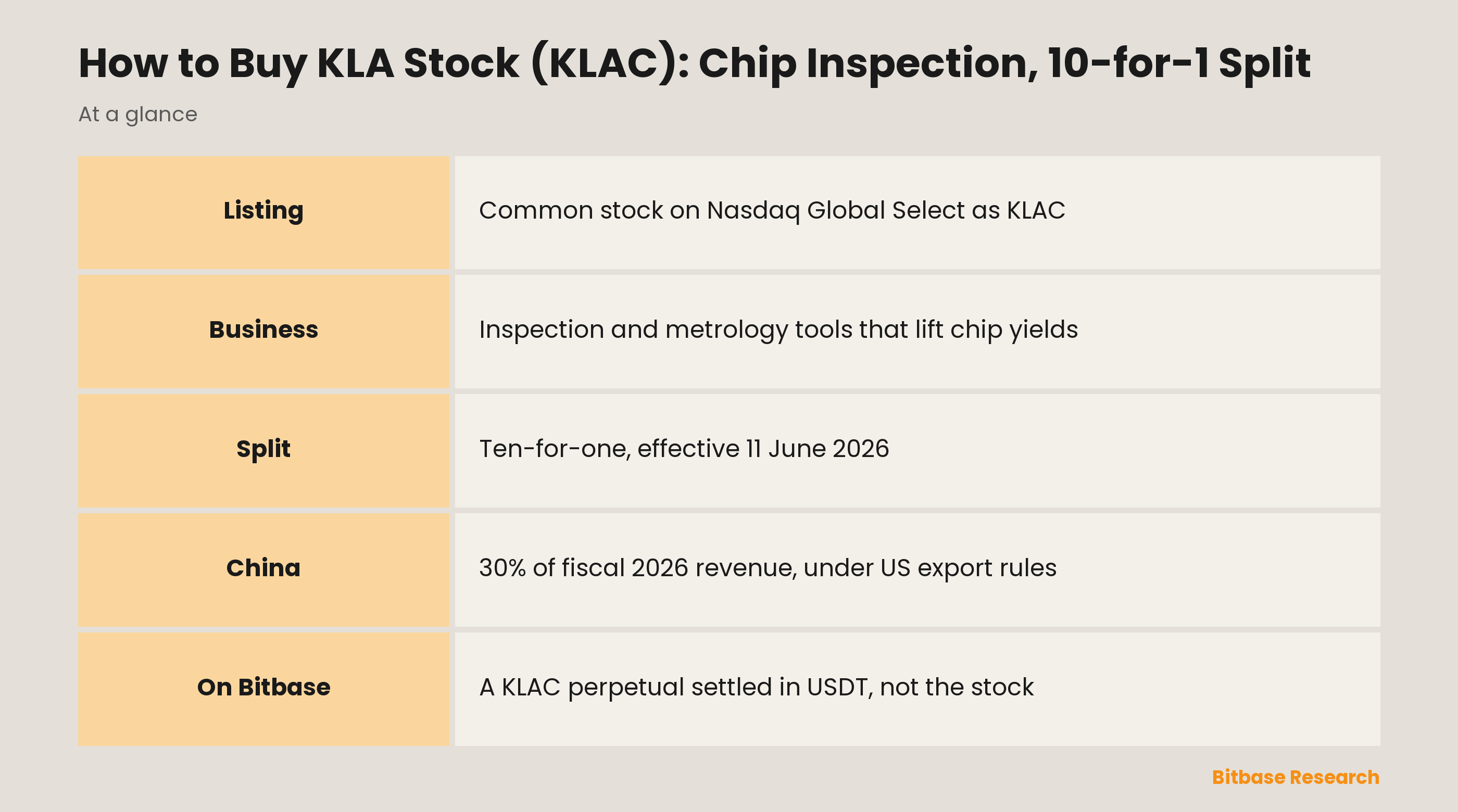
Owning KLA stock starts with an ordinary brokerage account with access to US shares: the common stock trades on the Nasdaq Global Select Market as KLAC, and a ten-for-one split took effect in June 2026. The company mostly checks chips rather than builds them: its inspection and metrology systems find defects and measure features so that fabs lose fewer wafers, and in fiscal 2026 Taiwan Semiconductor Manufacturing Company was its only customer above 10% of revenue. On Bitbase the exposure is a KLAC perpetual settled in USDT, which follows the price and contains no share.
What Does KLA Do?
A chip is built one layer at a time, and the 10-K notes that "the most advanced chip designs repeat these steps hundreds of times before the wafer is cut into individual chips, packaged and tested." Each pass can leave a particle or a misaligned layer. KLA sells the equipment and software that catch such problems early, a field known as process control, so that a fab raises its yield: the share of chips on each wafer that work.
Two families of tools do most of it. Inspection and review systems "identify, locate, characterize, review, and analyze defects" on patterned and bare wafers. Metrology systems measure pattern dimensions, film thickness, layer-to-layer alignment and surface topography. Similar systems check reticles, the masks used in lithography, including EUV ones, and software such as Klarity pulls the readings together to flag a drifting process.
The 10-K groups this into three reportable segments. Semiconductor Process Control is the inspection, metrology and software business. Specialty Semiconductor Process is the exception to the checking-not-making pattern: under the SPTS name it sells vacuum deposition and etch tools to makers of MEMS devices, radio-frequency chips and power semiconductors for cars and industry. PCB and Component Inspection inspects and patterns circuit boards, IC substrates and packaged chips, partly under the Orbotech name.
KLA-Tencor was formed in April 1997 by the merger of KLA Instruments and Tencor Instruments and became KLA Corporation in July 2019. It is incorporated in Delaware, based in Milpitas, California, and sells mostly through its own sales force. The 10-K names Applied Materials, ASML, Hitachi High-Tech, Lasertec and Onto Innovation among its competitors; our map of the semiconductor equipment supply chain shows where each sits.
How KLA Makes Money
Revenue grew 12% in fiscal 2026, which ended on 30 June 2026, mainly on "increased leading-edge customer investments in foundry/logic, memory and advanced packaging technologies, supported by strong demand associated with AI and HPC applications."
Semiconductor Process Control produced about 90% of fiscal 2026 segment revenue, PCB and Component Inspection about 6% and Specialty Semiconductor Process about 4%. By product category, wafer inspection systems alone brought in 49% of revenue and a category labelled Patterning 20%. PCB and Component Inspection grew fastest, up 21% mainly on advanced packaging, while Specialty Semiconductor Process slipped 1% on lower customer investment and reduced product sales in China. Gross margin was about 61%. Service on installed tools, a second stream, made up about 23% of revenue and rose 16% as the installed base grew.
By ship-to location, about 87% of fiscal 2026 revenue came from outside the United States, against 89% in each of the two prior years. China was the largest region at 30%, down from 33% in fiscal 2025 and 43% in fiscal 2024, with Taiwan at about 27%. KLA says China revenue held level in fiscal 2026 as "continued investments in legacy-node technologies by domestic semiconductor companies were largely offset by export control restrictions affecting certain advanced technology transactions."
The customer list is short at the top. TSMC is the only customer the 10-K lists above the 10% line in each of fiscal 2024, 2025 and 2026, and the segment note puts one customer at approximately 19% of revenue in both fiscal 2026 and fiscal 2025, up from about 13% in fiscal 2024.
KLAC Stock at a Glance
| Item | Detail |
|---|---|
| Exchange | Nasdaq Global Select Market |
| Ticker | KLAC |
| Share class | Common stock, the single class registered on the 10-K cover |
| Industry | Semiconductor process control and yield management equipment |
| Index membership | S&P 500 and Nasdaq-100, based on SPY and QQQ holdings on 16 October 2026 |
| Headquarters | Milpitas, California |
| Incorporated | Delaware |
| Formed | April 1997, as KLA-Tencor; renamed KLA Corporation in July 2019 |
| Fiscal year end | 30 June |
| Dividend policy | Quarterly cash dividend, first paid in June 2005; each one declared by the board |
| Share buybacks | Programme with no expiration date, which can be suspended at any time |
| Last stock split | Ten-for-one, effective 11 June 2026 |
The price moves all day, so it is left to the KLA stock page on Bitbase, with the live quote and chart.
How to Buy KLA Stock
The usual route is a broker:
1. Find a broker with US equities that accepts clients from your country.
2. Pass the identity checks. Non-US clients may need to complete Form W-8BEN.
3. Move money in. Non-dollar funds are converted, and the spread is a cost.
4. Look up KLAC and set the order. A market order takes whatever the market offers; a limit order only executes at your price or better.
5. Pick the quantity. Since the split each share is a tenth of a pre-split one, and fractional shares, where offered, go below one.
Outside the United States, nothing about the security changes: KLAC is ordinary common stock with no ADR layer. Tax is the difference. Under IRS rules most US-source income received by a foreign person is subject to US tax of 30%, which a treaty may reduce, and Form W-8BEN certifies foreign status to the payer whether or not a lower rate is claimed. This is not tax advice.
Through an index fund, you own KLA indirectly: funds tracking the S&P 500 or the Nasdaq-100 hold it as a small, shifting slice.
Trading KLAC on Bitbase
Bitbase lists a KLAC perpetual futures contract, margined and settled in USDT. It tracks KLA's share price but holds nothing underneath, so a position carries no share, no dividend and no vote. In exchange you can go long or short (selling the contract opens a short), use leverage, and keep trading while Nasdaq is shut.
Funding passes between longs and shorts at intervals, the more crowded side paying, which anchors the contract to the share price, and a position whose margin runs out is liquidated at the mark price instead of the latest fill. The contract trades through nights and weekends while the stock does not, so KLAC may open on Nasdaq well away from the contract's last price. Our guide to margin and liquidation risk on stock perpetuals shows how that gap catches leveraged positions.
How often funding settles, the margin tiers, the leverage cap and the mark price used outside US hours all sit in Bitbase's contract rules; read them before opening a position. The wider list of stock-linked products is on Bitbase's TradFi page.
What Moves KLAC Stock
How hard the leading edge pushes. KLA ties demand to complexity: nodes such as 2-nanometer are "increasing process complexity and process control intensity, which in turn is driving incremental demand for our solutions," and EUV in logic and DRAM adds new process control requirements. The pace of moves to new nodes feeds its orders.
One Taiwanese foundry. With TSMC the only buyer above 10% for three years running, a change in one foundry's capital budget reaches KLA's results quickly.
Washington's China rules. US export restrictions have tightened in rounds since October 2022, and the 10-K warns that China's share of revenue may decline further under current and future Commerce rules. It also reports that "some of our products destined for China have been held up by U.S. Customs and Border Protection," with no assurance they will clear in time or without a licence.
Advanced packaging. KLA credits the "increasing complexity and value of semiconductor packages, particularly for AI and HPC applications" for significant growth in its packaging business.
The installed base. Service revenue is typically a function of how many systems are installed and how heavily they run, so it follows fab utilisation rather than new orders.
The Main Risks
Licences that may not come. KLA applies for export licences when required, but "there can be no assurance that export licenses applied for by either us or our customers, now or in the future, will be granted." Failing to get them has harmed its backlog and can force it to return deposits from customers in China, and the rules can help China-based rivals gain share.
A few large buyers. The 10-K says "orders from a relatively limited number of manufacturers have accounted for, and are expected to continue to account for, a substantial portion of our sales," and orders can generally be cancelled or delayed with little or no penalty. A fab also tends to keep the process control equipment it first chose for a production line, which protects KLA where it is installed and makes lines won by a rival harder to take.
The spending cycle. The industry has historically been cyclical, and while AI adoption is likely to keep growing, "the sustainability of such elevated investments cannot be assured."
Parts and materials. A shortage of certain DRAM chips used in KLA's products has raised their cost, which KLA expects to weigh on fiscal 2027 gross margin, and China has tightened export controls on rare earth elements that some components need.
The stock itself. Shares can fall with the cycle, and KLA gives no assurance of future dividends in any amount.
The perpetual's extra layer. Borrowed exposure multiplies losses, every funding interval adds a cost or a credit, and an opening gap on Nasdaq can jump straight through a liquidation price.
How to Research KLAC Yourself
KLA files with the SEC under CIK 319201. In the 10-K, Item 1 describes the product lines and names competitors, Item 1A sets out the export and customer risks, and Note 17 the segment, region and customer figures. 8-Ks carry quarterly results and events such as the May 2026 split announcement, and ir.kla.com posts earnings materials and a split FAQ. The 10-K's performance graph compares KLA's shareholder return with the S&P 500 and the PHLX Semiconductor Index, the company's own yardstick.
KLA Stock FAQ
Does KLA pay a dividend?
Yes, quarterly. KLA-Tencor announced its first quarterly cash dividend in February 2005 and paid it on 1 June 2005. The board declares each one and intends to keep paying quarterly, subject to capital availability; the current amount is in each dividend announcement on ir.kla.com.
Did KLA stock split?
Yes. Holders of record at the close on 4 June 2026 received nine additional shares for each share after the close on 11 June, and KLAC traded on a split-adjusted basis from the open on 12 June 2026. The chief financial officer said it was meant "to improve the accessibility and liquidity of KLA shares." Value and ownership percentages were unchanged, but per-share figures in older documents need dividing by ten.
Is KLA the same company as KLA-Tencor?
Yes. KLA-Tencor was the name from the 1997 merger until 15 July 2019, when the company amended its certificate of incorporation to become KLA Corporation. The ticker predates the new name: a 2005 KLA-Tencor press release already lists NASDAQ: KLAC.
Is KLA in the S&P 500?
Yes. On 16 October 2026, both SPY, an S&P 500 tracker, and QQQ, a Nasdaq-100 tracker, listed KLAC among their holdings. Index membership is reviewed from time to time, so the date matters.
Can I buy KLA stock with crypto?
Only after converting it: a broker sells KLAC for ordinary currency, so crypto has to be sold into money first. Without selling, the nearest thing on Bitbase is the KLAC perpetual, traded with USDT, which mirrors KLA's price but, as a derivative, pays no dividend, gives no vote and can be liquidated. Our article on buying stocks with crypto compares the routes.
Conclusion
Buying KLA stock takes a broker order for KLAC. What deserves the time is the business: a process-control specialist whose demand rises with leading-edge complexity, whose largest customer is TSMC, and whose China sales sit under US export rules. A Bitbase perpetual trades KLA's price with funding and liquidation risk attached, and owns no part of the company.
Related reading
Other Bitbase articles on this topic:
- How to Buy Analog Devices Stock (ADI): Industry, Dividend, China
- How to Buy Applied Materials Stock (AMAT): China Risk and Perps
- How to Buy ASE Technology Stock (ASX): NYSE ADSs and Taipei 3711
Disclaimer: This article is educational content from Bitbase Academy, provided for information only. It explains what a company or fund does and how the instruments referenced here differ from one another; it does not constitute investment, trading, tax, or financial advice, and it is neither a recommendation nor an endorsement of any security, token, or trading strategy. A tokenized stock is issued by a third party and is designed to give economic exposure to an underlying asset: it is not a share, it carries no shareholder rights, and it depends on the issuer's structure, eligibility rules, and redemption terms, which the issuer can change. Perpetual futures are leveraged derivatives that hold no underlying asset and can be liquidated, and trading hours, product availability, and eligibility differ by instrument and by jurisdiction and can change at any time. Written as of October 2026; verify everything yourself through company filings, the issuer's own documentation, and the product pages of the venue you trade on.
References
[1] KLA fiscal 2026 Form 10-K (SEC EDGAR) www.sec.gov
[2] KLA press release, May 2026: ten-for-one stock split (SEC EDGAR) www.sec.gov
[3] KLA-Tencor press release, February 2005: first quarterly cash dividend (SEC EDGAR) www.sec.gov
[4] KLA Form 8-K, July 2019: name change from KLA-Tencor (SEC EDGAR) www.sec.gov
[5] State Street: SPY daily holdings, 16 October 2026 www.ssga.com
[6] Invesco QQQ: fund overview and holdings (tracks the Nasdaq-100) www.invesco.com
[7] IRS: NRA withholding www.irs.gov
[8] IRS: About Form W-8 BEN www.irs.gov





