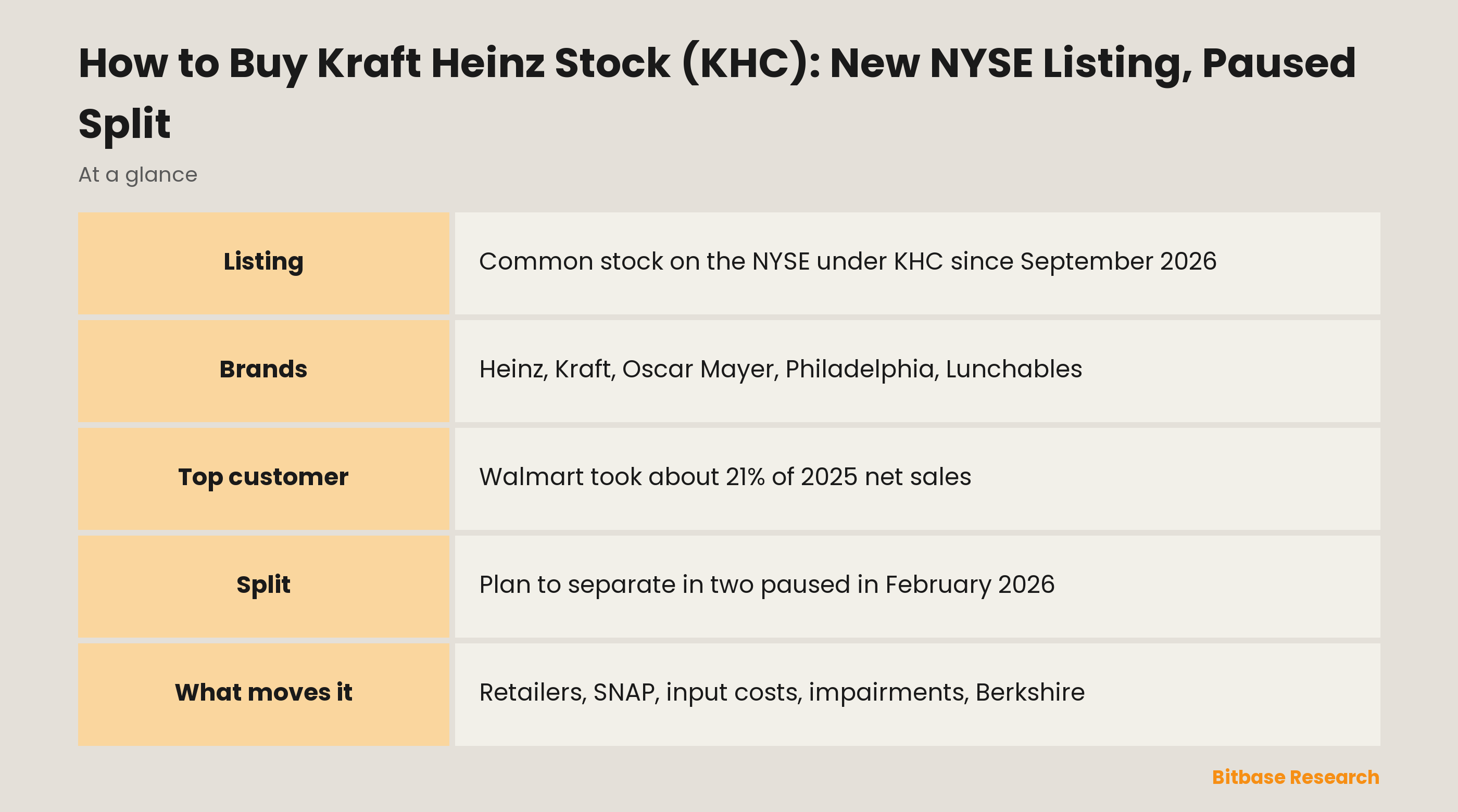
From a standard brokerage account you can buy Kraft Heinz stock: since 14 September 2026 the common shares have traded on the New York Stock Exchange under KHC, after the company moved its listing from Nasdaq. The maker of Heinz ketchup, Philadelphia cream cheese and Oscar Mayer meats gets about 21% of its net sales from one customer, Walmart, and its board has paused a plan to split the company in two. Below: the brands, the order steps and the pressures named in its filings.
What Does Kraft Heinz Do?
Kraft Heinz makes packaged food and drinks for supermarkets, discounters, convenience stores and restaurants. The company in its current form dates from 2 July 2015, when Kraft Foods Group merged into a subsidiary of H.J. Heinz Holding Corporation, which was then renamed The Kraft Heinz Company. It is incorporated in Delaware, with co-headquarters in Pittsburgh and Chicago, and since January 2026 its CEO has been Steve Cahillane, previously chief executive of Kellanova.
In North America, the 10-K names Kraft, Oscar Mayer, Heinz, Philadelphia, Lunchables, Velveeta, Ore-Ida, Capri Sun, Maxwell House, Kool-Aid and Jell-O as its most significant trademarks by 2025 net sales. Elsewhere Heinz leads again, next to Golden Circle and Wattie's in developed markets and Master, ABC, Quero and Pudliszki in emerging ones. Not every name is fully its own: Capri Sun is licensed from a third party, and Lactalis holds perpetual licences to the Kraft and Velveeta names for certain cheese products.
Internally the products fall into eight platforms. Taste Elevation (condiments, sauces, dressings and spreads) was 45% of 2025 net sales, Easy Ready Meals such as Kraft Mac & Cheese 17%, and Hydration and Meats 8% each. At the end of 2025 the company ran 69 plants, 65 of them owned.
How Kraft Heinz Makes Money
The 2025 10-K splits results into three groups of markets, and North America dominates both sales and profit:
| Market group | Share of 2025 net sales | Share of 2025 segment adjusted operating income | Example brands |
|---|---|---|---|
| North America | 75% | 83% | Kraft, Oscar Mayer, Lunchables, Velveeta |
| International Developed Markets | 14% | 10% | Heinz, Golden Circle, Wattie's |
| Emerging Markets | 11% | 6% | Heinz, Master, ABC, Quero |
Shares are calculated from the 10-K segment note; the profit measure leaves out impairments and separation costs.
Selling branded groceries through retailers gives the buyers leverage. Walmart accounted for about 21% of net sales in 2025, as in 2024 and 2023, and the five largest North American customers took about 46% of that segment's sales.
In 2025 net sales fell 3.5%, and 4.9% in North America, where volume and mix dropped 5.0 percentage points. Organic Net Sales, which strip out currency and divestitures, fell 3.4%. Non-cash impairments of goodwill and brand values turned the year into a net loss.
In the third quarter of 2026 net sales fell 2.0% and Organic Net Sales 1.1%; North America was down 3.4% while Emerging Markets grew 13.8%. That quarter the company also regrouped its markets into three reportable segments and restated earlier periods.
KHC Stock at a Glance
| Feature | KHC |
|---|---|
| Exchange | New York Stock Exchange, since 14 September 2026 (Nasdaq before that) |
| Ticker | KHC |
| Security | Common stock, the only share class registered; four series of senior notes stay listed on Nasdaq |
| Sector | Packaged food and beverages |
| Main brands | Heinz, Kraft, Oscar Mayer, Philadelphia, Lunchables, Velveeta |
| Index membership | S&P 500 |
| Headquarters | Pittsburgh, Pennsylvania and Chicago, Illinois |
| Incorporated | Delaware |
| Fiscal year | 52 or 53 weeks, ending on the last Saturday in December |
| Payouts | Quarterly cash dividend, set by the board |
| SEC identifier | CIK 1637459 |
Prices, market value and yield move all day; the Kraft Heinz stock page on Bitbase shows live figures.
How to Buy Kraft Heinz Stock
Kraft Heinz is a US company, so no depositary receipt is involved. A typical purchase:
1. Pick a broker with NYSE access. Abroad, check which legal entity holds your account and who regulates it.
2. Complete the tax form. Non-US individuals usually file IRS Form W-8BEN, which the IRS says should be submitted "when requested by the withholding agent or payer."
3. Fund the account. If you deposit euros or another currency, the conversion spread is part of your cost.
4. Search for KHC and confirm the line reads The Kraft Heinz Company common stock on the NYSE; older quote screens may still say Nasdaq.
5. Decide how to enter. FINRA describes a market order as the type that "provides the most certainty that your order will be executed," and a limit order as one to buy "at or better than a specified price," with the risk that it never fills.
6. Size the order. Not every broker sells fractional shares, and fractions may carry no voting rights; keep the trade confirmations for your cost basis.
Withholding abroad. The IRS says such US-source income of a nonresident is taxed at a flat 30%, "or lower treaty rate," and dividends may be taxed again at home.
Through a fund. KHC is in the S&P 500; State Street's SPY listed it in its holdings file of 9 November 2026, so an index fund gives you a small slice.
What Moves KHC Stock
Big retailers and store brands. With one retailer at about a fifth of sales, shelf space and price talks feed straight into results, and consolidation leaves "fewer but larger customers." Private label products, "generally sold at lower prices," have restricted the company's ability to raise prices.
SNAP benefits. US food assistance changes cut participants and average benefits, which the third-quarter 10-Q says "has, and may continue to have, a negative impact on consumers' demand for our products."
Input costs and tariffs. Dairy, meat, coffee, tomatoes and packaging all go into the products, and 2025 supply chain inflation came partly from tariff and trade actions.
Impairments. In the second quarter of 2026 the company cited "the sustained decline in our share price and market capitalization" as a trigger and wrote down brands including Kraft, Oscar Mayer and Lunchables. The charges were non-cash, but the first nine months of 2026 showed a reported loss.
The split that stopped. A plan to separate into two listed companies was announced on 2 September 2025 and paused on 11 February 2026, when Cahillane named "returning the business to profitable growth" as his priority and announced more spending on marketing, sales and R&D. Whether the split "will be completed is uncertain," says the 10-Q.
Berkshire Hathaway. Berkshire owned about 27.5% of the stock on 16 January 2026. Four days later Kraft Heinz registered shares held by Berkshire for possible resale, a step that "does not necessarily mean" Berkshire will sell.
Where Kraft Heinz Looks Vulnerable
These 10-K risks bear most directly on a shareholder:
Changing diets. Products must keep up with health trends and "changing consumption patterns, such as those potentially associated with weight-loss drugs."
Recipe changes. A pledge to remove FD&C colours from the US portfolio by the end of 2027 could hurt the brand image if missed.
Debt. The filing says its indebtedness and debt covenants "could adversely affect our business and financial condition," and a credit downgrade could raise its cost of funds.
More write-downs and a large holder. "Additional impairments" of goodwill and brands could hurt results, and Berkshire "has the ability to exert influence" over votes on directors and mergers.
The share adds its own risks: one stock means one company's fortunes, and the board "has previously decided, and may in the future decide," to change or stop the dividend, so "stockholders will not be able to rely on dividends."
How to Research KHC Yourself
Kraft Heinz files under CIK 1637459. Start with the 10-K for the year ended 27 December 2025: Item 1 covers brands and customers, Item 1A the risks, Note 9 the impairments and Note 21 the segments. The 10-Q filed on 4 November 2026 has the third quarter and the latest wording on the split.
Three 8-Ks explain recent changes: 26 August 2026 (the NYSE move), 7 October 2026 (past results restated under the new segments, needed whenever you compare 2026 with 2025) and 20 January 2026 (the Berkshire resale registration). For the largest holder's side, see our Berkshire Hathaway guide; for another packaged food maker, our Mondelez stock guide.
When checking quotes, ignore the KHC29 to KHC34 lines on Nasdaq: they are senior notes, not shares. The full list of US stock pages on Bitbase covers other companies.
Kraft Heinz Stock FAQ
Can I buy Kraft Heinz stock with crypto?
Not directly. KHC shares are bought in US dollars through a broker, so crypto has to be sold for cash first, possibly a taxable event. A share carries voting and dividend rights, which is how stocks differ from crypto assets.
Does Kraft Heinz pay a dividend?
Yes, in cash every quarter; the one declared in the fourth quarter of 2026 is payable on 23 December 2026. The board sets each amount and can change it.
Is KHC listed on the NYSE or Nasdaq?
The NYSE, since 14 September 2026, under the same ticker. Four series of its senior notes still trade on Nasdaq.
Is Kraft Heinz still splitting into two companies?
Not at present. The board paused the work on 11 February 2026; a restart would still need final board approval, favourable tax opinions and effective SEC filings.
Who is Kraft Heinz's largest shareholder?
The 10-K names Berkshire Hathaway, with about 27.5% on 16 January 2026. Stakes change, so check the latest proxy statement.
Conclusion
Kraft Heinz is a mature grocery business under a new chief executive, trying to win back US shoppers while one retailer, smaller SNAP benefits and repeated impairments weigh on results. The paused split and Berkshire's registered-for-resale stake leave open questions. Read the 10-K and latest 10-Q, watch North American volumes over several quarters, and decide how much one packaged food company should weigh in your portfolio.
Related reading
Other Bitbase articles on this topic:
- How to Buy Estee Lauder Stock (EL): Class A Shares, Family Control
- How to Buy FEMSA Stock (FMX): OXXO Stores and a 10-Unit ADS
- How to Buy Haleon Stock (HLN): Sensodyne, Advil and the GSK Split
Disclaimer: This article is educational content from Bitbase Academy, provided for information only. It explains what a company or fund does and how the instruments referenced here differ from one another; it does not constitute investment, trading, tax, or financial advice, and it is neither a recommendation nor an endorsement of any security, token, or trading strategy. A tokenized stock is issued by a third party and is designed to give economic exposure to an underlying asset: it is not a share, it carries no shareholder rights, and it depends on the issuer's structure, eligibility rules, and redemption terms, which the issuer can change. Perpetual futures are leveraged derivatives that hold no underlying asset and can be liquidated, and trading hours, product availability, and eligibility differ by instrument and by jurisdiction and can change at any time. Written as of November 2026; verify everything yourself through company filings, the issuer's own documentation, and the product pages of the venue you trade on.
References
[1] Kraft Heinz Form 10-K for fiscal 2025 (SEC EDGAR) www.sec.gov
[2] Kraft Heinz Form 10-Q for the third quarter of 2026 (SEC EDGAR) www.sec.gov
[3] Kraft Heinz Q3 2026 Form 10-Q, XBRL cover page (SEC EDGAR) www.sec.gov
[4] Kraft Heinz Form 8-K on the transfer of its listing to the NYSE, August 2026 (SEC EDGAR) www.sec.gov
[5] Kraft Heinz fourth-quarter and full-year 2025 results release, 11 February 2026 (SEC EDGAR) www.sec.gov
[6] Kraft Heinz third-quarter 2026 results release, 4 November 2026 (SEC EDGAR) www.sec.gov
[7] Kraft Heinz Form 8-K on the Berkshire Hathaway resale registration, January 2026 (SEC EDGAR) www.sec.gov
[8] Kraft Heinz Form 8-K on the change in reportable segments, October 2026 (SEC EDGAR) www.sec.gov
[9] State Street: SPY daily holdings www.ssga.com
[10] IRS: About Form W-8 BEN www.irs.gov
[11] IRS: Nonresident aliens www.irs.gov
[12] FINRA: Order types www.finra.org





