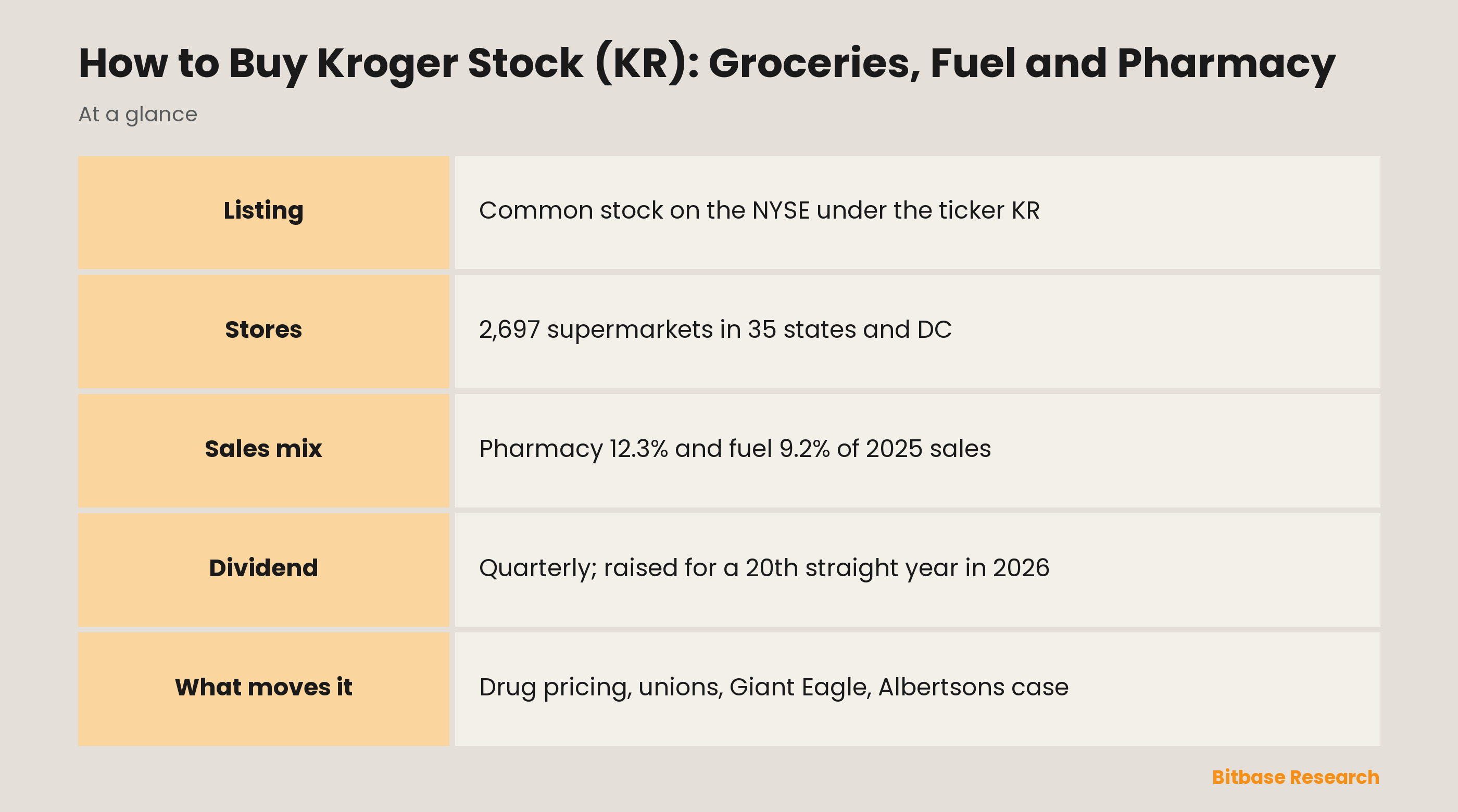
A Kroger share can be bought through any broker that offers US equities, since the company's common shares are listed on the New York Stock Exchange under the ticker KR. Kroger ran 2,697 supermarkets at the end of fiscal 2025, yet groceries were only part of the till: pharmacy counters brought in 12.3% of that year's sales and fuel pumps 9.2%. Below: what the company sells, how a purchase works, and the forces its filings point to, from drug pricing and union contracts to a pending Giant Eagle deal and a court fight left over from the failed Albertsons merger.
What Does Kroger Do?
The Kroger Co., based in Cincinnati, was founded in 1883 and incorporated in Ohio in 1902. Its annual report says the company "is built on the foundation of our retail grocery business, which includes the added convenience of our retail pharmacies and fuel centers."
At 31 January 2026 it operated 2,697 supermarkets in 35 states and the District of Columbia, under a variety of local banner names. Of those stores, 2,250 had a pharmacy and 1,731 had a fuel center. The company's stated aim is to add a fuel center at every supermarket "when it is feasible and it is expected to be profitable."
Online, Pickup (Harris Teeter ExpressLane at that banner) is offered at 2,408 supermarkets, and Delivery reaches substantially all customers from stores, fulfillment centers or third-party platforms.
The loyalty program is the engine behind a second line of business. Kroger says it serves about 63 million households a year and that over 95% of customer transactions are tied to a Kroger loyalty card. That data feeds Kroger Precision Marketing, a retail media unit that sells targeted advertising to consumer-goods brands, and the company's data analytics subsidiary. The 10-K groups these under "alternative profit" and calls them "fast-growing, high operating margin."
Private label is the third pillar. An average Kroger supermarket stocks over 13,000 private label items: Private Selection as the premium line, the Kroger brand for most items, Smart Way as the value line and Simple Truth for natural and organic food. About 20% of those units come from the company's own 33 food production plants, most of them dairies and deli or bakery plants.
The workforce is large and mostly unionized. Kroger employed more than 403,000 people at the end of fiscal 2025, and more than two-thirds of them are covered by roughly 350 collective bargaining agreements. Greg Foran became chief executive in February 2026; he previously ran Walmart U.S. and then Air New Zealand.
How Kroger Makes Money
Kroger reports a single segment, retail operations, and all of its operations are in the United States. The money comes from the checkout: the company earns income, in its words, "by selling products at price levels that produce revenues in excess of the costs we incur." The 10-K splits sales by product type:
| Product type | What it covers | Share of 2025 sales | Share of 2024 sales |
|---|---|---|---|
| Non-perishable | Grocery, general merchandise, health and beauty, natural foods | 52.5% | 52.4% |
| Fresh | Produce, floral, meat, seafood, deli, bakery, prepared food | 25.2% | 24.7% |
| Pharmacy | Sales at in-store pharmacies | 12.3% | 10.6% |
| Supermarket fuel | Sales at supermarket fuel centers | 9.2% | 10.2% |
| Other | Third-party media, data analytics, specialty pharmacy, in-store clinics | 0.8% | 2.1% |
Total sales rose 0.4% in fiscal 2025, but the parts moved apart. Pharmacy sales grew about 16%. Fuel sales fell 9.3%, which the company traces mainly to a lower average pump price and partly to fewer gallons sold. The Other line shrank because Kroger sold its specialty pharmacy business to Elevance Health in October 2024.
Identical sales excluding fuel, which compare the same stores year on year, rose 2.9%, led by pharmacy, eCommerce and Fresh, and eCommerce sales grew 16%.
The table shows sales, not profit. The 10-K lists the operating profit of the high-margin alternative profit businesses as a separate highlight. Fiscal 2025 earnings also took impairment and related charges after Kroger closed three automated fulfillment centers in January 2026 (Pleasant Prairie, Wisconsin; Frederick, Maryland; Groveland, Florida) that "had not met operational or financial expectations."
KR Stock at a Glance
| Feature | KR |
|---|---|
| Exchange | New York Stock Exchange |
| Ticker | KR |
| Security | Common shares, the only class registered under Section 12(b) |
| Sector | Food retail: supermarkets, pharmacies and fuel centers |
| Index membership | S&P 500 |
| Headquarters | Cincinnati, Ohio |
| Incorporated | Ohio, 1902 |
| Fiscal year | Ends on the Saturday closest to 31 January |
| Payouts | Quarterly cash dividend |
| Stock splits | Two-for-one, trading split-adjusted from 14 July 2015 |
| SEC identifier | CIK 56873 |
The share price, market value and dividend yield shift during every session; check live numbers on the Kroger stock page on Bitbase.
How to Buy Kroger Stock
Kroger is an Ohio corporation whose own common shares trade on the NYSE, so there is no depositary receipt in between. The purchase looks like this:
1. Pick a broker that reaches the NYSE. Outside the United States, that can be a local broker with access to US shares or an international one. Check which legal entity holds your account and who regulates it.
2. Complete the account checks. Non-US individuals usually file IRS Form W-8BEN with the broker, which the IRS says to submit "when requested by the withholding agent or payer."
3. Fund the account. Converting from another currency adds an exchange-rate cost.
4. Find the right line. Search KR and make sure the result is The Kroger Co. common stock on the New York Stock Exchange.
5. Choose the order. FINRA describes a market order as the one that "provides the most certainty that your order will be executed," while a limit order fills only "at or better than a specified price."
6. Decide the amount. Some brokers sell fractional shares, but FINRA notes that availability varies and that "as a fractional share owner, you might not have shareholder voting rights."
7. Save the records. Confirmations and statements document cost and dividends for tax.
Tax for buyers abroad. According to the IRS, "most types of U.S. source income received by a foreign person are subject to U.S. tax of 30%," and a treaty can lower the rate or remove it. Your home country may tax the same dividend again.
Through a fund. KR is an S&P 500 member, so an S&P 500 index fund such as State Street's SPY holds it as one position in a broad basket.
What Moves KR Stock
Prescription pricing. Pharmacy was the fastest-growing product type in the 2025 sales table, which makes drug pricing rules matter. In the second quarter of fiscal 2026, identical sales excluding fuel rose just 0.2%, and the 10-Q put the drag from the Inflation Reduction Act at 138 basis points, with a shift from brand to generic prescriptions taking off another 61. On 11 September 2026 the company cut its full-year identical sales outlook while keeping its earnings guidance.
Food prices and fuel. Inflation feeds both sales and costs; in 2025 the LIFO inventory charge rose with product cost inflation, and the 10-Q lists egg deflation and a Cyclospora outbreak among the second quarter's drags.
eCommerce and retail media. Kroger says its eCommerce business, including third-party media revenue, was profitable in the second quarter and in the first half of fiscal 2026. The September earnings release reported adjusted eCommerce sales up 20% and Kroger Precision Marketing profit up 24% in the second quarter.
Deals and the Albertsons dispute. The Albertsons merger, agreed in October 2022, was blocked by a federal court in December 2024 after a Federal Trade Commission challenge. Albertsons then sued in the Delaware Court of Chancery for a termination fee and damages; Kroger denies the claims and has counterclaimed. The September 2026 10-Q said trial was scheduled to begin on 19 October 2026; later filings will show the outcome. Separately, on 1 July 2026 Kroger agreed to acquire Giant Eagle, a family-owned grocer with stores in Ohio, Pennsylvania, West Virginia, Maryland and Indiana; closing is expected in fiscal 2027, subject to antitrust review and limited store divestitures.
New targets. At an investor update on 20 October 2026, Kroger replaced its earlier total-shareholder-return target with an earnings-per-share growth target running to fiscal 2029.
Rivals, Unions and Lawsuits in Kroger's Risk Factors
From Item 1A of the 10-K, these points bear most directly on the stock:
Competition. The company faces "intense and ever-increasing competition ranging from online retailers, mass merchants, club stores, regional chains, deep discounters, dollar stores, and ethnic, specialty and natural food stores." The latest 10-K adds a newer threat: AI shopping agents that buy on a customer's behalf could leave Kroger "disintermediated from the customer relationship."
Labor. With most associates under union contracts, "work stoppages by the affected workers could occur (and have occurred in the past)." A labor dispute hit stores in Colorado in early 2025, and Kroger expects its contributions to most of its multi-employer pension funds to rise.
Data. With a loyalty card behind nearly every sale, the 10-K warns that data governance failures "could adversely affect our brand and reputation and operating results."
Litigation. Kroger names "opioid litigation and litigation with Albertsons" among its proceedings. It settled most opioid claims by states and local governments in December 2024 and the claims by Native American tribes in September 2025, with abatement payments spread over 11 years.
Debt. The company warns that its indebtedness "could make us vulnerable to future economic downturns."
Beyond the business, one grocer is a concentrated bet, and dividends depend on the board: the 10-K says Kroger expects to keep paying quarterly dividends that increase over time, "depending on our earnings and other factors."
How to Research KR Yourself
Kroger files with the SEC under CIK 56873: a 10-K each fiscal year, three 10-Qs, and 8-Ks for earnings releases, which in 2026 came on 5 March, 18 June and 11 September. Its fiscal year is made of thirteen 28-day periods, so quarters differ in length.
In the 10-K, Item 1 covers stores, digital and Our Brands, Item 1A the risks, the revenue note the product-type table above, and later notes the Albertsons case and opioid settlements. Item 5 compares Kroger's shareholder return with the S&P 500 and a peer group that includes Albertsons, Costco, CVS Health, Ahold Delhaize, Target and Walmart; two of those peers have their own guides, on Target stock and CVS Health stock.
Kroger reports adjusted figures alongside GAAP ones, so check which measure a headline uses. Live quotes are on the stock page linked above, and the US stock list on Bitbase covers other listed companies.
Kroger Stock FAQ
Can I buy Kroger stock with crypto?
Not directly. KR shares are bought in US dollars through a brokerage account, so crypto has to be sold for cash first and the money sent to the broker, and that sale may be taxable where you live. A share also carries rights a token does not, which is part of how stocks differ from crypto assets.
Does Kroger pay a dividend?
Yes, quarterly. In its second-quarter 2026 release the company said it had raised the dividend by 11%, "marking the 20th consecutive year of dividend increases." Future payments depend on the board's approval.
Is Kroger in the S&P 500?
Yes. KROGER CO, ticker KR, appeared in State Street's daily holdings file for SPY, an S&P 500 index fund, dated 6 November 2026. Index weights change daily.
What happened to the Kroger and Albertsons merger?
It never closed. A federal court blocked it in December 2024, Kroger ended the agreement, and the two companies have since been litigating in Delaware over who breached it and whether a termination fee is owed.
Has Kroger stock ever split?
Yes. Kroger carried out a two-for-one stock split, and the shares began trading at the split-adjusted price on 14 July 2015. Per-share figures in later filings reflect it.
Conclusion
Kroger is a grocer with large pharmacy and fuel businesses attached, and its growth plan gives data and advertising a bigger role. Its near-term record will be shaped by drug pricing rules, union contracts, the Giant Eagle review and the Delaware case with Albertsons. Read the latest 10-K and quarterly release, separate fuel from the rest of the sales line, and decide how much a single supermarket chain should weigh in your holdings.
Related reading
Other Bitbase articles on this topic:
- How to Buy Estee Lauder Stock (EL): Class A Shares, Family Control
- How to Buy FEMSA Stock (FMX): OXXO Stores and a 10-Unit ADS
- How to Buy Haleon Stock (HLN): Sensodyne, Advil and the GSK Split
Disclaimer: This article is educational content from Bitbase Academy, provided for information only. It explains what a company or fund does and how the instruments referenced here differ from one another; it does not constitute investment, trading, tax, or financial advice, and it is neither a recommendation nor an endorsement of any security, token, or trading strategy. A tokenized stock is issued by a third party and is designed to give economic exposure to an underlying asset: it is not a share, it carries no shareholder rights, and it depends on the issuer's structure, eligibility rules, and redemption terms, which the issuer can change. Perpetual futures are leveraged derivatives that hold no underlying asset and can be liquidated, and trading hours, product availability, and eligibility differ by instrument and by jurisdiction and can change at any time. Written as of November 2026; verify everything yourself through company filings, the issuer's own documentation, and the product pages of the venue you trade on.
References
[1] Kroger Form 10-K for fiscal 2025 (SEC EDGAR) www.sec.gov
[2] Kroger fiscal 2025 Form 10-K, XBRL cover page (SEC EDGAR) www.sec.gov
[3] Kroger Form 10-Q for the second quarter of fiscal 2026 (SEC EDGAR) www.sec.gov
[4] Kroger second-quarter 2026 earnings release, filed with Form 8-K (SEC EDGAR) www.sec.gov
[5] Kroger Form 8-K of 1 July 2026: agreement to acquire Giant Eagle (SEC EDGAR) www.sec.gov
[6] Kroger investor update release of 20 October 2026, filed with Form 8-K (SEC EDGAR) www.sec.gov
[7] Kroger Form 10-K for fiscal 2015: two-for-one stock split (SEC EDGAR) www.sec.gov
[8] State Street SPDR S&P 500 ETF Trust (SPY): fund page and daily holdings www.ssga.com
[9] FINRA: Order Types www.finra.org
[10] FINRA: Investing in Fractional Shares www.finra.org
[11] IRS: NRA Withholding www.irs.gov
[12] IRS: About Form W-8 BEN www.irs.gov





