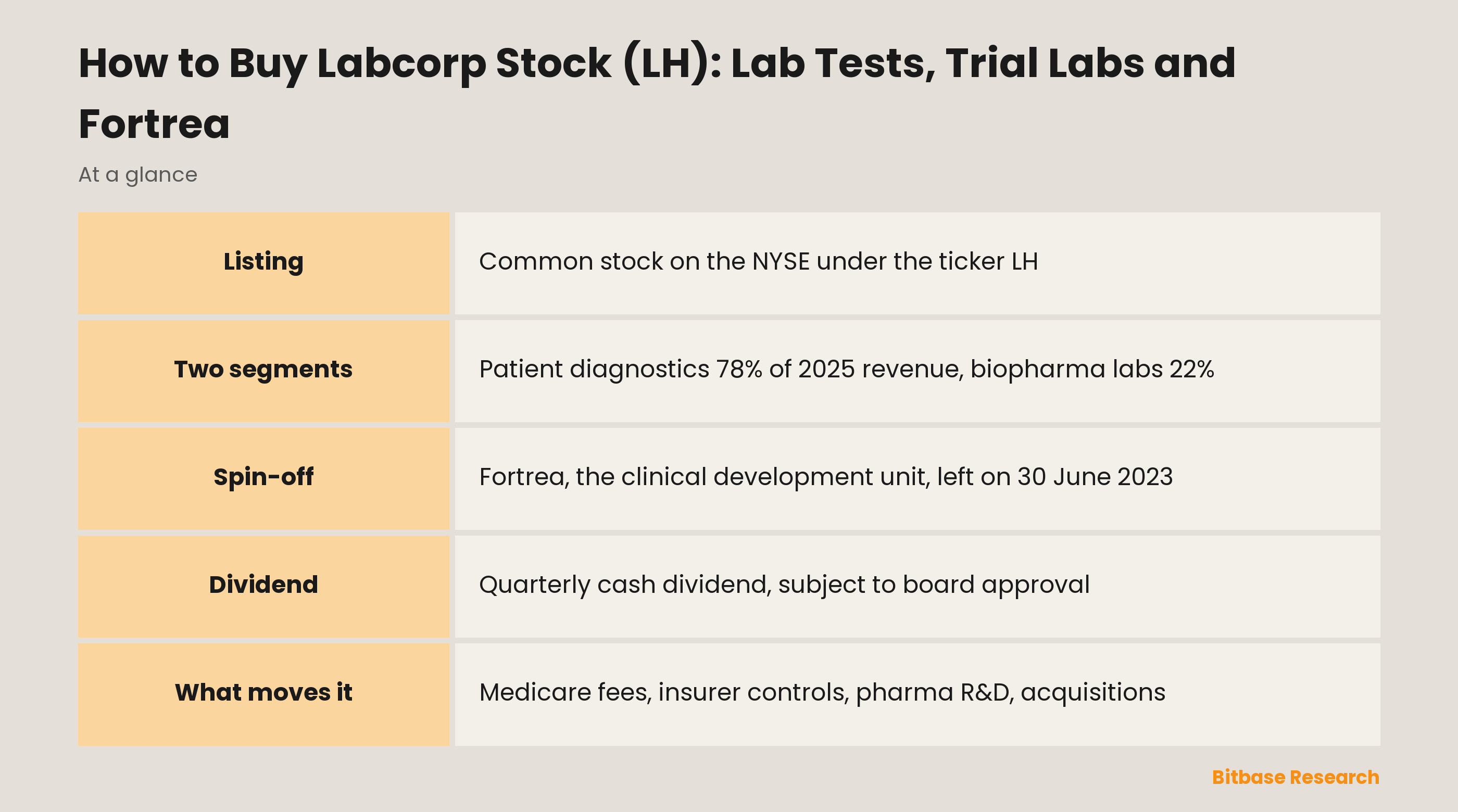
The listing to look for is LH on the New York Stock Exchange, where Labcorp Holdings common stock trades, so a broker that offers US shares can handle the order. Labcorp runs blood draws, routine tests and specialty diagnostics for patients in North America and also tests samples for drug developers worldwide; in 2025 the patient side brought in 78% of revenue and the drug developer side 22%, and the two earned almost the same operating margin. Below: the business, the order, and what its filings point to, from Medicare pricing and biopharma budgets to the 2023 Fortrea spin-off.
What Does Labcorp Do?
Labcorp calls itself "a global leader of innovative and comprehensive laboratory services." In 2025 its nearly 71,000 employees served clients in about 100 countries and performed more than 750 million tests for patients, according to the 10-K. The company also says it supported more than 85% of the new drugs and therapeutic products the FDA approved that year.
The work splits into two segments.
Diagnostics Laboratories (Dx) is the business most patients meet. A doctor orders a test, the sample is drawn at one of more than 2,200 patient service centers or by one of more than 7,000 phlebotomists placed in doctors' offices, and it travels to a network of primary and specialty labs in the United States and Canada. Routine work covers blood chemistry, blood counts, thyroid tests, hemoglobin A1C and PSA; specialty work reaches into oncology, genetics, women's health and infectious disease. The 10-K says most results reach providers within one to two days, that the segment launched more than 130 new tests in 2025, and that "nearly all of Dx's revenues were generated in the U.S."
Biopharma Laboratory Services (BLS) sells laboratory work to pharmaceutical, biotechnology, medical device and diagnostic companies. Its Central Laboratory analyzes samples from clinical trials in about 100 countries and, in the 10-K's words, runs "the world's largest automated clinical trial sample collection kit production." Its Early Development Research Laboratories handle the work before human trials begin, from bioanalysis to safety and toxicology studies, some of it using research animals. About 41% of BLS revenue came from the United States in 2025 and 59% from other countries.
The company is narrower than a few years ago. On 30 June 2023 it completed the spin-off of Fortrea, its former clinical development and commercialization services business. On 17 May 2024 it added a holding company, Labcorp Holdings Inc., on top of Laboratory Corporation of America Holdings, the entity that had filed with the SEC under that name since 1995. Both events are explained in the FAQ below.
Its strategy names four specialty growth areas (oncology, women's health, autoimmune disease and neurology) and a push to become the laboratory partner of hospitals and health systems; it signed or completed 13 such collaboration transactions in 2025. It also bought a minority stake in SYNLAB, "a leader in medical diagnostic services and specialty testing in Europe," that year.
How Labcorp Makes Money
Labcorp is paid per test or per study. The 10-K's segment note puts the two businesses side by side:
| Segment | Share of 2025 revenue | Share of 2025 segment operating income | 2025 segment operating margin | Who pays |
|---|---|---|---|---|
| Diagnostics Laboratories | 78% | 78% | 16.4% | Health insurers, doctors and hospitals, patients, Medicare and Medicaid |
| Biopharma Laboratory Services | 22% | 22% | 16.1% | Drug, biotech, device and diagnostic companies and CROs |
Shares and margins are calculated from the XBRL segment data, before unallocated corporate costs.
Of total 2025 revenue, health plans and other third-party payers accounted for 37%, "clients" (doctors, hospitals, health systems and employers that pay for the tests they order) for 23%, patients paying deductibles, coinsurance or cash prices for 10%, and traditional Medicare and Medicaid for 8%. The Medicare and Medicaid line covers the traditional fee-for-service programs; managed Medicare and Medicaid plans are billed to the insurers that run them.
Growth in 2025 came from both volume and price. Dx revenue rose 7.2%, with organic growth of 4.1% and acquisitions, net of divestitures, adding 3.2%. Volume, measured by requisitions, rose 3.7%, and price and test mix added 3.5%. BLS revenue rose 6.0%, with organic growth of 4.0% and currency adding 2.0%, and BLS operating income rose 8.6%. Total revenue rose 7.2%.
The pattern carried into 2026. In the third quarter, revenue rose 6.9% year on year, Dx revenue 6.5% and BLS revenue 8.5%; inside BLS, Central Laboratories grew 11.5% while Early Development grew 0.4%.
By region, 87% of 2025 revenue came from North America, 9% from Europe and 4% from elsewhere, the non-North American share almost all in BLS.
LH Stock at a Glance
| Feature | LH |
|---|---|
| Exchange | New York Stock Exchange |
| Ticker | LH |
| Security | Common stock; one class listed |
| Issuer | Labcorp Holdings Inc., holding company since May 2024 |
| Sector | Clinical laboratory testing and laboratory services for drug development |
| Segments | Diagnostics Laboratories (Dx) and Biopharma Laboratory Services (BLS) |
| Index membership | S&P 500 |
| Headquarters | Burlington, North Carolina |
| Incorporated | Delaware |
| Fiscal year | Ends 31 December |
| Dividend | Quarterly cash dividend, subject to board approval |
| SEC identifier | CIK 920148 |
The table leaves out anything that changes daily. Quotes, market value and yield are on the Labcorp stock page on Bitbase.
How to Buy Labcorp Stock
Because Labcorp Holdings is incorporated in Delaware, there is no ADR or foreign share line to choose between; the NYSE quote is for the common stock. A purchase takes seven steps:
1. Choose a broker that reaches the NYSE. Abroad, that means a local firm with US market access or an international broker; check who regulates the entity holding your account.
2. Open the account and confirm your tax status. Non-US individuals usually complete IRS Form W-8BEN, which the IRS says to submit "when requested by the withholding agent or payer."
3. Fund it. Deposits in a non-dollar currency get converted, and the conversion rate can cost more than the commission, so check both.
4. Search for LH. The result should read Labcorp Holdings Inc. common stock on the NYSE. Data from before May 2024 may carry the old name, Laboratory Corporation of America Holdings; it is the same listing.
5. Pick the order type. FINRA explains that a market order "provides the most certainty that your order will be executed," while a limit order executes only "at or better than a specified price."
6. Decide the size. If you want to invest a fixed amount rather than buy whole shares, ask whether the broker offers fractional shares for NYSE stocks and whether fractional holdings carry voting rights.
7. Keep the records. Confirmations and statements record your cost basis and dividends; if you owned Labcorp shares on 20 June 2023, keep the Fortrea records too.
Withholding on dividends. The IRS says that "most types of U.S. source income received by a foreign person are subject to U.S. tax of 30%," and that a tax treaty may lower that rate or remove it. Labcorp's dividends fall under that rule, and your home country may tax them again.
Through index funds. LH is a holding of State Street's SPY, which tracks the S&P 500, so S&P 500 index funds give indirect exposure to Labcorp as one of hundreds of companies.
What Moves LH Stock
Medicare's fee schedule. Medicare pays for most lab tests through the Clinical Laboratory Fee Schedule, and a federal law, PAMA, ties those fees to the rates private insurers pay. The 10-K calls PAMA "the most significant" of the government reimbursement changes. Further cuts have been postponed every year since 2021. A law that took effect on 3 February 2026 froze cuts for 2026 and set May to July 2026 as the window for reporting private-payer rates to CMS; those rates set fees for 2027 to 2029, when cuts resume, capped at 15% a year.
Insurers' controls on testing. Health plans are Labcorp's largest group of payers, and the 10-K describes how they manage test use: prior authorization, laboratory benefit managers, narrow networks of approved labs and claims edits, often aimed at molecular, genetic and toxicology tests.
Drug development budgets. The 10-K says BLS revenue is tied to R&D spending "which may depend on access to capital and reimbursement from payers." In the third quarter of 2026 the BLS backlog was 3.9% higher than a year earlier and trailing twelve-month orders ran at a book-to-bill ratio of 1.10, two figures that point to revenue still to come.
Hospital deals and acquisitions. Much of Labcorp's growth comes from buying laboratories and taking on testing for hospitals and health systems: acquisitions, net of divestitures, added 3.2% to Dx revenue in 2025. In the third quarter of 2026 it bought MLM Medical Labs, with labs in the United States, Germany and South Africa. In October 2026 it agreed to buy selected laboratory assets of OPKO Health's BioReference Health unit, Myriad Genetics' prenatal testing business and Millennium Health, a drug testing laboratory. The three deals are expected to close between late 2026 and mid-2027, subject to regulatory approval.
Specialty tests and FDA rules. New tests carry the growth story the company tells. In the third quarter of 2026 the FDA approved its PGDx elio tissue complete test as a companion diagnostic for advanced melanoma. Regulation can cut the other way: in April 2024 the FDA issued a rule to oversee laboratory-developed tests as medical devices, and the 10-K says legal challenges "led to its recission," while warning that a revised rule could increase regulatory burdens.
Currency. Most non-US revenue sits in BLS. In 2025 currency added 2.0% to BLS revenue; a stronger dollar could turn that into a drag.
Reimbursement, Research Budgets and Other Labcorp Risks
Of the risk factors in Item 1A of the 10-K, the following speak most directly to Labcorp's business:
Payers. "A shift toward a higher mix of government and MCO payers may adversely effect revenues due to lower reimbursement rates," and "ongoing efforts by payers to reduce reimbursement, tighten payment policies, and control utilization are expected to continue."
Competition. "The commercial laboratory business is intensely competitive in terms of price, service, specialty offerings, and the type and number of commercial laboratories." CMS counted nearly 320,000 clinical laboratories in the United States as of March 2024, including about 9,200 in hospitals, and the 10-K says expanding health system labs bring greater competition for tests ordered by physicians in and around those systems. On the BLS side, "BLS's services are subject to increased price competition."
Biopharma demand. Economic conditions or funding constraints "could lead to reduced or delayed R&D activity or outsourcing," and consolidation among drug companies can shift work in-house.
Research animals. Import restrictions, limited supply and the actions of animal rights activists "may have an adverse effect on the operations of BLS," and disease in animal populations can damage what the 10-K calls BLS's "inventory."
The spin-off's tax constraints. To keep the Fortrea spin-off tax-free, the company says it may be restricted in "certain desirable capital raising or strategic transactions."
Systems and data. Labcorp handles patients' protected health information, and a cybersecurity incident could bring costs, lawsuits and enforcement action. The third-quarter 2026 10-Q added one risk factor: the company "is implementing a new ERP system and expects to extend its deployment across broader areas of the Company," and the process "may be more difficult or costly than anticipated."
Regulation and licences. Violations of anti-fraud and abuse laws or the loss of a CLIA laboratory licence can lead to fines or exclusion from government programs.
Owning the stock adds two more. Your position rides on one company's results, which the 10-K says "may vary significantly from quarter to quarter." And the dividend is not promised: "There can be no assurance that the Company will continue to pay quarterly cash dividends at the current rate or at all."
How to Research LH Yourself
EDGAR keeps Labcorp's filings under CIK 920148, also listed under the earlier names Laboratory Corp of America Holdings and National Health Laboratories Holdings. Look for the 10-K, three 10-Qs a year, and 8-Ks for events; quarterly results came in 8-Ks filed on 30 April, 30 July and 28 October 2026. The same releases are on ir.labcorp.com.
The 10-K's Item 1 lays out the segments, payer groups and PAMA timetable, Item 1A the risks, Item 5 the dividend, and the MD&A splits growth into organic, acquisition and currency parts, with Dx volume and price/mix shown separately.
Three checks help when comparing years. The 2023 income statement carries a separate line for discontinued operations, Fortrea's results before the spin-off, so compare continuing operations across years. The quarterly releases report "adjusted" operating income and earnings per share alongside GAAP figures; reconcile one to the other before comparing. And for BLS, watch backlog and book-to-bill, which the releases publish each quarter.
To compare Labcorp with companies that sell instruments, reagents and tests to laboratories rather than run them, see our Thermo Fisher stock guide and Danaher stock guide. For quotes, use the Labcorp page linked in the table section, or browse Bitbase's index of US stock pages for other companies.
Labcorp Stock FAQ
Can I buy Labcorp stock with crypto?
Not directly. Brokers sell LH shares for US dollars, so any crypto has to be converted to cash and transferred first, and depending on where you live, that conversion can be taxable. What you then hold is a part of a company, with dividend and voting rights; our explainer on crypto versus stocks sets out the difference.
Does Labcorp pay a dividend?
Yes, a quarterly cash dividend. The 10-K says declarations, if made, are expected in January, April, July and October, with payment in March, June, September and December, all subject to board approval. The most recent was declared on 21 October 2026 and is payable on 11 December 2026. The company gives no assurance it will keep paying "at the current rate or at all."
Is LH in the S&P 500?
Yes. The SPY holdings list that State Street published for 9 November 2026 included Labcorp Holdings Inc. under LH; SPY tracks the S&P 500. Index weights change every day.
What is Fortrea, and how is it related to Labcorp?
Fortrea is Labcorp's former clinical development and commercialization services business. Labcorp spun it off on 30 June 2023 by distributing all of Fortrea's shares: holders received one Fortrea share for each Labcorp share held on the 20 June 2023 record date. Fortrea now trades separately as FTRE; the transition services agreement between the two expired on 30 June 2025. Labcorp kept the central and early development labs.
Why is the company now called Labcorp Holdings?
On 17 May 2024 Laboratory Corporation of America Holdings carried out a holding company reorganization. Each share was converted automatically into one share of Labcorp Holdings Inc., with the same rights and without an exchange of certificates, and the stock kept trading on the NYSE as LH "on an uninterrupted basis," under a new CUSIP number. The old company became a wholly owned subsidiary; the business itself did not change materially, the 8-K says.
Conclusion
Labcorp is two laboratory businesses of almost equal profitability under one ticker: a US patient-testing network whose prices depend on Medicare and insurers, and a smaller, more international business whose orders follow drug companies' research budgets. Before you buy, read the payer mix and PAMA timetable in the latest 10-K, follow BLS backlog in the quarterly releases, and size the position so that one laboratory operator's fortunes stay a limited part of your savings.
Related reading
Other Bitbase articles on this topic:
- How to Buy GE HealthCare Stock (GEHC): Scanners and Imaging Agents
- How to Buy HCA Healthcare Stock (HCA): Payers, Texas and Florida
- How to Buy Humana Stock (HUM): Medicare Advantage and CenterWell
- How to Buy Philips Stock (PHG): Registry Shares, CPAP Recall
Disclaimer: This article is educational content from Bitbase Academy, provided for information only. It explains what a company or fund does and how the instruments referenced here differ from one another; it does not constitute investment, trading, tax, or financial advice, and it is neither a recommendation nor an endorsement of any security, token, or trading strategy. A tokenized stock is issued by a third party and is designed to give economic exposure to an underlying asset: it is not a share, it carries no shareholder rights, and it depends on the issuer's structure, eligibility rules, and redemption terms, which the issuer can change. Perpetual futures are leveraged derivatives that hold no underlying asset and can be liquidated, and trading hours, product availability, and eligibility differ by instrument and by jurisdiction and can change at any time. Written as of November 2026; verify everything yourself through company filings, the issuer's own documentation, and the product pages of the venue you trade on.
References
[1] Labcorp Form 10-K for 2025 (SEC EDGAR) www.sec.gov
[2] Labcorp 2025 Form 10-K, XBRL cover page (SEC EDGAR) www.sec.gov
[3] Labcorp 2025 Form 10-K, XBRL segment data (SEC EDGAR) www.sec.gov
[4] Labcorp 2025 Form 10-K, XBRL revenue by payer and region (SEC EDGAR) www.sec.gov
[5] Labcorp Form 10-Q for the third quarter of 2026 (SEC EDGAR) www.sec.gov
[6] Labcorp third-quarter 2026 earnings release, filed with Form 8-K (SEC EDGAR) www.sec.gov
[7] Labcorp Holdings Form 8-K12B of 17 May 2024: holding company reorganization (SEC EDGAR) www.sec.gov
[8] Labcorp Form 10-K for 2023: the Fortrea spin-off (SEC EDGAR) www.sec.gov
[9] Labcorp Form 8-K of 21 October 2026: quarterly dividend (SEC EDGAR) www.sec.gov
[10] Labcorp Holdings filer page and former names (SEC EDGAR) www.sec.gov
[11] State Street SPDR S&P 500 ETF Trust (SPY): fund page and daily holdings www.ssga.com
[12] FINRA: Order Types www.finra.org
[13] IRS: NRA Withholding www.irs.gov
[14] IRS: About Form W-8 BEN www.irs.gov





