
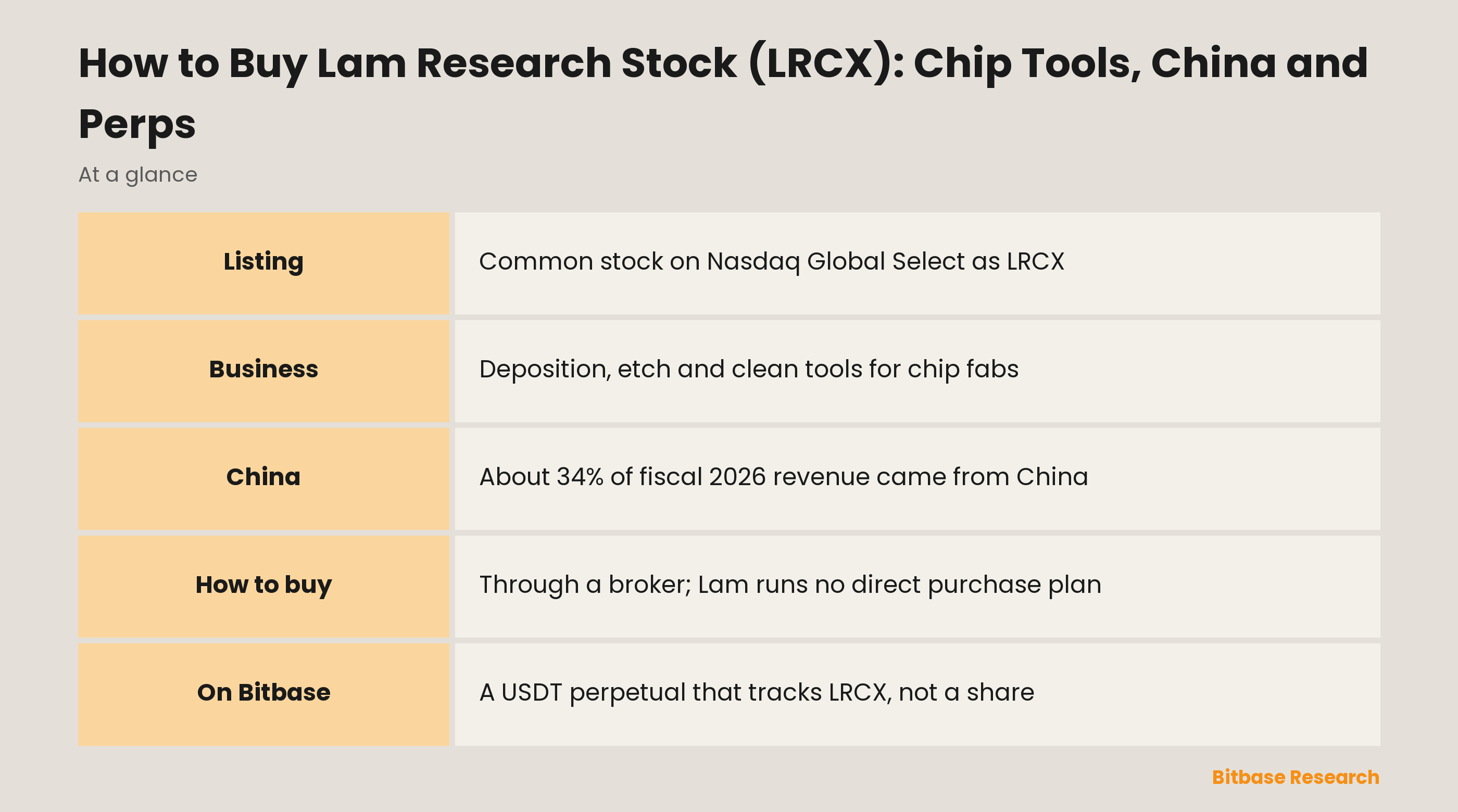
Buying Lam Research stock means placing an order for LRCX, its common stock on the Nasdaq Global Select Market, through a broker that offers US shares. What you would own is a maker of the deposition, etch and clean machines that chipmakers install in their fabs, and 34% of its fiscal 2026 revenue came from customer facilities in China, where US export rules limit what it may ship. There is no Lam share on Bitbase; what it offers is an LRCX perpetual, margined in USDT, that follows the price without owning anything.
What Does Lam Research Do?
Lam Research builds wafer-processing equipment: the machines that add, remove and clean the thin films a chip is made of. Its tools cover three families of steps. Deposition "create[s] layers of dielectric (insulating) and metal (conducting) materials used to build a semiconductor device." Etch creates chip features "by selectively removing dielectric, metal, silicon and poly silicon materials." Clean runs between steps to remove particles and residues "that could later lead to defects."
The product lines show where those steps land: Vantex etches the deep holes of 3D NAND memory, Akara etches conductors for gate-all-around transistors and SABRE plates copper wiring. Aether develops EUV photoresist without liquid chemicals, and the packaging tools include ones for stacking high bandwidth memory (HBM).
The buyers are memory makers, foundries and integrated device manufacturers. A second business, the Customer Support Business Group, keeps installed tools running with service, spare parts and upgrades, and sells older-generation and refurbished equipment under the Reliant name. Lam still reports a single segment.
Lam was organised in California in January 1980 and named for its founder, David Lam. It went public in May 1984, became a Delaware corporation in 1989 and bought Novellus Systems in 2012. The 10-K names Applied Materials as its main rival in deposition and, with Hitachi and Tokyo Electron, in etch. How these steps sit beside lithography and inspection is mapped in our guide to semiconductor equipment stocks.
How Lam Research Makes Money
A Lam tool earns twice: once when it ships, and again over the years it runs in a customer's fab. In fiscal 2026, which ended on 28 June 2026, new systems brought in about 64% of revenue and customer support-related sales (service, spares, upgrades and Reliant equipment) about 36%. Revenue rose 26%, on demand for equipment systems "particularly from customers within the foundry market segment," plus growth in customer support.
Which kind of chipmaker is buying has shifted. The 10-K splits equipment and upgrade revenue, not total revenue, by customer market:
| Customer market | Fiscal 2024 | Fiscal 2025 | Fiscal 2026 |
|---|---|---|---|
| Foundry | 40% | 45% | 54% |
| Memory | 42% | 42% | 39% |
| Logic and integrated device makers | 18% | 13% | 7% |
Lam puts the foundry gain down to "mature node spending as well as investments in leading-edge equipment," and the memory dip mainly to the timing of customer investments.
Revenue is booked where the customer's fab sits. In fiscal 2026 China accounted for 34%, Taiwan 22%, Korea 19% and Japan 9%. China was also 34% in fiscal 2025 but 42% in fiscal 2024, and the figure counts both Chinese chipmakers and global companies with plants there. Sales outside the United States were approximately 93% of revenue in each of the three years.
The buyer list is short. In fiscal 2026 four customers each passed 10% of revenue, at approximately 16%, 15%, 12% and 12%, roughly 55% between them; in fiscal 2024 only one did, at about 17%.
LRCX Stock at a Glance
| Item | Detail |
|---|---|
| Listing venue | Nasdaq Global Select Market |
| Symbol | LRCX |
| Shares | Common stock, the only listed class |
| Business | Wafer fabrication equipment and services |
| Indices | S&P 500 and Nasdaq-100 (held by SPY and QQQ on 16 October 2026) |
| Head office | Fremont, California |
| Organised | California, January 1980; Delaware corporation since 1989 |
| Public since | May 1984 |
| Fiscal year end | Last Sunday in June |
| Dividends | Quarterly, declared since April 2014; the board decides each one |
| Buybacks | Open-ended programme that may be suspended or ended at any time |
| Last split | Ten-for-one, October 2024 |
Prices change by the second, so none appear here; follow the live quote on Bitbase's LRCX stock page.
How to Buy Lam Research Stock
Lam will not sell you shares itself. Its investor FAQ says it does not currently offer a direct stock purchase plan or a dividend reinvestment plan, and suggests contacting a broker. From there:
1. Find a broker that lists Nasdaq shares and takes clients from your country.
2. Open the account and verify your identity. Non-US customers are usually asked for Form W-8BEN.
3. Deposit funds. A non-dollar deposit is changed into US dollars, and the exchange costs money.
4. Search LRCX and choose how to order. Market orders take the current price; limit orders name a maximum and can go unfilled.
5. Pick a quantity: whole shares or, where the broker offers them, fractional ones.
If you live outside the US, you buy the same thing: LRCX is the common stock Lam itself issued, with no depositary receipt in between. Tax is what differs. The IRS says "Most types of U.S. source income received by a foreign person are subject to U.S. tax of 30%," and a tax treaty can lower that rate. W-8BEN is the form that certifies foreign status, to be filed "whether or not you are claiming a reduced rate." None of this is tax advice.
Through an index fund, you hold Lam at one remove: funds tracking the S&P 500 or the Nasdaq-100 carry it among their constituents, as a small and shifting slice.
Trading LRCX on Bitbase
On Bitbase, Lam trades as an LRCX perpetual futures contract, with margin and settlement in USDT. It is price exposure, not a share: nothing sits underneath, so there is no dividend and no vote. The trade-off is flexibility: long or short, with leverage, on a market that keeps running after Nasdaq closes.
Longs and shorts exchange a funding payment at intervals, flowing from the more crowded side, which pulls the contract toward the share price. If margin is exhausted, liquidation is triggered by the mark price rather than the latest trade. Overnight and at weekends the contract keeps trading while the stock cannot, so the next Nasdaq open can land some distance away. Both mechanisms are explained in the guide to stock perpetuals.
Check the contract's own rules on Bitbase before trading: they set how often funding is paid, the margin tiers, the leverage ceiling and how the mark price is formed while Nasdaq is shut. Bitbase's TradFi page lists the other stocks available and in what form.
What Moves LRCX Stock
Chipmakers' capital budgets. Lam's 10-K says its industry "has historically been characterized by rapid changes in demand." The filing calls AI "a significant driver of capital equipment expenditures" and lists what could reverse it, from "slower-than-anticipated adoption of AI technologies" to "oversupply of AI-related infrastructure compute power."
The foundry and memory mix. Foundries moved ahead of memory makers in fiscal 2025 and widened the gap in fiscal 2026, yet memory still took 39% of equipment revenue, so the timing of memory makers' spending can swing results.
Washington's rules on China. With 34% of revenue booked in China, export licensing is a direct lever. Lam says expanded US license requirements "have limited the market for our products, adversely impacted our revenues, and increased our exposure to foreign competition," and a broadened foreign direct product rule can reach chips made with its tools when Huawei is involved.
A few machines, a whole quarter. "Our products are priced up to the tens of millions of dollars per system," the 10-K notes, so "the inability to recognize revenue on even a few systems can cause a significantly adverse impact on our revenues for a given quarter."
Chip designs that add steps. Chipmakers are moving to 3D architectures, more complex patterning and new materials, which the filing says is "increasing manufacturing complexity and precision requirements" and driving demand for its tools.
Risks to Weigh
Licences that may not arrive. Some sales in China need extra export licences, and "there is no assurance that we will be issued licenses that we apply for on a timely basis or at all." The rules give "an advantage to our international competitors that are not subject to these restrictions," and local supply-chain programmes, China's included, could add domestic rivals.
Few customers, narrow product lines. "Sales to a limited number of large customers constitute a significant portion of our overall shipments, revenue, cash flows, and profitability." Lam also warns that customers may see a supplier with limited product lines "as less important to their business."
A change in how chips are made. If manufacturing comes to need "fewer steps using our products," the hit to Lam would be larger than to less concentrated competitors.
Single-source parts. Some components "may only be obtained from a single supplier," and a prolonged shortage of them could hurt results.
The stock itself. One risk factor is headed "The Market for Our Common Stock Is Volatile," and Lam "cannot provide assurance that we will continue to declare dividends or repurchase shares at all or in any particular amounts."
Leverage on top. A leveraged position loses faster, pays or receives funding for every interval it stays open, and can be liquidated in one jump if LRCX opens far from where the contract last traded.
How to Research LRCX Yourself
Lam files with the SEC under CIK 707549. In the 10-K, Item 1 covers products and competitors, Item 1A the China and customer risks, Note 4 revenue by customer market and Note 19 revenue by region and by major customer. Quarterly results and the October 2024 split came on Form 8-K; proxy statements (DEF 14A) set out shareholder votes. investor.lamresearch.com adds the FAQ, dividend history and split-adjusted historical prices.
Lam Research Stock FAQ
Does Lam Research pay a dividend?
Yes. The board has declared quarterly dividends since April 2014 and decides each one in turn. The latest per-share amount is listed under dividend history on investor.lamresearch.com.
Has Lam Research stock split?
Yes. The most recent split was ten-for-one, effective at 5:00 p.m. Eastern Time on 2 October 2024, with split-adjusted trading from the open on 3 October under the same ticker. Each share became ten and shareholder rights did not change, so per-share figures from before October 2024 need adjusting by a factor of ten.
Is Lam Research in the S&P 500?
Yes. State Street's SPY, an S&P 500 tracker, listed LRCX in its holdings on 16 October 2026, and so did Invesco's QQQ, a Nasdaq-100 tracker. Membership can change, so the date matters.
Can I buy Lam Research stock with crypto?
Not the stock itself. Brokers sell LRCX for ordinary currency, which means swapping crypto into money before you buy. What crypto can reach on Bitbase is the LRCX perpetual, traded with USDT: it tracks the share price, but as a derivative it carries no dividend or vote and can be liquidated. Our piece on buying stocks with crypto compares the routes.
Who are Lam Research's biggest customers?
The 10-K names Micron Technology, Samsung Electronics, SK hynix and Taiwan Semiconductor Manufacturing Company as its most significant customers across fiscal 2024 to 2026. It gives each large customer's share of revenue without saying which company is which.
When does Lam Research report earnings?
Every quarter. Lam's fiscal year closes on the last Sunday of June; for fiscal 2026 it released results by Form 8-K on 22 October 2025, 28 January, 22 April and 29 July 2026, then filed the 10-K on 7 August 2026.
Conclusion
Buying Lam Research stock is an ordinary broker order for LRCX; the reading is the real work. The business rides chipmakers' capital spending, with foundries now the bigger buyer, about a third of revenue booked in China under US export rules, and four customers taking more than half of fiscal 2026 sales. A perpetual on Bitbase is a view on the price with its own costs, not a stake in the company.
Related reading
Other Bitbase articles on this topic:
- How to Buy Analog Devices Stock (ADI): Industry, Dividend, China
- How to Buy Applied Materials Stock (AMAT): China Risk and Perps
- How to Buy ASE Technology Stock (ASX): NYSE ADSs and Taipei 3711
Disclaimer: This article is educational content from Bitbase Academy, provided for information only. It explains what a company or fund does and how the instruments referenced here differ from one another; it does not constitute investment, trading, tax, or financial advice, and it is neither a recommendation nor an endorsement of any security, token, or trading strategy. A tokenized stock is issued by a third party and is designed to give economic exposure to an underlying asset: it is not a share, it carries no shareholder rights, and it depends on the issuer's structure, eligibility rules, and redemption terms, which the issuer can change. Perpetual futures are leveraged derivatives that hold no underlying asset and can be liquidated, and trading hours, product availability, and eligibility differ by instrument and by jurisdiction and can change at any time. Written as of October 2026; verify everything yourself through company filings, the issuer's own documentation, and the product pages of the venue you trade on.
References
[1] Lam Research fiscal 2026 Form 10-K (SEC EDGAR) www.sec.gov
[2] Lam Research investor relations: FAQs investor.lamresearch.com
[3] Lam Research Form 8-K, 2 October 2024: ten-for-one stock split (SEC EDGAR) www.sec.gov
[4] State Street: SPY daily holdings, 16 October 2026 www.ssga.com
[5] Invesco QQQ: fund overview and holdings (tracks the Nasdaq-100) www.invesco.com
[6] IRS: NRA withholding www.irs.gov
[7] IRS: About Form W-8 BEN www.irs.gov





