
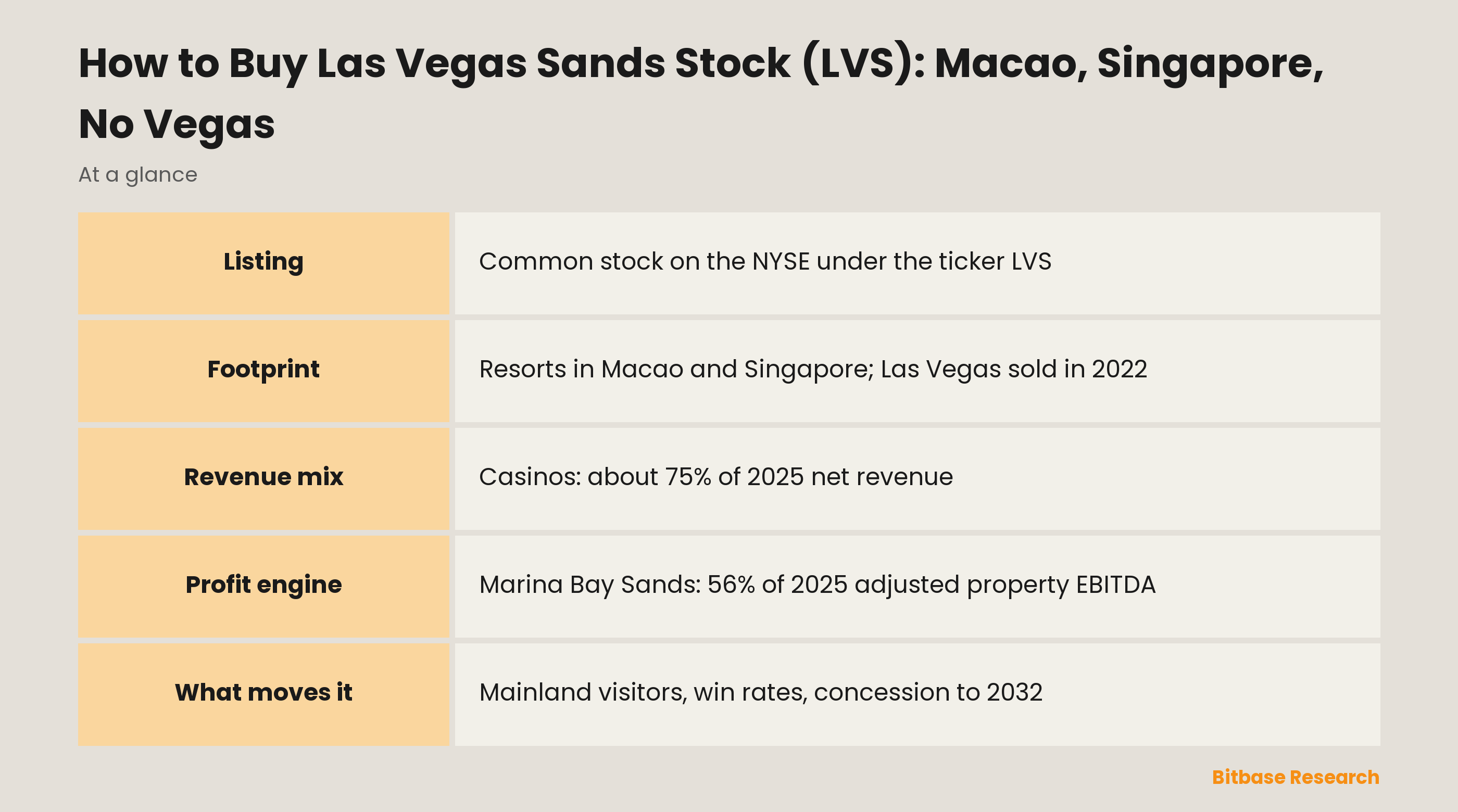
For anyone with a brokerage account that reaches the New York Stock Exchange, buying Las Vegas Sands stock means ordering the ticker LVS. Despite the name, the company sold its Las Vegas resort and convention center in 2022, and its integrated resorts now sit in Macao and Singapore: in 2025 casinos produced about 75% of net revenue, and Marina Bay Sands alone delivered 56% of adjusted property EBITDA. Below: the resorts, the order steps, and what its filings flag, from mainland visitors and win rates to a concession ending in 2032.
What Does Las Vegas Sands Do?
Las Vegas Sands runs very large resorts in which the casino is one part. Its annual report calls the company "the leading global developer and operator of destination properties ("Integrated Resorts")," combining hotels, gaming, entertainment, retail malls, convention and exhibition halls and restaurants under one roof.
The company was incorporated in Nevada in August 2004 and listed on the NYSE as LVS through an initial public offering that December. Months earlier, on 18 May 2004, its Macao subsidiary had opened the Sands Macao, which the 10-K still describes as "the first U.S. operated Las Vegas-style casino in Macao."
Macao. Las Vegas Sands owned 74.80% of Sands China Ltd at the end of 2025, a subsidiary whose shares have traded on the Main Board of the Hong Kong stock exchange since November 2009. Sands China runs five resorts that the company reports as separate segments: The Venetian Macao, The Londoner Macao, The Parisian Macao, The Plaza Macao and Four Seasons Macao, and the Sands Macao. All but the last sit on the Cotai Strip. The Londoner is the largest; in 2025 its former Sheraton towers reopened as the Londoner Grand, Macao's first Marriott International Luxury Collection hotel (see our Marriott stock guide). The casinos operate under a ten-year gaming concession that began on 1 January 2023 and expires on 31 December 2032. Sands China is one of six concessionaires, alongside SJM, Wynn, Galaxy, MGM and Melco.
Singapore. Marina Bay Sands, wholly owned, has three 55-story hotel towers topped by the Sands SkyPark and its infinity pool, plus a mall, a museum and convention space. It operates under a 30-year casino concession granted through a 2006 development agreement, and Singapore's only other casino license belongs to Resorts World Sentosa. The regulator must keep it at two licenses until 1 January 2031.
What it no longer has. On 23 February 2022 the company completed the sale of its Las Vegas operations, including The Venetian Resort Las Vegas and the Sands Expo and Convention Center, to VICI Properties L.P. and Pioneer OpCo, LLC. Part of the price came as a seller loan, repaid early and in full in May 2026. The headquarters remain in Las Vegas. In June 2023 the company bought the Nassau Veterans Memorial Coliseum in New York, hoping for a casino license, and in April 2025 it dropped that pursuit, citing a lower expected return.
"We focus on the mass market, which is our most profitable gaming segment," the 10-K says, while VIP players get private salons under the Paiza brand.
How Las Vegas Sands Makes Money
Casino winnings are the bulk of it; hotel rooms, malls and food make up most of the rest. The 2025 mix of net revenue:
| Revenue line | Share of 2025 net revenue | Change from 2024 |
|---|---|---|
| Casino | 75% | +17.9% |
| Rooms | 11% | +11.6% |
| Mall | 6% | +6.1% |
| Food and beverage | 5% | +6.1% |
| Convention, retail and other | 3% | +0.6% |
Shares are calculated from the 10-K revenue table. Total net revenue rose 15.2% in 2025.
The two regions split the work unevenly. Macao produced about 57% of 2025 net revenue and Singapore 43%, yet the 10-K says Macao contributed 44% of adjusted property EBITDA and Singapore 56%. That measure is the company's own, a non-GAAP figure that leaves out corporate, development and pre-opening costs as well as depreciation. Marina Bay Sands grew net revenue by about 32% in 2025, helped by higher win and hold percentages, while Macao revenue grew about 5% and its adjusted property EBITDA slipped 0.7%, which the company tied to higher marketing and payroll costs in a competitive market.
Taxes take a large slice before any of that. In Macao the company pays a special gaming tax of 35% of gross gaming revenue plus a 5% contribution. In Singapore, goods and services tax of 9% applies to gross gaming revenue, and a casino tax runs from 8% for premium players and 18% for mass players up to 12% and 22% above set revenue thresholds.
LVS Stock at a Glance
| Item | Detail |
|---|---|
| Exchange | New York Stock Exchange |
| Ticker | LVS |
| Security | Common stock; no other class is registered under Section 12(b) |
| Business | Integrated resorts: casinos, hotels, malls and convention space |
| Where it operates | Macao (through Sands China) and Singapore (Marina Bay Sands) |
| Index membership | S&P 500 |
| Headquarters | Las Vegas, Nevada |
| Incorporated | Nevada, August 2004; listed since December 2004 |
| Fiscal year | Calendar year, ending 31 December |
| Payouts | Quarterly cash dividend, resumed in August 2023; share repurchase program |
| Largest holders | Adelson family and related trusts, about 57% at the end of 2025 |
| SEC identifier | CIK 1300514 |
Prices, market value and yield change all day; for live figures, open the Las Vegas Sands stock page on Bitbase.
How to Buy Las Vegas Sands Stock
Las Vegas Sands is a Nevada corporation, so what trades under LVS on the NYSE is its common stock, not a depositary receipt. A purchase has five stages:
1. Pick the brokerage. It needs access to NYSE-listed shares. Outside the United States that can be a local firm with a US market service or an international broker; check which legal entity holds your account and who regulates it.
2. Complete the paperwork. Non-US investors usually certify foreign status on IRS Form W-8BEN, which the IRS says to submit "when requested by the withholding agent or payer." US-source dividends paid to a foreign person face a 30% withholding tax unless a tax treaty lowers it.
3. Fund in dollars. If your money is in euros, yen or another currency, the conversion has a price of its own, so compare the exchange spread along with the commission.
4. Find the right line. Search LVS and check that the result names Las Vegas Sands Corp. common stock on the NYSE. Sands China shares trade separately in Hong Kong and are a different security.
5. Choose the order and the size. FINRA notes that a market order "provides the most certainty that your order will be executed," while a limit order fills only "at or better than a specified price." Some brokers sell fractions of a share, others limit them to "large-cap stocks or ETFs" or skip them, and "as a fractional share owner, you might not have shareholder voting rights."
Owning it through a fund. Las Vegas Sands Corp appeared in the 10 November 2026 daily holdings of State Street's SPY, which tracks the S&P 500, so an S&P 500 index fund gives you a small, indirect stake.
What Moves LVS Stock
Visitors from mainland China. Most customers travel to reach the resorts, and the 10-K says "a significant number of gaming patrons come to our casinos from mainland China." The Macao government reported that visitation from the mainland rose about 18.5% in 2025, and that Macao's gross gaming revenue rose about 9.1%.
Win rates. Casino revenue depends on how much the house wins on what is wagered, and that swings. The third quarter of 2026 showed it: net revenue fell 3.5% from a year earlier, mainly because lower win percentages cut casino revenue at Marina Bay Sands, while the first nine months were still up 6.3%. The company says average win percentages stay "fairly consistent" over long periods "but can vary considerably within shorter time periods."
Competition and patron spending in Macao. In the first nine months of 2026, Macao net revenue rose 7.7% while adjusted property EBITDA fell 6.5%, which the 10-Q attributes to more spending on patron reinvestment and payroll in a competitive market.
The Marina Bay Sands expansion. Construction of a new tower with a hotel, gaming space and an arena of about 15,000 seats began on 26 May 2025. The company estimates completion by June 2030 and opening in January 2031, while the agreed completion date with Singapore is 8 July 2029; any extension needs government approval.
Macao commitments and taxes. Under the concession, Sands China has committed to an investment plan in Macao through 2032, mostly in non-gaming projects. Its exemption from Macao's 12% corporate income tax on gaming profits runs through 31 December 2027, with no certainty of renewal.
Capital returns and leadership. In July 2026 the board enlarged the share repurchase program and extended it to 21 July 2029. Patrick Dumont, previously president and chief operating officer, became chairman and chief executive on 1 March 2026, when Robert Goldstein moved to a senior advisor role.
What Could Go Wrong for Sands
Of the 10-K's risk factors, these bear most directly on Las Vegas Sands:
Two markets, one parent. "We are primarily dependent upon our Asia properties for all of our cash flow." Las Vegas Sands is a holding company whose cash comes from its subsidiaries, so a problem in Macao or Singapore reaches shareholders directly. During the pandemic it suspended its own dividend from April 2020 to July 2023, and Sands China paid none from February 2020 until June 2025.
Licenses that can end. Macao may terminate the concession for serious non-compliance, in which case the casinos revert to the government without compensation, and from 1 January 2029 it may redeem the concession on a year's notice, with compensation that "may not be adequate." In Singapore, the development agreements contain events of default that could allow the tourism board to terminate them without compensation.
China policy and travel. The company warns that slower growth in China or changes to its policies on travel and currency movements have disrupted, and could again disrupt, the flow of visitors and what they spend.
Luck and credit. "If the winnings of our gaming patrons exceed our winnings, we may record a loss from our gaming operations." In 2025 about 9.4% of table play in Macao and 12.3% at Marina Bay Sands was credit-based wagering, and that credit is unsecured.
A controlling holder. Dr. Miriam Adelson, her family and related trusts beneficially owned about 57% of the common stock at the end of 2025, which gives them significant influence over the board and over any matter put to a shareholder vote. The 10-K puts it in one line: "The interests of our Principal Stockholders may differ from your interests."
Currencies and the stock itself. The accounts are reported in US dollars, but the resorts earn in Singapore dollars, patacas and Hong Kong dollars, and the 10-K warns that moves in those exchange rates could cut the dividends and distributions that reach the parent. The pataca is pegged to the Hong Kong dollar, which is pegged to the US dollar. And a single stock concentrates your money in one company.
How to Research LVS Yourself
Las Vegas Sands files with the SEC under CIK 1300514: the 10-K each February, a 10-Q after each of the first three quarters, and 8-Ks when events occur. Quarterly results arrive as 8-Ks with the earnings release attached; in 2026 they were filed on 28 January, 22 April, 22 July and 21 October. Filings and Sands China material also appear on investor.sands.com.
Inside the 10-K, the segment note gives revenue and adjusted property EBITDA resort by resort. The casino activity tables in the management discussion give drop, rolling chip volume and win percentages per property, which shows whether a weak quarter came from fewer bets or from luck. The risk factors set out the concession, tax and licensing terms, and the Item 5 graph compares the stock with the S&P 500 and the Dow Jones US Gambling Index.
Two checks help. Compare reported win percentages with the expected ones the company states before reading much into a single quarter. And put Macao figures in context: the DICJ, Macao's gaming regulator, publishes the market's gross gaming revenue monthly, and the Singapore Tourism Board publishes visitor arrivals. For live prices, use the stock page linked above, and the list of US stock pages on Bitbase to compare other listed companies.
Las Vegas Sands Stock FAQ
Can I buy Las Vegas Sands stock with crypto?
Not directly. LVS shares are bought in US dollars through a brokerage account, so any crypto has to be sold for cash first and the money moved to the broker, and that sale may be a taxable event in your country. A share also gives you something a token does not, a legal stake in a registered company with dividend and voting rights; our guide on how stocks and crypto differ covers the gap.
Does Las Vegas Sands still operate casinos in Las Vegas?
No. It sold The Venetian Resort Las Vegas and the Sands Expo and Convention Center in February 2022, and its integrated resorts are now in Macao and Singapore. The name and the Las Vegas headquarters stayed.
Does Las Vegas Sands pay a dividend?
Yes, a quarterly cash dividend. It was suspended from April 2020 and resumed in August 2023, and in its 10-K the company said it expected the January 2026 level to continue quarterly through the rest of 2026. The board reviews the dividend, so check the latest earnings release for the current amount.
How much of Sands China does Las Vegas Sands own?
It owned 74.80% at the end of 2025 and, after buying more shares, 75.56% on 30 September 2026. Sands China is listed in Hong Kong and runs the Macao resorts, so part of the Macao profits belongs to Sands China's other shareholders.
Who controls Las Vegas Sands?
The Adelson family, which with related trusts owned about 57% of the common stock at the end of 2025. Dr. Miriam Adelson's son-in-law Patrick Dumont has been chairman and chief executive since 1 March 2026.
Is LVS in the S&P 500?
Yes. Las Vegas Sands Corp was listed in State Street's daily SPY holdings dated 10 November 2026. Index weights change every day.
Conclusion
Las Vegas Sands is, in practice, a position on two Asian gaming markets and on how lucky its tables are in a given quarter, run by a family that controls the vote. Its strongest earner, Marina Bay Sands, sits in a two-license market with a large expansion due around 2031, while Macao brings more revenue but tighter margins and a concession that ends in 2032. Work through the newest 10-K and earnings release, set win percentages beside volumes, and decide how much one casino operator, with all its cash flow in Asia, should weigh in your portfolio.
Related reading
Other Bitbase articles on this topic:
- How to Buy Coupang Stock (CPNG): US Listing, Korean Revenue
- How to Buy Darden Stock (DRI): The Company Behind Olive Garden
- How to Buy Expedia Stock (EXPE): Vrbo, B2B and Class B Votes
- How to Buy Williams-Sonoma Stock (WSM): Pottery Barn and West Elm
Disclaimer: This article is educational content from Bitbase Academy, provided for information only. It explains what a company or fund does and how the instruments referenced here differ from one another; it does not constitute investment, trading, tax, or financial advice, and it is neither a recommendation nor an endorsement of any security, token, or trading strategy. A tokenized stock is issued by a third party and is designed to give economic exposure to an underlying asset: it is not a share, it carries no shareholder rights, and it depends on the issuer's structure, eligibility rules, and redemption terms, which the issuer can change. Perpetual futures are leveraged derivatives that hold no underlying asset and can be liquidated, and trading hours, product availability, and eligibility differ by instrument and by jurisdiction and can change at any time. Written as of November 2026; verify everything yourself through company filings, the issuer's own documentation, and the product pages of the venue you trade on.
References
[1] Las Vegas Sands Form 10-K for 2025 (SEC EDGAR) www.sec.gov
[2] Las Vegas Sands 2025 Form 10-K, XBRL cover page (SEC EDGAR) www.sec.gov
[3] Las Vegas Sands Form 10-Q for the third quarter of 2026 (SEC EDGAR) www.sec.gov
[4] Las Vegas Sands Form 8-K of 12 February 2026: leadership transition (SEC EDGAR) www.sec.gov
[5] Las Vegas Sands initial public offering prospectus, December 2004 (SEC EDGAR) www.sec.gov
[6] State Street SPDR S&P 500 ETF Trust (SPY): fund page and daily holdings www.ssga.com
[7] FINRA: Order Types www.finra.org
[8] FINRA: Investing in Fractional Shares www.finra.org
[9] IRS: NRA Withholding www.irs.gov
[10] IRS: About Form W-8 BEN www.irs.gov





