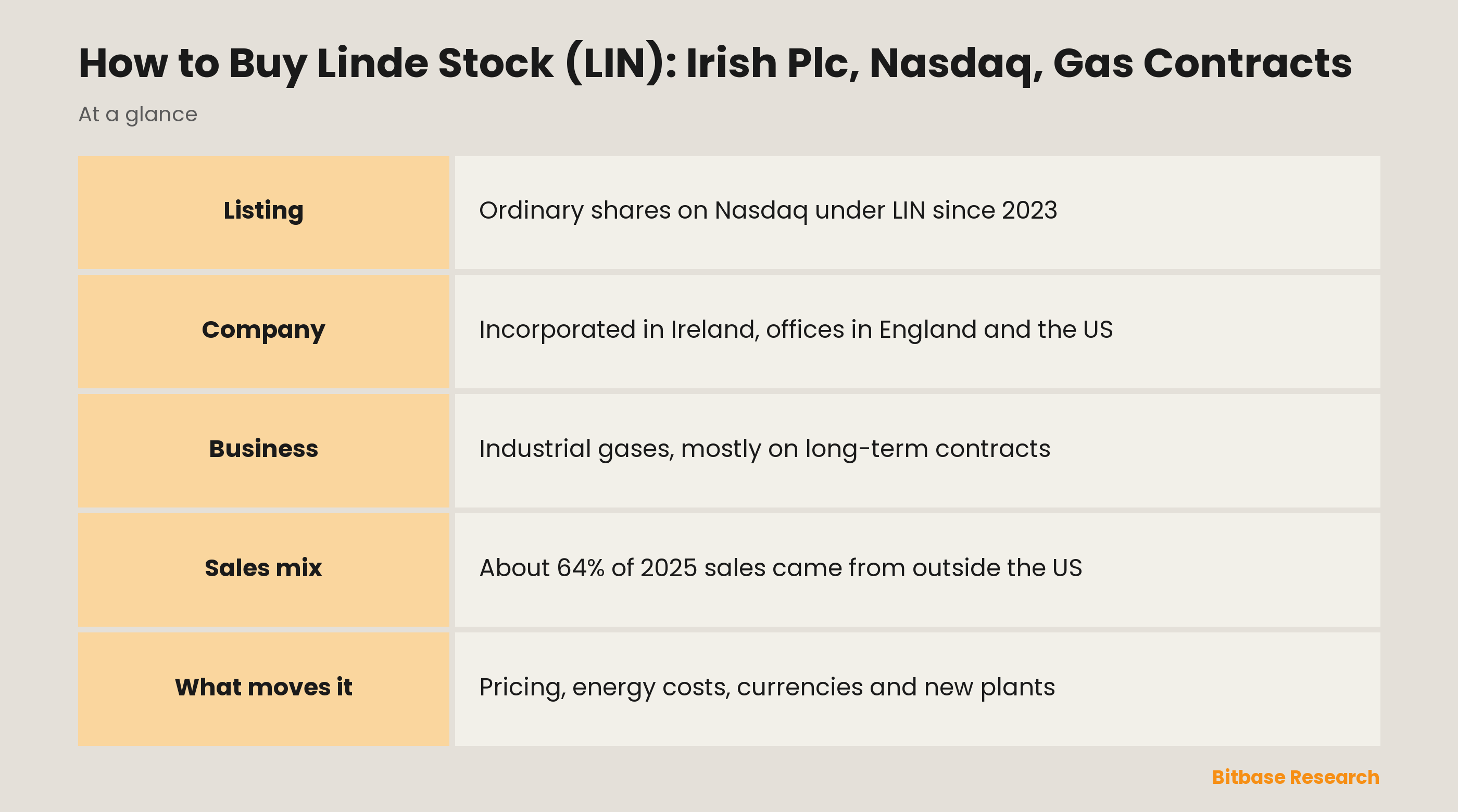
Since November 2023, Linde's ordinary shares have traded on Nasdaq under the ticker LIN, so any brokerage account with access to US-listed stocks can buy them. The company behind the ticker is less American than it looks: Linde plc is incorporated in Ireland, keeps principal offices in Woking, England, and Danbury, Connecticut, and made about 64% of its 2025 sales outside the United States. Its income comes mainly from oxygen, nitrogen, argon, hydrogen and other industrial gases, most of it sold under long-term contracts. This guide explains what Linde sells, how to buy LIN step by step, and what its filings flag: energy costs, currencies, cyclical customers and a legal dispute in Russia.
What Does Linde Do?
Linde makes and sells industrial gases, and it designs and builds the plants that produce them. Its 10-K describes it, in the company's own words, as "the largest industrial gas company worldwide."
The product list has two halves. Atmospheric gases (oxygen, nitrogen and argon) are the highest-volume products, made from ambient air mostly by cryogenic air separation, which also yields rare gases such as krypton, neon and xenon. Process gases include hydrogen, whose conventional output Linde mostly derives from natural gas or methane, plus helium, carbon dioxide, carbon monoxide, electronic gases, specialty gases and acetylene. Customers span healthcare, chemicals and energy, manufacturing, metals and mining, food and beverage, and electronics, and the 10-K states that "Linde is not dependent upon a single customer or a few customers."
How the gas reaches a customer matters as much as which gas it is, because each route has its own contract. On-site supply means a plant on or next to a large customer's site, piping product in under contracts that typically run 10 to 20 years with minimum purchase requirements and price escalation provisions. Merchant customers receive liquid by tanker truck, usually under three- to seven-year agreements, and packaged gases go out in cylinders on one- to three-year contracts or purchase orders. The Engineering business designs and builds gas plants, both for outside customers and for Linde's own gas business.
The 10-K names L'Air Liquide, Air Products and Chemicals, Messer Group and Taiyo Nippon Sanso, part of Mitsubishi Chemical, among its competitors, alongside many small local suppliers, and says customer-owned plants account for a significant portion of the international market.
Today's company dates from 31 October 2018, when Praxair, listed on the NYSE as PX, and Germany's Linde AG, listed in Frankfurt as LIN, combined under the Irish holding company Linde plc. Each Praxair share became one Linde plc share, and each Linde AG share tendered in the exchange offer became 1.54 Linde plc shares. A reorganization on 1 March 2023 exchanged every share one for one into a new holding company and ended the Frankfurt listing; on 7 November 2023, Linde moved its remaining listing from the NYSE to Nasdaq and kept the ticker.
How Linde Makes Money
Linde runs its gas business by region, and about 90% of 2025 sales came from the three geographic segments. The segment note in the 10-K shows how the total divides:
| Segment | What it covers | Share of 2025 sales | 2025 sales change | 2025 segment operating margin |
|---|---|---|---|---|
| Americas | Gases in about 20 countries, including the US, Canada, Mexico and Brazil | 44.7% | +5% | 31.2% |
| EMEA | Gases in about 50 countries in Europe, the Middle East and Africa | 25.2% | +2% | 35.7% |
| APAC | Gases in about 15 countries and regions, including China, Australia, India and South Korea | 19.6% | Flat | 29.0% |
| Engineering | Design and construction of gas plants, managed worldwide | 6.6% | −3% | 18.1% |
| Other | Corporate costs, Linde Advanced Materials Technology and global helium wholesale | 3.9% | +5% | Slightly negative |
Shares are calculated from 2025 segment sales and rounded to one decimal. Segment operating profit excludes purchase accounting effects from the Linde AG merger and cost reduction charges.
By supply mode, packaged gases brought in about 35% of 2025 sales, merchant deliveries about 30% and on-site plants about 24%, with the remaining 11% mostly from Engineering and the Other segment.
Contracts do much of the work. According to the 10-K, "the majority of Linde's business is conducted through long-term contracts which provide stability in cash flow," and large ones typically contain "escalation and pass-through clauses to recover energy and feedstock costs." So cost pass-through is its own line in the sales bridge: when power or natural gas prices move, sales move too, and in the Americas in 2025 pass-through added 1% to sales "with minimal impact on operating profit."
In 2025, sales rose 3%. Higher pricing added 2% and acquisitions 1%, while volumes were flat as new project start-ups largely offset declines in the base business. The reported operating margin was 26.3%. About 64% of sales came from outside the United States: the euro alone accounted for about 17% of consolidated sales, the Chinese yuan about 7%, and the British pound, Brazilian real and Australian dollar about 4% each.
LIN Stock at a Glance
| Item | Detail |
|---|---|
| Exchange | Nasdaq Stock Market, since 7 November 2023 (NYSE before that) |
| Ticker | LIN |
| Security | Ordinary shares, the only class registered on the 10-K cover |
| ISIN | IE000S9YS762, an Irish identifier |
| Sector | Materials: industrial gases and engineering |
| Index membership | S&P 500 and Nasdaq-100 |
| Incorporated | Ireland, as a public limited company |
| Principal offices | Woking, Surrey (UK) and Danbury, Connecticut (US) |
| Tax residence | United Kingdom, according to the 10-K |
| Fiscal year | Calendar year, ending 31 December |
| Reporting currency | US dollar |
| Dividend policy | Quarterly cash dividend, raised 8% per share in 2025 |
| SEC identifier | CIK 1707925; files 10-K, 10-Q and 8-K reports |
Quotes move all day, so none appear in this table; for the current price, open the Linde stock page on Bitbase.
How to Buy Linde Stock
Being Irish does not make LIN a depositary receipt. The Nasdaq line is Linde's ordinary share itself, the single security registered on its 10-K cover, and it trades in US dollars. If a broker shows Linde on another venue, check which security and currency you are buying.
1. Choose a broker that offers Nasdaq stocks. Outside the US, that means a domestic broker that routes orders to US markets or an international broker; confirm which legal entity holds your money and under which regulator.
2. Open and verify the account. A US broker will usually ask a non-US individual for IRS Form W-8BEN, the "Certificate of Foreign Status of Beneficial Owner for United States Tax Withholding."
3. Fund it. LIN is priced in dollars, so a currency conversion usually comes first; check the conversion spread alongside the commission.
4. Pick the right line. Search LIN and check that the result reads Linde plc ordinary shares on Nasdaq, with the ISIN IE000S9YS762 as a cross-check. Letters alone can mislead, which is one way stock symbols differ from crypto tickers.
5. Choose an order type. FINRA explains that a market order generally executes at or near the current bid or ask, though in a fast market you may not get the price you saw; a limit order executes only at your price or better, and may not execute at all. Outside the main session, see how regular and extended-hours stock prices differ.
6. Decide on the size. If your broker offers fractional shares, ask how it treats fractions for order types, voting and transfers before you rely on them.
7. Keep the paperwork. Trade confirmations and account statements record what you paid and the dividends credited.
Outside the United States, tax is where Linde's structure shows. The company is incorporated in Ireland, treated as UK tax resident, and, in its 10-K's words, "not expected to be treated as a domestic corporation for U.S. federal income tax purposes." Do not assume that rules for a US company's dividends carry over to LIN; ask your broker how it treats Linde dividends where you live.
Through an index fund, you can hold Linde without picking it. In the holdings reports filed with the SEC for 30 June 2026, both the Invesco QQQ Trust, which tracks the Nasdaq-100, and the SPDR S&P 500 ETF Trust listed Linde, one company among many in each.
What Moves LIN Stock
Pricing against energy costs. "Energy is the single largest cost item in the production and distribution of industrial gases," the 10-K says, mostly electricity, natural gas and diesel. Contracts pass much of it through, and 2025 shows what carries growth when volumes stall: pricing added 2% to sales while volumes were flat. Whether prices keep running ahead of cost inflation is the line to read each quarter.
Industrial volumes. Many customers "are in businesses that are cyclical in nature, such as the chemicals and energy, and metals and mining end markets." The 2025 regional figures show how uneven that can be: EMEA volumes fell 3%, mainly in metals and mining, manufacturing, and chemicals and energy, while the Americas gained 1%, helped by electronics and project start-ups, and APAC slipped 1%.
New plants and electronics. New plants add volume as they start up, which is how 2025 volumes held flat. About 60% of 2025 capital spending went to the Americas and 21% to APAC, mainly for new plants serving the project backlog. In the second quarter of 2026, underlying sales rose 4%, with volume gains led by electronics, manufacturing, and chemicals and energy, and the chief executive said Linde had signed "another long-term electronics supply contract in the U.S."
Currencies. Linde reports in dollars but earns most of its sales elsewhere. In 2025 a stronger euro and pound added 3% to EMEA sales, while a weaker Brazilian real and Mexican peso took 1% off the Americas. Engineering, whose sales fell 3% on project timing, and helium, which pulled down profit in the Other segment, are smaller swing factors.
Buybacks. Diluted shares outstanding fell 2% in 2025 as Linde bought back stock under a program its board approved in October 2023, which still had authority left at the end of 2025. Fewer shares mean higher earnings per share for the same profit.
Risks to Weigh Before Buying LIN
Of the risk factors in Item 1A of the 10-K, these are the ones most tied to how Linde earns its money:
Economic cycles. "Weakening economic conditions in markets in which Linde does business may adversely impact its financial results and/or cash flows."
Energy and raw materials. "Increases in the cost of energy and raw materials and/or disruption in the supply of these materials could result in lost sales or reduced profitability." Pass-through clauses help, but such efforts "may not successfully mitigate cost variability."
Plant and pipeline safety. The 10-K warns that operating failures at plants, storage sites or pipelines, "including fire, toxic release and explosions," or transport accidents could cost lives, damage the environment and halt production.
Russia. Since its engineering contracts in Russia were suspended under sanctions in May 2022, Linde has been in a legal fight with RusChemAlliance (RCA), a company 50% owned by Gazprom. A Hong Kong court ruled for Linde in January 2024, yet RCA kept pursuing claims in Russia, and in 2024 two Linde joint ventures there were sold locally under a St. Petersburg court order, the proceeds going to RCA. In its report for the quarter to 30 June 2026, Linde still did not expect "a material adverse impact on earnings," citing liabilities already recorded.
Irish incorporation. Under the heading "U.S. civil liabilities may not be enforceable against Linde," the 10-K notes: "There is no treaty between Ireland and the United States providing for the reciprocal enforcement of foreign judgments." It adds that a change in Linde's tax residency "may trigger taxes on dividends or exit charges."
Two general points apply too: a single holding ties your outcome to one company, however many countries it serves, and a holder outside the dollar receives both price and dividend through an exchange rate.
How to Research LIN Yourself
Linde's SEC filings sit under CIK 1707925: annual reports on Form 10-K, quarterly ones on 10-Q, and current reports on 8-K, to which each quarterly results release is attached as an exhibit.
Inside the 10-K, Item 1 covers products, supply modes and competitors, Item 1A the risks, and Item 5 the exchange plus a five-year return comparison with the S&P 500 and the S5 Materials Index. The segment, revenue and contingencies notes give sales by region, sales by distribution method and the Russia cases.
Two checks save confusion. The structured cover of the annual report, R1.htm, lists one registered security, on Nasdaq, which settles it when older pages still mention the NYSE or Frankfurt. And the sales bridge separates price, volume, currency, cost pass-through and acquisitions; growth from pass-through says little about demand. Earnings call webcasts are on the company's investor site, and Bitbase's US stock pages cover other listings.
Linde Stock FAQ
Is Linde a US company?
Not by incorporation. Linde plc is an Irish public limited company, treated as UK tax resident, with principal offices in England and Connecticut. It still files a 10-K, the annual report form of US companies, reports in US dollars and lists its shares on Nasdaq.
What exchange is Linde stock listed on?
Nasdaq, under LIN. Linde moved its listing there from the NYSE on 7 November 2023 and kept the ticker. Its Frankfurt listing ended with the reorganization of March 2023.
Does Linde pay a dividend?
Yes, every quarter. Dividends per share rose 8% in 2025, and Linde's report for the quarter to 30 June 2026 put the 2026 quarterly dividend 7% above the 2025 rate. The board declares each payment; the current amount is in Linde's latest filings.
Can I buy Linde stock with crypto?
Not directly. A brokerage account is the route to LIN, and Nasdaq trades settle in US dollars, so any crypto would have to be converted to cash and transferred to the broker first; that conversion can create a tax bill of its own, depending on your country. Keep the decisions apart, because an ordinary share is a registered stake that carries dividends and votes, unlike a token; this piece on what separates shares from crypto sets out the differences.
What happened to Praxair stock?
It became Linde stock. When the companies combined on 31 October 2018, each Praxair share was converted into one Linde plc share, and PX was suspended from NYSE trading after the close on 30 October 2018. Per-share history from before the merger belongs to Praxair or Linde AG, so compare it with care.
Is LIN in the S&P 500 and the Nasdaq-100?
Yes, both. In their holdings reports filed with the SEC for 30 June 2026, the SPDR S&P 500 ETF Trust and the Invesco QQQ Trust, a Nasdaq-100 fund, each listed Linde. Index weights change daily.
Conclusion
Buying LIN takes the same steps as any Nasdaq stock: a broker with US market access, the Linde plc ordinary share line, and a market or limit order. Knowing what the share represents takes more reading: a stake in an Irish-incorporated, UK-tax-resident company selling gases under long contracts in many currencies. The 10-K's segment, revenue and contingencies notes cover most of what matters, from pricing against energy costs to the Russia dispute; read the latest annual and quarterly reports before deciding how much of a portfolio one industrial gas company should be.
Related reading
Other Bitbase articles on this topic:
- How to Buy CRH Stock (CRH): Aggregates, Arcosa and the NYSE Move
- How to Buy Ecolab Stock (ECL): Water, Hygiene and AI Data Centers
- How to Buy Freeport-McMoRan Stock (FCX): Copper, Gold and Grasberg
Disclaimer: This article is educational content from Bitbase Academy, provided for information only. It explains what a company or fund does and how the instruments referenced here differ from one another; it does not constitute investment, trading, tax, or financial advice, and it is neither a recommendation nor an endorsement of any security, token, or trading strategy. A tokenized stock is issued by a third party and is designed to give economic exposure to an underlying asset: it is not a share, it carries no shareholder rights, and it depends on the issuer's structure, eligibility rules, and redemption terms, which the issuer can change. Perpetual futures are leveraged derivatives that hold no underlying asset and can be liquidated, and trading hours, product availability, and eligibility differ by instrument and by jurisdiction and can change at any time. Written as of October 2026; verify everything yourself through company filings, the issuer's own documentation, and the product pages of the venue you trade on.
References
[1] Linde plc Form 10-K, fiscal 2025: business, segments, risk factors and contingencies (SEC EDGAR) www.sec.gov
[2] Linde plc Form 10-Q for the quarter ended 30 June 2026: dividends and Russia litigation (SEC EDGAR) www.sec.gov
[3] Linde second-quarter 2026 results release (Form 8-K, Exhibit 99.1) www.sec.gov
[4] Linde plc Form 8-K, 31 October 2018: completion of the Praxair and Linde AG business combination (SEC EDGAR) www.sec.gov
[5] Linde plc Form 8-K12B, 1 March 2023: completion of the holding company reorganization (SEC EDGAR) www.sec.gov
[6] Linde plc Form 8-K, 26 October 2023: transfer of the share listing from the NYSE to Nasdaq (SEC EDGAR) www.sec.gov
[7] Invesco QQQ Trust, Series 1: Form N-PORT holdings report as of 30 June 2026 (SEC EDGAR) www.sec.gov
[8] SPDR S&P 500 ETF Trust: Form N-PORT holdings report as of 30 June 2026 (SEC EDGAR) www.sec.gov
[9] FINRA: Order Types www.finra.org
[10] IRS: NRA Withholding www.irs.gov





