
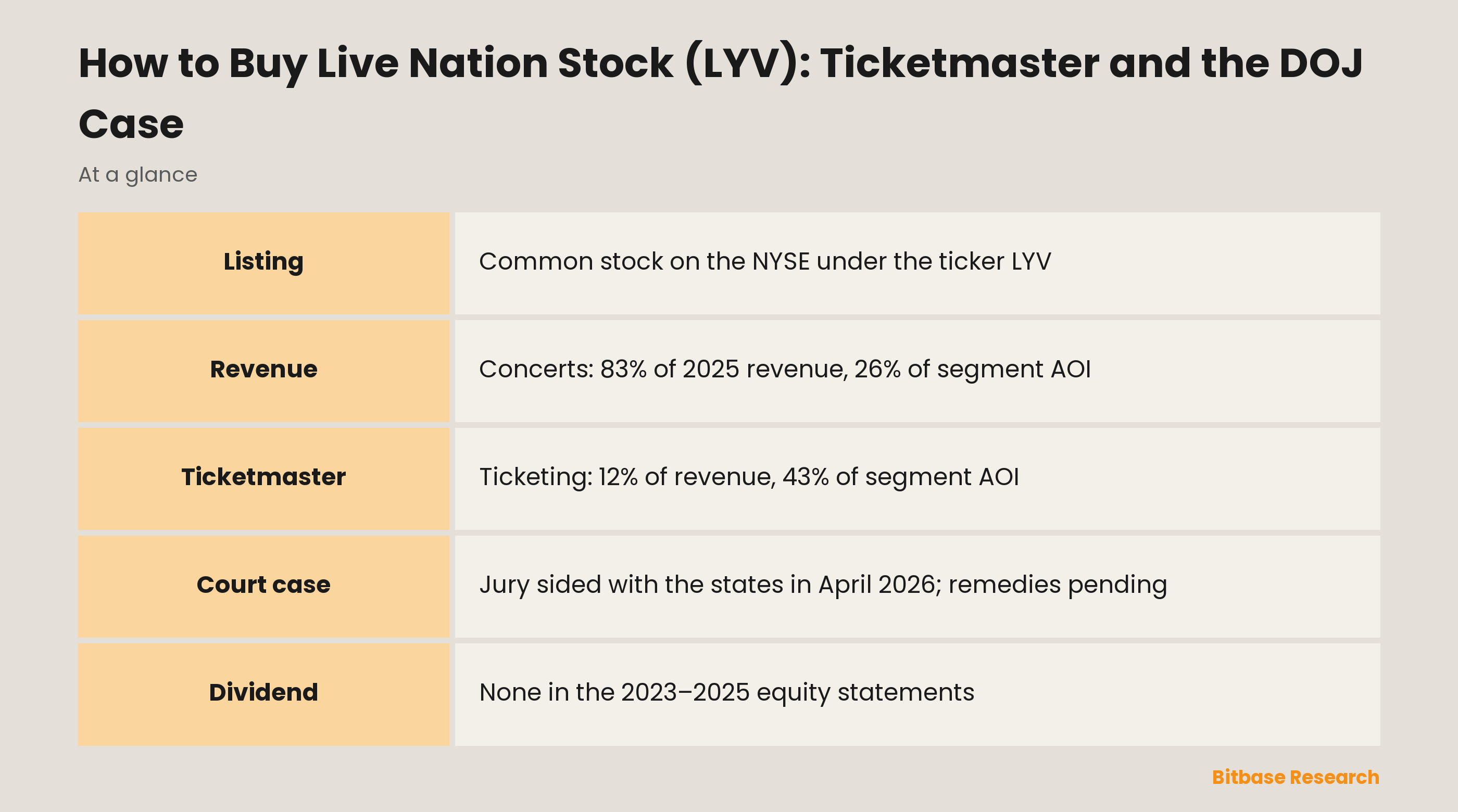
A single brokerage account with access to the New York Stock Exchange is enough to buy Live Nation stock, because the company's common shares trade there under the ticker LYV. What makes the share unusual is the mix behind it: concerts brought in 83% of 2025 revenue, yet Ticketmaster and sponsorship earned most of the segment profit, and the ticketing arm sits at the centre of an antitrust case brought by the Justice Department and dozens of states, part of which went to a jury in 2026. This guide covers the business, the order itself and the issues the filings flag.
What Does Live Nation Do?
Live Nation Entertainment promotes concerts, runs venues and sells tickets. Its 10-K opens with the claim "We believe that we are the largest live entertainment company in the world," and backs it with 2025 figures: over 805 million fans connected across its concerts and ticketing platforms in 55 countries, and 159 million fans at about 55,000 events for more than 11,000 artists.
The company was incorporated in Delaware in August 2005 to receive the entertainment assets of Clear Channel Communications. That separation closed on 21 December 2005, the same day the stock began trading on the NYSE as LYV. On 25 January 2010 Live Nation merged with Ticketmaster Entertainment, and Live Nation, Inc. took its current name, Live Nation Entertainment, Inc. Headquarters are in Beverly Hills, California, and Michael Rapino has been chief executive since August 2005.
The business is reported in three segments.
Concerts. Live Nation books tours, rents third-party venues or uses its own, produces festivals, and manages artists. At the end of 2025 it owned, operated, held exclusive booking rights for or had an equity interest in 460 venues: 333 in North America and 127 elsewhere, from House of Blues clubs and The Fillmore in San Francisco to the Ziggo Dome in Amsterdam and the Moody Center in Austin. Only 40 of those were owned outright. The company also ran 131 festivals in 2025 and managed about 360 artists. Over 97% of Concerts revenue is recognized on the day of the event.
Ticketing. Ticketmaster sells tickets for venues, promoters, sports teams and leagues, theaters and museums, mostly under contracts of three to five years. The 10-K says 646 million tickets went through its systems in 2025: about 346 million on which it earned a fee, plus roughly 300 million sold through the system without one, such as season-seat packages and venue box offices. It served about 10,500 clients. In North America and Australia, venue contracts generally give it exclusive rights to sell tickets to the general public; elsewhere it usually receives an allocation from promoters. Segment revenue counts the fees it keeps, not the face value of the ticket.
Sponsorship & Advertising. A sales force of about 830 people worked with more than 1,500 sponsors in 2025, selling naming rights, venue signage, festival partnerships and online advertising. Brands named in the filing include Citibank, Mastercard, Cisco, Red Bull and Anheuser Busch.
Competition is listed by name. In promotion, the 10-K cites AEG, CTS Eventim and several regional promoters; in venues, Legends Global, Madison Square Garden Entertainment and The Nederlander Organization; in primary ticketing, AXS, SeatGeek, Eventbrite, Paciolan and others; in resale, StubHub, Vivid Seats and Viagogo.
How Live Nation Makes Money
Revenue and profit sit in different places. Live Nation measures segments by adjusted operating income (AOI), a non-GAAP figure defined in its filings, and the 2025 split looks like this:
| Segment | Share of 2025 revenue | Share of 2025 segment AOI | Main sources |
|---|---|---|---|
| Concerts | 83% | 26% | Ticket sales for promoted shows, venue concessions, parking, premium seats, artist management |
| Ticketing | 12% | 43% | Service and order-processing fees on primary and resale tickets |
| Sponsorship & Advertising | 5% | 32% | Naming rights, signage, festival and venue partnerships, online ads |
Revenue shares include intersegment sales, as in the 10-K. AOI shares are calculated from the segment note across the three segments, before corporate costs, and are rounded.
The reason for the gap is in how promotion works. A promoter collects ticket money and pays the artist, often a fixed guarantee or a share of ticket sales, and the 10-K says event costs "are typically substantial in relation to the revenue." It also says "our artists receive the majority of all ticketing revenue." So a rise in Concerts revenue does not usually bring an equal rise in operating income. Venue operations carry higher margins than promotion, and the 10-K calls them an increasingly large part of its Concerts strategy.
Ticketing and sponsorship are lighter. Ticketmaster keeps part of the service charge after paying venues and card processors. Sponsors pay to reach the fans who attend the shows, which links that segment to the same concert calendar.
Growth in 2025 came mostly from abroad. Revenue rose 9%, operating income rose 52% (largely because 2024 carried the Astroworld losses) and AOI rose 10%. Concerts AOI grew 30%, while Ticketing AOI was up 1% and fee-bearing tickets rose 2%. By the location of operations, the United States contributed about 57% of 2025 revenue, Europe 23% and other foreign markets the rest, and the 10-K notes that more than half of the year's fans came from outside the United States for the first time.
Cash timing matters too. Fans pay for many shows months in advance, so event-related deferred revenue builds before the busy season. It rose 21% over 2025.
LYV Stock at a Glance
| Item | Detail |
|---|---|
| Exchange | New York Stock Exchange |
| Ticker | LYV |
| Share class | Common stock, $.01 par value, the only class registered under Section 12(b) |
| Listed since | 21 December 2005 |
| Industry | Live entertainment: concert promotion, venues, ticketing, sponsorship |
| Main brands | Live Nation, Ticketmaster, House of Blues, The Fillmore |
| Index membership | S&P 500 |
| Headquarters | Beverly Hills, California |
| Incorporated | Delaware, 2005 |
| Fiscal year | Calendar year, ending 31 December |
| Dividends | None recorded in the 2023–2025 equity statements; no announced buyback program |
| SEC identifier | CIK 1335258 |
The share price, market value and trading volume move every session, so they are not in this table. For a live quote, open the Live Nation stock page on Bitbase.
How to Buy Live Nation Stock
There is no depositary receipt to think about here. Live Nation is a Delaware company, and the security on the NYSE is its common stock. The route goes through a broker:
1. Find a broker that reaches the NYSE. Many local brokers outside the United States offer US shares; international brokers do too. Check which entity holds your account and who supervises it.
2. Open the account and complete the checks. Identity verification is standard. Non-US residents are usually asked for IRS Form W-8BEN, which the IRS says to submit "when requested by the withholding agent or payer."
3. Fund it. If your money is in another currency, the conversion spread is part of your cost.
4. Search for LYV. The listing should read Live Nation Entertainment, Inc. common stock on the New York Stock Exchange.
5. Choose how the order executes. FINRA describes a market order as the type that "provides the most certainty that your order will be executed"; a limit order caps what you pay and executes only "at or better than a specified price." A limit can sit unfilled if the stock never reaches it.
6. Decide the size. Some brokers let you buy a fraction of a share for a fixed amount of money. FINRA notes that availability varies, with some firms limiting it to "large-cap stocks or ETFs," and that "as a fractional share owner, you might not have shareholder voting rights."
7. Keep the records. Confirmations and statements show your cost basis for tax reporting.
Tax for non-US investors. Live Nation records no common dividends in its recent equity statements, so dividend withholding is mostly a theoretical issue for now. The general IRS rule still applies if that changes: most US-source income paid to a foreign person is "subject to U.S. tax of 30%," and a tax treaty can lower that rate. Capital gains are taxed according to where you live.
Through a fund. LYV appears in State Street's daily holdings for SPY, an S&P 500 fund, so anyone holding an S&P 500 index fund already owns a small slice of the company. That route spreads risk across hundreds of companies, but it gives no control over how much Live Nation you hold.
What Moves LYV Stock
The antitrust case. In May 2024 the US Department of Justice and a group of states sued Live Nation and Ticketmaster in federal court in New York, alleging anticompetitive conduct and seeking remedies that included a divestiture of Ticketmaster. According to the third-quarter 2026 10-Q, the remaining claims went to trial in March 2026. Early in the trial the company settled with the United States; the terms, made public on 9 March 2026, provide for injunctive and structural relief, and six more states later settled on the same terms. A Proposed Final Judgment was filed on 12 June 2026, and under the Tunney Act the judge must approve it before it takes final effect. The other states continued, and on 15 April 2026 the jury returned a verdict for them on all remaining claims. The company's motions for judgment as a matter of law and for a new trial were argued in July 2026 and were still pending at the time of the 10-Q; it says it intends to appeal to the Second Circuit as needed, and a remedies phase is still to come. How all of this ends is not known, and it bears on how Ticketmaster can operate.
The FTC suit. In September 2025 the Federal Trade Commission and seven states sued over ticket-price advertising, purchase limits and sales to brokers. The court denied Live Nation's motion to dismiss in September 2026. The plaintiffs seek injunctive relief, penalties and restitution.
Who tours. Results depend on artists choosing to go on the road. The 10-K warns that "there are a limited number of artists that can headline a major North American or global tour or who can sell out larger venues." A big stadium year can lift one period and make the next look weak in comparison.
International growth. International markets supplied most of the 2025 fan growth, and in the third quarter of 2026 the company reported revenue up 19% and attendance up 19% on the prior-year quarter. Rapino framed the demand this way: "In a world of endless screens and AI-generated everything, the one thing that can't be replicated is being there." It also said ticket sales for 2026 shows reached about 170 million by late October, up 13%.
Seasonality. Outdoor amphitheaters and festivals run mainly from May to October, so the second and third quarters carry the most revenue. The company recorded an operating loss in the fourth quarter of both 2024 and 2025, so single quarters can mislead.
Venue building. Most of the capital spending planned for 2026 goes to expanding and improving venues. Openings in 2025 included Rogers Stadium in Toronto and the Vive Claro stadium in Bogotá, its first venue in South America.
Verdicts, Tour Guarantees and Debt at Live Nation
The 10-K lists many risk factors. These bear most directly on the stock:
Litigation outcomes. The filing says that in antitrust matters "any adverse outcome could limit or prevent us from engaging in the ticketing business generally (or in a particular segment thereof) or subject us to potential damage assessments." The 10-Q adds that there can be no assurance the court will approve the federal settlement, or that the company will succeed in challenging the verdict. Separate consumer class actions are also pending; a consumer class was certified in one of them in December 2025.
Rules on ticketing and resale. Agreements with the FTC and several states already restrict how Live Nation can run resale, and the company says its competitors in that market are not bound in the same way. Legislators in some places have proposed laws to restrict ticketing methods.
Fixed guarantees. Tours are booked four to eight months ahead, and the company "often agrees to pay an artist a fixed guaranteed amount prior to our receiving any revenue." Weak demand or a cancellation can turn a tour into a loss.
Debt. One risk-factor heading reads: "We have a large amount of debt and lease obligations that could restrict our operations and impair our financial condition." The credit agreement limits dividends, buybacks and new borrowing. In October 2026 the company priced new notes due 2032 to redeem notes due 2027. Its convertible notes can also add shares if converted.
Data and cyber security. Ticketmaster handles personal and payment data for the fans who buy through it, and the 10-K warns that a breach "may result in negative publicity," lost customers, fines and lawsuits.
Currency and safety. International operations made up about 43% of 2025 revenue, mainly in pounds, euros, Australian and Canadian dollars and Mexican pesos. Crowd safety is a separate exposure: lawsuits after the 2021 Astroworld festival in Houston were resolved by early 2025, with losses above insurance recovery.
Shareholder base. In December 2025 Liberty Media split off Liberty Live, which took over Liberty Media's significant stake in Live Nation, and two board members were originally nominated by Liberty Media.
Beyond the business, a single stock concentrates your money in one company, and LYV pays no dividend that might cushion a falling price.
How to Research LYV Yourself
All filings are on SEC EDGAR under CIK 1335258. The 10-K has the business description, the full list of risk factors, the venue table and the segment note. Each 10-Q has an update on litigation in the contingencies note, which is the first place to look for news on the antitrust case. Earnings releases are attached to 8-K filings; the third-quarter 2026 release came on 5 November 2026. Executive changes also arrive by 8-K: in September 2026 Rapino signed an employment agreement running to the end of 2031, and Da-Wai Hu was named general counsel from 2 November 2026.
When you read the numbers, keep two definitions in mind. AOI is the company's own measure and excludes items such as depreciation, stock-based compensation and certain legal charges, so compare it with GAAP operating income. Ticketing revenue is net of the fees passed to clients and excludes face value, so ticket counts and gross transaction value say more about volume.
The company's investor relations site mirrors these filings. For prices, the stock page linked above has live quotes, and the list of US stock pages on Bitbase covers other companies, including the music-streaming business in our Spotify stock guide.
Live Nation Stock FAQ
Can I buy Live Nation stock with crypto?
Not directly. LYV is bought in US dollars through a brokerage account, so any crypto has to be sold for cash first and the money moved to the broker, and that sale may count as a taxable event where you live. A share is a different thing from a token: it is a registered claim on the company with voting rights, which is how a share differs from a crypto asset.
Does Live Nation pay a dividend?
No. The consolidated statements of changes in equity for 2023, 2024 and 2025 record no common dividends, the company has no publicly announced buyback program, and its credit agreement restricts both.
Does Live Nation own Ticketmaster?
Yes. Live Nation merged with Ticketmaster Entertainment on 25 January 2010, and Ticketmaster has been a wholly owned subsidiary since then. It is reported as the Ticketing segment.
What happened in the DOJ case against Live Nation?
The United States settled during the March 2026 trial, on terms that include injunctive and structural relief and that still need court approval. A jury found for the states that kept litigating on 15 April 2026. Post-trial motions and a remedies phase were pending as of the third-quarter 2026 10-Q, and the company has said it intends to appeal as needed.
Is LYV in the S&P 500?
Yes. Live Nation Entertainment appears in State Street's daily holdings file for SPY dated 6 November 2026. It is listed on the NYSE, so it is not in the Nasdaq-100.
Conclusion
Owning LYV means owning a concert promoter whose profits lean on a ticketing business that courts and regulators are still deciding how to restrain. The revenue comes from shows, the margin from Ticketmaster and sponsors, and the swing factors are the artists who tour, the remedies a judge may order and the cost of a large debt load. Read the latest 10-Q's litigation note before anything else, then weigh how much of your portfolio should depend on one company in that position.
Related reading
Other Bitbase articles on this topic:
- How to Buy Chunghwa Telecom Stock (CHT): 10-Share ADS, State Stake
- How to Buy EchoStar Stock (ECHO): Spectrum Sales, SpaceX Deal
- How to Buy Formula One Stock (FWONK): F1, MotoGP and No Vote
Disclaimer: This article is educational content from Bitbase Academy, provided for information only. It explains what a company or fund does and how the instruments referenced here differ from one another; it does not constitute investment, trading, tax, or financial advice, and it is neither a recommendation nor an endorsement of any security, token, or trading strategy. A tokenized stock is issued by a third party and is designed to give economic exposure to an underlying asset: it is not a share, it carries no shareholder rights, and it depends on the issuer's structure, eligibility rules, and redemption terms, which the issuer can change. Perpetual futures are leveraged derivatives that hold no underlying asset and can be liquidated, and trading hours, product availability, and eligibility differ by instrument and by jurisdiction and can change at any time. Written as of November 2026; verify everything yourself through company filings, the issuer's own documentation, and the product pages of the venue you trade on.
References
[1] Live Nation Form 10-K for 2025 (SEC EDGAR) www.sec.gov
[2] Live Nation 2025 Form 10-K, XBRL cover page (SEC EDGAR) www.sec.gov
[3] Live Nation 2025 Form 10-K, XBRL segment results (SEC EDGAR) www.sec.gov
[4] Live Nation 2025 Form 10-K, XBRL geographic data (SEC EDGAR) www.sec.gov
[5] Live Nation 2025 Form 10-K, XBRL statements of changes in equity (SEC EDGAR) www.sec.gov
[6] Live Nation Form 10-Q for the third quarter of 2026 (SEC EDGAR) www.sec.gov
[7] Live Nation third-quarter 2026 earnings release, filed with Form 8-K (SEC EDGAR) www.sec.gov
[8] Live Nation Form 8-K, October 2026: new senior notes due 2032 (SEC EDGAR) www.sec.gov
[9] Live Nation Form 8-K, September 2026: CEO employment agreement (SEC EDGAR) www.sec.gov
[10] Live Nation Form 8-K, September 2026: new general counsel (SEC EDGAR) www.sec.gov
[11] State Street SPDR S&P 500 ETF Trust (SPY): fund page and daily holdings www.ssga.com
[12] FINRA: Order Types www.finra.org
[13] FINRA: Investing in Fractional Shares www.finra.org
[14] IRS: NRA Withholding www.irs.gov
[15] IRS: About Form W-8 BEN www.irs.gov





