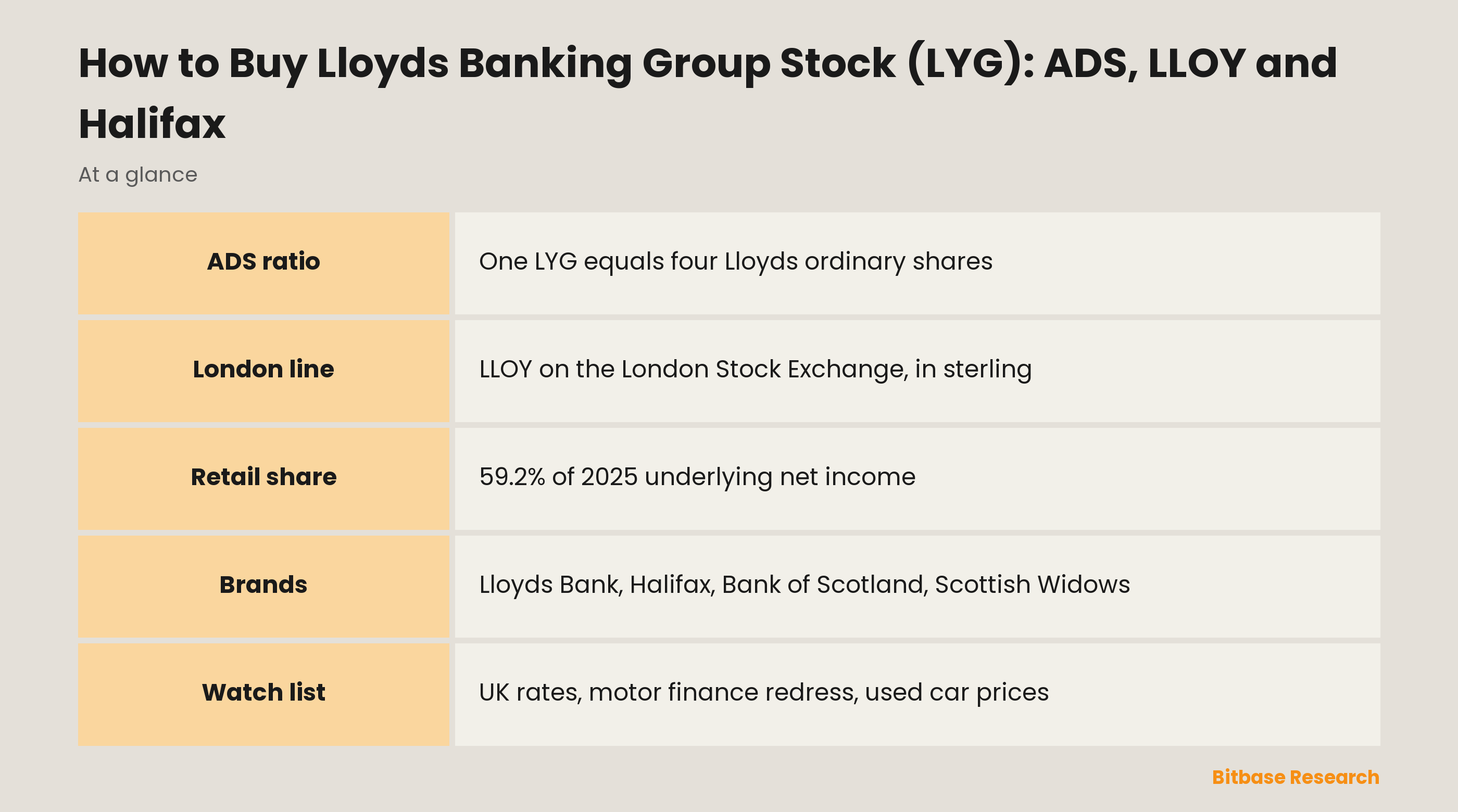
Another way to own a piece of Britain's high street from outside the UK is LYG, the New York-listed American depositary share (ADS) of Lloyds Banking Group: open an account with a broker that offers NYSE stocks, search for LYG and buy it like a US share, remembering that one ADS stands for four ordinary shares. The group behind the ticker owns Lloyds Bank, Halifax, Bank of Scotland and Scottish Widows, and in 2025 its Retail division produced 59.2% of underlying net income. This guide explains where that income comes from, how LYG relates to the London line LLOY, and what tends to move the shares.
What Does Lloyds Banking Group Do?
In its own words, Lloyds Banking Group is "a leading provider of financial services to individual and business customers in the UK." It counts about 28 million customers and says it runs the country's largest branch network and largest digital bank.
The brands are much older than the group. The 20-F traces its origins to Taylors and Lloyds, an 18th-century Birmingham bank. Lloyds Bank plc, incorporated in 1865, merged with TSB in 1995 and bought Scottish Widows in 2000; Halifax and Bank of Scotland had formed HBOS in 2001. Lloyds TSB completed its takeover of HBOS on 16 January 2009 and renamed itself Lloyds Banking Group. The parent is registered in Scotland, with its registered office in Edinburgh and principal executive offices in London.
The group reports three divisions and a fourth, smaller bucket:
Retail sells current accounts, savings, mortgages, credit cards, unsecured loans, motor finance and leasing to personal customers in the UK, plus a growing European business focused on mortgages and savings. The company describes itself as the UK's largest mortgage lender. Car finance runs under the Black Horse name, leasing through Lex Autolease and Tusker, the group's salary sacrifice car specialist.
Commercial Banking serves small and medium-sized businesses as well as corporate and institutional clients, with lending, transaction banking, working capital, debt financing and risk management.
Insurance, Pensions and Investments (IP&I) is built around Scottish Widows. It says it serves over 10 million customers and holds a top-three market share in home insurance, workplace pensions and individual annuities. In late 2025 it took full ownership of Schroders Personal Wealth, a former joint venture, and is rebranding it as Lloyds Wealth.
Equity Investments and Central Items holds LDC, the private equity arm, and Lloyds Living, the group's residential landlord business, together with income and costs not allocated to the divisions.
Since 1 January 2019, large UK banks have had to keep everyday personal banking apart from riskier activities such as investment banking, a regime known as ring-fencing. At Lloyds, the ring-fenced banks are Lloyds Bank plc and Bank of Scotland plc, which also carries the Halifax and MBNA businesses. Products not allowed inside the fence sit in Lloyds Bank Corporate Markets plc, insurance under Scottish Widows Group and equity investments under LBG Equity Investments. Since a PRA direction of 8 May 2026, directors of the two ring-fenced banks may also sit on the group board. In May 2026 the group also completed the purchase of Curve, a digital wallet that combines a customer's bank cards.
How Lloyds Banking Group Makes Money
Lloyds is above all a lender. In 2025, underlying net interest income, the gap between what it earns on loans and securities and what it pays for deposits and funding, made up 69.0% of its two main income lines. Fees, insurance, vehicle rentals and other income supplied the other 31.0%.
One accounting step matters for a bank with a large car fleet: in its underlying results, Lloyds deducts the depreciation on vehicles it leases out from income before it reports "net income." On that basis, 2025 split as follows:
| Division | What it sells | Share of 2025 underlying net income | Share of 2025 underlying profit |
|---|---|---|---|
| Retail | Current accounts, mortgages, cards, loans, car finance and leasing | 59.2% | 49.5% |
| Commercial Banking | Lending, transaction banking and markets products for businesses | 30.0% | 37.6% |
| Insurance, Pensions and Investments | Workplace pensions, annuities, home insurance, wealth | 7.0% | 4.9% |
| Equity Investments and Central Items | Private equity, rental homes, unallocated items | 3.9% | 8.0% |
Shares are calculated from the segment note of the 2025 annual report, on the underlying basis.
Retail brings in most of the income but a smaller share of profit, because it also bears the bulk of costs, impairments and remediation charges; Commercial Banking runs the other way. Across 2025, group underlying net income grew 6.9%: Retail grew 8.7%, Commercial Banking 4.6% and IP&I 10.7%, while IP&I's underlying profit rose 50%.
The engine under the interest margin is the structural hedge. Current accounts and some savings balances pay little and barely react to rate changes, so Lloyds hedges them, together with part of its equity, with longer-term fixed-rate assets and interest rate swaps that mature and are reinvested over time. At 30 September 2026 its weighted average life was about 3.75 years. As older positions are reinvested at higher rates, income climbs: the banking net interest margin reached 3.21% in the first nine months of 2026, against 3.04% a year earlier, partly offset by thinner mortgage margins and a competitive deposit market.
LYG Stock at a Glance
| Field | LYG |
|---|---|
| Issuer | Lloyds Banking Group plc, incorporated in Scotland (registered number SC095000) |
| US security | American depositary shares on the New York Stock Exchange, ticker LYG |
| ADS ratio | One ADS represents four ordinary shares |
| Ordinary shares | London Stock Exchange, ticker LLOY, priced in pounds sterling |
| ADS depositary | The Bank of New York Mellon |
| Sector | Banking, insurance and pensions |
| Index membership | FTSE 100 |
| Offices | Registered office in Edinburgh; principal executive offices at 33 Old Broad Street, London |
| Financial year | Calendar year, reported in pounds sterling under IFRS |
| Dividend policy | Interim and final ordinary dividends under a policy the board calls "progressive and sustainable," plus buybacks |
| SEC identifier | CIK 1160106; Form 20-F each year, Form 6-K for other news |
Quotes, market value and dividend yield move all day; for live numbers, see the Lloyds Banking Group stock page on Bitbase.
How to Buy Lloyds Banking Group Stock
Any broker that offers NYSE stocks can usually fill an order for LYG, which is quoted in US dollars during New York hours; the ordinary shares behind it trade in London as LLOY, in pounds sterling. The steps:
1. Pick a broker. LYG needs NYSE access; LLOY needs a broker that reaches the London Stock Exchange. Find out which legal entity keeps your account and who regulates it.
2. Open and verify the account. Expect identity checks and tax forms; the 20-F notes that US holders can face backup withholding without a correct taxpayer identification number.
3. Add money in the right currency. LYG settles in US dollars and LLOY in sterling, and the exchange spread on a currency conversion can matter more than the commission.
4. Find the correct line. Search for LYG and check that the description reads American depositary shares of Lloyds Banking Group plc. The 20-F cover also registers 29 series of Lloyds notes on the NYSE under symbols such as LYG26 or LYG33; those are bonds. EDGAR also lists two over-the-counter symbols, LLDTF and LLOBF, that the 20-F does not explain.
5. Set the order. A market order fills at whatever price is available; a limit order names the highest price you will accept.
6. Choose the size. One LYG equals four London shares, so compare prices after converting currency and multiplying by four. Bank ADSs do not share one ratio: an HSBC ADS stands for five shares and a Santander ADS for one. Ask your broker whether it sells fractions of an ADS.
7. Keep the paperwork. Hold on to trade confirmations and dividend statements; you will need them to work out gains and report income.
LYG or LLOY. Same company, same ordinary shares, different wrappers. On 5 February 2026 The Bank of New York Mellon held 4.07% of the issued share capital for the ADS programme; most registered shareholders are in the UK. ADS dividends are paid in US dollars through the depositary, which may take capped fees per ADS from cash distributions and once a year for its services. Voting also runs through the depositary: it agrees to "endeavor, in so far as practical, to vote" as instructed, and holders "will not be entitled to vote ordinary shares directly."
Stamp duty. Buying LLOY generally costs 0.5% in UK stamp duty or stamp duty reserve tax. Transfers of ADSs generally escape it, provided the transfer documents are signed and kept outside the UK. Moving ordinary shares into the ADS programme can trigger a 1.5% charge unless an exemption applies.
Withholding. According to the 20-F, the company "will not be required to withhold tax at source when paying a dividend on the ordinary shares or ADSs to a US holder." Your own country may still tax the payment. For certain individual US holders, dividends "may be taxable at favourable rates," subject to limitations, and the filing tells them to ask a tax adviser.
Through a fund. As a FTSE 100 constituent, Lloyds also turns up in funds that track large UK companies. The holdings file of the iShares MSCI United Kingdom ETF dated 29 October 2026, for example, includes Lloyds Banking Group's London line, LLOY.
What Moves LYG Stock
The direction of UK rates. With net interest income at roughly two-thirds of income, the Bank of England's rate path runs straight into earnings. The hedge spreads the effect over several years, but the risk factors are blunt: "if interest rates continue to lower, the Group may face reduced income." Deposit competition matters too: Retail deposits shrank in 2026 as Lloyds held back on pricing.
Motor finance commissions. In August 2025 the UK Supreme Court found an unfair relationship under the Consumer Credit Act in Johnson v FirstRand Bank, and in October 2025 the Financial Conduct Authority (FCA) proposed an industry redress scheme; Lloyds raised its provision in the third quarter of 2025. The FCA set out final rules in March 2026, and on 2 April 2026 Lloyds said it did not believe the provision needed to change. No further charges were taken in the first nine months of 2026, but four challenges to the scheme are listed for an Upper Tribunal hearing in the second half of February 2027, which delays implementation.
Used car prices. Leasing gives Lloyds direct exposure to vehicle values; Tusker's fleet passed 100,000 vehicles for the first time in the first half of 2026. Operating lease depreciation rose 17% in the first nine months of 2026, partly because of a second-quarter charge for lower used car prices. The risk factors add that the shift to electric vehicles could push average second-hand prices down.
Housing and household credit. As the UK's largest mortgage lender by its own description, Lloyds is exposed to house prices and to borrowers' ability to keep paying. The risk factors flag a "payment shock" for borrowers refinancing fixed-rate mortgages taken out before 2022.
Capital and distributions. Buybacks now follow a half-yearly review of excess capital. At 30 September 2026 the CET1 ratio was 13.3%, against a total regulatory CET1 requirement of about 12% and a board target of about 13.0% that includes a management buffer of about 1%; the board plans to pay down to that target by the end of 2026. New rules from 1 January 2027 cut the Pillar 2A part of the requirement from about 1.4% to about 1.2% of risk-weighted assets. The interim dividend for the first half of 2026 was 30% higher than a year earlier.
Five Warnings From the Lloyds Risk Filing
The January 2026 risk factor filing is long; five points stand out for anyone holding the shares.
One economy. The group is "particularly exposed to economic conditions in the UK, where the Group's earnings are predominantly generated and its operations are concentrated."
Provisions that prove too small. One heading warns that "Amounts eventually paid may materially exceed the amount of provisions set aside to cover such risks." Motor finance is the live example: the annual report calls the provision the group's "current best estimate" and says the final impact "could materially differ."
Resolution powers. Under the Banking Act 2009, UK authorities can sell, transfer, bail in or temporarily nationalise a failing bank, and the bail-in tool reaches equity as well as capital instruments and debt. Shares that result from such steps "may be subject to severe dilution, transfer for no consideration, write-down or write-off."
A holding company behind a fence. The listed parent depends on "distributions from operating subsidiaries," and ring-fencing rules can restrict what the ring-fenced banks pay upstream.
Dividends are a decision, not a promise. Another heading reads "The Company may not pay a dividend on its ordinary shares in any given financial/calendar year," and the 20-F adds that "profit growth may not necessarily result in increases in the dividend."
Then come the risks of any single stock. One bank concentrates your money in one balance sheet, and LYG is priced in dollars while the business earns in pounds, so for a dollar-based holder both price and dividend move with sterling.
Researching LYG: Filings, Results Dates and Quotes
Lloyds files with the SEC under CIK 1160106. The 20-F for 2025 arrived on 13 February 2026; results, buyback transactions, board changes and motor finance updates come as Form 6-K. The 20-F itself is a short wrapper, and most of the substance sits in the Annual Report and Accounts filed with it: the segment note splits income and profit by division, the provisions note covers motor finance, and a group structure section explains ring-fencing. The full risk factors were filed as a separate 6-K on 29 January 2026.
In 2026, full-year 2025 results came on 29 January, first-quarter results on 29 April, half-year results on 30 July and third-quarter results on 29 October; preliminary 2026 results are scheduled for 28 January 2027. The investor pages of lloydsbankinggroup.com carry the same documents.
When comparing years, check that segment figures share a basis: Lloyds re-presents comparatives when it changes how costs are allocated. Live quotes sit on the LYG page linked above, and Bitbase's US stock pages cover other companies.
Lloyds Banking Group Stock FAQ
How many Lloyds shares does one LYG ADS represent?
Four. Each LYG ADS represents four ordinary shares of Lloyds Banking Group plc, held by The Bank of New York Mellon as depositary. The ordinary shares themselves trade in London as LLOY. To compare the two prices, convert LLOY into dollars and multiply by four.
Does Lloyds Banking Group pay a dividend?
Yes. Lloyds pays an interim and a final dividend each year under a policy the board calls "progressive and sustainable," and returns surplus capital through buybacks as well. The ordinary dividend for 2025 was 15% higher than for 2024, but each payment is a board decision and is not guaranteed. ADS holders receive US dollars through the depositary.
Can I buy Lloyds Banking Group stock with crypto?
Not directly. LYG and LLOY are bought through a broker and settle in government currency, US dollars or pounds sterling. To use crypto, you would first sell it for one of those currencies and move the cash to your brokerage account; that sale can itself be a taxable event where you live.
Is Lloyds Banking Group the same as Lloyd's of London?
No. Lloyd's, with an apostrophe, describes itself as an insurance marketplace, and its name is a registered trademark of the Society of Lloyd's. Lloyds Banking Group is a bank group that traces its roots to Taylors and Lloyds in 18th-century Birmingham; its insurance business sits in the Scottish Widows group. The names are close; the organisations are different.
What is the motor finance commission issue?
It concerns the commission arrangements behind UK motor finance loans, some dating back to 2007. After an August 2025 Supreme Court ruling, the FCA designed a redress scheme and published final rules in March 2026. Lloyds holds a provision it calls its current best estimate; legal challenges to the scheme are listed before the Upper Tribunal in February 2027.
Conclusion
For a buyer outside Britain, the mechanics come down to one choice: LYG in New York, at four shares per ADS and in dollars, or LLOY in London, in sterling and with stamp duty. The bigger decision concerns the bank itself. Lloyds earns most of its money in the UK, so its results track Bank of England rates, house prices, used car values and a motor finance scheme still awaiting its tribunal hearing. Each quarterly statement updates that picture; read the newest one before deciding how much room one British lender deserves in a portfolio.
Related reading
Other Bitbase articles on this topic:
- How to Buy Citigroup Stock (C): Five Businesses, Banamex Exit
- How to Buy Deutsche Bank Stock (DB): Same Share as Frankfurt's DBK
- How to Buy HDFC Bank Stock (HDB): Three Shares per ADS, No Vote
Disclaimer: This article is educational content from Bitbase Academy, provided for information only. It explains what a company or fund does and how the instruments referenced here differ from one another; it does not constitute investment, trading, tax, or financial advice, and it is neither a recommendation nor an endorsement of any security, token, or trading strategy. A tokenized stock is issued by a third party and is designed to give economic exposure to an underlying asset: it is not a share, it carries no shareholder rights, and it depends on the issuer's structure, eligibility rules, and redemption terms, which the issuer can change. Perpetual futures are leveraged derivatives that hold no underlying asset and can be liquidated, and trading hours, product availability, and eligibility differ by instrument and by jurisdiction and can change at any time. Written as of October 2026; verify everything yourself through company filings, the issuer's own documentation, and the product pages of the venue you trade on.
References
[1] Lloyds Banking Group plc, Form 20-F for 2025 (SEC EDGAR) www.sec.gov
[2] Lloyds Banking Group plc, Annual Report and Accounts 2025, filed with the 20-F www.sec.gov
[3] Lloyds Banking Group plc 2025 Form 20-F, XBRL segment results www.sec.gov
[4] Lloyds Banking Group plc, description of securities and ADSs, filed with the 2025 Form 20-F www.sec.gov
[5] Lloyds Banking Group plc, risk factors, 29 January 2026 (Form 6-K) www.sec.gov
[6] Lloyds Banking Group plc, third-quarter 2026 results, 29 October 2026 (Form 6-K) www.sec.gov
[7] Lloyds Banking Group plc, 2026 half-year results, 30 July 2026 (Form 6-K) www.sec.gov
[8] Lloyds Banking Group plc, motor finance update, 2 April 2026 (Form 6-K) www.sec.gov
[9] Lloyds Banking Group plc, board changes after new ring-fencing governance, 22 October 2026 (Form 6-K) www.sec.gov
[10] SEC EDGAR company data for Lloyds Banking Group plc, CIK 1160106 data.sec.gov
[11] iShares MSCI United Kingdom ETF, fund page and holdings file (BlackRock) www.ishares.com
[12] Lloyd's, About Lloyd's (lloyds.com) www.lloyds.com





