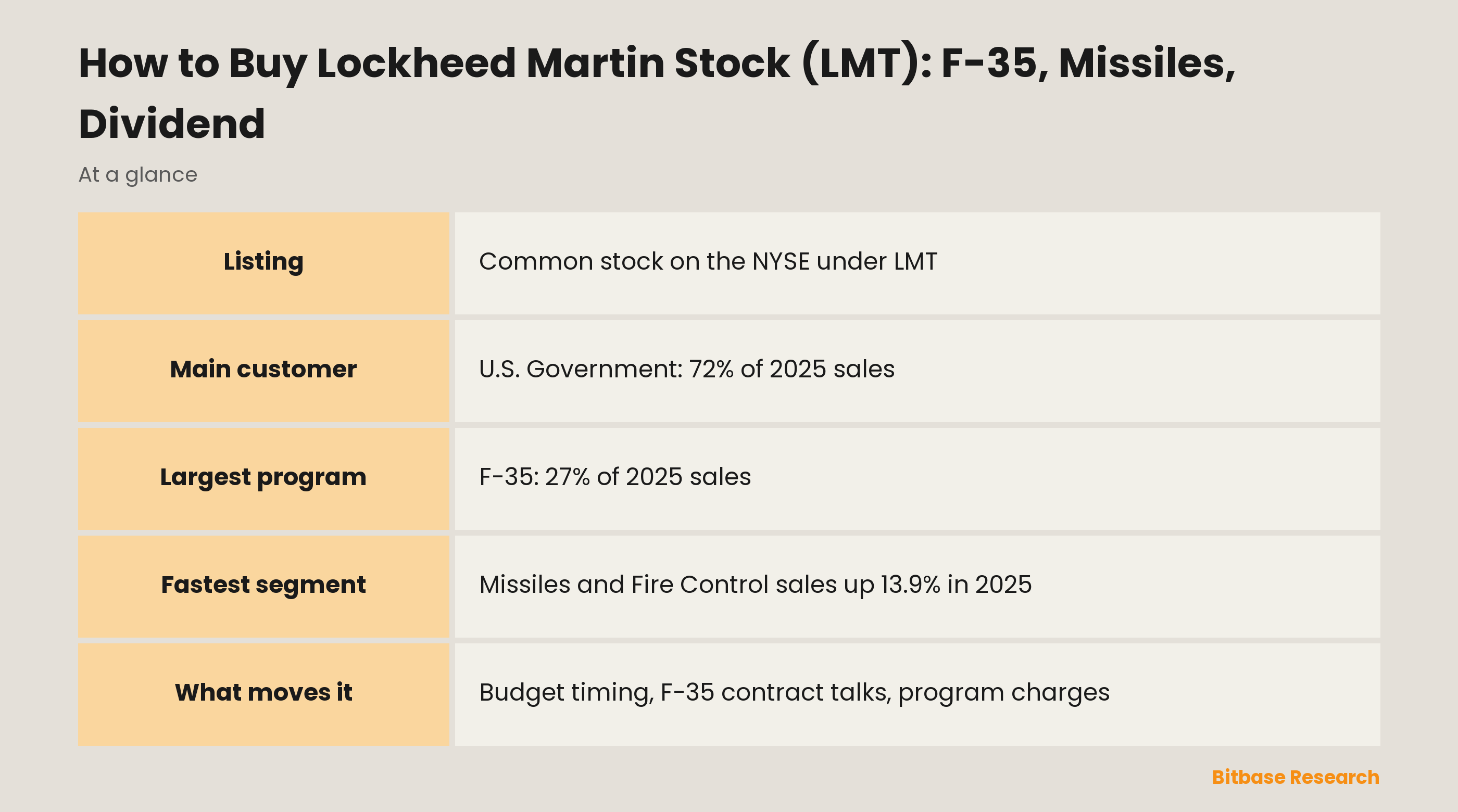
The usual route to Lockheed Martin stock is an ordinary brokerage account that can reach the New York Stock Exchange, where LMT is the symbol for its common shares. One customer dominates what that share buys into: 72% of 2025 sales came from the U.S. Government, and 27% from the F-35 fighter program alone. This guide covers the four segments, the order itself and what moves the shares, from missile output to budget timing.
What Does Lockheed Martin Do?
Lockheed Martin calls itself "a global aerospace and defense technology company." It is a Maryland corporation formed in 1995 by combining the businesses of Lockheed Corporation and Martin Marietta, headquartered in Bethesda, Maryland, and its principal customers are, in the 10-K's words, "agencies of the U.S. Government and allies." It reports four segments.
Aeronautics builds and supports military aircraft: the F-35 Lightning II, the C-130 Hercules, the F-16 and the F-22.
Missiles and Fire Control makes PAC-3 and THAAD interceptors, strike weapons such as JASSM and the Precision Strike Missile (PrSM), and rockets fired from HIMARS launchers. Javelin comes from a joint venture with RTX, which the 10-K also names as a primary competitor.
Rotary and Mission Systems (RMS) covers Sikorsky helicopters such as the Black Hawk, the Aegis combat system for warships, radars, and training and simulation.
Space builds GPS III satellites, the Trident II D5 submarine-launched missile, the Next Generation Interceptor (NGI) and NASA's Orion crew vehicle, and holds the company's stake in the United Launch Alliance joint venture.
All four segments also carry classified contracts, whose security rules, the 10-K notes, "limit our ability to discuss our performance on these contracts."
How Lockheed Martin Makes Money
The 10-K's segment note gives the 2025 split:
| Segment | Main programs | Share of 2025 sales | Sales change vs 2024 | 2025 operating margin |
|---|---|---|---|---|
| Aeronautics | F-35, C-130, F-16, F-22 | 40.3% | +5.7% | 6.9% |
| Rotary and Mission Systems | Sikorsky, Aegis, radars | 23.1% | +0.3% | 7.6% |
| Missiles and Fire Control | PAC-3, THAAD, JASSM, PrSM | 19.3% | +13.9% | 13.8% |
| Space | Trident II D5, GPS III, Orion, NGI | 17.4% | +4.4% | 10.3% |
All figures are calculated from segment sales and segment operating profit in the 10-K.
The F-35 alone generated 27% of total sales and 67% of Aeronautics' sales in 2025. The U.S. Government's stated objective is to procure 2,456 of the jets, and seven international partner countries and 12 foreign military sales customers have also committed to it.
In 2025, 72% of sales came from the U.S. Government, including 63% from the Department of War, the name the filing now uses for the Department of Defense. International customers supplied the other 28%, including foreign military sales contracted through Washington.
Fixed-price contracts produced about 60% of 2025 sales, and on the firm fixed-price kind, the 10-K says, "we carry the burden of any cost overruns." When a contract's estimated cost exceeds its price, the whole expected loss is recorded at once as a "reach-forward loss." Backlog grew 10% during 2025, and the company expected about 37% of it to become revenue within 12 months.
LMT Stock: Key Facts
| Field | LMT |
|---|---|
| Primary listing | New York Stock Exchange (NYSE) |
| Ticker | LMT |
| Security | Common stock, the only security registered on the 10-K cover |
| CUSIP | 539830109 |
| Sector | Aerospace and defense |
| Benchmark indexes | S&P 500 member; not a Dow Jones Industrial Average stock |
| Headquarters | Bethesda, Maryland |
| Incorporated | Maryland, 1995 |
| Fiscal year | Ends 31 December; the first three quarters close on a Sunday |
| Dividend policy | Quarterly cash dividend, raised in October 2026 for the 24th year in a row |
| SEC identifier | CIK 936468 |
Quotes date within minutes; for the live price, market value and dividend yield, open Bitbase's Lockheed Martin stock page.
How to Buy Lockheed Martin Stock
Lockheed Martin is a US company and the NYSE line is its own common stock, so there is no depositary receipt to think about:
1. Choose a broker with US market access. Abroad, that may be a local firm with a US-stocks service or an international brokerage; check who regulates it.
2. Open and verify the account. Non-US individuals normally complete IRS Form W-8BEN, which tells the broker whether a lower treaty rate applies.
3. Deposit money. Converting into US dollars has a price of its own, so compare it with the commission.
4. Find the right line. Search for LMT and confirm it reads Lockheed Martin common stock on the NYSE.
5. Decide how to order. A market order "guarantees that the order will be executed, but does not guarantee the execution price," while a limit order executes only "at a specific price or better," useful on earnings days.
6. Size the position. Buying part of a share lets you invest a fixed sum, though "not every brokerage firm offers fractional share investing" and a fraction may come without voting rights.
7. Keep the records of what you paid and the dividends received.
From abroad, tax comes off US dividends before they arrive. According to the IRS, "most types of U.S. source income received by a foreign person are subject to U.S. tax of 30%," and a tax treaty can lower that rate; your home country may tax the income again.
Through funds, you can hold Lockheed Martin without picking it: State Street's holdings files of 28 October 2026 list it in SPY, an S&P 500 tracker, and in XLI, an industrial sector fund.
What Drives LMT Stock
Budget timing. Under a continuing resolution, the 10-K warns, "new contract and program starts are restricted and funding for our programs may be unavailable, reduced or delayed." The latest 10-Q describes one: signed on 2 September 2026, it generally held funding at fiscal 2026 levels through 11 December 2026, with full-year fiscal 2027 appropriations unfinished.
F-35 contract talks. The company is still negotiating production contracts for Lots 20 and higher, and its costs on the Lot 20 advance acquisition contract began to exceed the current contractual authorization and funding in the third quarter of 2026. Without more, results "will be negatively impacted in future periods."
Missile production rates. In 2026 the company signed multi-year contracts to raise PAC-3 MSE and THAAD output, plus framework agreements for PrSM and the Joint Advanced Tactical Missile. In the third quarter of 2026, Missiles and Fire Control sales rose 24% on production ramps for PAC-3, THAAD, GMLRS and PrSM, against 11% for the whole company.
Program charges. In 2025 the company booked reach-forward losses on a classified Aeronautics program and, at RMS, on the Canadian Maritime Helicopter Program and the Türkish Utility Helicopter Program. Aeronautics' operating profit fell 17% and RMS's 31% that year, although both segments' sales grew.
Risks to Weigh Before Buying LMT
Item 1A is long; these five risk factors weigh most on an LMT share:
One dominant customer. "We depend heavily on contracts with the U.S. Government for a substantial portion of our business," and government terms allow contracts to be ended "for convenience."
The F-35. The program "comprises a material portion of our revenue"; supplier performance, software development and timely contract funding are among its listed challenges.
Cost estimates. "Our profitability and cash flow may vary based on the mix of our contracts and programs, our performance, and our ability to estimate and control costs."
Suppliers. "We are heavily dependent on suppliers," and some products need "relatively scarce raw materials, such as rare earth minerals."
Capital returns. "There can be no assurance that we will continue to pay or increase our dividend," and payouts and buybacks "may also be impacted by the implementation of presidential executive orders."
A single stock also ties your result to one company, and if you buy with another currency, the exchange rate becomes part of your return.
How to Research LMT Yourself
Lockheed Martin's SEC filings sit under CIK 936468: a 10-K each year, 10-Qs for the first three quarters, and 8-Ks for events such as quarterly results.
In the 10-K, Item 1 describes the segments, Item 1A the risks, and the segment note splits sales by contract type, customer and region. Its stockholder return graph compares LMT with the S&P 500 and with the S&P Aerospace & Defense Index.
One detail helps with comparisons: interim quarters end on the last Sunday of the quarter's final month, so the third quarter of 2026 closed on 27 September. For other companies, browse Bitbase's US stock pages.
Lockheed Martin Stock FAQ
Does Lockheed Martin pay a dividend?
Yes, quarterly. In October 2026 the company authorized a higher fourth-quarter payment, and its chief executive said that let it "raise our dividend for the 24th year in a row." The 10-K stresses there is "no assurance" it will continue.
Can I buy Lockheed Martin stock with crypto?
No. Brokers sell LMT shares for US dollars, so crypto would first have to be converted to cash, possibly a taxable disposal where you live, and then moved into the brokerage account. The result is a registered share with voting and dividend rights, not the same kind of asset as a cryptocurrency.
How much of Lockheed Martin's revenue comes from the US government?
In 2025, 72%, including 63% from the Department of War; international customers, foreign military sales included, made up the other 28%.
Is LMT in the S&P 500 or the Dow?
Only the S&P 500. State Street's SPY holdings file dated 28 October 2026 lists Lockheed Martin, while its DIA file of the same day, which covers the 30 Dow Jones Industrial Average stocks, does not.
Who are Lockheed Martin's main competitors?
The 10-K names Boeing, General Dynamics, L3Harris Technologies, Northrop Grumman and RTX, and notes that a losing bidder may become the winner's subcontractor.
Conclusion
The purchase itself is routine: a broker that reaches the NYSE, the common stock line, then a limit or market order. The harder question is what the share concentrates: 72% of 2025 sales from one government, 27% from one aircraft, and profits exposed to fixed-price estimates. Budget timing, the Lot 20 talks and missile output are what the next 10-Q will update; read it before you size a position in a single defense contractor.
Related reading
Other Bitbase articles on this topic:
- How to Buy Fastenal Stock (FAST): Vending, Onsites and Splits
- How to Buy FedEx Stock (FDX): After the Freight Spin-Off
- How to Buy Garmin Stock (GRMN): Wearables, Taiwan, Swiss Dividend
Disclaimer: This article is educational content from Bitbase Academy, provided for information only. It explains what a company or fund does and how the instruments referenced here differ from one another; it does not constitute investment, trading, tax, or financial advice, and it is neither a recommendation nor an endorsement of any security, token, or trading strategy. A tokenized stock is issued by a third party and is designed to give economic exposure to an underlying asset: it is not a share, it carries no shareholder rights, and it depends on the issuer's structure, eligibility rules, and redemption terms, which the issuer can change. Perpetual futures are leveraged derivatives that hold no underlying asset and can be liquidated, and trading hours, product availability, and eligibility differ by instrument and by jurisdiction and can change at any time. Written as of October 2026; verify everything yourself through company filings, the issuer's own documentation, and the product pages of the venue you trade on.
References
[1] Lockheed Martin Form 10-K, fiscal 2025: business, segment sales, customers, backlog and risk factors (SEC EDGAR) www.sec.gov
[2] Lockheed Martin Form 10-Q for the quarter ended 27 September 2026: F-35 Lot 20 status, multi-year munitions contracts, budget and dividend (SEC EDGAR) www.sec.gov
[3] Lockheed Martin third-quarter 2026 results release, 22 October 2026 (Form 8-K exhibit, SEC EDGAR) www.sec.gov
[4] State Street SPDR S&P 500 ETF Trust (SPY): fund page and daily holdings www.ssga.com
[5] State Street SPDR Dow Jones Industrial Average ETF Trust (DIA): fund page and daily holdings www.ssga.com
[6] State Street Industrial Select Sector SPDR ETF (XLI): fund page and daily holdings www.ssga.com
[7] Investor.gov (SEC): Types of Orders www.investor.gov
[8] Investor.gov (SEC): Investor Bulletin on fractional share investing www.investor.gov
[9] IRS: NRA Withholding www.irs.gov





