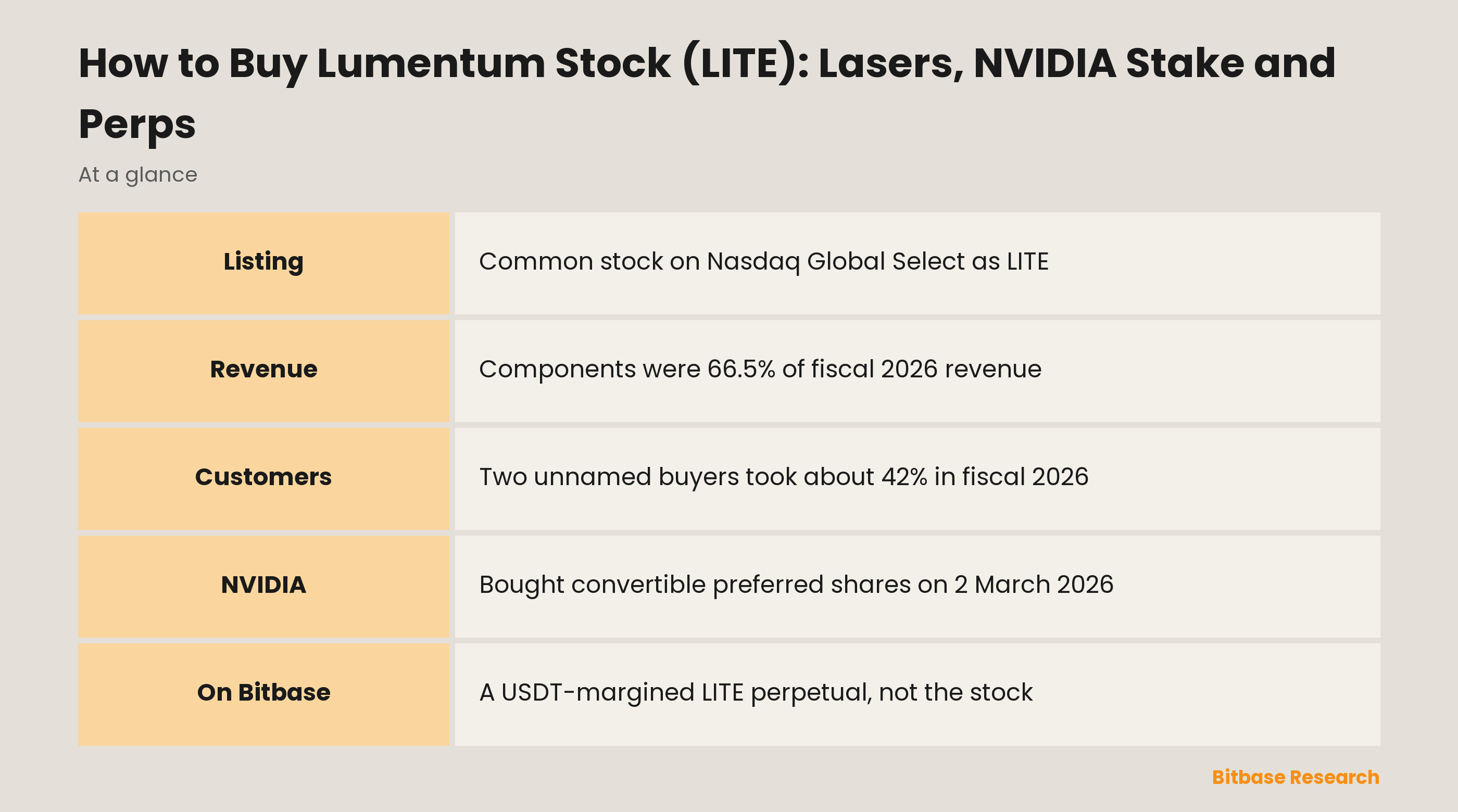
These are the three things a Lumentum stock purchase takes: a brokerage account that reaches the Nasdaq Global Select Market, money in it, and an order for the ticker LITE. The company makes the laser chips, optical modules and switches that carry data through AI data centers and telecom networks, and in March 2026 NVIDIA took a stake through convertible preferred shares alongside a non-exclusive, multi-year purchase agreement. On Bitbase, LITE exists only as a perpetual futures contract settled in USDT, which follows the share price, keeps trading while Nasdaq is closed and gives no ownership.
What Does Lumentum Do?
Lumentum describes itself as "a global leader in optical and photonic technologies." Put simply, it builds the parts that turn electrical signals into light so data can travel through optical fiber: semiconductor lasers, the modules that package them, and equipment that switches and amplifies light across a network.
Revenue is reported in two product types. Components are building blocks that other manufacturers fit into their own equipment: laser chips, laser sub-assemblies, line subsystems and wavelength management systems, sold to cloud data center operators, AI infrastructure providers and network equipment makers. Systems are complete products that work on their own: optical transceiver modules, optical circuit switches, and industrial lasers from short-pulse solid-state units to kilowatt-class fiber lasers.
Inside a data center, these products link servers, AI accelerators, storage and network switches, the category of equipment that Arista Networks sells. The 10-K describes cloud operators wiring AI clusters with optics in three ways: scale-out links across a facility, where 200G-per-lane components double the data rate of 100G lanes; scale-up links that tie GPUs and other accelerators into one compute fabric; and scale-across links between distant data centers. AI workloads, it says, are "shifting infrastructure from traditional copper interconnects to high-speed photonics."
Beyond the data center, Lumentum supplies telecom networks from local access to long-haul and undersea routes with tunable transceivers, coherent components, reconfigurable optical add-drop multiplexers (ROADMs), amplifiers and pump lasers. Its industrial lasers cut sheet metal, drill circuit boards and scribe solar cells, and its vertical-cavity surface-emitting lasers (VCSELs) light the 3D-sensing cameras in smartphones and computers.
The company was incorporated in Delaware on 10 February 2015 as a subsidiary of JDS Uniphase (JDSU), built from its communications and commercial optical products segment, and was spun off that August; JDSU became Viavi Solutions. Acquisitions followed: Oclaro in 2018, NeoPhotonics and IPG Photonics' telecom transmission lines in 2022, and Cloud Light in November 2023. A reorganization in fiscal 2026 merged the former Cloud & Networking and Industrial Tech segments into one.
Headquarters are in San Jose, California, and Michael Hurlston is president and chief executive. At the end of fiscal 2026 there were approximately 13,757 full-time employees, about 11,916 of them in manufacturing. Main plants are in the United States, Thailand, China, the United Kingdom, Slovenia and Japan, with contract manufacturers in Thailand, Taiwan, Malaysia and the Philippines; in March 2026 Lumentum bought an operating fabrication plant in Greensboro, North Carolina. The 10-K names no rivals, saying only that some competitors "are also our customers for certain of our products."
How Lumentum Makes Money
The fiscal year ends on the Saturday closest to 30 June; fiscal 2026 ended on 27 June 2026. Most revenue comes from hardware sales recognized when products ship or are delivered, and the company cautions that its backlog is not a reliable guide to future revenue.
In fiscal 2026, Components made up 66.5% of net revenue and Systems 33.5%, against 67.9% and 32.1% in fiscal 2025 and 60.5% and 39.5% in fiscal 2024. Revenue rose 83.2% in fiscal 2026, after 21% growth the year before; Components grew 79.7% and Systems 90.7%.
The filing attributes 78% of the Components increase to higher shipments of laser chips and laser assemblies, with demand "across intra-data center, data center interconnect, and long-haul applications," plus a slight rise in laser-chip prices as customers moved to 200G lanes. In Systems, cloud transceiver lines grew by more than 173% on volume, partly offset by lower selling prices, and optical circuit switches were in their first phase of shipments.
Margins moved further still. Gross margin was 41.7% in fiscal 2026, against 28% in fiscal 2025 and 18.5% in fiscal 2024, mainly because Lumentum's own factories ran fuller and the mix shifted toward higher-margin products. Operating income reached 17.4% of revenue, after an operating loss of 10.9% the year before. Even so, the year closed with a net loss: in the fourth quarter Lumentum issued about 10.6 million shares to retire part of three convertible note series, and the conversion value above principal was booked as a loss on debt extinguishment.
Two end customers dominate, identified only as Customer A and Customer B. A accounted for 26.6% of fiscal 2026 revenue, up from 15.4% in fiscal 2025 and 18.9% in fiscal 2024; B for 15%, after 16% and 11.4%. Together that is about 42% of fiscal 2026 revenue from two undisclosed buyers.
By country of first shipment, 79.2% of fiscal 2026 revenue came from outside the United States: the United States and Thailand each took 20.8%, Hong Kong 17.2%, Mexico 14.7% and China 9.4%. Those figures follow delivery addresses, often contract manufacturers' factories, not customer headquarters. One former customer is gone altogether: Lumentum stopped all shipments to Huawei, "historically our largest networking customer in China," at the beginning of 2024.
LITE Stock at a Glance
| Item | Detail |
|---|---|
| Exchange | Nasdaq Global Select Market |
| Ticker | LITE |
| Listed security | Common stock, the only class registered for exchange trading |
| Other equity | Series A Convertible Preferred Stock, sold privately to NVIDIA in March 2026 |
| Depositary receipt | None: LITE is the common stock of a Delaware company |
| CUSIP | 55024U109 |
| Industry | Optical and photonic products |
| Reporting | One segment since fiscal 2026; revenue split into Components and Systems |
| Index membership | S&P 500 and Nasdaq-100, per SPY and QQQ holdings on 29 October 2026 |
| Headquarters | San Jose, California |
| Public since | 4 August 2015, after the spin-off from JDSU |
| Fiscal year | Ends on the Saturday closest to 30 June |
| Dividend policy | No cash dividend expected in the foreseeable future |
| SEC identifier | CIK 1633978 |
Quotes change by the second, so none appear here; the Lumentum stock page on Bitbase carries the live price and chart.
How to Buy Lumentum Stock
A purchase through a broker usually runs like this:
1. Find a broker that offers US-listed shares to residents of your country.
2. Complete the account checks. Expect identity verification; a non-US resident is normally asked for IRS Form W-8BEN, which declares foreign status for US tax purposes.
3. Deposit money. Funding in a currency other than US dollars adds an exchange rate and possibly a conversion fee to the cost.
4. Look up LITE and confirm that the listing reads Lumentum Holdings Inc. common stock.
5. Set the order type. A market order fills at the going price; a limit order caps what you pay and may not fill.
6. Decide on size. Whole shares, or a fraction of one where the broker offers fractional trading.
For buyers outside the United States, there is no depositary receipt or ratio to check: LITE is the company's ordinary common stock, whichever broker holds it. With no cash dividend expected, US dividend withholding has nothing to apply to for now; the tax on a profitable sale depends on your home country's rules.
Through index funds, you can hold a small slice indirectly. On 29 October 2026 Lumentum was among the holdings of SPY, which tracks the S&P 500, and of QQQ, which tracks the Nasdaq-100, in each case one holding among many.
Trading LITE on Bitbase
On Bitbase, LITE is a futures market rather than a share register. The LITE perpetual futures contract is margined and settled in USDT and is designed to track Lumentum's Nasdaq price, with no Lumentum share or tokenized share behind it.
It differs from owning the stock in three ways. A position has no expiry; it lasts until closed or liquidated. Going short is as available as going long, and leverage enlarges both outcomes. Trading continues through nights, weekends and holidays, when Nasdaq is shut. The holder receives no shares, no vote and no claim on anything in Lumentum's capital structure.
Periodic funding payments pass between long and short holders, with the more crowded side paying the other, which keeps the contract near the stock. Liquidation is triggered on the mark price rather than the last trade once margin can no longer support a position. Because the contract trades while the stock does not, news released while Nasdaq is closed can make the next open land well away from the perpetual's last price. A separate guide covers the liquidation mechanics of a stock perpetual.
The funding interval and formula, margin tiers, maximum leverage, and how mark price and funding are handled while Nasdaq is closed are set in the LITE contract rules; check them before trading. Bitbase's other stock-linked markets are on its TradFi page.
What Moves LITE Stock
AI and cloud data-center spending. The 10-K says demand from AI and cloud customers "is outpacing our current supply which has required us to make decisions on supply allocation," and capacity is being added in Lumentum's own plants and at contract manufacturers. It also warns that demand in AI-driven markets "may change and is difficult to predict."
The two largest customers. With one end customer at 26.6% of fiscal 2026 revenue and another at 15%, a change in either one's orders reaches results directly. Most customers have no contractual purchase commitment and "may alter their purchasing behavior with little or no notice."
Lane speeds and prices. Speed upgrades have helped prices lately: part of fiscal 2026's growth came from slightly higher laser-chip prices as 200G lanes spread. The longer pattern runs the other way. Optical communications products "have increasingly become subject to commoditization," mainly Asia-based competitors have added pricing pressure, and the company expects declines in average selling prices in some areas to continue.
Capacity and the NVIDIA agreement. Because supply is the stated constraint, capacity steps matter: Greensboro, contract manufacturers and the March 2026 agreements with NVIDIA. The joint press release describes a non-exclusive, multi-year deal that "includes an NVIDIA multi-billion purchase commitment and future capacity access rights for advanced laser components," with NVIDIA's investment supporting research, capacity and a new US fab. Hurlston said Lumentum is "investing in a new fabrication facility to increase capacity and accelerate innovation."
Trade policy and export controls. US tariffs through 2025 and 2026, a Section 232 investigation into semiconductors and their derivative products opened on 14 April 2025, and China's export controls on rare earths and other critical minerals all bear on costs or supply. Export rules have already removed one customer: business with Huawei is "now completely restricted," and the company "may never recover this demand even if such export restrictions ease."
Convertible notes and the share count. Lumentum has convertible notes due in 2026, 2028, 2029 and 2032. Principal must be paid in cash on conversion; value above it can be settled in cash, shares or both, at the company's choice. Because the stock stayed above each series' price trigger late in fiscal 2026, all four series were convertible at holders' option in the first quarter of fiscal 2027. NVIDIA's preferred shares convert one-for-one into common stock once the Hart-Scott-Rodino antitrust waiting period expires or ends. Both change the share count behind every per-share figure.
How the Lumentum Story Could Break
Concentration without commitments. Lumentum leans on two dominant customers, and "the majority of our customers do not have contractual purchase commitments." Orders can fall quickly, and customers may turn to "their own product solutions" or to competitors.
Supply and execution. Some components come under "sole or limited source supply arrangements." If demand outruns forecasts, the company may fail to scale in time, with lost revenue and "decisions on supply allocation" among the consequences it lists; new products depend on factory ramps that can slip.
Regulators and geography. BIS and the US Department of Justice have both issued subpoenas about Lumentum's past business with Huawei, and the company has made voluntary self-disclosures to BIS. Thailand hosts company plants and contract manufacturers, and the 10-K's geopolitical list includes China-Taiwan relations and the conflict between Cambodia and Thailand.
Dilution. "Transactions relating to our convertible notes may dilute the ownership interest of existing stockholders, or may otherwise depress the price of our common stock," the 10-K warns.
The share price. One risk factor reads: "Our stock price may be volatile and may decline regardless of our operating performance." With no dividend planned, the success of an investment "will depend on future appreciation in its value."
The perpetual's added risks. Losses grow with leverage, funding keeps flowing for as long as a position is open, and if Lumentum's shares reopen far from Friday's close, a leveraged position can be liquidated before its holder reacts.
How to Research LITE Yourself
Lumentum files with the SEC under CIK 1633978. The fiscal 2026 Form 10-K, filed on 17 August 2026, covers the business in Item 1 and risks in Item 1A; its management discussion holds the Components and Systems split, the customer table and revenue by ship-to country, and its notes give the terms of NVIDIA's preferred stock and each convertible note. Quarterly results arrive on Form 8-K; the one dated 2 March 2026 carries the joint press release with NVIDIA. The fiscal 2015 10-K records the spin-off terms, and investor.lumentum.com gathers filings and results.
Lumentum Stock FAQ
Does Lumentum pay a dividend?
No. The 10-K states: "We do not expect to pay cash dividends on our common stock in the foreseeable future." Any future dividend would be for the board to decide.
Can I buy Lumentum stock with crypto?
Not with the crypto itself. A broker sells the shares for US dollars, so any crypto would need to be sold for cash first. What Bitbase offers instead is the LITE perpetual, traded with USDT: it moves with Lumentum's share price, but as a derivative it pays no dividend, has no vote and can be liquidated.
How did Lumentum become a public company?
Through a spin-off. On 1 August 2015, JDSU distributed 80.1% of Lumentum's shares to its stockholders, one LITE share for every five JDSU shares held on the 27 July 2015 record date. JDSU kept 19.9% and was renamed Viavi Solutions, and LITE began regular-way trading on Nasdaq on 4 August 2015.
What did NVIDIA buy in Lumentum?
On 2 March 2026, NVIDIA bought 2,876,415 shares of Series A Convertible Preferred Stock in a private placement. Each converts into one common share once the Hart-Scott-Rodino waiting period has expired or been terminated. The preferred shares share in any dividend on an as-converted basis and vote with the common stock on everything except the election of directors.
Is Lumentum in the S&P 500?
Yes, going by fund holdings. On 29 October 2026, LITE was among the holdings of SPY, which tracks the S&P 500, and of QQQ, which tracks the Nasdaq-100. Index lists are revised from time to time, so a current holdings file is the check.
When does Lumentum report earnings?
Quarterly. Fiscal 2026 results came on Form 8-K on 4 November 2025, 3 February 2026, 5 May 2026 and 11 August 2026, and the 10-K followed on 17 August 2026.
Conclusion
Buying Lumentum stock is a standard broker order for LITE on Nasdaq; the work lies in reading what sits behind the ticker. Fiscal 2026 growth came mainly from laser chips and cloud transceivers, two unnamed customers accounted for about 42% of revenue, and supply is the constraint the company itself describes. NVIDIA's convertible preferred stake and four series of convertible notes each affect the share count. The Bitbase perpetual is a separate instrument: it tracks the price with leverage and owns nothing in the company.
Related reading
Other Bitbase articles on this topic:
- How to Buy Hewlett Packard Enterprise Stock (HPE): After Juniper
- How to Buy Motorola Solutions Stock (MSI): Radios, Video and 911
- How to Buy Sony Stock (SONY): PlayStation, Sensors and 24/7 Perps
Disclaimer: This article is educational content from Bitbase Academy, provided for information only. It explains what a company or fund does and how the instruments referenced here differ from one another; it does not constitute investment, trading, tax, or financial advice, and it is neither a recommendation nor an endorsement of any security, token, or trading strategy. A tokenized stock is issued by a third party and is designed to give economic exposure to an underlying asset: it is not a share, it carries no shareholder rights, and it depends on the issuer's structure, eligibility rules, and redemption terms, which the issuer can change. Perpetual futures are leveraged derivatives that hold no underlying asset and can be liquidated, and trading hours, product availability, and eligibility differ by instrument and by jurisdiction and can change at any time. Written as of October 2026; verify everything yourself through company filings, the issuer's own documentation, and the product pages of the venue you trade on.
References
[1] Lumentum Form 10-K, fiscal 2026 (SEC EDGAR) www.sec.gov
[2] Lumentum Form 8-K, March 2026: preferred stock sold to NVIDIA (SEC EDGAR) www.sec.gov
[3] NVIDIA and Lumentum joint press release, March 2026 (SEC EDGAR) www.sec.gov
[4] Lumentum Form 10-K, fiscal 2015: spin-off from JDSU (SEC EDGAR) www.sec.gov
[5] State Street: SPY daily holdings, 29 October 2026 www.ssga.com
[6] Invesco QQQ: fund overview and holdings (tracks the Nasdaq-100) www.invesco.com





