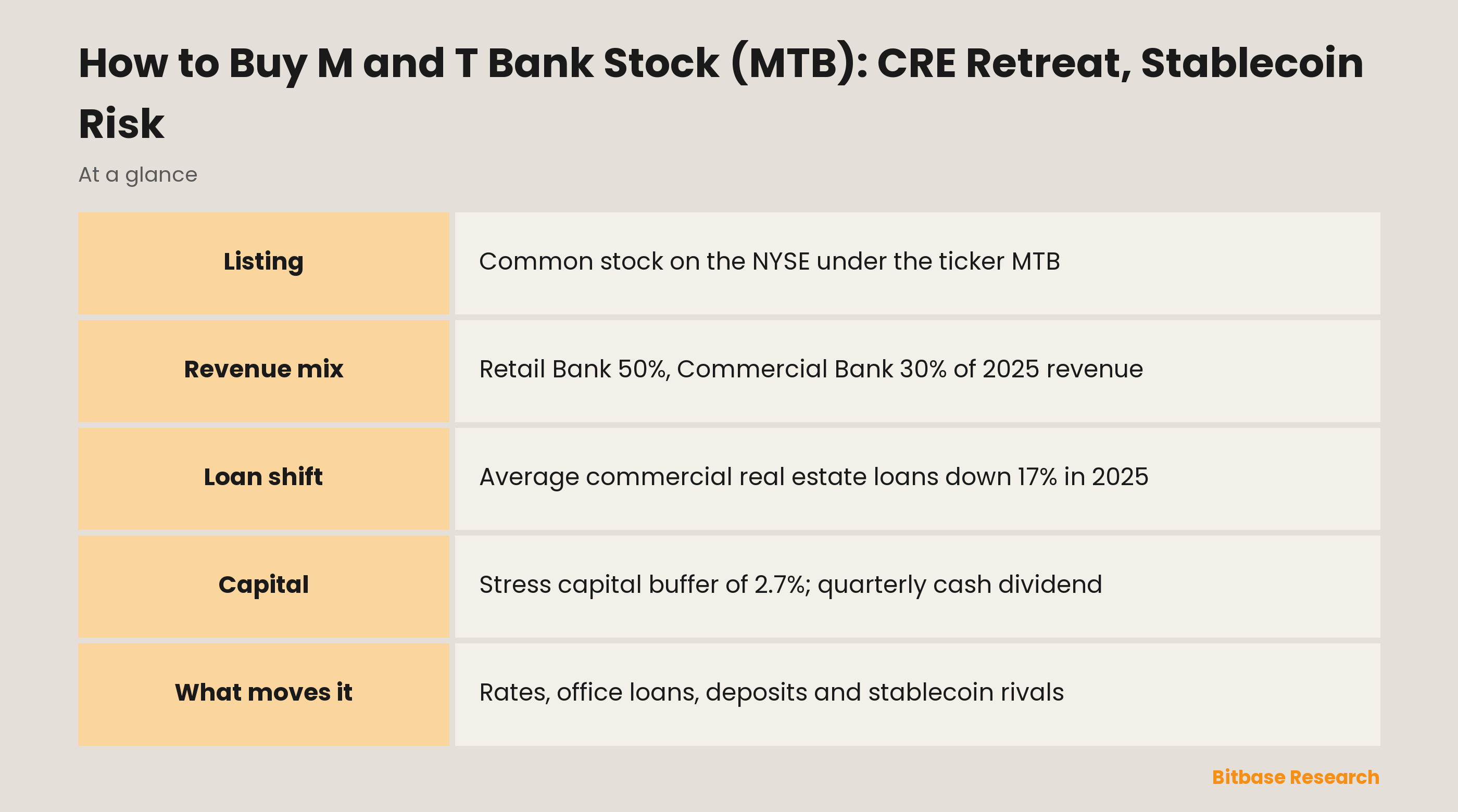
Owning shares of M&T Bank takes only a broker with NYSE access, because that is where M&T Bank Corporation's common stock is listed under the ticker MTB. Behind the ticker is a Buffalo lender whose banking business dates back to 1856, and whose latest annual report holds two surprises for a crypto reader: an account of two years spent shrinking its commercial real estate book, and a warning that payment stablecoins could stand in for bank deposits.
What Does M&T Bank Do?
M&T Bank Corporation is a bank holding company, incorporated in New York in November 1969 and supervised by the Federal Reserve. It owns two banks. M&T Bank, legally Manufacturers and Traders Trust Company, is a New York-chartered commercial bank that holds over 99% of the group's assets; its state charter dates from 1892 and its business from 1856. Wilmington Trust, N.A. is a small national bank serving institutional and wealth clients. Until 1998 the holding company's SEC filings carried the name First Empire State Corporation.
At the end of 2025 M&T Bank had 942 domestic banking offices in 12 states and the District of Columbia, from Maine down to Virginia and West Virginia, plus one commercial office in Ontario. Its most recent large acquisition, People's United Financial, closed on 1 April 2022, and People's United Bank was merged into M&T Bank. International activity accounts for under 1% of assets and revenue.
The company reports three segments. Commercial Bank lends to middle-market and large companies, finances commercial property, and offers deposits and cash management; it also originates and services property loans through the Fannie Mae DUS program. Retail Bank serves individuals and small firms via branches, digital banking and ATMs, taking deposits and making auto and recreational vehicle loans, mostly arranged through dealers, plus home equity loans, credit cards and mortgages. Institutional Services and Wealth Management works as trustee, agent and investment manager for institutions and provides trust, planning and family office services to wealthy families. René F. Jones is chairman and chief executive.
How M&T Bank Makes Money
Most revenue comes from the spread between what M&T collects on loans and securities and what it pays out on deposits and borrowings. In 2025 net interest income was about 72% of segment revenue, with fees and other noninterest income supplying the other 28%.
| Segment | Share of 2025 revenue | Share of 2025 net income | Main customers |
|---|---|---|---|
| Retail Bank | 50% | 51% | Consumers and small businesses |
| Commercial Bank | 30% | 32% | Middle-market and large companies |
| Institutional Services and Wealth Management | 16% | 18% | Institutions and wealthy families |
Percentages are worked out from the segment note in the 10-K, with revenue defined as net interest income plus noninterest income. An "All Other" line, which holds the securities portfolio, acquisition intangibles and unallocated costs, took about 3% of revenue and almost none of the profit.
In 2025 net interest income rose 1% and noninterest income 13%, lifted by mortgage banking, deposit service charges and trust income, which grew 7%. The net interest margin rose to 3.67% from 3.58% in 2024, though it stayed below the 3.83% of 2023; interest rate swaps had cut it by 0.22 percentage points in 2024 but by only 0.08 points in 2025. The provision for credit losses fell 17% and net income rose 10%. Diluted earnings per share climbed 16%, the faster pace reflecting a smaller share count after M&T repurchased 14.3 million shares.
The loan book explains the risk profile. Average 2025 loans split roughly into commercial and industrial at 45%, commercial real estate at 18%, residential mortgages at 18% and consumer loans at 19%. The 10-K says M&T "executed various strategies to lessen its relative concentration of commercial real estate loans and to reduce the amount of criticized loans in this category throughout 2024 and 2025." Average commercial real estate balances fell 17% in 2025 after a 12% decline in 2024, while recreational finance loans grew 19%.
On the funding side, core deposits, meaning checking, savings and smaller time deposits, made up about 92% of average deposits in 2025, a base the 10-K calls "a sizeable source of relatively stable and low-cost funds."
MTB Stock at a Glance
| Feature | MTB |
|---|---|
| Exchange | New York Stock Exchange (NYSE) |
| Ticker | MTB |
| Security | Common stock, the only common class registered; preferred series have their own symbols |
| Sector | Regional banking: retail, commercial, trust and wealth services |
| Banks owned | M&T Bank and Wilmington Trust, N.A. |
| Index membership | S&P 500; also held by the Financial Select Sector SPDR ETF (XLF) |
| Headquarters | Buffalo, New York |
| Incorporated | New York, November 1969 |
| Fiscal year | Calendar year, ending 31 December |
| Dividend | Quarterly cash dividend |
| Supervision | Federal Reserve; Category IV under the US Tailoring Rules |
| SEC identifier | CIK 36270 |
Quotes, market value and dividend yield move every session, so they are left out here; the M&T Bank stock page on Bitbase carries them in real time.
How to Buy M&T Bank Stock
MTB is a plain NYSE listing, so the purchase looks the same at most brokers that offer US shares:
1. Choose a broker. Pick a regulated brokerage that can reach US-listed stocks from your country, and compare fees and currency conversion costs.
2. Open and fund the account. Expect identity checks; money deposited in another currency is converted into US dollars.
3. Find the right line. Search for MTB and confirm the description says M&T Bank Corporation common stock. The preferred shares trade under other symbols.
4. Decide how to order. In FINRA's words, a market order "provides the most certainty that your order will be executed because it's not tied to any restrictions," while a limit order trades "at or better than a specified price." A limit protects your price but may not fill.
5. Set the size and keep records. Buy whole shares or, where offered, a fraction, and note the date, price and fees for tax purposes.
Fractional shares. FINRA notes that some brokers have "more limited availability" or "don't offer fractional share trading at all," and warns: "As a fractional share owner, you might not have shareholder voting rights."
Buying from outside the United States. MTB is ordinary US common stock, not a depositary receipt, so an international broker buys the same NYSE line. Dividends are US-source income: the IRS says "Most types of U.S. source income received by a foreign person are subject to U.S. tax of 30%," with a lower rate possible under a tax treaty. Brokers usually ask for Form W-8BEN, which the IRS says to submit "when requested by the withholding agent or payer." Your home country may tax the dividend as well.
Holding it through a fund. As an S&P 500 member, M&T sits in index funds that track that benchmark, and in financial sector funds such as XLF. A fund spreads risk but dilutes any view you hold on M&T itself.
What Moves MTB Stock
Rates and the margin. The risk summary says it directly: "The Company's business and financial performance is impacted significantly by market interest rates and movements in those rates." M&T's own simulation at the end of 2025 projected net interest income slightly lower, by less than 1%, under either a gradual 200-basis-point rise or fall. In the third quarter of 2026 the margin narrowed from the second, which the 10-Q puts down to rates paid on liabilities rising faster than yields on earning assets.
Commercial property. The risk factors single out "the concentration of commercial real estate loans in the Company's loan portfolio, including construction loans, loans secured by office, retail, health services, hospitality and multifamily properties and loans secured by property in the New York City and certain other large metropolitan areas." Nonaccrual loans, those no longer booking interest, stood at 0.90% of total loans when 2025 closed, down from 1.25% a year before and 1.62% two years before. Reserves against office loans still stood at 4.65% of those balances, and about 83% of the commercial real estate portfolio carries adjustable rates.
Deposits and a new rival. The 10-K warns that if M&T "is unable to maintain or grow its deposits, it may be subject to paying higher funding costs." It then adds a risk crypto readers will recognize: "In July 2025 the GENIUS Act, which establishes a regulatory framework for 'payment stablecoins' and their issuers, was signed into law. Consumers and businesses may view payment stablecoins as a substitute for traditional bank deposits, which could result in reduced levels of deposits in the banking system." The effect "will depend on what those regulations provide," since the act requires the Treasury and other regulators to issue implementing rules. Our explainer on what a stablecoin is covers the basics.
Stress tests and capital returns. M&T sits in Category IV, the least demanding of the four categories US regulators apply to large banks, so the Federal Reserve stress-tests it at least every two years and M&T files a capital plan annually. The result sets a stress capital buffer on top of minimum capital ratios. According to the third-quarter 2026 10-Q, the June 2026 test results would imply a cut to the 2.5% minimum, but the Fed had said in February that earlier requirements would continue through 2027, so the buffer remains 2.7%. That buffer caps what can go to dividends and buybacks; M&T bought back 8.9 million shares in the first nine months of 2026, and its board approved a new repurchase program on 30 March 2026.
The home region. The core business is "largely concentrated" in the branch footprint, which the 10-K says makes M&T "particularly vulnerable to adverse changes in economic conditions in the Northeast and Mid-Atlantic regions."
Where an MTB Holding Can Go Wrong
Credit. "Deteriorating credit quality could adversely impact the Company," reads one heading. The 10-K notes that consumer loans have historically produced higher net charge-offs relative to balances than other loans, and recreational finance is one of the fastest-growing portfolios. Net charge-offs equalled 0.41% of average loans in 2025.
The parent's cash. The holding company is a separate legal entity that "relies on dividends from its subsidiaries for its liquidity"; those dividends fund its own shareholder payouts, debt service and buybacks, and regulators can limit them.
Rules and capital. M&T says it "may be subject to more stringent capital and liquidity requirements," and it discusses a 2023 long-term debt proposal that, if adopted, would likely raise interest expense.
Operations and competition. Cyber attacks, failures at outside vendors, data misuse and artificial intelligence each get a risk factor, and the 10-K notes that negative media coverage can trigger sudden deposit withdrawals. Rivals range from private credit funds and brokers to financial technology companies, some facing lighter regulation than a bank.
Position-level risks. A single bank stock concentrates your exposure in one balance sheet and one region. The dividend needs board approval each time and can be restricted by capital rules, and preferred shareholders rank ahead of common holders for dividends and in liquidation.
How to Research MTB Yourself
M&T files on SEC EDGAR under CIK 36270: the annual 10-K, quarterly 10-Qs and 8-Ks for events, including earnings releases, dated 16 January, 15 April, 15 July and 16 October in 2026.
In the 10-K, the risk factors open with a summary in seven groups. Table 1 summarises the year, Table 8 breaks down average loans, Table 40 shows how projected net interest income responds to rate changes, and Table 48 lists quarterly results, including each quarter's dividend.
M&T also reports "net operating" figures that exclude acquisition-related amortization and merger costs, so read them next to the GAAP numbers rather than instead of them. Compare margins and credit costs across several years and against similar lenders; our guides to PNC stock and U.S. Bancorp stock treat two other US banks the same way. The stock page linked earlier carries real-time quotes, and the Bitbase index of US stock pages covers other companies.
M&T Bank Stock FAQ
Can I buy M&T Bank stock with crypto?
Not directly. US stock purchases settle in dollars, so crypto has to be sold for cash first, which may be a taxable disposal where you live; then you move the money to a brokerage account and place the order there.
Does M&T Bank pay a dividend?
Yes. The common stock earns a cash dividend every quarter. The quarterly amount was raised in the third quarter of 2025, and dividends declared per share for 2025 were about 7% higher than for 2024. Each payment needs board approval within the Federal Reserve's capital rules; check the latest earnings release for amounts and dates.
What does M&T stand for?
Manufacturers and Traders. The 10-K traces the bank's business to Manufacturers and Traders Bank, organized in 1856, and the main subsidiary's legal name is still Manufacturers and Traders Trust Company.
Is MTB in the S&P 500?
Yes. State Street's holdings file for SPY, the fund that tracks the S&P 500, lists M&T Bank as of 9 November 2026, and the financial sector fund XLF held it on the same date.
Is MTB the same as M&T's preferred stock?
No. MTB is the common stock; several series of perpetual, non-cumulative preferred stock are listed separately on the NYSE. The company says preferred shares rank senior to common for dividends and in liquidation but "have no general voting rights."
Conclusion
M&T's share price rests on a Northeast lender's balance sheet: how its customer deposits hold up against rates and newer alternatives such as payment stablecoins, how the smaller but still sizeable commercial property book performs, and how much capital the Fed's stress tests leave for dividends and buybacks. The 2025 gains in margin and credit quality can reverse with the rate cycle or the regional economy. Work through the most recent 10-K and 10-Q, follow margin and credit data over several years, and decide how much weight one regional bank deserves in your portfolio.
Related reading
Other Bitbase articles on this topic:
- How to Buy Bradesco Stock (BBD): Two ADSs and Monthly Payouts
- How to Buy Citizens Financial Stock (CFG): Private Bank Growth
- How to Buy Credicorp Stock (BAP): BCP, Yape and Dividends in Soles
- How to Buy Shinhan Financial Stock (SHG): One ADS, One Share
Disclaimer: This article is educational content from Bitbase Academy, provided for information only. It explains what a company or fund does and how the instruments referenced here differ from one another; it does not constitute investment, trading, tax, or financial advice, and it is neither a recommendation nor an endorsement of any security, token, or trading strategy. A tokenized stock is issued by a third party and is designed to give economic exposure to an underlying asset: it is not a share, it carries no shareholder rights, and it depends on the issuer's structure, eligibility rules, and redemption terms, which the issuer can change. Perpetual futures are leveraged derivatives that hold no underlying asset and can be liquidated, and trading hours, product availability, and eligibility differ by instrument and by jurisdiction and can change at any time. Written as of November 2026; verify everything yourself through company filings, the issuer's own documentation, and the product pages of the venue you trade on.
References
[1] M&T Bank Form 10-K for 2025 (SEC EDGAR) www.sec.gov
[2] M&T Bank 2025 Form 10-K, XBRL cover page (SEC EDGAR) www.sec.gov
[3] M&T Bank 2025 Form 10-K, XBRL segment data (SEC EDGAR) www.sec.gov
[4] M&T Bank Form 10-Q for the third quarter of 2026 (SEC EDGAR) www.sec.gov
[5] M&T Bank Form 8-K, April 2022: People's United acquisition completed (SEC EDGAR) www.sec.gov
[6] SEC EDGAR filing index for M&T Bank (CIK 36270) data.sec.gov
[7] State Street: SPY daily holdings, 9 November 2026 www.ssga.com
[8] State Street: XLF daily holdings, 9 November 2026 www.ssga.com
[9] FINRA: Order Types www.finra.org
[10] FINRA: Investing in Fractional Shares www.finra.org
[11] IRS: NRA Withholding www.irs.gov
[12] IRS: About Form W-8 BEN www.irs.gov