
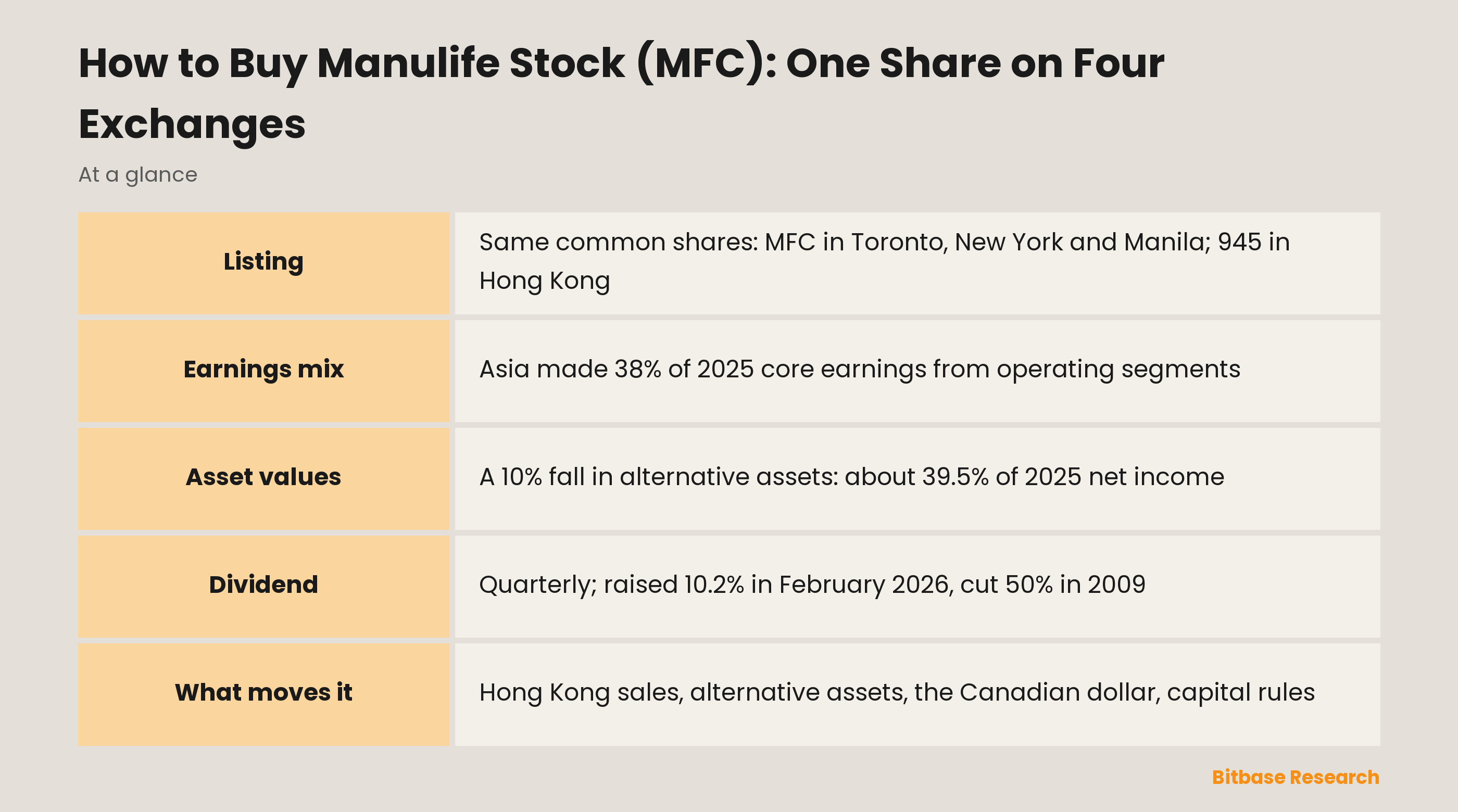
Like its Toronto neighbour Royal Bank of Canada, Manulife lists one class of common share in more than one city, so buying MFC takes only a brokerage account with access to New York or Toronto, where the shares trade under the same ticker in US and Canadian dollars. The same shares also trade in Manila as MFC and in Hong Kong as 945, fitting for a life insurer that drew 38% of its 2025 core earnings from operating segments in Asia.
What Does Manulife Do?
Manulife Financial Corporation is a Toronto-based life insurance company incorporated under Canada's Insurance Companies Act. The business is older than the listed company: The Manufacturers Life Insurance Company (MLI) was incorporated by an Act of Parliament in 1887 and became a mutual in 1968. MFC was formed on 26 April 1999 as the holding company for MLI's demutualization, which took effect that September. The Office of the Superintendent of Financial Institutions (OSFI) supervises the group.
There are four operating segments.
Asia sells insurance and insurance-based savings in 12 markets, from Hong Kong, Macau, Japan and mainland China to Singapore, Vietnam, Indonesia and the Philippines. The annual information form names Hong Kong and Japan as the jurisdictions "governing Manulife's most significant operations in Asia." Bank partners include DBS Bank under a regional exclusive bancassurance deal. In November 2025 Manulife agreed to form a 50:50 life insurance joint venture with Mahindra & Mahindra in India, subject to regulatory approval.
Canada covers group benefits for employers, individual life and critical illness insurance, segregated funds and annuities, affinity cover under the CoverMe brand, and Manulife Bank.
U.S. is John Hancock, which Manulife took over by completing a merger with John Hancock Financial Services on 28 April 2004. It sells life insurance built around the John Hancock Vitality program and still carries in-force long-term care (LTC) and annuity businesses.
Global Wealth and Asset Management (Global WAM) runs retirement plans, retail funds and institutional mandates in 20 geographies. In 2025 it bought 75% of Comvest Credit Partners, a US private credit manager.
Corporate and Other holds unallocated capital, financing costs and a property and casualty reinsurance business.
How Manulife Makes Money
Start with the three lines in Manulife's IFRS income statement. The insurance service result, what insurance revenue leaves after claims, expenses and reinsurance, rose 13.1% in 2025. The investment result, investment income minus the finance cost of policy liabilities, fell 31.6%. Other revenue rose 7.1%, and Global WAM, the fee business, booked 98.7% of it.
Profit on policies sold but not yet earned sits in the contractual service margin (CSM), "a liability that represents future unearned profits on insurance contracts written." The CSM balance grew 16% in 2025 and new business CSM 28%, at constant exchange rates.
| Segment | What it sells | Share of 2025 core earnings | Change from 2024 |
|---|---|---|---|
| Asia | Insurance and savings products in 12 markets | 38% | Up 18% |
| Canada | Group benefits, individual insurance, banking | 21% | Up 4% |
| U.S. | John Hancock life insurance; legacy LTC and annuities | 16% | Down 30% |
| Global WAM | Retirement, retail and institutional asset management | 25% | Up 14% |
Shares are of core earnings from operating segments, a non-GAAP measure; changes are at constant exchange rates.
Core earnings leave out market experience and some one-off items. On the IFRS measure, net income attributed to shareholders rose 3.5%, Asia supplied 53.3% of it, and the U.S. segment reported a loss, partly from a reinsurance deal with Reinsurance Group of America (RGA) that, from 1 January 2025, took on 75% of its US long-term care and structured settlement legacy blocks.
The Asia tilt is deliberate: the Asia region, including Asian asset management, produced 47% of 2025 core earnings, against a 50% target for 2027. Legacy LTC and variable annuities contributed 9%.
MFC Stock at a Glance
| Feature | Fact |
|---|---|
| Exchanges | Toronto, New York, Philippine and Hong Kong stock exchanges |
| Ticker | MFC; 945 in Hong Kong |
| Security | Common shares, Manulife's only NYSE-registered security; no depositary receipts |
| Currency | US dollars in New York, Canadian dollars in Toronto |
| Sector | Life and health insurance, wealth and asset management |
| Index funds | Held by the iShares S&P/TSX 60 Index ETF; not in SPY (October 2026) |
| Headquarters | Toronto |
| Fiscal year | Calendar year |
| Accounts | IFRS, reported in Canadian dollars; annual Form 40-F, quarterly Form 6-K |
| Regulator | OSFI; capital measured by the LICAT test |
| Dividend policy | Quarterly; core payout target of 35% to 45% |
Prices move across four markets in one day; the Manulife stock page on Bitbase shows the live quote.
How to Buy Manulife Stock
The New York and Toronto lines are the same common shares, much like Royal Bank of Canada's interlisted shares, so the choices are market, currency and order.
1. Pick the market. US access buys MFC on the NYSE in US dollars; Canadian access adds the TSX in Canadian dollars.
2. Open the account. Check who regulates the broker where you live; the tax residence you declare decides how dividends are treated at source.
3. Fund it. Ask what conversion rate and markup apply; on a small order that can cost more than the commission.
4. Pick the right line. Look for Manulife Financial Corporation common shares. Toronto also lists preferred series with look-alike symbols such as MFC.PR.B, a different security without a vote at ordinary meetings.
5. Choose the order. A market order takes whatever price is on offer; a limit order names the worst price you will accept.
6. Size the position. If your broker sells fractional shares, ask whether a fraction receives dividends and votes.
A Toronto quote matches a New York quote only after currency conversion, and one exchange can show different numbers for regular and extended trading hours.
Dividend tax. Canada taxes dividends paid to non-residents at source under Part XIII of its Income Tax Act, and the Canada Revenue Agency notes that the rate can be cut under a tax treaty. Manulife's filings do not say what a foreign shareholder will lose to withholding, so ask your broker.
Ownership caps. Under the Insurance Companies Act, any stake above 10% of a class of Manulife shares needs the Minister of Finance's prior approval, and a holding above 20% of a voting class is barred. State insurance law in Michigan, Massachusetts and New York presumes control at 10% of the voting securities.
Through a fund. BlackRock's iShares S&P/TSX 60 Index ETF (XIU) held Manulife on 29 October 2026; S&P 500 funds do not.
What Moves MFC Stock
Hong Kong sales. Annualized premium equivalent (APE) sales in Asia rose 18% in 2025. Hong Kong, 37.4% of the region's APE, grew 21% on sales to "both mainland Chinese visitor and domestic customers," and Asia's core earnings rose 21% in the second quarter of 2026. Quarterly reports split APE by market, so a shift in Hong Kong demand shows there first.
Alternative assets. Manulife's general fund holds real estate, private equity, infrastructure, timber, agriculture and energy assets, grouped as alternative long-duration assets (ALDA). At the end of 2025 it estimated that an immediate 10% fall in their value would cut net income attributed to shareholders by about 39.5% of the 2025 figure, against about 8.1% for a 10% fall in public equities after hedging. Weak ALDA returns drove 2025's market experience charge.
The Canadian dollar. Results are in Canadian dollars, yet the Asia and U.S. segments earn more than half of core earnings from operating segments. A 10% rise in the Canadian dollar against the US and Hong Kong dollars would cut core earnings by about 5.7% of the 2025 total, by Manulife's estimate.
Capital returned. Buybacks and dividends depend on OSFI's LICAT test. At the end of 2025 the ratio was 136% for the operating insurer, MLI, against a 100% supervisory target, and 125% for the MFC holding company, against a 90% minimum. The 2026 normal course issuer bid allows up to 42 million shares, roughly 2.5% of the share count, to be bought back by 23 February 2027, while February 2026 brought a 10.2% increase in the quarterly dividend.
Legacy blocks. Reinsurance deals keep reshaping the US book, and the RGA deal brought a net loss in 2025. On 5 August 2026 the chief executive said that "the long-term care reinsurance transaction announced today will further reduce our risk profile."
Interest rates. The immediate effect is small: a 50 basis point parallel move would change 2025 net income attributed to shareholders by about 1.8%, with lower rates helping. The risk factors look further out: "Prolonged changes in market interest rates may impact our net income attributed to shareholders and capital ratios."
What Can Go Against MFC Shareholders
Of the six risk categories in the annual report, these weigh most on an MFC holder.
Guarantees. "Our most significant source of publicly traded equity risk arises from equity-linked products with guarantees, where the guarantees are linked to the performance of the underlying funds." Hedging covers part of it and may underperform when volatility is high.
Assumptions. "Losses may result should actual experience be materially different than that assumed in the valuation of insurance contract liabilities." Unfavourable US life claims helped cut that segment's 2025 core earnings by 30%.
Asia and geopolitics. "A substantial portion of our revenue and net income attributed to shareholders is derived from our operations outside of North America, primarily in Asian markets." The report adds that "Mainland China and the Hong Kong SAR are important markets for Manulife and tensions may create a more challenging operating environment for Manulife."
Rules written for policyholders. Canadian regulation aims at "protecting policyholders, beneficiaries, and the stability of the Canadian financial system, rather than investors, and may adversely impact shareholder value." The Insurance Companies Act bars a dividend when capital or liquidity is inadequate.
The holding company. "As a holding company, MFC depends on the ability of its subsidiaries to transfer funds to MFC to meet its obligations and pay dividends." In August 2009 the board cut the quarterly dividend by 50% to keep earnings as capital.
A single stock also concentrates your money, and since Manulife reports and declares dividends in Canadian dollars, currency sits between its results and your return.
Where Manulife Publishes the Numbers
Manulife files with the SEC under CIK 1086888. The annual report is a Form 40-F; the fiscal 2025 package, filed on 11 February 2026, carries the annual information form, the management's discussion and analysis (MD&A) and the audited statements. Quarterly results and news releases are filed on Form 6-K and mirrored on SEDAR+ in Canada.
In the MD&A, "Risk Management and Risk Factors" holds the sensitivity tables and "Capital Management Framework" covers LICAT and the buyback. The annual information form lists the four listings and the ownership limits.
Second-quarter 2026 results came out on 5 August 2026, so look for a newer report before relying on any figure here. Quotes for other companies are on Bitbase's list of stock pages.
Manulife Stock FAQ
Is MFC the same stock in Toronto, New York, Manila and Hong Kong?
Yes. The annual information form lists the common shares under MFC in Toronto, New York and Manila and under 945 in Hong Kong, and the 40-F cover registers those shares, not depositary receipts, on the NYSE. Only the currency and trading hours differ.
Does Manulife pay a dividend?
Yes, quarterly, in March, June, September and December from 2023 to 2025. It rose 10.2% in February 2026, and the core payout ratio was 42% in 2025. It has been cut before, by 50% in 2009.
Can I buy Manulife stock with crypto?
Not directly. You buy MFC from a broker, so crypto must first be sold for cash and moved to the brokerage, and that sale may be taxable where you live. Make the two decisions separately and look at what separates owning a stock from holding a coin.
Is Manulife the same company as John Hancock?
John Hancock is the brand of Manulife's U.S. segment. The merger with John Hancock Financial Services closed on 28 April 2004, and the main John Hancock insurers are Manulife subsidiaries.
Has Manulife stock ever split?
Yes. In May 2006 Manulife declared a stock dividend "which has the same effect as a two-for-one split," paid on 2 June 2006. Per-share history before that date needs adjusting for comparisons.
Is Manulife in the S&P 500?
No. Manulife is missing from the SPY holdings file State Street published for 29 October 2026; in Canada it sits in the iShares S&P/TSX 60 Index ETF.
Conclusion
The order itself is routine: a broker with NYSE or TSX access, a currency and a limit price. What the share carries is less routine: an Asian insurer led by Hong Kong, a fee business in Global WAM, US legacy blocks that reinsurance keeps reshaping, and capital rules written for policyholders first. Read the latest 40-F and 6-K, find out what your country charges on a Canadian dividend, and size the position for profit that moves with asset values and currencies.
Related reading
Other Bitbase articles on this topic:
- How to Buy Aflac Stock (AFL): Japan, the Yen and Ten-Vote Shares
- How to Buy Allstate Stock (ALL): Auto Rates, Storms and Buybacks
- How to Buy Aon Stock (AON): Dublin plc, NYSE Shares, USI Deal
- How to Buy Travelers Stock (TRV): Underwriting, Catastrophes, Dow
Disclaimer: This article is educational content from Bitbase Academy, provided for information only. It explains what a company or fund does and how the instruments referenced here differ from one another; it does not constitute investment, trading, tax, or financial advice, and it is neither a recommendation nor an endorsement of any security, token, or trading strategy. A tokenized stock is issued by a third party and is designed to give economic exposure to an underlying asset: it is not a share, it carries no shareholder rights, and it depends on the issuer's structure, eligibility rules, and redemption terms, which the issuer can change. Perpetual futures are leveraged derivatives that hold no underlying asset and can be liquidated, and trading hours, product availability, and eligibility differ by instrument and by jurisdiction and can change at any time. Written as of October 2026; verify everything yourself through company filings, the issuer's own documentation, and the product pages of the venue you trade on.
References
[1] Manulife Form 40-F for 2025: cover page (SEC EDGAR) www.sec.gov
[2] Manulife 2025 consolidated financial statements: income statement, segments, reinsurance www.sec.gov
[3] Manulife Annual Information Form, February 2026: listings, regulation, share capital, ownership limits www.sec.gov
[4] Manulife 2025 management's discussion and analysis: segments, risk factors, sensitivities, capital www.sec.gov
[5] Manulife second quarter 2026 results, 5 August 2026 www.sec.gov
[6] Manulife news release, 11 February 2026: common share dividend increase www.sec.gov
[7] Manulife news release, 19 February 2026: normal course issuer bid www.sec.gov
[8] Manulife news release, 6 August 2009: common share dividend reduction www.sec.gov
[9] Manulife news release, 4 May 2006: stock split by way of stock dividend www.sec.gov
[10] Manulife second quarter 2004 news release: completion of the John Hancock merger www.sec.gov
[11] Canada Revenue Agency, guide T4061: Part XIII tax on payments to non-residents www.canada.ca
[12] BlackRock Canada, iShares S&P/TSX 60 Index ETF (XIU): holdings as of 29 October 2026 www.blackrock.com
[13] State Street, SPDR S&P 500 ETF Trust (SPY): daily holdings as of 29 October 2026 www.ssga.com





