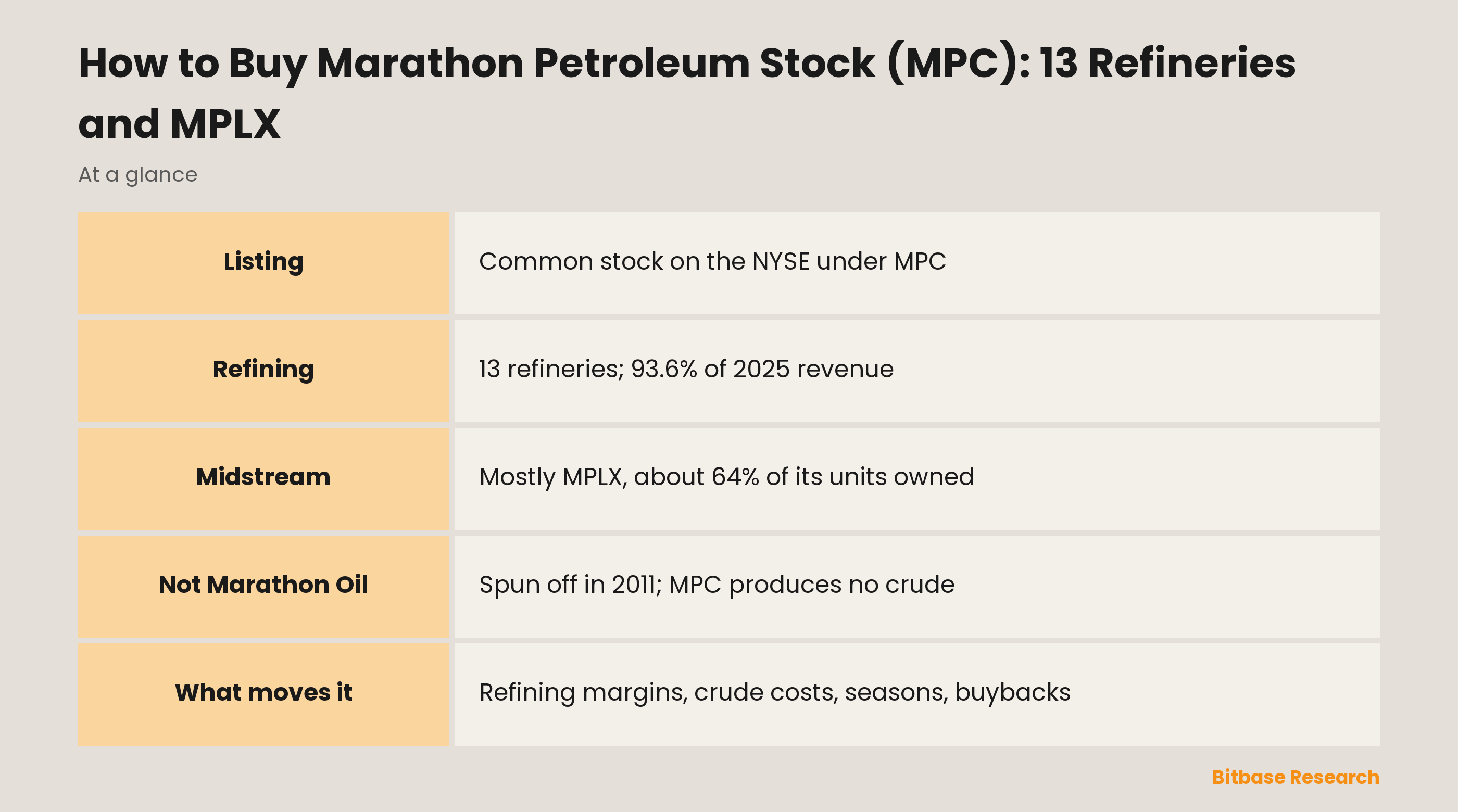
The common stock of Marathon Petroleum trades on the New York Stock Exchange under the ticker MPC, so any brokerage account with access to US shares can place the order. What that share owns is less obvious than the name suggests: refining brought in 93.6% of 2025 revenue, yet the pipeline-heavy Midstream segment, mostly the listed partnership MPLX, earned about 10% more segment profit. This guide also separates MPC from Marathon Oil, a different company, before walking through the purchase, the drivers and the risk factors.
What Does Marathon Petroleum Do?
Marathon Petroleum describes itself as "a leading, integrated, downstream and midstream energy company" with "nearly 140 years of history in the energy business." In plain terms, it buys crude oil, turns it into gasoline, diesel, jet fuel, asphalt and other products, and moves those products to market through pipelines, terminals and barges. The company is incorporated in Delaware and headquartered in Findlay, Ohio, and it reports three segments.
Refining & Marketing runs 13 refineries with a combined crude capacity of 2,986 thousand barrels per calendar day, which the 10-K rounds to about 3.0 million barrels a day. They sit in three regions: the Gulf Coast holds 41.8% of that capacity, the Mid-Continent 39.7% and the West Coast 18.5%. Galveston Bay in Texas City is the largest plant; Los Angeles is, in the filing's words, "the largest refinery on the West Coast"; and Detroit is "the only petroleum refinery currently operating in Michigan." The segment also sells fuel. At the end of 2025 there were 7,882 Marathon-branded outlets run by independent operators in 40 states, the District of Columbia and Mexico, plus long-term supply contracts covering 1,162 direct dealer sites, mostly in Southern California under the ARCO brand. Its company-operated retail chain, Speedway, was sold to 7-Eleven in May 2021.
Midstream gathers, processes, transports, stores and fractionates crude oil, natural gas, natural gas liquids and refined products. The 10-K says this segment "primarily reflects the results of MPLX," a master limited partnership formed in 2012. MPC owns MPLX's general partner and about 64% of its common units, and much of the segment's logistics work is done "principally for the Refining & Marketing segment."
Renewable Diesel turns corn oil, soybean oil, fats and greases into renewable diesel. MPC owns a plant in Dickinson, North Dakota, rated at 184 million gallons a year, and half of the Martinez Renewables joint venture with Neste in California, rated at 730 million gallons a year.
Not Marathon Oil. The two names are easy to mix up, so the history matters. MPC was incorporated in 2009 inside Marathon Oil Corporation, and on 30 June 2011 Marathon Oil distributed MPC's shares to its own stockholders, spinning off its refining, marketing and transportation business. Marathon Oil stayed an oil and gas producer and was acquired by ConocoPhillips on 22 November 2024; MPC's 10-K now names ConocoPhillips as Marathon Oil's successor under the spinoff indemnities. MPC itself pumps no oil. Its risk factors state plainly that "we do not produce any of our crude oil feedstocks." The 2018 acquisition of Andeavor, a refiner and fuel marketer operating mainly in the western and Mid-Continent United States, "substantially increased our geographic diversification and the scale of our assets," the 10-K says.
How Marathon Petroleum Makes Money
Almost every dollar of revenue comes from selling refined products, but the profit picture is more balanced. The FY2025 segment note gives these figures:
| Segment | What it sells | Share of 2025 revenue from external customers | Segment adjusted EBITDA, 2025 vs 2024 |
|---|---|---|---|
| Refining & Marketing | Gasoline, distillates, asphalt, propane and petrochemicals | 93.6% | +7.6% |
| Midstream (mostly MPLX) | Pipeline, terminal, gathering, processing and fractionation services | 4.2% | +3.1% |
| Renewable Diesel | Renewable diesel from vegetable oils and fats | 2.1% | Negative in both years |
Shares are calculated from external revenue; changes are calculated from segment adjusted EBITDA, the profit measure the chief executive uses to judge each segment.
The table hides one inversion. Midstream contributed only 4.2% of outside revenue, yet its 2025 segment adjusted EBITDA was about 10% larger than that of Refining & Marketing. Much of Midstream's business is internal: 51.2% of its 2025 segment revenue came from MPC's other segments, mainly refineries paying to move crude in and products out. Those payments run under "long-term, fee-based commercial agreements" with MPLX, some with minimum throughput commitments, and they cancel out in the consolidated income statement. The flip side sits in refining, where those committed costs weigh on segment profit "in periods when throughput or sales are lower or refineries are idled."
Revenue and profit can also move in opposite directions. Consolidated revenue fell 4.4% in 2025 while Refining & Marketing segment adjusted EBITDA rose 7.6%. What matters is the margin, which the 10-K defines as "the difference between the prices of refined products sold and the costs of crude oil and other charge and blendstocks refined," including transport.
The product mix is weighted toward road fuel. Gasoline made up 53.3% of refined product sales volumes in 2025 and distillates, mainly diesel and jet fuel, another 33.3%; cargoes bound for export were 10.8%. On the input side, 70.5% of the crude the refineries ran came from the United States, 21.5% from Canada and 8.0% from other countries. The plants ran at 94% of crude capacity in 2025, up from 92% the year before, and 45% of their crude throughput was sour, meaning higher-sulfur oil that can typically be bought at a discount to benchmark grades.
MPC Stock at a Glance
| Field | MPC |
|---|---|
| Exchange | New York Stock Exchange (NYSE) |
| Ticker | MPC |
| Security | Common stock, the single 12(b) security named on the 10-K cover |
| CUSIP | 56585A102 |
| Sector | Energy: crude oil refining, fuel marketing and midstream |
| Index membership | S&P 500 member; held by the Energy Select Sector SPDR (XLE); not in the Dow Jones Industrial Average |
| Headquarters | Findlay, Ohio |
| Incorporated | Delaware, 2009; independent since the 30 June 2011 spinoff |
| Fiscal year | Ends 31 December |
| Stock split | Two-for-one, distributed 10 June 2015 |
| Dividend policy | Quarterly cash dividend, declared by the board each time |
| Listed affiliate | MPLX LP (NYSE: MPLX), controlled by MPC |
| SEC identifier | CIK 1510295 |
The index rows come from State Street's daily holdings files dated 28 October 2026. The live share price, market capitalization and yield are on Bitbase's Marathon Petroleum stock page.
How to Buy Marathon Petroleum Stock
MPC is incorporated in the United States, and what trades on the NYSE is its common stock itself; no depositary receipt or foreign share class is involved. The usual path:
1. Pick a broker that reaches US exchanges. Outside the United States, look at local banks or brokers that offer US shares, or at international brokerages, and confirm which regulator oversees the firm.
2. Complete the account checks. Investors who are not US persons usually sign IRS Form W-8BEN, which certifies foreign status and lets the broker apply any treaty rate.
3. Fund it. If your money is not in US dollars, the conversion has a cost of its own, so weigh that spread against the trading fee.
4. Confirm the listing. Type MPC and make sure the name shown is Marathon Petroleum Corporation, not MPLX.
5. Choose the order type. Investor.gov explains that a market order "guarantees that the order will be executed, but does not guarantee the execution price," while a limit order executes "at a specific price or better." It is worth reading how market and limit orders fill before the first trade.
Fractional shares. Some brokers sell slices of a share, but Investor.gov notes that "not every brokerage firm offers fractional share investing" and that "you may not have voting rights if you own fractional shares."
Tax on dividends for non-US holders. The IRS states that "most types of U.S. source income received by a foreign person are subject to U.S. tax of 30%," and that a reduced rate may apply under a tax treaty. The tax is generally withheld from the payment, and how it is treated at home depends on your own country's rules.
MPC is not MPLX. Buying MPC shares gives you MPC's stake in MPLX indirectly, alongside the refineries. MPLX's own units trade separately on the NYSE under MPLX and are limited partnership interests, a different security whose tax treatment MPC's 10-K lists as a risk in its own right. If you meant to buy the partnership, that is a separate order.
Through a fund. MPC sits inside S&P 500 index funds and inside the Energy Select Sector SPDR, among other funds. A fund spreads the money across many companies, so the result depends far less on one refiner's margins.
What Moves MPC Stock
Refining margins. The first risk factor reads: "Our financial results are affected by volatile refining margins, which are dependent on factors beyond our control." The industry shorthand for that margin is the crack spread, which the 10-K calls "a proxy for the refining margin." The company tracks a blend weighted 42% Gulf Coast, 40% Mid-Continent and 18% West Coast, close to where its capacity sits, and its MD&A carries a sensitivity table that estimates how much annual segment profit shifts for each one-dollar move. The swings can be large: in the second quarter of 2026, Refining & Marketing segment adjusted EBITDA was more than three times its level a year earlier, which the 10-Q put down to higher realized margins and to product prices lifted by disruptions in global crude supply. Midstream's rose 8.3% over the same comparison.
Crude costs and differentials. Margins also depend on what MPC pays for crude relative to benchmarks, and the 10-K notes that "larger sweet and sour differentials will enhance our Refining & Marketing margin," which is why the 45% sour share matters. With 21.5% of its 2025 crude coming from Canada, the filing also lists "tariffs on goods, including crude oil and other feedstocks, imported into the United States" among the margin factors. Timing adds noise: "We generally purchase our feedstocks weeks before we refine them and sell the refined products."
Seasons and turnarounds. Demand for gasoline, diesel and asphalt is higher in spring and summer, with more highway traffic and construction, so the 10-K warns that first- and fourth-quarter refining results "may be lower than for those in the second and third quarters." Each refinery also shuts units periodically for planned turnarounds, and the timing of that work shows up in quarterly throughput and costs.
Fuel rules and California. As a fuel producer, MPC must meet the federal Renewable Fuel Standard, and when it does not blend enough renewable fuel itself, "we must purchase RINs in the open market." California adds its own layer around the Los Angeles refinery: state law allows regulators to set a maximum gasoline refining margin with a penalty and to require minimum fuel inventories. In August 2025 the California Energy Commission said it would not act on the margin penalty for at least five years, and in the same month it opened an informational proceeding on minimum inventories.
MPLX distributions. MPLX pays quarterly distributions on its units, and MPC's large holding makes it the biggest recipient. Those cash flows depend on volumes in MPLX's basins, a link the next section quotes from the risk factors.
Buybacks and dividends. Capital returns have reshaped the share count: the number on the 10-K cover fell about 55% between February 2021 and February 2026, a period that began just before the Speedway sale closed. Dividends declared per share rose 10.1% in 2024 and 10.2% in 2025, and in May 2026 the board added another repurchase authorization with no expiration date. The same risk factor ties both to margins: the ability "to execute share repurchases and pay our dividend at intended levels" is "highly dependent on the margins we realize on our refined products."
Marathon Petroleum's Main Risk Factors
Item 1A runs long. These six entries bear most directly on an MPC share:
Margin volatility. Covered above, and first in the list for a reason: almost everything else in the filing, from buybacks to debt capacity, is described as depending on it.
Long-term fuel demand. "Industry, market, technological and regulatory developments regarding emissions, fuel efficiency and alternative fuel vehicles may decrease demand for liquid transportation fuels." With more than half of sales volume in gasoline, that sentence carries weight.
No crude production of its own. The company buys all of its crude, and the 10-K notes that "competitors that produce crude oil are at times better positioned to withstand periods of depressed refining margins or feedstock shortages."
Plant hazards. "Our operations are subject to business interruptions and present inherent hazards and risks, which could adversely impact our results of operations and financial condition." The 10-K's list of uncertainties also names "industrial incidents or other unscheduled shutdowns affecting our refineries."
Dependence on MPLX. "A significant decrease in oil and natural gas production in MPLX's areas of operation may adversely affect MPLX's business … and cash available for distribution to its unitholders, including MPC."
Climate litigation and debt. "Energy companies are subject to increasing environmental and climate-related litigation." The FY2025 10-K listed climate cases against MPC in Delaware, Maryland and Oregon; by the second-quarter 2026 10-Q, one remained pending, in Delaware. Separately, the company warns that "we have significant debt obligations"; at the end of 2025, 78.1% of its total debt and finance lease obligations belonged to MPLX and its subsidiaries.
Beyond the filing, a single-stock position concentrates your outcome in one company, and buying in a foreign currency adds exchange-rate swings to the result.
How to Research MPC Yourself
Marathon Petroleum reports to the SEC under CIK 1510295. Expect an annual 10-K (the FY2025 report was filed on 26 February 2026), a 10-Q after each of the first three quarters, and 8-Ks when something material happens, such as an earnings release or a board change. An 8-K filed on 29 October 2026, for example, reported that a new director will join the board on 1 March 2027.
In the 10-K, Item 1 lists every refinery with its capacity and describes the brands; Item 1A holds the risk factors; and the MD&A carries the crack spread definitions, the sensitivity table and the supplemental refining statistics, including utilization and the sour-crude share. The segment note splits revenue and segment adjusted EBITDA three ways. Because so much of Midstream is MPLX, the partnership's own filings under CIK 1552000 are the place to study pipeline volumes and distributions.
When you read a quarter, compare it with the same quarter a year earlier rather than the one before, since seasons and turnaround schedules distort sequential comparisons. To compare other listed companies, see Bitbase's US stock pages.
Marathon Petroleum Stock FAQ
Is Marathon Petroleum the same company as Marathon Oil?
No. Marathon Oil spun off Marathon Petroleum on 30 June 2011 and kept producing oil and gas until ConocoPhillips acquired it in November 2024. MPC is the refiner and fuel marketer, and it produces none of the crude it processes.
Can I buy Marathon Petroleum stock with crypto?
Not directly. MPC shares are priced and settled in US dollars at a broker, so any crypto has to be sold for cash first, which in many countries is a taxable disposal, and the money then moved into a brokerage account. What you end up with is a registered share carrying voting and dividend rights.
Does Marathon Petroleum pay a dividend?
Yes, quarterly, with each payment declared by the board. Dividends declared per share rose 10.2% in 2025, but the 10-K ties the company's ability to keep paying at intended levels to its refining margins.
What is MPLX, and do MPC shareholders own it?
MPLX is a separately listed master limited partnership that runs most of MPC's Midstream business. MPC owns its general partner and about 64% of its common units, so an MPC share carries an indirect interest; MPLX units themselves trade on the NYSE under MPLX.
Has MPC stock ever split?
Yes. The board declared a two-for-one split in the form of a stock dividend, distributed on 10 June 2015, and the shares began trading on a split-adjusted basis the next day.
Is MPC in the S&P 500?
Yes. Marathon Petroleum appears in State Street's SPY holdings file of 28 October 2026, as it does in the Energy Select Sector SPDR file. The DIA file for the same day, covering the 30 stocks of the Dow Jones Industrial Average, leaves it out.
Conclusion
Placing the order is the easy part: an account that reaches the NYSE, the MPC ticker, and a limit or market order. What deserves more thought is what you hold: a refiner that buys all of its crude, plus a Midstream business, mostly the MPLX partnership, whose segment profit topped the refineries' in 2025. Refining margins, seasons, fuel rules and the pace of buybacks are what each new 10-Q updates, so read the latest one before deciding how much of a single energy stock you want.
Related reading
Other Bitbase articles on this topic:
- How to Buy Enbridge Stock (ENB): Pipelines, Dividend, Line 5
- How to Buy Eni Stock (E): Two-Share ADRs, State Stake, Dividends
- How to Buy Enterprise Products Stock (EPD): MLP Units and the K-1
Disclaimer: This article is educational content from Bitbase Academy, provided for information only. It explains what a company or fund does and how the instruments referenced here differ from one another; it does not constitute investment, trading, tax, or financial advice, and it is neither a recommendation nor an endorsement of any security, token, or trading strategy. A tokenized stock is issued by a third party and is designed to give economic exposure to an underlying asset: it is not a share, it carries no shareholder rights, and it depends on the issuer's structure, eligibility rules, and redemption terms, which the issuer can change. Perpetual futures are leveraged derivatives that hold no underlying asset and can be liquidated, and trading hours, product availability, and eligibility differ by instrument and by jurisdiction and can change at any time. Written as of October 2026; verify everything yourself through company filings, the issuer's own documentation, and the product pages of the venue you trade on.
References
[1] Marathon Petroleum Form 10-K, fiscal 2025: business, refineries, segments, risk factors (SEC EDGAR) www.sec.gov
[2] Marathon Petroleum Form 10-Q for the quarter ended 30 June 2026 (SEC EDGAR) www.sec.gov
[3] Marathon Petroleum Form 8-K filed 29 October 2026: board election (SEC EDGAR) www.sec.gov
[4] Marathon Petroleum release on the two-for-one stock split, 29 April 2015 (Form 8-K exhibit, SEC EDGAR) www.sec.gov
[5] ConocoPhillips Form 10-K, fiscal 2024: completion of the Marathon Oil acquisition (SEC EDGAR) www.sec.gov
[6] MPLX LP Form 10-K, fiscal 2025 (SEC EDGAR) www.sec.gov
[7] Marathon Petroleum Form 10-K, fiscal 2020: cover page with shares outstanding (SEC EDGAR) www.sec.gov
[8] State Street SPDR S&P 500 ETF Trust (SPY): fund page and daily holdings www.ssga.com
[9] State Street Energy Select Sector SPDR ETF (XLE): fund page and daily holdings www.ssga.com
[10] State Street SPDR Dow Jones Industrial Average ETF Trust (DIA): fund page and daily holdings www.ssga.com
[11] Investor.gov (SEC): Types of Orders www.investor.gov
[12] Investor.gov (SEC): Investor Bulletin on fractional share investing www.investor.gov
[13] IRS: NRA Withholding www.irs.gov