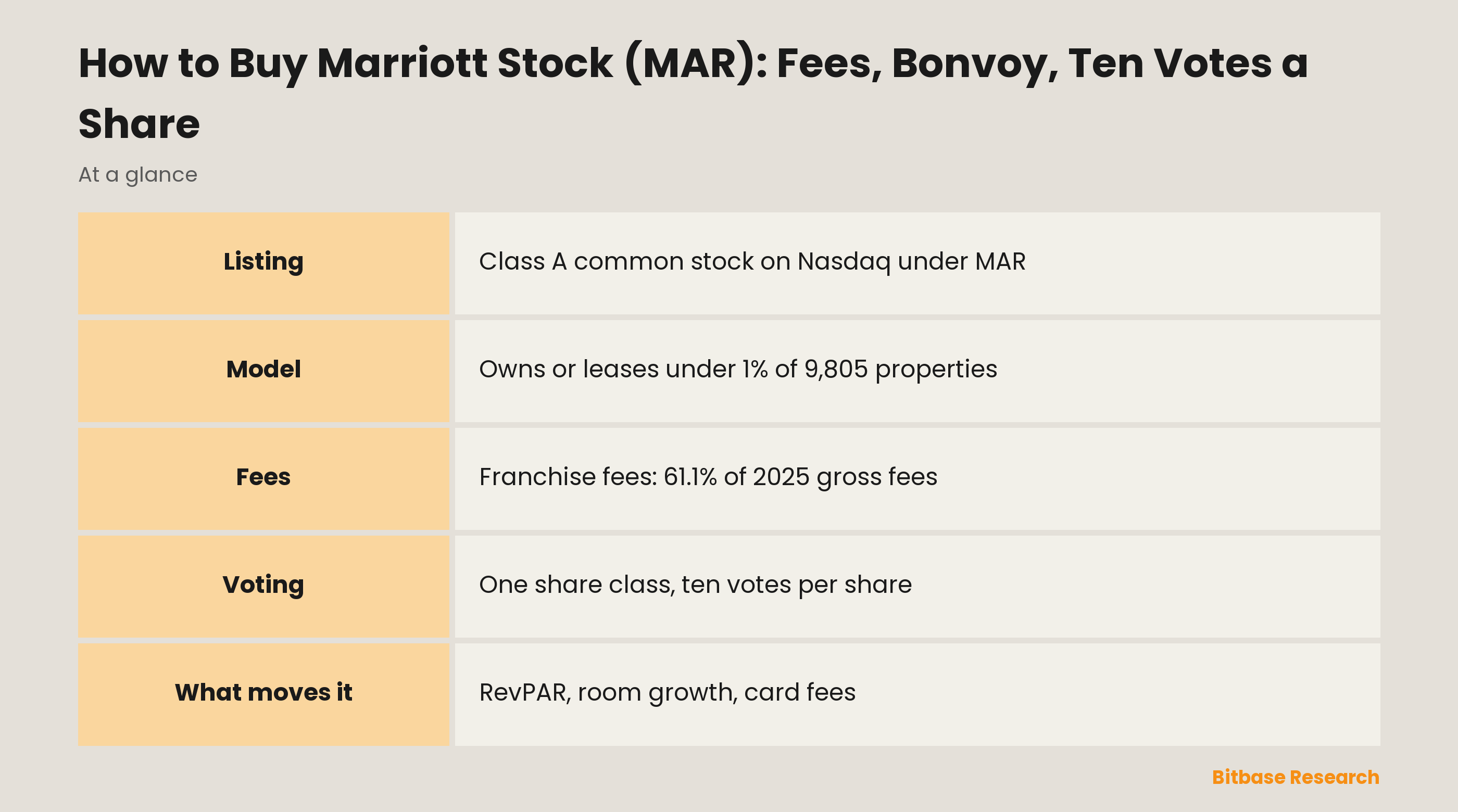
Its Class A common stock trades on the Nasdaq Global Select Market under the ticker MAR, so buying Marriott International takes a brokerage account with access to US-listed shares and nothing more unusual. What the share buys is mostly a stream of fees: at the end of 2025 the company owned or leased less than one percent of the 9,805 properties in its system and earned its income by franchising, managing and licensing hotels that belong to other people. This guide explains how those fees work, how to place the order, and what Marriott's own filings flag, from disputes with hotel owners to the Starwood data breach.
What Does Marriott Do?
Marriott International describes itself as "a worldwide franchisor, operator, and licensor of hotel, residential, timeshare, and other lodging properties under a portfolio of compelling brands at different price and service points." At the end of 2025 its system counted 9,805 properties with 1,779,936 rooms in 145 countries and territories, and about 4,100 more properties, with nearly 610,000 rooms, sat in the development pipeline.
The brands are grouped into two styles, Classic and Distinctive, and four quality tiers. Luxury includes JW Marriott, The Ritz-Carlton, St. Regis and W Hotels; Premium includes Marriott Hotels, Sheraton and Westin. Select holds the two brands with the most properties at year-end 2025: Fairfield by Marriott, with 1,381, and Courtyard, with 1,362. Midscale, a tier the company says it is expanding, includes City Express by Marriott. Marriott also licenses its names to timeshare resorts and brands residences sold by developers.
Results are reported in four segments: U.S. & Canada; Europe, Middle East & Africa (EMEA); Greater China; and Asia Pacific excluding China (APEC), with Caribbean & Latin America folded into "Unallocated corporate and other."
The listed company in its present form dates from 27 March 1998, when it was spun off from the former Marriott International. Three later deals shaped it. In November 2011 Marriott spun off its timeshare business as Marriott Vacations Worldwide, which now pays it royalties for certain brands. On 23 September 2016 it completed the acquisition of Starwood Hotels & Resorts Worldwide for cash plus Marriott shares, saying the combined company would operate or franchise more than 5,700 properties under 30 brands. In 2025 it bought the citizenM brand, adding 37 hotels.
How Marriott Makes Money
The income statement is easy to misread. In 2025, cost reimbursements made up 73.3% of total revenue, net fee revenues 20.3% and owned, leased and other revenue 6.4%. The largest line is mostly pass-through: owners repay Marriott, "with no added mark-up," for costs incurred for their hotels, chiefly payroll at managed hotels, and the 10-K says these centralized programs "are not designed to impact our economics, either positively or negatively" over the long term. The economics sit in the fees.
| Fee stream, fiscal 2025 | How it is charged | Share of gross fee revenues | Change from 2024 |
|---|---|---|---|
| Franchise fees | Royalties on room revenue (and, for some brands, food and beverage), plus credit card, residential and other licence fees | 61.1% | 7% |
| Base management fees | A percentage of a managed hotel's revenue | 24.3% | 3% |
| Incentive management fees | A share of a managed hotel's profit, often only after the owner has earned a set return | 14.5% | 3% |
Shares are calculated from the fiscal 2025 income statement and sum to 99.9% because of rounding.
Franchising is the larger half. Royalties typically run "four to seven percent of room revenues, plus for certain brands, up to four percent of food and beverage revenues," under agreements of generally 10 to 25 years. At year-end 2025, franchised, licensed and similar properties held 66.5% of the system's rooms.
Management covers most of the rest: 31.8% of rooms, in hotels whose owners generally bear the operating costs, under agreements that generally start at 20 to 30 years. In 2025 Marriott earned an incentive fee from 69% of its managed hotels, but from only 32% in U.S. & Canada against 85% internationally; in many contracts, particularly in U.S. & Canada, Europe and Latin America, the owner must first earn a specified return. International hotels produced 67% of incentive fees.
Owned and leased hotels are a residual: 51 at year-end 2025, 14 in U.S. & Canada and 37 elsewhere. That differs from McDonald's, which also calls itself primarily a franchisor but collects rent from many franchisees and keeps control of the underlying real estate.
By region, U.S. & Canada produced 55.2% of 2025 gross fee revenues, EMEA 11.8%, APEC 6.9% and Greater China 4.8%. The remaining 21.3% is booked as "Unallocated corporate and other," which holds credit card and timeshare licensing fees as well as the Caribbean & Latin America region.
Cards tie fees to loyalty. Marriott Bonvoy, the loyalty program, is "central to our business strategy": in 2025 members booked about 75% of US room nights and about 68% worldwide. Co-branded Bonvoy cards are issued in 11 countries, in the US with JPMorgan Chase and American Express, and card payments are "a significant funding source for the Loyalty Program."
MAR Stock at a Glance
| Item | Detail |
|---|---|
| Exchange | Nasdaq Global Select Market (transferred from the NYSE in October 2013) |
| Ticker | MAR |
| Security | Class A common stock, the only class outstanding and the only security on the 10-K cover |
| Voting | Ten votes per share, the same for every share |
| Sector | Lodging: hotel franchising, management and licensing |
| Index membership | S&P 500 and Nasdaq-100; not in the Dow Jones Industrial Average |
| Headquarters | Bethesda, Maryland |
| Incorporated | Delaware |
| Public as the current company since | 27 March 1998 spin-off |
| Fiscal year | Calendar year, ending 31 December |
| Dividend policy | Quarterly cash dividend, plus buybacks under an authorization with no expiration date |
| Stock split | Two-for-one, June 2006 |
| SEC identifier | CIK 1048286 |
Prices, market value and yield change with every trade; the Marriott stock page on Bitbase shows the live quote and chart.
How to Buy Marriott Stock
Marriott is a US company with one listed share class, so there is no depositary receipt to consider:
1. Choose a broker that offers Nasdaq-listed US shares, and check which entity will hold your account and who regulates it.
2. Open and verify the account. Brokers ask non-US individuals for IRS Form W-8BEN, the certificate of foreign status used for US tax withholding.
3. Fund it. If your money is in another currency, compare the conversion rate as well as the commission.
4. Find the right line. Search MAR and check that it reads Marriott International Class A common stock on Nasdaq. VAC is Marriott Vacations Worldwide, the separate timeshare company, and MARA belongs to MARA Holdings, a different company.
5. Pick the order type. FINRA explains that a market order "provides the most certainty that your order will be executed," but "you might not get the price you saw or were originally quoted, especially in fast-moving markets"; a buy limit order "can be executed only at or below the limit price."
6. Decide on size. "The availability of fractional share trading varies by brokerage firm," FINRA notes, and a fractional owner "might not have shareholder voting rights."
7. Submit and keep the confirmations, your record of cost basis and dividends.
If you live outside the United States, dividends are generally taxed at source. The IRS says most types of US-source income received by a foreign person are "subject to U.S. tax of 30%," and that "a reduced rate, including exemption, may apply" under a tax treaty. Your home country may tax the income again.
Through a fund, you can own Marriott indirectly: State Street's files dated 28 October 2026 list it in SPY, which tracks the S&P 500, and in XLY, a consumer discretionary fund, and funds that fully replicate the Nasdaq-100 hold it too.
What Drives MAR Stock
RevPAR. Revenue per available room, room revenue divided by rooms available, combines occupancy and average daily rate. Marriott warns it "should not be viewed as necessarily correlating with our fee revenue." In 2025 worldwide RevPAR rose 2.0%, driven by a 2.1% rise in average daily rate; U.S. & Canada managed 0.7% as select-service hotels met "weaker business transient demand, in part due to declines in government travel," while International rose 5.1% and Greater China 0.4%. In the first half of 2026 worldwide RevPAR rose 3.8%, and U.S. & Canada was up 5.0% in the second quarter, with World Cup demand in June adding to it.
Room growth. Fees grow with rooms. In 2025 the system added 703 properties and lost 253; roughly 33,400 added rooms were conversions from competitor brands, and 43% of pipeline rooms were under construction at year-end. Conversions and new builds both depend on owners being able to finance the work.
Credit cards and other brand fees. In 2025 the rise in franchise fees "primarily reflected higher co-branded credit card and other brand-related fees" as well as rooms growth, and in the first half of 2026 franchise fees rose 18%, helped by card fees, rooms growth and residential branding. In 2026 Marriott signed new multi-year US card agreements with JPMorgan Chase and American Express, which it expects "to have a favorable impact on our total revenues in future periods."
Geopolitics. The 10-K lists pandemics, disasters, conflict and war among conditions that have materially affected the business. In the second quarter of 2026 International RevPAR fell 0.5%, hit by the Middle East conflict, which "resulted in a sharp decline in RevPAR in our Middle East & Africa region beginning in March 2026."
Capital returns. Marriott repurchased 12.1 million shares in 2025 under an authorization with no expiration date, while interest expense rose 16% that year as senior note issuances raised debt.
Marriott Risk Factors Worth Reading First
Five headings in Item 1A bear most directly on a MAR share.
Contracts that can end early. "Premature termination of our agreements with hotel owners could materially hurt our financial performance." Owners may claim a right to terminate even where an agreement says otherwise, and "some courts have upheld such assertions."
Owners' access to capital. "Our hotel owners depend on capital to buy, develop, and improve hotels, and they may be unable to access capital when necessary." The filing adds that construction timelines for pipeline hotels have lengthened.
Booking intermediaries. Some companies buy trademarked search keywords "such as 'Marriott'," and "bookings through these intermediaries are more costly to hotels in our system than bookings through our direct digital channels." The 10-K also warns that AI from intermediaries "may change the way guests plan, book, and pay for travel."
The Starwood data breach. In November 2018 Marriott disclosed unauthorized access to the Starwood reservations database. About 100 lawsuits followed; in 2024 it reached final resolutions with the FTC and the attorneys general of 49 states and the District of Columbia, with "various long-term requirements relating to our data privacy and information security programs." After the Fourth Circuit reversed class certification in June 2025, the company called losses in the US cases probable and booked an accrual it describes as not material; it does not believe the incident "will impact our long-term financial health."
Labour. "A significant number of associates at our managed, leased, and owned hotels are covered by collective bargaining agreements," and about 19,000 of its roughly 115,000 US employees belong to unions.
Above the business, one stock ties your money to one company. And at the end of 2025 the balance sheet showed a stockholders' deficit, since shares bought back are carried as treasury stock at cost, more than retained earnings and paid-in capital combined.
How to Research Marriott Yourself
Marriott files with the SEC under CIK 1048286: the fiscal 2025 10-K on 10 February 2026, the latest 10-Q, for the quarter ended 30 June 2026, on 3 August 2026, and 8-Ks for earnings and other events. Marriott.com/investor links to every filing.
In the 10-K, Item 1 has the brand table and the terms of franchise and management agreements, Item 1A the risks, and the management discussion the RevPAR tables; read the systemwide rows, which include franchised hotels. The segment note splits fees by region, and the legal proceedings note covers the data breach cases.
Two quick checks: the R1.htm cover lists a single trading symbol, MAR, and the description of securities filed with the fiscal 2023 10-K sets out the ten-vote rule and the anti-takeover provisions. Other companies are on more US stock pages on Bitbase.
Marriott Stock FAQ
Does Marriott pay a dividend?
Yes, quarterly. The board declared a cash dividend in every quarter of 2025, and the amount declared in May 2026 was higher than the one declared that February. The company says it expects "to continue to return cash to stockholders through a combination of share repurchases and cash dividends." Amounts and dates are in its 10-Q and 8-K filings.
Can I buy Marriott stock with crypto?
Not directly. MAR is bought through a brokerage account and trades in US dollars, so crypto has to be sold first and the proceeds sent to the broker; depending on where you live, that sale may be taxable. The Class A share you then hold carries dividend and voting rights, which is what separates a share from a crypto asset.
Why is Marriott's stock called Class A?
Because of how the company was spun off in 1998. Holders of the former Marriott received one share of common stock and one share of Class A common stock for each old share, and on 21 May 1998 the common stock was converted one for one into Class A. Class A is now the only class outstanding, and each share carries ten votes. FINRA notes that investors "typically receive one vote per share of common stock"; at Marriott every share has the same ten, so voting power still follows the number of shares held.
Is MAR in the S&P 500 and the Nasdaq-100?
Yes, both. State Street's SPY holdings file of 28 October 2026 lists Marriott International Class A, and Nasdaq's Nasdaq-100 constituent list dated 29 October 2026 includes it. It is not in the Dow Jones Industrial Average: the DIA file of 28 October 2026, covering the 30 Dow stocks, does not list it.
Has Marriott stock ever split?
Yes. On 9 June 2006 the company completed a two-for-one split, paid as a stock dividend. Per-share figures from before that date need adjusting before comparison.
Conclusion
Placing the trade takes little: a broker with Nasdaq access, the MAR Class A line and a market or limit order. Knowing what the share represents takes longer: fees from hotels mostly owned by others, plus a loyalty program and card business, so RevPAR, owners' appetite to build and card economics are the numbers to follow. Read the latest 10-K and 10-Q before deciding how large a position in one hotel company should be.
Related reading
Other Bitbase articles on this topic:
- How to Buy Ferrari Stock (RACE): Dual Listing and Loyalty Votes
- How to Buy General Motors Stock (GM): Nasdaq Move, Trucks and EVs
- How to Buy Hilton Stock (HLT): Fees, Honors and the Nasdaq Move
Disclaimer: This article is educational content from Bitbase Academy, provided for information only. It explains what a company or fund does and how the instruments referenced here differ from one another; it does not constitute investment, trading, tax, or financial advice, and it is neither a recommendation nor an endorsement of any security, token, or trading strategy. A tokenized stock is issued by a third party and is designed to give economic exposure to an underlying asset: it is not a share, it carries no shareholder rights, and it depends on the issuer's structure, eligibility rules, and redemption terms, which the issuer can change. Perpetual futures are leveraged derivatives that hold no underlying asset and can be liquidated, and trading hours, product availability, and eligibility differ by instrument and by jurisdiction and can change at any time. Written as of October 2026; verify everything yourself through company filings, the issuer's own documentation, and the product pages of the venue you trade on.
References
[1] Marriott Form 10-K, fiscal 2025: business, fees, lodging statistics and risk factors (SEC EDGAR) www.sec.gov
[2] Marriott Form 10-Q for the quarter ended 30 June 2026 (SEC EDGAR) www.sec.gov
[3] Marriott, Description of the Registrant's Securities, Exhibit 4.3 to the fiscal 2023 Form 10-K (SEC EDGAR) www.sec.gov
[4] Marriott Form 10-K405, fiscal 1998: the spin-off and the Class A conversion (SEC EDGAR) www.sec.gov
[5] Marriott Form 10-K, fiscal 2012: NYSE listing and the timeshare spin-off (SEC EDGAR) www.sec.gov
[6] Marriott Form 8-A, October 2013: transfer of the listing to the Nasdaq Global Select Market (SEC EDGAR) www.sec.gov
[7] Marriott press release, 23 September 2016: completion of the Starwood acquisition (Form 8-K, Exhibit 99.1) www.sec.gov
[8] Marriott Form 10-K, fiscal 2006: two-for-one stock split (SEC EDGAR) www.sec.gov
[9] SEC: company tickers and exchanges file www.sec.gov
[10] State Street SPDR S&P 500 ETF Trust (SPY): fund page and daily holdings www.ssga.com
[11] State Street SPDR Dow Jones Industrial Average ETF Trust (DIA): fund page and daily holdings www.ssga.com
[12] State Street Consumer Discretionary Select Sector SPDR ETF (XLY): fund page and daily holdings www.ssga.com
[13] Nasdaq: Nasdaq-100 index constituents www.nasdaq.com
[14] FINRA: Order Types www.finra.org
[15] FINRA: Investing in Fractional Shares www.finra.org
[16] IRS: NRA Withholding www.irs.gov





