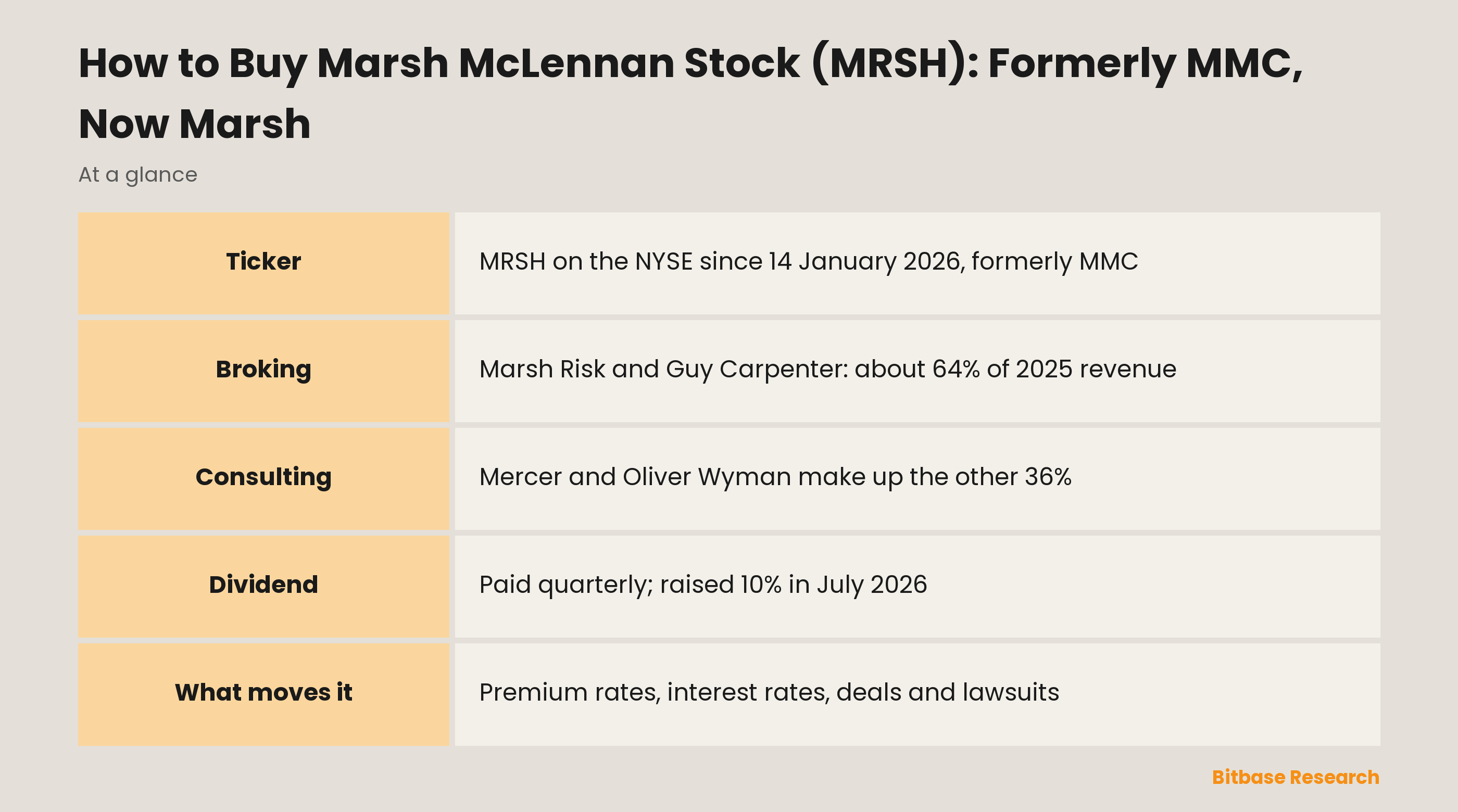
If you still know it as MMC, update the ticker first: since 14 January 2026, Marsh & McLennan Companies has traded on the New York Stock Exchange as MRSH, and any brokerage account with NYSE access can buy the shares. The company took the brand name Marsh that day, but the business did not change: it brokers insurance and reinsurance through Marsh Risk and Guy Carpenter and sells advice through Mercer and Oliver Wyman, with broking bringing in about 64% of 2025 revenue. This guide covers how those fees are earned, how to place the order and what moves the stock.
What Does Marsh McLennan Do?
Marsh & McLennan Companies, Inc. is a professional services firm incorporated in Delaware and based in New York. Its annual report describes it as "a global leader in risk, reinsurance and capital, people and investments, and management consulting, advising clients in 130 countries," with more than 95,000 colleagues at the end of 2025. It does not carry insurance risk itself: it advises clients, places their cover with insurers and reinsurers, and consults on workforce, retirement and strategy.
The work is reported in two segments. Risk and Insurance Services holds Marsh Risk, which the 10-K calls "the world's leading insurance broker and risk advisor," and Guy Carpenter, the reinsurance intermediary, which also structures catastrophe bonds through GC Securities. Marsh Risk reaches mid-sized businesses and individuals through Marsh McLennan Agency, now branded Marsh Agency. Consulting holds Mercer, which advises employers on health benefits, retirement and careers and manages retirement plan investments, and Marsh Management Consulting: Oliver Wyman, Lippincott for brand strategy and NERA for economic analysis.
The names are halfway through a change. Announced in October 2025, the rebrand took effect on 14 January 2026, when the NYSE symbol also moved from MMC to MRSH. The company said its four businesses would adopt the Marsh brand beginning in 2027, Guy Carpenter as Marsh Re, and its third-quarter 2026 report already shows Guy Carpenter's results as Reinsurance and Mercer's as People and Investments.
Much of the firm was bought. It acquired UK-based Sedgwick Group in 1998 and completed its takeover of London-listed Jardine Lloyd Thompson on 1 April 2019. Marsh McLennan Agency "has acquired more than 135 agencies" since 2009, and on 15 November 2024 it closed the all-cash purchase of McGriff, a North Carolina insurance broker. The 10-K counts 102 acquisitions across the company from 2021 to 2025.
How Marsh McLennan Makes Money
A broker is paid for arranging cover, not for bearing the losses. Marsh Risk and Guy Carpenter earn commissions and fees; Marsh Risk also receives contingent commissions from insurers, "based on factors such as volume or profitability" of what it places, and both earn interest on premiums and claim payments held for clients in a fiduciary capacity. Mercer charges fees, commissions and charges based on assets or plan members; Marsh Management Consulting lives mainly on client fees.
Broking produced about 64% of 2025 revenue and consulting about 36%:
| Business | Segment | Approximate share of 2025 revenue | What it sells |
|---|---|---|---|
| Marsh Risk | Risk and Insurance Services | 54% | Insurance broking, risk advice, Marsh Agency |
| Guy Carpenter | Risk and Insurance Services | 10% | Reinsurance broking, catastrophe bonds |
| Mercer | Consulting | 23% | Health benefits, retirement, investments, careers |
| Marsh Management Consulting | Consulting | 13% | Oliver Wyman, Lippincott, NERA |
Shares are the 10-K's own rounded figures.
Reported growth in 2025 ran well ahead of underlying growth. Revenue rose 10%, but on the company's underlying basis, which strips out currency moves, acquisitions and disposals, it grew 4%. Marsh Risk's reported revenue climbed 15% with McGriff in for a full year, against underlying growth of 4%; on the same basis Guy Carpenter grew 5%, Mercer 4% and Marsh Management Consulting 6%.
The United States supplied 49.3% of 2025 segment revenue and the United Kingdom 14.1%; within Marsh Risk, the US and Canada accounted for 59.3%. Interest on fiduciary funds is a small line but a rate-sensitive one: it fell 18.9% in 2025 and was 12.2% lower in the first nine months of 2026, and the 10-K says why: "Lower interest rates have led to a decline in our fiduciary income."
MRSH Stock at a Glance
| Item | Detail |
|---|---|
| Exchange | New York Stock Exchange (NYSE); also registered on NYSE Texas |
| Ticker | MRSH since 14 January 2026; MMC before that |
| Security | Common stock |
| CUSIP | 571748102, unchanged by the ticker switch |
| Legal name | Marsh & McLennan Companies, Inc. |
| Brand | Marsh; Marsh McLennan until January 2026 |
| Sector | Insurance and reinsurance broking, consulting |
| Index membership | S&P 500 |
| Headquarters | New York; incorporated in Delaware |
| Fiscal year | Calendar year, ending 31 December |
| Dividend policy | Quarterly cash dividend; raised in July 2026 |
| SEC identifier | CIK 62709 |
Quotes, market value and yield shift through every session, so none of them is printed here; the Marsh McLennan stock page on Bitbase shows them live.
How to Buy Marsh McLennan Stock
As a US company, Marsh McLennan has no depositary receipt to sort out: the NYSE line is the common stock. The order goes through a broker:
1. Choose a broker with NYSE access. Outside the US, that is a local firm offering US markets or an international broker; find out which legal entity will hold your account and which authority supervises it.
2. Open and verify the account. A non-US individual completes IRS Form W-8BEN, which the IRS tells foreign persons to give "to the withholding agent or payer."
3. Fund it. Depositing another currency adds a conversion cost to the commission.
4. Search for MRSH, not MMC. Confirm the result reads Marsh & McLennan Companies common stock on the NYSE. Older watchlists may still show MMC.
5. Pick an order type. FINRA says a market order "provides the most certainty that your order will be executed," though "you might not get the price you saw or were originally quoted"; a limit order guarantees "your limit price or a better price if your order is executed," with "a chance your order doesn't get executed at all."
6. Set the size. "The availability of fractional share trading varies by brokerage firm," FINRA notes, and a fractional owner "might not have shareholder voting rights."
7. Keep the confirmations as your record of cost and dividends.
Dividends for non-US holders. The IRS states that "most types of U.S. source income received by a foreign person are subject to U.S. tax of 30%," and a tax treaty can reduce that or grant an exemption, which is why brokers ask for Form W-8BEN. How your home country taxes the same dividend is a separate question.
Through an index fund. MRSH is in the S&P 500, so a fund tracking that index holds it as one position among hundreds, at a weight set by how an index fund decides what to hold.
What Moves MRSH Stock
Insurance pricing. A significant portion of broking revenue is commission paid out of clients' premiums, and the 10-K is explicit: "We do not determine the insurance premiums on which our commissions are generally based." Revenue moves "to the extent that premium rates fluctuate or trend in a particular direction," and the filing notes that "the property and casualty insurance market has seen softer pricing recently."
The reinsurance calendar. Guy Carpenter's revenue arrives unevenly: in the first nine months of 2026, 83.6% of it came in the first two quarters, and third-quarter reinsurance revenue was 6% lower than a year earlier. In Continental Europe, too, the largest share of broking renewal revenue falls in the first quarter, so read each quarter against the same quarter a year before.
Interest rates and markets. Beyond fiduciary interest, Mercer's investment fees "are derived from the value of assets under management, advisement or administration," and the company's own defined benefit pension obligations can make earnings and cash flows fluctuate.
Acquisitions. Deals keep reshaping the totals: 20 in 2025 and eight more by September 2026, including the remaining 60% of Deasterra Partners, a Spanish broker. The 10-K warns the company "may not be able to successfully integrate the businesses" it buys; the underlying growth rate is the number to follow.
Consulting demand. Advisory revenue follows client budgets, and clients "may decide to delay or terminate a current or anticipated project." On an underlying basis, Management Consulting grew 11% in the first nine months of 2026 and People and Investments 5%.
Legal matters. Marsh Ltd. placed trade credit insurance for Greensill Capital from 2014, and claims followed Greensill's collapse. Marsh settled with Greensill Bank in June 2026 and with two Credit Suisse funds in September; the latest 10-Q says the settlements "conclude Marsh's involvement in the Australian proceedings" and that no further charges are expected. Operating income for the first nine months of 2026 was 3% lower, in a period that included those charges.
Where an MRSH Share Is Exposed
Item 1A of the 10-K runs long. These passages bear most directly on a broker:
Professional liability. "We are subject to significant uninsured exposures arising from errors and omissions, breach of fiduciary duty and other claims," from a failure to place cover or advise a client to errors in pension and investment work.
How intermediaries are paid. "Adverse legal developments and future regulations concerning how intermediaries are compensated by insurers or clients" could hurt results. In January 2019, Brazil's competition authority notified the company of a proceeding against several brokers, Marsh and JLT among them, over alleged sharing of confidential information in aviation insurance; the latest 10-Q still lists it.
Disintermediation and new rivals. Clients can self-insure, use captive insurers or turn to capital markets, and "private equity sponsors have invested tens of billions of dollars into the insurance brokerage sector."
Debt and currencies. The 10-K says the current debt level, raised partly to pay for McGriff, "could adversely affect our financial flexibility," and with about half of revenue earned outside the US, exchange rates move the reported figures.
The share carries its own risks as well: holding MRSH alone ties the outcome to one firm, the board can change the dividend, and from another currency both price and payments pass through an exchange rate.
How to Research MRSH Yourself
Marsh & McLennan Companies files with the SEC under CIK 62709, and the file names followed the ticker: the 2025 10-K and the 2026 10-Qs begin with mrsh-, while older reports and even the 2026 earnings 8-Ks begin with mmc-. In the 10-K, Item 1 describes each business, Item 1A the risks and Item 7 revenue by business with underlying growth; the notes carry segment data and legal contingencies.
Two checks prevent mismatches. Data before January 2026 sits under MMC and the Marsh McLennan name, and the CUSIP links the two; a ticker change does not create a second security, because stock symbols do not collide the way crypto tickers do. And from the third quarter of 2026 the businesses report as Risk, Reinsurance, People and Investments and Management Consulting, so match the labels before comparing years. For quotes, use the stock page above; other companies are on the US stock pages on Bitbase.
Marsh McLennan Stock FAQ
Why did the ticker change from MMC to MRSH?
To match the new brand. On 29 December 2025 the company said its NYSE symbol would change from MMC to MRSH with the rebrand to Marsh, effective 14 January 2026. Shareholders did not need to act, and the legal name and CUSIP stayed the same.
Is Marsh McLennan now called Marsh?
As a brand, yes, since 14 January 2026; the listed company is still Marsh & McLennan Companies, Inc. Marsh Risk and Marsh Management Consulting took their names that day, Mercer and Guy Carpenter kept theirs for a transition period, and Oliver Wyman is to go to market as "Oliver Wyman, a Marsh business."
Does Marsh McLennan pay a dividend?
Yes, quarterly. In July 2026 the board raised the quarterly dividend by 10%, and it declared the next one in September 2026. Each payment is a board decision, and the 10-Q and company releases give the amounts and dates.
Can I buy Marsh McLennan stock with crypto?
Not directly. MRSH is bought through a brokerage account and trades on the NYSE in US dollars, so crypto has to be sold for cash and the cash moved to the broker first; depending on where you live, that sale can be taxable in its own right. The general route is in the guide to buying stocks with crypto.
Is MRSH in the S&P 500?
Yes. State Street's daily holdings file for its S&P 500 ETF Trust (SPY), dated 29 October 2026, lists Marsh & McLennan under MRSH. Index weights change daily.
Is Marsh McLennan an insurance company?
No. It is a broker and adviser: it places clients' risks with insurers and reinsurers and is paid in commissions and fees, while the insurer carries the losses. Insurers rely on it as a channel; Chubb's 10-K says Marsh & McLennan generated or placed about 11% of its gross premiums written in each of 2023, 2024 and 2025.
Conclusion
Buying MRSH takes a broker with NYSE access, the new ticker and an order type you understand. The harder part is knowing what the share holds: a broker paid out of other companies' premiums, a reinsurance intermediary with an uneven calendar and consulting businesses whose fees follow budgets and markets, all partway through a change of name. Read the latest 10-Q with the new business labels in mind before deciding how large a position one broker should take.
Related reading
Other Bitbase articles on this topic:
- How to Buy Aflac Stock (AFL): Japan, the Yen and Ten-Vote Shares
- How to Buy Allstate Stock (ALL): Auto Rates, Storms and Buybacks
- How to Buy Aon Stock (AON): Dublin plc, NYSE Shares, USI Deal
Disclaimer: This article is educational content from Bitbase Academy, provided for information only. It explains what a company or fund does and how the instruments referenced here differ from one another; it does not constitute investment, trading, tax, or financial advice, and it is neither a recommendation nor an endorsement of any security, token, or trading strategy. A tokenized stock is issued by a third party and is designed to give economic exposure to an underlying asset: it is not a share, it carries no shareholder rights, and it depends on the issuer's structure, eligibility rules, and redemption terms, which the issuer can change. Perpetual futures are leveraged derivatives that hold no underlying asset and can be liquidated, and trading hours, product availability, and eligibility differ by instrument and by jurisdiction and can change at any time. Written as of October 2026; verify everything yourself through company filings, the issuer's own documentation, and the product pages of the venue you trade on.
References
[1] Marsh & McLennan Companies Form 10-K, fiscal 2025: business, segments, revenue, risk factors and the ticker change (SEC EDGAR) www.sec.gov
[2] Marsh & McLennan Companies Form 10-Q for the quarter ended 30 September 2026: new reporting labels, results, Greensill and dividends www.sec.gov
[3] Marsh McLennan press release, 29 December 2025: NYSE symbol to change from MMC to MRSH www.marsh.com
[4] Marsh McLennan announcement, 14 October 2025: the company and its businesses will brand as Marsh (Mercer newsroom) www.mercer.com
[5] Marsh & McLennan Companies Form 8-K, 15 November 2024: completion of the McGriff acquisition www.sec.gov
[6] Marsh & McLennan Companies Form 8-K, 1 April 2019: completion of the Jardine Lloyd Thompson acquisition www.sec.gov
[7] Chubb Limited Form 10-K, fiscal 2025: share of gross premiums written generated or placed by Marsh & McLennan www.sec.gov
[8] State Street: SPDR S&P 500 ETF Trust (SPY), daily holdings as of 29 October 2026 www.ssga.com
[9] FINRA: Order Types www.finra.org
[10] FINRA: Investing in Fractional Shares www.finra.org
[11] IRS: About Form W-8 BEN www.irs.gov
[12] IRS: NRA Withholding www.irs.gov





