
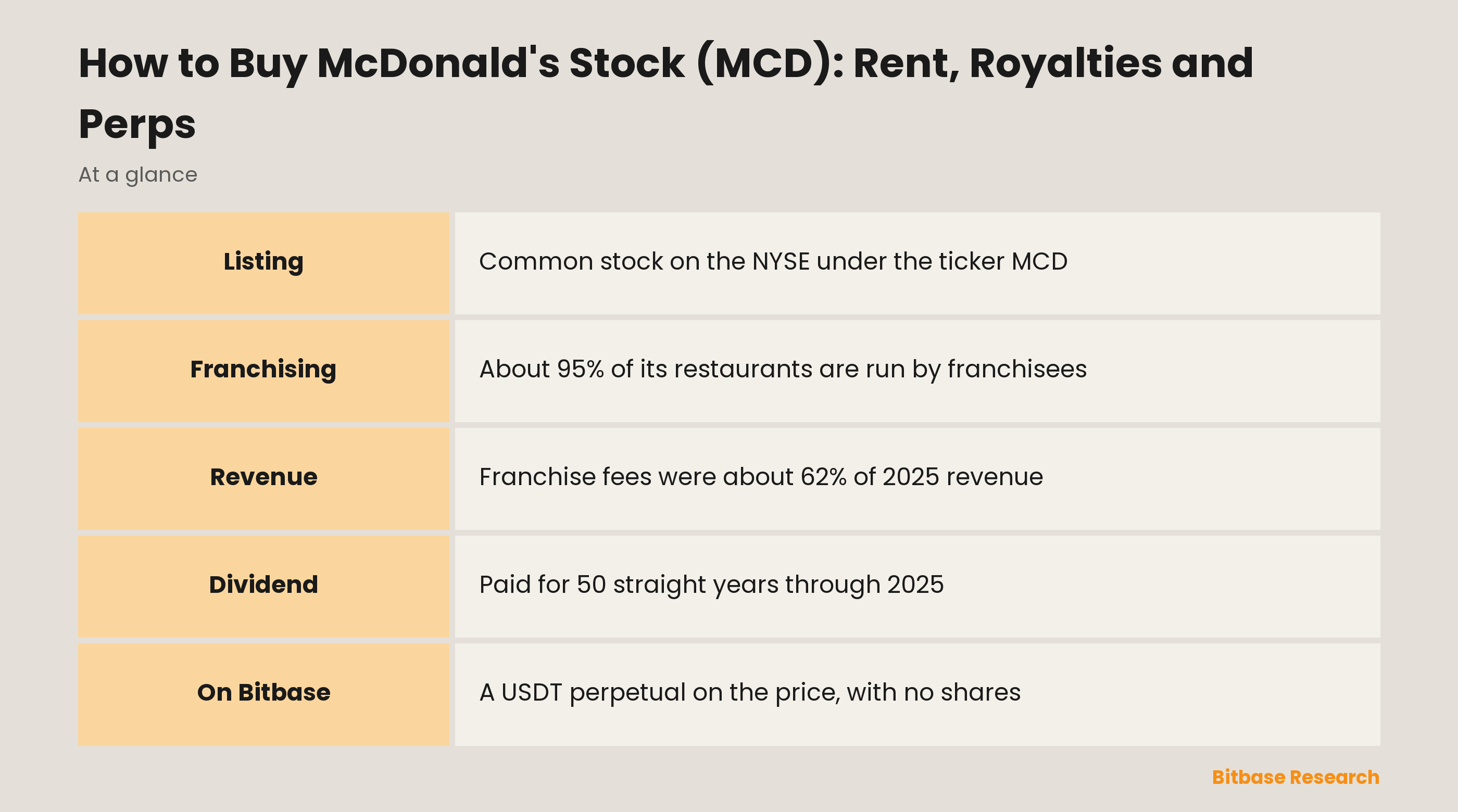
Every broker that offers US shares can place an order for McDonald's Corporation, whose common stock trades on the New York Stock Exchange under the ticker MCD. What the shares buy into is mostly a landlord and licensor: about 95% of its 45,356 restaurants were run by franchisees at the end of 2025, and the fees those franchisees paid made up about 62% of that year's revenue. Bitbase does not sell MCD shares; what it offers is an MCD perpetual, margined in USDT, that follows the price and confers no ownership.
What Does McDonald's Do?
McDonald's franchises and runs fast-food restaurants in more than 100 countries, selling hamburgers, the Big Mac, Chicken McNuggets and fries. Its annual report calls the company "primarily a franchisor," and the franchising comes in three structures.
Under a conventional franchise, McDonald's "generally owns or secures a long-term lease on the land and building," while the franchisee pays for equipment, signs, seating and décor, then pays rent and royalties based on a percentage of sales. Under a developmental license, the licensee supplies the capital, real estate included, and pays a royalty; McDonald's generally invests no restaurant capital. Affiliates, mainly in China and Japan, work in a similar way, except that McDonald's also holds an equity stake. Agreements generally run 20 years. When a conventional one expires, the company keeps control of the site and can sign again with the same operator, choose another or close the restaurant.
Results are reported in three segments: the U.S., its largest market; International Operated Markets, such as Australia, Canada, France, Germany and the U.K., where it both runs and franchises restaurants; and International Developmental Licensed Markets & Corporate, more than 75 countries run mainly by licensees and affiliates, plus head office.
How McDonald's Makes Money
Franchisees supply most of it. In 2025, fees from franchised restaurants were about 62% of total revenue and sales at company-operated restaurants about 36%, with technology fees and brand licensing a small remainder. Within the franchise line, rent alone came to about 39% of revenue and royalties to about 22%, so McDonald's took in more as a landlord than it sold across the counters of its own restaurants.
Profit tilts further the same way: franchised margins were "approximately 90% of restaurant margin dollars," and operating income was 46.1% of revenue in 2025, up from 45.2% in 2024. Property sits beneath it. In its consolidated markets, McDonald's owned approximately 56% of the land and approximately 80% of the buildings for its restaurants at the end of 2025.
| Segment | Restaurants, end of 2025 | Franchised | Share of 2025 revenue | Share of 2025 operating income |
|---|---|---|---|---|
| U.S. | 13,706 | 95% | 40.3% | 46.9% |
| International Operated Markets | 10,845 | 89% | 50.7% | 51.5% |
| International Developmental Licensed Markets & Corporate | 20,805 | 99% | 9.0% | 1.6% |
Shares are calculated from the 2025 segment note; the 99% covers the licensed markets, not Corporate. The licensed markets hold almost half of all restaurants yet produce about a tenth of revenue: there, McDonald's generally collects a royalty and puts in no restaurant capital.
MCD Stock at a Glance
| Item | Detail |
|---|---|
| Exchange | New York Stock Exchange |
| Ticker | MCD |
| Share class | Common stock, the only class registered on the 10-K cover |
| Industry | Quick-service restaurants, mostly franchised |
| Index membership | Dow Jones Industrial Average since 1985, per the 10-K; S&P 500 and Dow tracking funds SPY and DIA both held it on 16 October 2026 |
| Headquarters | Chicago, Illinois |
| Incorporated | Delaware |
| Public since | 1965 |
| Fiscal year | Calendar year, ending 31 December |
| Dividend policy | Paid for 50 consecutive years through 2025, raised at least once every year |
| Share buybacks | Programme approved in November 2024, effective January 2025, with no expiration date |
Price and chart change daily; follow them on the McDonald's stock page on Bitbase.
How to Buy McDonald's Stock
A broker handles the purchase in six moves:
1. Find a broker with NYSE access that accepts clients from your country, and note which entity holds your account.
2. Open and verify the account. Non-US individuals are usually asked for IRS Form W-8BEN.
3. Deposit funds. Money in another currency is converted to dollars, and the exchange rate is part of the cost.
4. Search MCD and confirm the listing says McDonald's Corporation common stock, New York Stock Exchange.
5. Choose the order. A market order takes the current price; a limit order names your maximum and might not execute.
6. Choose the amount, in whole shares or, where allowed, fractional ones, and keep every confirmation.
Outside the US, MCD is still McDonald's own common stock rather than an ADR, so there is no conversion ratio; dividend tax is what changes. The IRS says "Most types of U.S. source income received by a foreign person are subject to U.S. tax of 30%," and a tax treaty can cut or remove that rate. This is general information, not tax advice.
Through an index fund such as SPY or DIA, McDonald's comes as one holding among many.
Trading MCD on Bitbase
Bitbase lists an MCD perpetual futures contract with USDT as margin and settlement currency. It tracks McDonald's share price and owns nothing: no dividend, no vote, no way to swap it for shares. It can be bought or sold short, with leverage, and it trades on while the NYSE is shut.
Funding moves between buyers and sellers at regular intervals to keep the contract near the share price; the crowded side pays, and the bill grows the longer a position stays open, as how funding works on a stock perpetual explains. Once margin runs out, liquidation is triggered by the mark price, not the latest trade.
The funding schedule, margin tiers, leverage limits and the mark price outside NYSE hours are set in Bitbase's contract rules; read them first. Other US stock products are on Bitbase's TradFi page.
What Moves MCD Stock
Franchisee sales. Rent and royalties are mostly percentages of sales at restaurants McDonald's does not run; the filing calls franchise revenue "largely dependent on the ability of our franchisees to grow their sales."
Comparable sales. The measure covers every restaurant open at least thirteen months, franchised or company-run. In 2025 it rose 3.1% worldwide: 2.1% in the U.S., "benefiting from average check growth," 3.2% in International Operated Markets and 4.6% in the licensed markets, led by Japan.
The NEXT strategy. On 23 September 2026 McDonald's set out NEXT, a strategy built on its earlier Accelerating the Arches plan, whose growth pillars spelled M-C-D. It includes franchisee support through 2036 in the form of rent relief and capital support; rent was the company's largest single revenue line in 2025.
Restaurant openings. The company opened 2,276 restaurants and closed 396 in 2025, and its annual report targets 50,000 by the end of 2027.
Currency. International Operated Markets produced about half of 2025 revenue. Revenue rose 4% as reported but 2% in constant currencies, and the filing attributes the currency effect mainly to "the strengthening of most major currencies against the U.S. Dollar."
Food and labour costs. The filing ties the profitability of company-operated restaurants to commodity and labour costs and calls beef and chicken "particularly volatile"; U.S. company-operated margins fell 14% in 2025 amid inflationary cost pressure and weaker sales at those restaurants.
Risks to Weigh
The franchise model. Litigation or regulation over "the legal distinction between our franchisees and us for employment law or other purposes, if determined adversely, could challenge our franchise business model."
Food safety and eating habits. "Food safety concerns have had and may in the future have an adverse effect on our business," and the company lists "changes to dietary guidelines or use of weight-loss medications" among the forces that can shift what customers buy.
Property and borrowing. Long-term sites leave "limited flexibility to quickly alter our real estate portfolio," and weaker credit ratings or higher funding costs "could adversely affect our profitability."
More than 100 countries. Tariffs, sanctions and what the filing calls "anti-American sentiment" are among the disruptions it names.
Share and contract. The share price can fall, and dividends are "declared at the discretion of the Company's Board of Directors." On the perpetual, leverage enlarges losses and a jump at the NYSE open can push a position through its liquidation level; see margin and liquidation on a stock perpetual.
How to Research McDonald's Yourself
McDonald's files on SEC EDGAR under CIK 63908. Its 10-K reads like an annual report rather than following the standard item order; a "Form 10-K Cross-Reference Index" near the end maps its sections back to items such as Risk Factors. The franchise economics are in two notes, Franchise Arrangements and Segment and Geographic Information, and franchisees' own sales "are not recorded as revenues by the Company." Quarterly 10-Qs and 8-K releases fill in the rest; the company calls investor.mcdonalds.com "a primary channel for disclosing key information to its investors."
McDonald's Stock FAQ
Does McDonald's pay a dividend?
Yes, every quarter. Its first dividend was declared in 1976, and the 2025 annual report says it "has paid dividends on common stock for 50 consecutive years through 2025 and has increased the dividend amount at least once every year." The latest rise in that report, 5%, applied from the fourth quarter of 2025; the board sets each future amount.
Has McDonald's stock ever split?
Twelve times since it went public in 1965. The 12th, a two-for-one split, was paid on 5 March 1999, and the 2025 annual report shows the same count of issued shares as at the end of 1999, so none has followed.
Is McDonald's in the Dow Jones and the S&P 500?
Both. The 10-K dates its Dow Jones Industrial Average membership to 1985, and SPY and DIA, funds tracking the S&P 500 and the Dow, each held it on 16 October 2026. Index members change over time, hence the date.
Does McDonald's own its restaurants?
It runs few of them but controls much of the real estate. Only 2,039 of the 45,356 restaurants were company-operated at the end of 2025, yet in its consolidated markets it owned about 56% of the land and about 80% of the buildings, and conventional franchisees pay it rent.
Can I buy McDonald's stock with crypto?
Not as shares. Brokers fill MCD orders in dollars, so crypto must be converted first. What a USDT balance can reach on Bitbase is the MCD perpetual: it follows the price but pays no dividend, carries no vote and can be liquidated. Other routes from a stablecoin balance to US equities are weighed in buying US stocks with USDT.
Conclusion
Buying MCD is a routine broker order; the business behind it is less routine. Most of the revenue is rent and royalties from franchisees, so their sales, the support built into NEXT and the dollar all run through the results. The dividend has been raised every year for half a century through 2025, and the Bitbase perpetual is a price contract that owns no part of McDonald's.
Related reading
Other Bitbase articles on this topic:
- How to Buy Ferrari Stock (RACE): Dual Listing and Loyalty Votes
- How to Buy General Motors Stock (GM): Nasdaq Move, Trucks and EVs
- How to Buy Hilton Stock (HLT): Fees, Honors and the Nasdaq Move
Disclaimer: This article is educational content from Bitbase Academy, provided for information only. It explains what a company or fund does and how the instruments referenced here differ from one another; it does not constitute investment, trading, tax, or financial advice, and it is neither a recommendation nor an endorsement of any security, token, or trading strategy. A tokenized stock is issued by a third party and is designed to give economic exposure to an underlying asset: it is not a share, it carries no shareholder rights, and it depends on the issuer's structure, eligibility rules, and redemption terms, which the issuer can change. Perpetual futures are leveraged derivatives that hold no underlying asset and can be liquidated, and trading hours, product availability, and eligibility differ by instrument and by jurisdiction and can change at any time. Written as of October 2026; verify everything yourself through company filings, the issuer's own documentation, and the product pages of the venue you trade on.
References
[1] McDonald's 2025 Form 10-K (SEC EDGAR) www.sec.gov
[2] McDonald's investor release, 23 September 2026: NEXT strategy (SEC EDGAR) www.sec.gov
[3] McDonald's press release, January 1999: 12th stock split (SEC EDGAR) www.sec.gov
[4] McDonald's 1999 Form 10-K: shares issued (SEC EDGAR) www.sec.gov
[5] State Street: SPY daily holdings, 16 October 2026 www.ssga.com
[6] State Street: DIA daily holdings, 16 October 2026 www.ssga.com
[7] IRS: NRA withholding www.irs.gov
[8] IRS: About Form W-8 BEN www.irs.gov





