
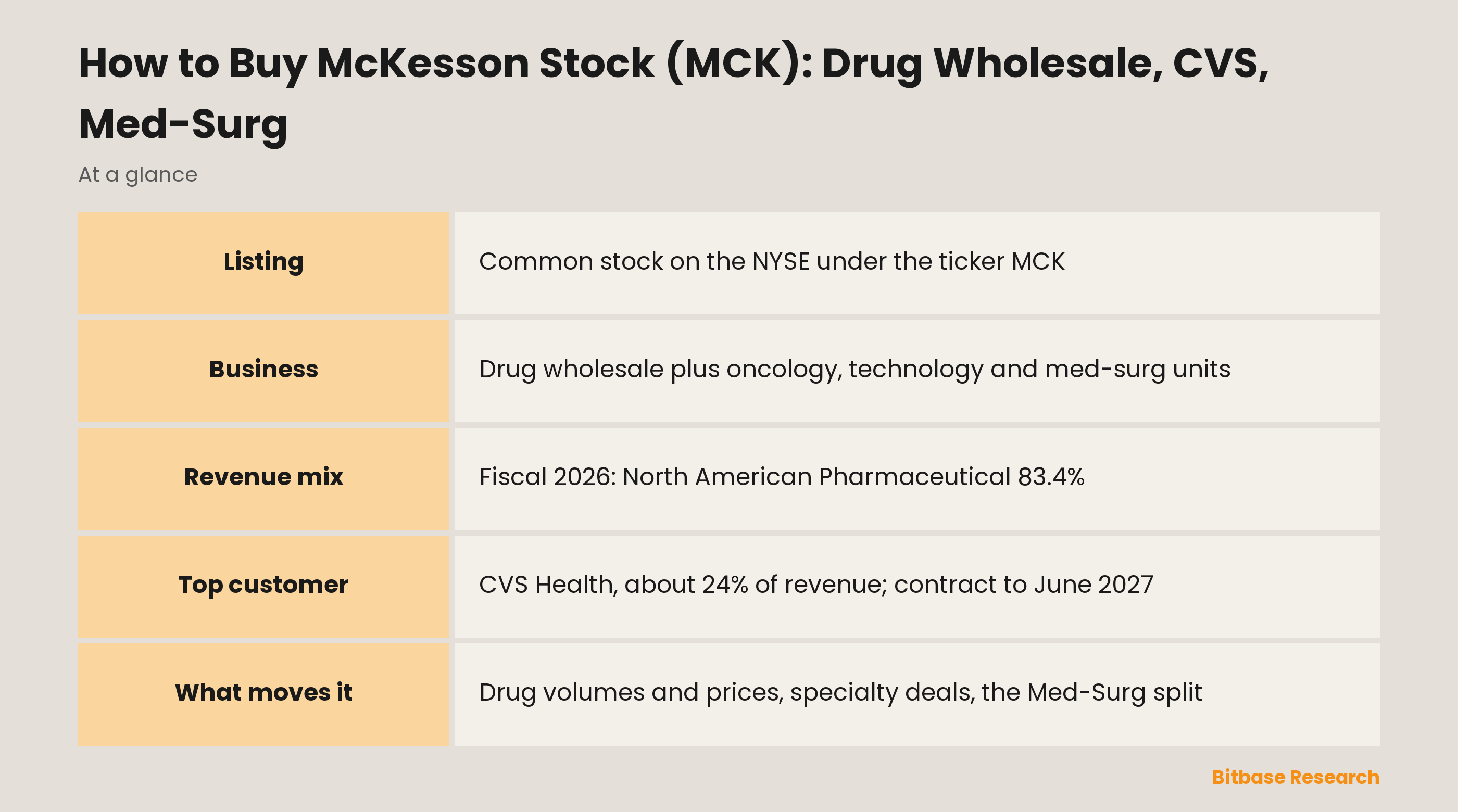
From an ordinary brokerage account with access to US exchanges, you can buy McKesson stock by searching for MCK, the ticker of its common shares on the New York Stock Exchange. What the share holds is mostly a drug wholesaler: in fiscal 2026, the year that ended on 31 March 2026, North American Pharmaceutical produced about 83% of revenue, and gross profit came to only 3.61% of revenue. This guide covers where the money comes from, how an order is placed, and what the filings flag, from the largest customer to opioid litigation and the planned Medical-Surgical separation.
What Does McKesson Do?
McKesson stands between drugmakers and the pharmacies, clinics and hospitals that dispense medicines. Its annual report calls it "a diversified healthcare services leader" that "traces its business roots to 1833." The current parent was incorporated in Delaware in 1994 and is based in Irving, Texas. Its fiscal year runs from 1 April to 31 March.
Since the second quarter of fiscal 2026 it has reported four segments.
North American Pharmaceutical distributes branded, generic, specialty, biosimilar and over-the-counter drugs across the US and Canada. In the US it runs 27 distribution centers and backs Health Mart, a franchise network of about 3,900 independently owned pharmacies; generics are sourced through ClarusONE, a joint venture with Walmart. In Canada about 2,600 independent pharmacies operate under its five retail banners.
Oncology & Multispecialty serves specialist practices, including the US Oncology Network, with specialty drugs, group purchasing and practice management. It holds 80% of PRISM Vision, a retina and ophthalmology business bought on 1 April 2025, 70% of Core Ventures, set up by Florida Cancer Specialists, and 51% of the Sarah Cannon Research Institute.
Prescription Technology Solutions sells drugmakers medication access tools such as electronic prior authorization, plus third-party logistics.
Medical-Surgical Solutions supplies gloves, syringes, wound care, laboratory equipment and drugs to physician offices, surgery centers, nursing homes and home health agencies.
The map keeps shrinking toward North America. McKesson sold its Rexall and Well.ca retail businesses in Canada in fiscal 2025 and its Norwegian operations on 30 January 2026. Earlier, in March 2020, it split off its interest in Change Healthcare.
How McKesson Makes Money
Most revenue is the price of medicines passing through McKesson's warehouses, so the totals are huge and the margins thin. Revenue rose 12% in fiscal 2026 and gross profit 9%, while gross margin slipped from 3.71% to 3.61%. The segment note shows the split:
| Segment | Share of fiscal 2026 revenue | Revenue growth | Segment operating margin |
|---|---|---|---|
| North American Pharmaceutical | 83.4% | 11% | 1.09% |
| Oncology & Multispecialty | 12.0% | 31% | 2.37% |
| Medical-Surgical Solutions | 2.9% | 1% | 8.15% |
| Prescription Technology Solutions | 1.4% | 11% | 17.98% |
| Other (Norway, sold January 2026) | 0.3% | Business sold | Not meaningful |
Revenue shares are calculated from segment revenues and rounded; growth and margins are as reported in the 10-K.
Profit is spread differently. North American Pharmaceutical earned 49.6% of segment operating profit, while Prescription Technology Solutions turned 1.4% of revenue into 14.1% of it.
The ten largest customers, counting group purchasing organizations, accounted for about 73% of revenue, the single largest, CVS Health, for about 24%, and the next two for 11% and 10%. The largest supplier made up 11% of purchases and the ten largest about 71%. Some supplier contracts carry an inflation-based component: McKesson benefits "when the manufacturers increase their prices as we sell our existing inventory at the new higher prices," so fewer or smaller price rises can squeeze gross margin.
MCK Stock at a Glance
| Fact | MCK |
|---|---|
| Listed on | NYSE (New York Stock Exchange) |
| Symbol | MCK |
| Share class | Common stock; no other class appears on the 10-K cover |
| Also on the 10-K cover | Notes listed as MCK26 and MCK29 |
| Sector | Healthcare: drug distribution and services |
| Index | S&P 500 constituent |
| Headquarters | Irving, Texas |
| Incorporated | Delaware, 1994 |
| Fiscal year | 1 April to 31 March |
| Dividend | Paid quarterly, declared by the board |
| SEC filer number | CIK 927653 |
Live price, market value and yield are on the MCK quote page on Bitbase.
How to Buy McKesson Stock
McKesson is a US company listed directly on the NYSE, so there is no ADR layer. The steps:
1. Find a broker that reaches the NYSE. Outside the US, confirm which entity will hold your shares and who supervises it.
2. Complete the account checks. Brokers ask non-US individuals for IRS Form W-8BEN, which documents foreign status for withholding on US dividends.
3. Move money in. Currency conversion has a cost of its own, so look at the exchange rate, not only the commission.
4. Select the security. Type MCK and check that the line says McKesson Corporation, common stock, NYSE; MCK26 and MCK29 are bonds.
5. Decide how to order. A market order "guarantees that the order will be executed, but does not guarantee the execution price"; a limit order runs only "at a specific price or better."
6. Decide on size. Buying part of a share lets you put in a set sum, though "not every brokerage firm offers fractional share investing," some firms take only market orders for fractions, and you "may not have voting rights" on one.
Quotes in regular and extended-hours trading can differ; when volume is light, a limit order sets the most you will pay.
If you live outside the US, dividends are taxed where they arise. The IRS says "most types of U.S. source income received by a foreign person are subject to U.S. tax of 30%," and "a reduced rate, including exemption, may apply" under a tax treaty. Tax at home may come on top.
Index and sector funds hold McKesson as well: State Street's holdings files dated 28 October 2026 list it in its S&P 500 fund (SPY) and its health care sector fund (XLV), which also holds Cencora and Cardinal Health, the two rivals the 10-K names.
What Moves MCK Stock
What flows through the warehouses. Fiscal 2026 growth came mainly from higher volumes with retail national accounts, partly offset by "branded to generic drug conversion and branded pharmaceutical price decreases." The Pfizer stock guide shows the same patent cycle from the drugmaker's side; for McKesson it drags on revenue, while manufacturer price increases help through the inflation-based terms.
One customer's contract. CVS Health alone brought in about 24% of revenue, and the 10-K says the pharmaceutical distribution partnership with CVS was extended in fiscal 2023 "to June 2027." What happens then is a milestone for MCK holders.
Specialty care. Oncology & Multispecialty revenue rose 31% in fiscal 2026 and 33% in the quarter to 30 June 2026. On 6 October 2026 McKesson and the private investment firm CD&R agreed to buy Option Care Health, a home infusion provider, with CD&R taking about 51% and McKesson about 49%, plus a framework for McKesson to buy CD&R's interest later. Closing is expected in the first half of calendar 2027.
The Medical-Surgical separation. McKesson intends to make Medical-Surgical Solutions an independent company. Funds managed by Apollo bought about 13% of it on 1 June 2026, and McKesson kept operating control. The 10-K expects the exit "ultimately, through a split-off or spin-off, or a combination of both," intended to be tax-free, and its conditions include a tax opinion, an effective SEC registration statement and board approval.
Drug pricing policy. The 10-K names reforms that could change distribution economics, among them the Inflation Reduction Act, Executive Order 14297 on most-favored-nation drug prices, and 340B litigation.
Buybacks. Repurchases made up most of the cash returned to shareholders in fiscal 2026, and the weighted-average diluted share count fell 3%.
MCK Risks Flagged in the 10-K
These risk factors bear most directly on an MCK share:
Opioid litigation. "We experience costly legal disputes, government actions, and adverse publicity regarding our role in distributing controlled substances such as opioids." McKesson and two other national distributors settled with 48 states and their participating subdivisions, plus the District of Columbia and territories; payments run to 2038, and the distributors "did not admit liability or wrongdoing." State-court consent decrees govern how it distributes controlled substances, and some local governments that stayed out are still suing.
Licenses. "We might lose our ability to purchase, store, or distribute pharmaceuticals, including controlled substances, and medical products." The business depends on permissions from the DEA, the FDA and state pharmacy boards.
Customers. "We are impacted by customer purchase reductions, contract non-renewals, payment defaults, and bankruptcies."
The separation. It "may not be completed on the currently contemplated terms or timeline, or at all."
Cyber incidents. On 25 August 2026 McKesson discovered a cybersecurity incident; its filing three days later said it had not determined the incident was material.
Above the business, owning one stock ties your outcome to one company, and dividends are not promised: future payments "remain within the discretion of the Board."
How to Research MCK Yourself
McKesson's SEC filer number is CIK 927653. Its 10-K arrives in May (fiscal 2026's on 8 May 2026), and 8-Ks carry events such as the cyber incident and the Option Care Health agreement. Within the 10-K, the business section names the segments and the two main rivals, Item 1A lists risks, the segments note breaks out revenue and operating profit, and the contingent liabilities note covers the opioid cases.
Three checks prevent mix-ups. Label the year: fiscal 2026 ended in March 2026, not December. Mind the recast: older reports built on "U.S. Pharmaceutical" and "International" segments do not line up with the current four. And open the machine-readable cover page of the 10-K (R1.htm): it lists three NYSE securities, of which only MCK is the common stock. Live prices are on the quote page linked earlier, and Bitbase's US stock directory covers other companies.
McKesson Stock FAQ
Does McKesson pay a dividend?
Yes, every quarter, and the board raised it in July 2025 and again in July 2026. Future dividends "remain within the discretion of the Board," and buybacks return far more cash.
Can I buy McKesson stock with crypto?
Not directly. A broker executes MCK on the NYSE in US dollars, so the crypto would first have to be sold, which may trigger tax where you live, and the proceeds sent to the brokerage account. What you then own is a registered stake that carries votes and dividends, unlike a crypto asset.
Is McKesson in the S&P 500?
Yes. State Street's SPY holdings file dated 28 October 2026 lists McKesson, and the 10-K's performance graph compares MCK with the S&P 500 and the S&P 500 Health Care Index. Fund weights move every day.
Has McKesson stock ever split?
Yes. The board declared a two-for-one split on 29 October 1997, effective 2 January 1998, according to the fiscal 1998 annual report; per-share numbers from before then are comparable only after adjusting for it.
What is happening to McKesson's medical-surgical business?
McKesson plans to separate it into an independent company. Apollo funds have held about 13% since June 2026, McKesson still consolidates the segment, and the final step is expected to be a split-off, a spin-off or both. What shareholders receive depends on the structure chosen.
Conclusion
The purchase itself is simple: an account that reaches the NYSE, the common stock rather than a note, and a market or limit order chosen on purpose. The business takes more reading: thin wholesale margins, about a quarter of revenue from one customer whose contract runs to June 2027, opioid payments that stretch to 2038, and a shape that is changing as Medical-Surgical heads out and a stake in Option Care Health comes in. Check the newest 10-Q and 8-Ks on those moves, then decide how much weight one drug distributor deserves in a portfolio.
Related reading
Other Bitbase articles on this topic:
- How to Buy Cigna Stock (CI): Express Scripts and Rebate Reform
- How to Buy CVS Health Stock (CVS): Insurer, PBM and Drugstores
- How to Buy Edwards Lifesciences Stock (EW): TAVR, No Dividend
Disclaimer: This article is educational content from Bitbase Academy, provided for information only. It explains what a company or fund does and how the instruments referenced here differ from one another; it does not constitute investment, trading, tax, or financial advice, and it is neither a recommendation nor an endorsement of any security, token, or trading strategy. A tokenized stock is issued by a third party and is designed to give economic exposure to an underlying asset: it is not a share, it carries no shareholder rights, and it depends on the issuer's structure, eligibility rules, and redemption terms, which the issuer can change. Perpetual futures are leveraged derivatives that hold no underlying asset and can be liquidated, and trading hours, product availability, and eligibility differ by instrument and by jurisdiction and can change at any time. Written as of October 2026; verify everything yourself through company filings, the issuer's own documentation, and the product pages of the venue you trade on.
References
[1] McKesson Form 10-K, fiscal 2026 (year ended 31 March 2026): business, segments, customers, risk factors and legal proceedings (SEC EDGAR) www.sec.gov
[2] McKesson Form 10-Q for the quarter ended 30 June 2026: segment revenues, the Apollo investment in Medical-Surgical and the dividend (SEC EDGAR) www.sec.gov
[3] CD&R and McKesson agreement to acquire Option Care Health, joint news release of 6 October 2026 (Form 8-K exhibit) www.sec.gov
[4] McKesson Form 8-K, 28 August 2026: cybersecurity incident discovered on 25 August 2026 (SEC EDGAR) www.sec.gov
[5] McKesson annual report on Form 10-K405 for fiscal 1998: two-for-one stock split effective 2 January 1998 (SEC EDGAR) www.sec.gov
[6] State Street SPDR S&P 500 ETF Trust (SPY): fund page and daily holdings www.ssga.com
[7] State Street Health Care Select Sector SPDR ETF (XLV): fund page and daily holdings www.ssga.com
[8] Investor.gov (SEC): Types of Orders www.investor.gov
[9] Investor.gov (SEC): Investor Bulletin on fractional share investing www.investor.gov
[10] IRS: NRA Withholding www.irs.gov





