
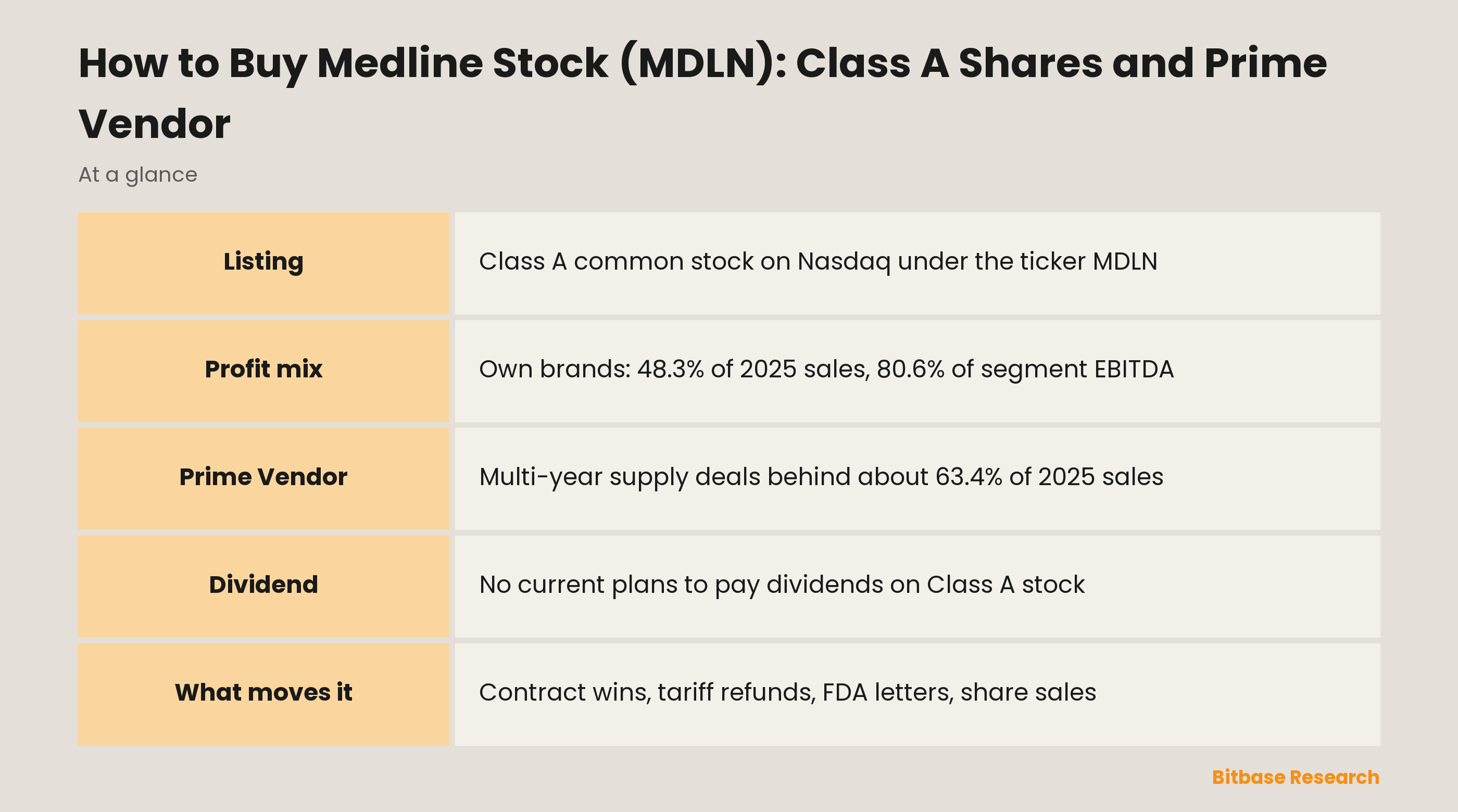
The Class A shares Medline sold in its December 2025 initial public offering trade on Nasdaq under the ticker MDLN, so any broker that offers US stocks can fill an order for them. Behind the ticker is a company that both makes and delivers hospital supplies: its own Medline Brand products were 48.3% of 2025 net sales but 80.6% of segment adjusted EBITDA, and distributing other makers' goods supplied the rest. Below: what Medline sells, how to buy the shares, why a second, unlisted class exists, and the risks its filings flag, from FDA warning letters to a warehouse fire.
What Does Medline Do?
Medline supplies the everyday material of medical care, from gloves and surgical kits to wound dressings, and the logistics that get it onto hospital shelves. Its annual report calls it "the largest provider of med-surg products and supply chain solutions serving all points of care," a ranking it bases on 2025 net sales among companies that both make and distribute such products. Its customers range from hospitals to physician offices and post-acute facilities, and its two segments offer about 335,000 products.
The business is far older than the ticker. Jim and Jon Mills founded Medline in Evanston, Illinois, in 1966 and opened its first manufacturing facility in 1968. The IPO prospectus traces the family's roots to their grandfather A.L. Mills, whose Mills Hospital Supply made surgeons' gowns and uniforms for Mercy Hospital in Chicago during World War I. A second generation, Charles N. Mills, Andrew J. Mills and James D. Abrams, took over in 1997. In October 2021 a partnership of funds managed by Blackstone, Carlyle and Hellman & Friedman bought a majority stake, and in 2023 Jim Boyle became chief executive. The listed parent, Medline Inc., was incorporated in Delaware on 6 November 2024 and has its head office in Northfield, Illinois.
Medline Brand is the manufacturing side. At the end of 2025 it offered about 190,000 products in three categories. Front Line Care covers patient-facing items such as wound care, exam gloves, incontinence products, cleaning supplies and durable medical equipment. Surgical Solutions covers the operating room: procedure trays and kits, drapes and gowns, instruments and orthopedic implants. Laboratory and Diagnostics covers point-of-care testing, analyzers and lab consumables.
Medline makes about one-third of its Medline Brand products itself, in 30 manufacturing facilities, 24 of them in North America. Most of the other two-thirds come from more than 600 partners in about 40 countries, and no single sourcing partner accounted for more than 5% of total spend at the end of 2025. Its trademarks include Medline, Curad, Microtek, Hudson and Proxima; Microtek arrived with the 2024 purchase of Ecolab's global surgical solutions business, the same year Medline bought Sinclair Dental, a Canadian dental distributor.
Supply Chain Solutions is the distribution side: about 145,000 products from more than 1,300 third-party suppliers, "including nearly all leading national brands," plus services such as consulting, outsourced warehouse management and third-party logistics.
Both segments share one network: 70 distribution centers, warehouses, cross-docks and transship facilities, 45 of them in the United States, placed to give next-day delivery to 95% of its US customer base. More than 2,100 MedTrans trucks make the deliveries. At the end of 2025 the company employed more than 45,000 people, over 26,000 of them in the United States.
How Medline Makes Money
The two segments are close in size and far apart in profit. In 2025:
| Segment | Share of 2025 net sales | Share of 2025 segment adjusted EBITDA | What it sells |
|---|---|---|---|
| Medline Brand | 48.3% | 80.6% | Products Medline makes or has made under its own brands |
| Supply Chain Solutions | 51.7% | 19.4% | Other manufacturers' products, plus supply chain services |
Both percentages come from the 10-K. Segment adjusted EBITDA, the profit measure Medline uses for its segments, is counted before corporate costs, interest, depreciation and other items, so it is not net income.
Inside Medline Brand, Front Line Care brought in 22.9% of total 2025 net sales, Surgical Solutions 21.7% and Laboratory and Diagnostics 3.7%. Surgical Solutions grew fastest, by 12.7%, mainly on kitting and operating room products.
The engine linking the two segments is what Medline calls the Prime Vendor model. A Prime Vendor agreement is a multi-year distribution contract, typically for five years, under which a customer "agrees to use Medline for the vast majority of its med-surg product needs." At the end of 2025 Medline had more than 1,600 such relationships, and active Prime Vendor agreements produced about 63.4% of 2025 net sales. The company reports an average Prime Vendor retention rate above 98% over the past five years.
Those contracts open the door to conversion. On average, Prime Vendor agreements were weighted about 65% toward Supply Chain Solutions and 35% toward Medline Brand at the end of 2025. When a hospital swaps a national-brand item for a like-for-like Medline Brand product, Medline has historically earned a higher margin, but net sales usually fall, because Medline Brand prices are lower.
Growth in 2025 came mostly from volume. Net sales rose 11.5%: 10.5% from organic growth and 0.9% from acquisitions, and the 10-K says organic growth was "substantially all related to increased volumes with pricing having an immaterial impact." Medline Brand sales rose 9.6% and Supply Chain Solutions 13.2%.
The United States produced 93.1% of 2025 net sales: hospital health systems alone accounted for 68.6% and other US care settings for 24.5%, leaving 6.9% for international sales. The five largest US customers represented 11.3% of net sales, and about 69% came from member hospitals under contract with the three largest group purchasing organizations, or GPOs: Vizient, HealthTrust and Premier. Net sales have historically been highest in the fourth quarter.
MDLN Stock at a Glance
| Feature | MDLN |
|---|---|
| Exchange | Nasdaq Global Select Market |
| Ticker | MDLN |
| Security | Class A common stock; the 10-K cover registers no other class under Section 12(b) |
| Second class | Class B common stock: votes but no economic rights, and no public market |
| First trading day | 17 December 2025; the IPO closed on 18 December 2025 |
| Sector | Medical-surgical products and supply chain services |
| Main brands | Medline, Curad, Microtek, Hudson, Proxima |
| Structure | Up-C: a holding company whose main asset is a controlling interest in Medline Holdings, LP |
| S&P 500 | Not in SPY's daily holdings file of 5 November 2026 |
| Headquarters | Northfield, Illinois |
| Incorporated | Delaware, 6 November 2024 (business founded in 1966) |
| Fiscal year | Calendar year to 31 December; quarters follow a 4-4-5-week calendar |
| Dividends | No current plans to pay dividends on the Class A stock |
| SEC identifier | CIK 2046386 |
Price, market value and trading volume change constantly; for live figures, open Medline's stock page at Bitbase.
How to Buy Medline Stock
Because Medline is incorporated in Delaware, there is no depositary receipt layer to think about; the Nasdaq listing is the Class A stock. The purchase breaks down into seven steps:
1. Find a broker that reaches Nasdaq. Abroad, that means a local firm with US market access or an international broker; check who regulates the entity holding your account.
2. Get the account approved. Brokers usually ask investors from outside the United States for IRS Form W-8BEN, and the IRS tells filers to hand it in "when requested by the withholding agent or payer."
3. Fund it. If your cash is not in dollars, the conversion spread can cost more than the commission, so check both.
4. Search for MDLN. Confirm the result reads Medline Inc. Class A common stock on Nasdaq. Class B shares cannot be bought on any exchange.
5. Choose an order type. A market order, in FINRA's words, "provides the most certainty that your order will be executed"; a limit order fills only "at or better than a specified price." The 10-K warns that the Class A share price "may be volatile," which is an argument for a limit.
6. Decide on size. Fractional shares let you invest a fixed amount of money, but availability varies: some firms limit them to "large-cap stocks or ETFs," others skip them entirely, and FINRA cautions that "as a fractional share owner, you might not have shareholder voting rights."
7. Keep the records. Confirmations and statements establish your cost basis.
Taxes for non-US investors. Under IRS rules, "most types of U.S. source income received by a foreign person are subject to U.S. tax of 30%," though a treaty between the United States and your country can cut the rate. With no dividend planned, that withholding is not an immediate issue, but a sale may be taxed where you live.
Through funds. Medline was not in the daily holdings file of SPY, State Street's S&P 500 fund, on 5 November 2026, so check any fund's holdings list before assuming it owns MDLN.
What Moves MDLN Stock
New Prime Vendor contracts and conversion. Growth depends on signing Prime Vendor customers and moving them toward Medline Brand products. In the third quarter of 2026, net sales rose 10.4%, with organic growth of 10.5%. Supply Chain Solutions grew 13.9%, led by a 19.1% rise in its Prime Vendor sales, while Medline Brand grew 6.6%. "Medline delivered another strong quarter, with double-digit net sales growth, reflecting continued momentum across our business," chief executive Jim Boyle said.
Tariffs and refunds. The 10-K says tariffs had a net adverse effect on 2025 income before taxes. In February 2026 the US Supreme Court ruled that the International Emergency Economic Powers Act (IEEPA) does not authorize the President to impose tariffs, and Medline has since booked refunds of IEEPA duties, net of amounts it expects to pass back to customers, entirely within the Medline Brand segment. Those refunds lifted the segment's adjusted EBITDA margin to 25.9% in the third quarter of 2026 from 24.1% a year earlier. The company keeps them out of its adjusted EBITDA guidance.
Quality and the FDA. As of 26 September 2026 Medline had three unresolved FDA warning letters, issued after inspections in Northfield and Waukegan, Illinois, and Glens Falls, New York, over quality system and manufacturing practice rules. On 16 September 2026 it also began exiting Medline Brand beds, including homecare, bariatric and long-term care models, followed in October by a voluntary field action offering refunds, repair or replacement. Medline expects the related costs in the fourth quarter of 2026 and in 2027.
The Tracy fire. On 11 June 2026 a fire destroyed Medline's distribution center in Tracy, California; all employees were evacuated safely, and the company has leased two other sites in Northern California to keep serving the region. The fire is one reason the company gave for a 28.8% fall in net income over the first nine months of 2026, even as adjusted EBITDA rose 5.0%.
Share supply. The Up-C structure keeps feeding new Class A shares to the market. In March 2026 a subsidiary of the Abu Dhabi Investment Authority and affiliates of the three private equity sponsors sold 86,250,000 Class A shares in an underwritten offering, and in May 2026 the same group sold 72,554,594 more. Medline received no proceeds from either. In October 2026 the board authorized a share repurchase program for Class A stock and Medline Holdings units, with no expiration date and no obligation to buy any amount.
GPO Contracts, FDA Letters and Debt at Medline
These items from the 10-K risk factors bear most directly on an MDLN share:
Concentration. With the top five US customers at 11.3% of 2025 net sales and the three largest GPOs behind 69%, a single contract can matter. "We could lose a significant healthcare provider customer if an existing contract expires without being replaced or is terminated by the customer prior to its expiration," the 10-K says, and "certain of our Prime Vendor agreements provide for rights of termination for convenience."
Price pressure. "The med-surg industry is highly competitive and characterized by pricing and margin pressure for our business." It adds that "the increasing leverage of organized buying groups may reduce market prices for our products."
Quality and liability. "Quality problems and product liability claims have in the past led, and could in the future lead, to recalls or safety alerts, reputational harm, adverse verdicts, or costly settlements." Medline also sterilizes certain products with ethylene oxide, which some jurisdictions now regulate more tightly.
Debt. "We have a substantial amount of debt and are permitted to incur a substantial amount of additional indebtedness." The 10-K says the debt could divert cash flow from operations to debt payments, and the credit agreement and note indentures restrict what its subsidiaries can do.
Control and structure. When the 10-K was filed, the sponsors and members of the Mills family, the "designating stockholders," controlled about 67.0% of the combined voting power and could nominate directors. Under a tax receivable agreement, Medline Inc. pays certain pre-IPO owners 90% of certain tax benefits it realizes, payments the company expects to be substantial. As a holding company, Medline Inc. also depends on distributions from Medline Holdings to pay taxes and any dividends.
The share class itself. Medline warns that "certain index providers have in the past announced restrictions on including companies with multiple class share structures in certain of their indices," which could keep index funds away. The stock has traded only since December 2025, so there is little history to judge it by, and it pays no dividend.
Checking Medline's Numbers on EDGAR
Medline files with the SEC under CIK 2046386. The 10-K for 2025 was filed on 25 February 2026; quarterly 10-Qs followed on 6 May, 5 August and 4 November 2026, each alongside an 8-K with the earnings release. The final IPO prospectus of 18 December 2025 explains the history and the Up-C structure most fully, and earnings call webcasts are on ir.medline.com.
Three habits help. First, compare like periods: quarters end on a Saturday under the 4-4-5-week calendar, while the year always ends on 31 December. Second, read adjusted EBITDA next to net income, because the adjustments include the Tracy fire, the bed exit and FDA remediation costs. Third, check the cover page of each report for the count of both classes, since the balance shifts each time units are exchanged.
Two other listed healthcare distributors are covered in our guides to buying Cardinal Health shares and buying McKesson shares. For live prices, use the Medline page linked under the summary table, or browse every US stock page on Bitbase.
Medline Stock FAQ
Can I buy Medline stock with crypto?
Not in one step. Brokers sell MDLN for US dollars, so you would first convert crypto to cash, withdraw it and fund the brokerage account, and that conversion may itself be taxed in your country. Owning the stock means owning part of a registered company, which our guide to the differences between crypto and stocks sets against owning a token.
Does Medline pay a dividend?
No. The 10-K says Medline has "no current plans to pay dividends" on its Class A common stock, and any future dividend is at the board's discretion. Class B shares carry no right to dividends at all.
When did Medline go public?
Medline's Class A common stock began trading on the Nasdaq Global Select Market on 17 December 2025, and the initial public offering was completed the next day. Before that it was privately held, majority-owned since October 2021 by Blackstone, Carlyle and Hellman & Friedman funds.
What is the difference between Medline's Class A and Class B shares?
Class A shares trade on Nasdaq and carry both votes and economic rights, including dividends if any are declared. Class B shares, held by pre-IPO owners, carry one vote each but no economic rights; together with a Medline Holdings unit, each can be exchanged for one Class A share.
Does Medline make the products it sells?
Partly. It manufactures about one-third of its Medline Brand products in 30 facilities, sources most of the rest from more than 600 partners, and distributes about 145,000 products from more than 1,300 other suppliers through Supply Chain Solutions.
Conclusion
The order itself is simple: a broker with Nasdaq access, the MDLN Class A listing and one of the two order types above. Understanding the company takes longer: Medline earns most of its profit on its own brand while most of its sales come from distributing other makers' goods, and its results in 2026 have been shaped by tariff refunds, FDA warning letters, a product exit and a warehouse fire. Read the latest 10-Q next to the 10-K, watch how the Class A share count changes, and decide how much of your portfolio one newly listed supplier should carry.
Related reading
Other Bitbase articles on this topic:
- How to Buy GE HealthCare Stock (GEHC): Scanners and Imaging Agents
- How to Buy HCA Healthcare Stock (HCA): Payers, Texas and Florida
- How to Buy Humana Stock (HUM): Medicare Advantage and CenterWell
- How to Buy Quest Diagnostics Stock (DGX): Lab Tests and Who Pays
Disclaimer: This article is educational content from Bitbase Academy, provided for information only. It explains what a company or fund does and how the instruments referenced here differ from one another; it does not constitute investment, trading, tax, or financial advice, and it is neither a recommendation nor an endorsement of any security, token, or trading strategy. A tokenized stock is issued by a third party and is designed to give economic exposure to an underlying asset: it is not a share, it carries no shareholder rights, and it depends on the issuer's structure, eligibility rules, and redemption terms, which the issuer can change. Perpetual futures are leveraged derivatives that hold no underlying asset and can be liquidated, and trading hours, product availability, and eligibility differ by instrument and by jurisdiction and can change at any time. Written as of November 2026; verify everything yourself through company filings, the issuer's own documentation, and the product pages of the venue you trade on.
References
[1] Medline Form 10-K for 2025 (SEC EDGAR) www.sec.gov
[2] Medline 2025 Form 10-K, XBRL cover page (SEC EDGAR) www.sec.gov
[3] Medline 2025 Form 10-K, XBRL segment data (SEC EDGAR) www.sec.gov
[4] Medline 2025 Form 10-K, XBRL sales by geography (SEC EDGAR) www.sec.gov
[5] Medline Form 10-Q for the third quarter of 2026 (SEC EDGAR) www.sec.gov
[6] Medline third-quarter 2026 earnings release, filed with Form 8-K (SEC EDGAR) www.sec.gov
[7] Medline IPO prospectus (Form 424B4), December 2025 (SEC EDGAR) www.sec.gov
[8] State Street SPDR S&P 500 ETF Trust (SPY): fund page and daily holdings www.ssga.com
[9] FINRA: Order Types www.finra.org
[10] FINRA: Investing in Fractional Shares www.finra.org
[11] IRS: NRA Withholding www.irs.gov
[12] IRS: About Form W-8 BEN www.irs.gov





